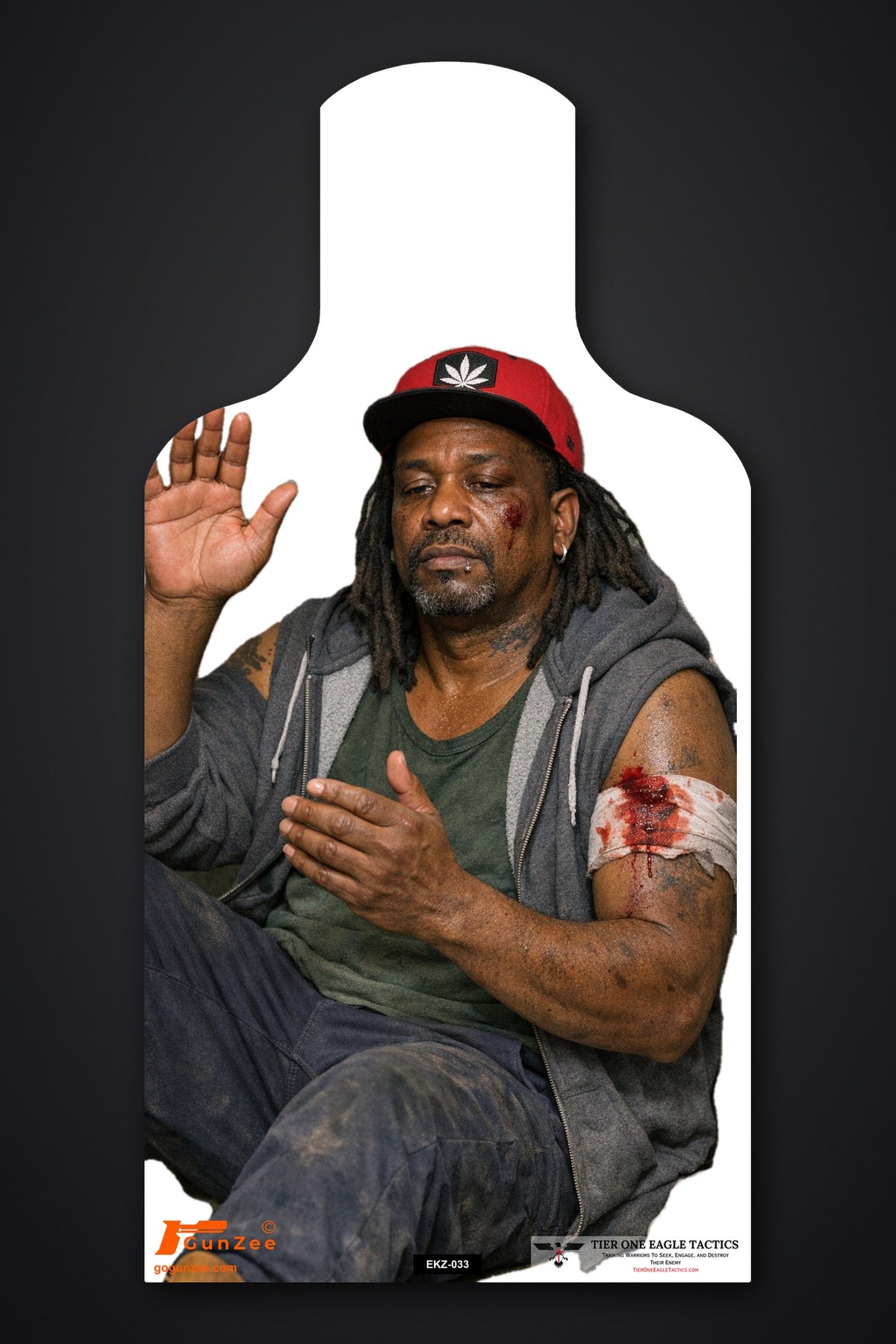
Unarmed Male Seated Injured Hands Up No-Shoot E-Backer Target [19" x 38"]
each · sold in 5s · mix any designs
Price drops automatically: 50+ $2.37 · 100+ $2.24 · 250+ $2.12 · Up to 25% off at 999+ · Volume quote →
$40 order minimum for your whole cart, not each design. Mix any targets.
Quantity must be in increments of 5
Unarmed Male Seated Injured Hands Up No-Shoot E-Backer Target
A wounded man on the ground showing his hands. It trains what to do with an injured, surrendering person: hold fire, give commands, keep scanning.
What the Trainee Has to Work Out
He is hurt, on the ground and showing his hands. He may have been part of the fight or caught in it. The shooter cannot know, and does not need to. There is no weapon and he is giving up.
Training Purpose
It trains what to do with a wounded, surrendering person: hold fire, give commands, keep scanning. It also mirrors the seated armed woman in the shoot set. Hung among armed targets, it is the one the shooter has to leave alone.
Skills Reinforced
- Holding fire on a wounded subject who is surrendering
- Continuing to scan after finding a casualty
- Checking the hands before deciding
- Target identification at qualification distances
- Shoot / no-shoot discrimination under time pressure
No Kill Zones: This Is a No-Shoot Target
You will not find a scoring line on this target. A head circle or a cardiac box would tell the shooter where to aim, and this is a person who must not be shot. The only passing score is an untouched target.
Hang it beside the armed designs, which carry a 4-inch head circle and a 10-inch cardiac box, and the hostage designs, which carry the head circle on the gunman only. Those are scored by zone. This one is scored by whether it was left alone. The Range Manual covers how to build shoot / no-shoot decision drills and identifying armed and unarmed subjects.
Cut to Fit the E-Type Backer
An E-type backer is the plastic or cardboard silhouette, 19.5" wide and 40" tall, that pop-up lifters and static stands on military and police ranges are built around. This target... ...
Unarmed Male Seated Injured Hands Up No-Shoot E-Backer Target
A wounded man on the ground showing his hands. It trains what to do with an injured, surrendering person: hold fire, give commands, keep scanning.
What the Trainee Has to Work Out
He is hurt, on the ground and showing his hands. He may have been part of the fight or caught in it. The shooter cannot know, and does not need to. There is no weapon and he is giving up.
Training Purpose
It trains what to do with a wounded, surrendering person: hold fire, give commands, keep scanning. It also mirrors the seated armed woman in the shoot set. Hung among armed targets, it is the one the shooter has to leave alone.
Skills Reinforced
- Holding fire on a wounded subject who is surrendering
- Continuing to scan after finding a casualty
- Checking the hands before deciding
- Target identification at qualification distances
- Shoot / no-shoot discrimination under time pressure
No Kill Zones: This Is a No-Shoot Target
You will not find a scoring line on this target. A head circle or a cardiac box would tell the shooter where to aim, and this is a person who must not be shot. The only passing score is an untouched target.
Hang it beside the armed designs, which carry a 4-inch head circle and a 10-inch cardiac box, and the hostage designs, which carry the head circle on the gunman only. Those are scored by zone. This one is scored by whether it was left alone. The Range Manual covers how to build shoot / no-shoot decision drills and identifying armed and unarmed subjects.
Cut to Fit the E-Type Backer
An E-type backer is the plastic or cardboard silhouette, 19.5" wide and 40" tall, that pop-up lifters and static stands on military and police ranges are built around. This target is cut to that same outline at 19" x 38", so the paper covers the face of the backer and the figure fills the shape from edge to edge. Hang it the way you hang any E-type facing.
The figure is printed at about 85 percent of life size so that everything the shooter has to read stays inside the silhouette.
Instructor Notes
Run it in the same string as the seated armed woman. Same height, same posture, opposite answer. It works on static stands, turning stands and pop-up lifters that take an E-type backer.
Who This Target Is For
Any program that scores judgment as well as marksmanship. It is built for law enforcement and military police courses of fire, academy use-of-force blocks, and civilian decision training.
Product Details
- Size: 19" x 38", die-cut to the E-type silhouette
- Fits: standard E-type backers (19.5" x 40")
- Figure: about 85 percent of life size, so every decision cue stays inside the silhouette
- Kill zones: none. This is a no-shoot target
- Paper: heavy, durable stock with a matte finish, so there is no glare under range lights
- Printed in full color on one side
- Price: $2.49 each. Volume pricing on quotes runs from 5% off at 50 targets to 25% off at 999. Request a quote
- SKU: EKZ-033
- Made in the USA
Related E-Backer Targets
A course of fire needs armed threats, no-shoots and hostage problems side by side. These five come from across the E-backer line:
- Unarmed Female Holding Infant Hand Raised No-Shoot E-Backer Target
- Unarmed Male Holding Keys Agitated No-Shoot E-Backer Target
- Armed Female Sequin Top Handgun Aiming Forward E-Backer Target
- Armed Male Sleeveless Shirt Handgun Aiming Forward E-Backer Target
- Hostage Scenario Green Jacket Gunman Handgun Aimed Forward E-Backer Target
See all 48 designs in the E-Type Silhouette Targets collection, or browse Shoot / No-Shoot Decision Targets and Law Enforcement Training Targets. For agency programs, see from qualification to decision training.
The same decisions on a 24" x 36" scenario sheet: Interior Doorway Male With Phone Ambiguous Threat Shooting Target, Living Room No-Shoot Scenario Shooting Target and CQB Home Defense Hostage – Closet Ambush Hands-Up Compliance Shooting Target.