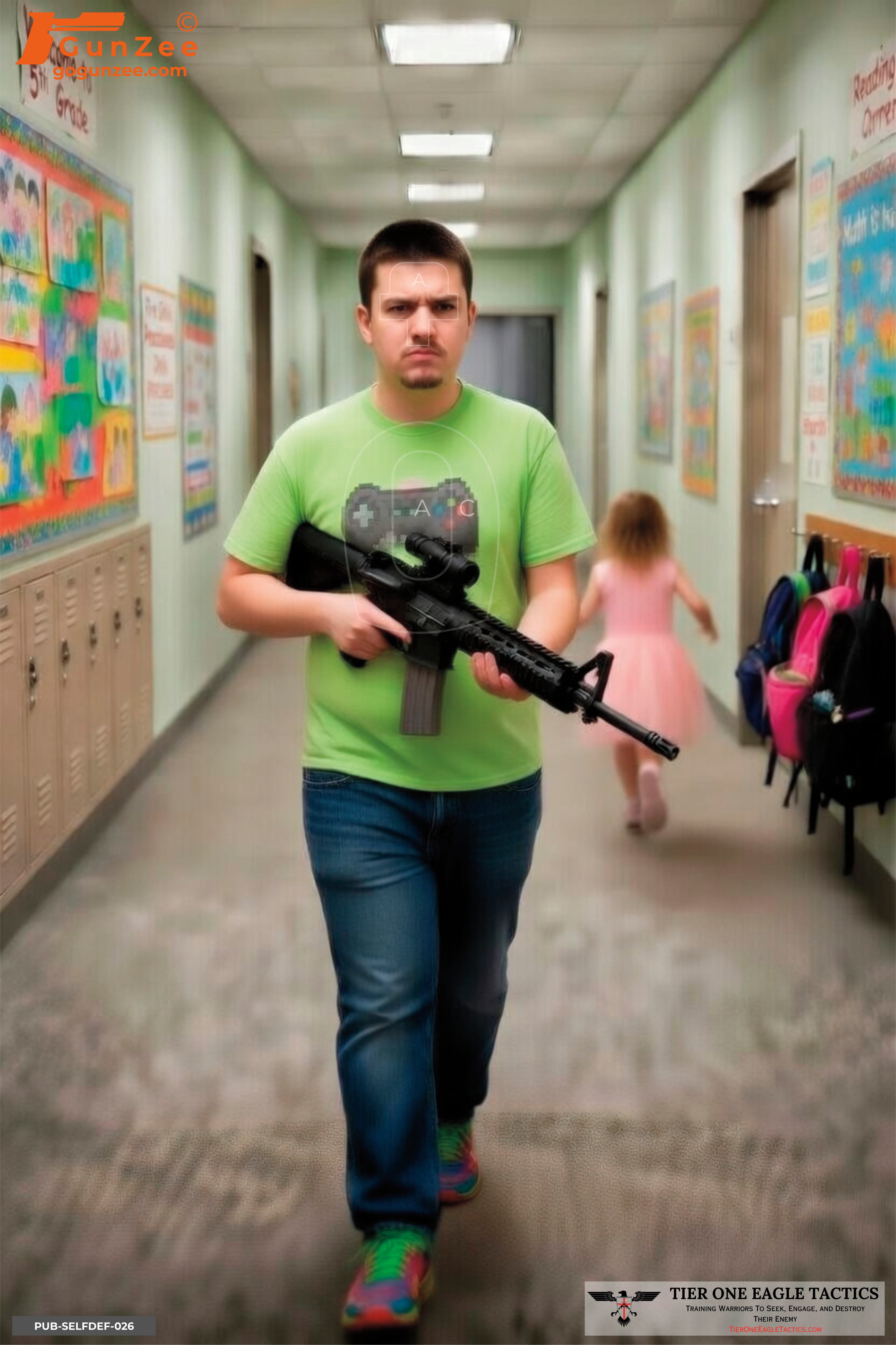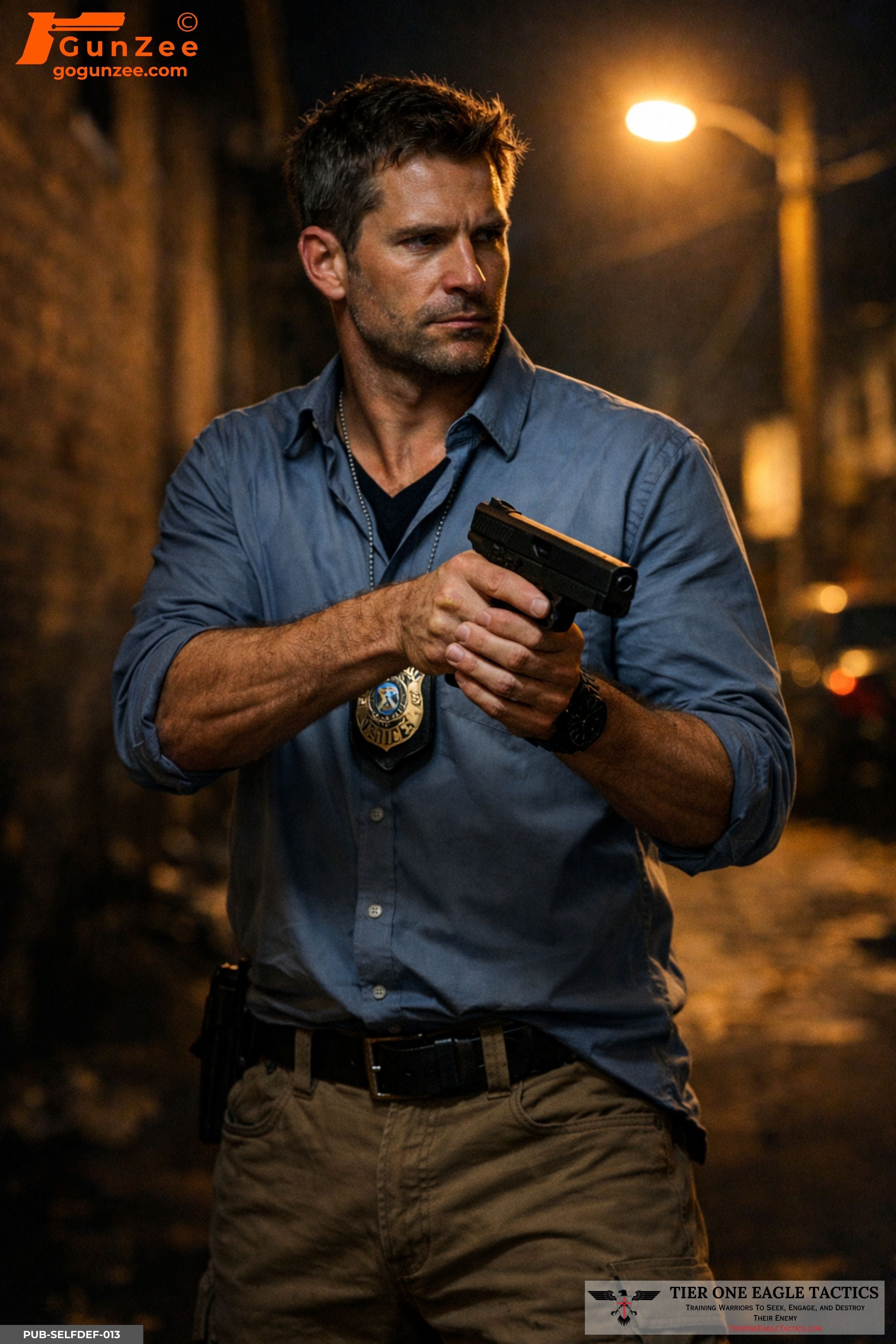
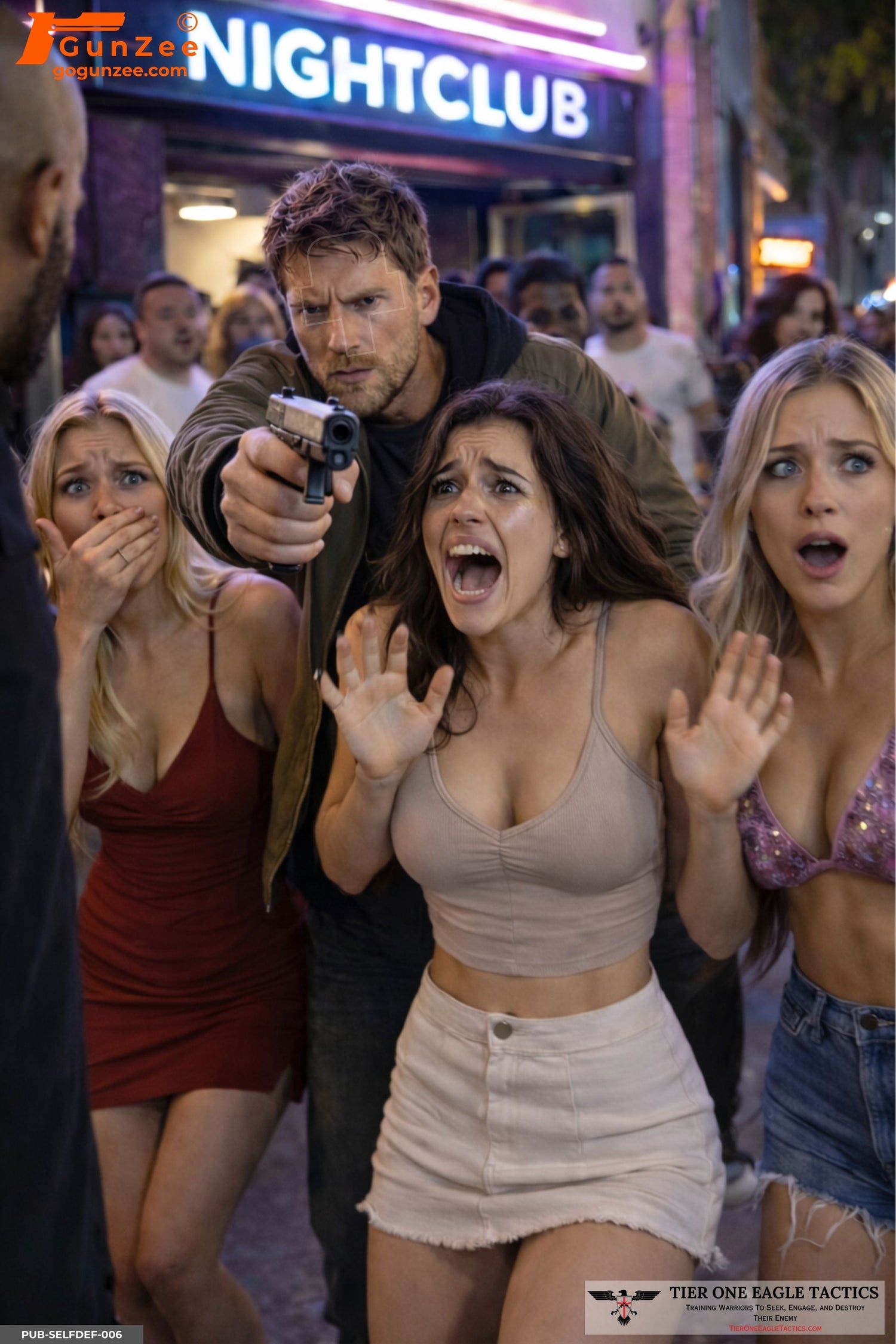
Most range training starts after the hardest part is already over. The target goes up, the timer beeps, and the only question left is how fast and how accurately the shooter can press the trigger. Real defensive encounters do not work that way. They open with a question — is this person a threat right now? — and everything that follows depends on getting that answer right. Shoot no shoot targets exist to put that question back into training, where it belongs.
A shoot / no-shoot target presents a decision, not just an aiming point. Some depict an armed subject mid-assault. Others depict a bystander, a fleeing person, or a hostage directly in the line of fire. The shooter has to read the scene, find the cue that justifies or forbids the shot, and act — under time pressure, with consequences for both kinds of error. Shooting a no-shoot is a failure. Freezing on a lethal threat is also a failure. Judgment lives in the space between those two mistakes.
This guide covers how to train that judgment deliberately: the decision sequence worth drilling, a crawl-walk-run progression that works on any square range, a scoring method that grades decisions instead of just groups, and program structure for academies, departments, and instructors who need to run this at scale. It is written for professional trainers and serious civilians alike, using GunZee's 24" x 36" scenario targets — true-to-life scenes at $1.95 per target that make decision training affordable enough to run every session, not once a year.
What Shoot / No-Shoot Targets Train — and Why Speed Isn't the Point
Marksmanship answers can you hit it? Decision training answers should you? Those are different skills, stored in different places. A shooter can own a sub-second draw and still be dangerously untrained for the moment when a figure rounds a corner holding something that might be a weapon. The draw was rehearsed thousands of times; the decision was rehearsed never.
The decision layer
Every legitimate use of force sits on a decision that must survive scrutiny afterward. Shoot / no-shoot work trains the inputs of that decision: what the hands are doing, what the object actually is, who else occupies the frame, and whether the behavior in front of the shooter constitutes an imminent threat. Training on scenario targets that depict a real person in a real environment — a parking garage, a residential hallway, a crowded sidewalk — forces the eye to process the same visual clutter it would face in the actual event, rather than the sterile silhouette that says "shoot me" by its mere existence.
What happens when judgment is never trained
A program that only ever presents shoot targets teaches, rep by rep, that the correct answer is always to fire. That conditioning is invisible on the range and expensive in the real world. The armed civilian who has never practiced holding fire has outsourced the most consequential decision of their life to improvisation. The officer whose qualification course never included a no-shoot has a training record that any review board will read with interest. Mixing genuine no-shoot presentations into live fire is the correction, and it costs nothing but target selection. For a deeper look at the visual cues themselves, see training to identify armed versus unarmed subjects.
The Decision Ladder: Detect, Discriminate, Decide, Deliver
Judgment under stress is trainable because it has a structure. Break the engagement into four rungs and each one becomes a drillable skill with its own failure pattern.

Detect and orient
The first failure in most force encounters is late detection. On the range, train it by keeping the target faced away, covered, or out of the shooter's line until the start signal, then requiring the shooter to find and orient to the scene before anything else. Even this small step — turn, find, assess — adds a cognitive load that flat-range repetition never touches.
Discriminate the threat cue
Discrimination is where shoot / no-shoot targets earn their place. The shooter reads hands first, object second, behavior third. A scene depicting a man controlling a hostage with a knife at her throat demands a different response than a scene depicting a man simply standing close to a frightened woman. GunZee's scenario library is built around exactly these contrasts, and a target like the Two-Man Corridor Hostage Escort stacks discrimination and prioritization into a single frame: two subjects, one primary gunman, one hostage who must not be hit.
Decide — and be ready to not shoot
The decision rung must include a live possibility of holding fire, or it is not a decision at all. Verbalization belongs here: challenge commands ("Drop it! Get back!") issued at full volume, because speaking under stress is its own perishable skill and because the verbal record matters afterward. Deliver — the shot itself — is the only rung most programs ever train. Keep training it; just stop training it alone.
A Crawl-Walk-Run Shoot / No-Shoot Progression
Decision training fails when it starts too hard. A shooter who has never seen a no-shoot presentation should not meet their first one at speed, in low light, gasping from a sprint. Build the ladder in three stages, and only promote when the current stage is clean.

Stage 1 — known outcomes, unlimited time
Hang three or four different scenario targets and walk the line with the shooter, no gun in hand. Identify each threat cue out loud: where the weapon is, what the hands are doing, who in the frame is not a threat. Then shoot each scene slow-fire with the decision already made. The goal is a clean library of reference pictures — what "shoot" looks like, what "don't" looks like — before any time pressure exists.
Stage 2 — randomized presentation
Now remove certainty. A training partner or instructor hangs targets while the shooter faces away, shuffling shoot and no-shoot scenes between strings. On the turn signal, the shooter must process whatever is actually there. Number multiple targets and call engagement sequences to add ordering decisions. This stage is where target variety matters most: a shooter who trains against one scene memorizes it by the third repetition. At $1.95 per 24" x 36" target, rotating four to six fresh scenes per session is a rounding error in a training budget — that affordability is the point of running paper shooting targets for decision work.
Stage 3 — stress, movement, and time
Add a par time. Add movement to cover. Add a physical loading — burpees or a sprint to spike the heart rate — then present the scene. Low light and a handheld flashlight rebuild every discrimination problem from scratch. Stage 3 is also where precision demands enter: a hostage-taker exposing half a face over a victim's shoulder compresses the acceptable target zone to inches, exactly what the Anatomical Hostage Shield Vital Zone target was built to grade.
Scoring Judgment: Grade the Decision, Not Just the Group
What gets scored gets trained. If the debrief only ever measures group size and time, shooters will optimize for group size and time — and judgment quietly exits the program. Score the decision first, the shooting second.

The four outcomes
Every presentation ends in one of four boxes: correct shoot, correct hold, wrongful shot, or failure to engage. Log all four, per shooter, across the session. A shooter who is fast but carries two wrongful shots on no-shoot scenes has a worse record than the shooter who is a half-second slower and clean — and the scoreboard should say so unambiguously.
Penalties that change behavior
Borrow from practical shooting: a hit on a no-shoot or a hostage figure costs more than any time bonus can buy back. Ten seconds added, or an outright failed run, both work. What matters is that the penalty is severe enough that shooters stop treating no-shoot hits as acceptable noise. On scenario scenes with a victim and a threat in contact — the core of the hostage rescue target line — mark the victim silhouette as an automatic run-killer. The companion pillar on hostage decision-making drills covers that scoring structure in depth.
Running Shoot / No-Shoot Programs for Academies, Departments, and Instructors
Individual shooters can run everything above with a range bag and a stapler. Institutions have a harder problem: consistency across relays, documentation that survives review, and target logistics for dozens or hundreds of students. The program design is the same ladder, scaled.

Academy blocks and in-service refreshers
In an academy block, put stage 1 in the classroom: project the scenes, run the threat-cue walkthrough as a group, and test discrimination verbally before anyone loads a magazine. Live fire then starts at stage 2 with instructors controlling target order per relay. For in-service training, a 90-minute refresher of randomized shoot / no-shoot strings with logged decision scores does more for street readiness than another static qualification — and produces a paper trail showing the department trains judgment deliberately. Multi-suspect scenes like the Bank Lobby Active Robbery target add the prioritization problem — several armed subjects, one engagement order — that in-service strings need.
Target logistics at scale
Decision training consumes targets by design — reuse defeats randomization, because students remember the scenes. GunZee's volume pricing is built for that consumption: 5% off at 50 targets, 10% at 100, 15% at 250, 20% at 500, 25% at 999 or more, all on the same $1.95 base. Orders ship same day from Raleigh, NC, which matters when a training cycle got scheduled before the target order did.
Six Mistakes That Quietly Erase the Training Value
Shoot / no-shoot training fails in predictable ways. Audit a program against these six and most of its decision-training value can be recovered in one session.
- Letting shooters memorize the scenes. By the third repetition against the same target, the shooter is recalling, not discriminating. Rotate scenes every session — the shoot no shoot collection exists so the library outlasts the memory.
- Running an all-shoot diet with a token no-shoot. One no-shoot in fifty presentations still teaches "the answer is fire." Keep genuine uncertainty in every string — a 60/40 to 70/30 shoot-to-hold mix keeps the question real.
- Skipping verbalization. Silent decision drills train half the encounter. Challenge commands, at volume, on every hold.
- Ignoring no-shoot hits in the debrief. If a round through a bystander figure draws a shrug, the scoreboard just declared it acceptable. Grade it as the run-ending error it represents.
- Freezing the distance. A scene that is obvious at 5 yards is a genuine discrimination problem at 15. Move the decision distance around; a scene like the Crowded Street Knife Threat target changes character completely with range.
- Treating it as an annual event. Judgment decays like any perishable skill. Ten minutes of randomized decision strings inside every range session beats a dedicated decision day once a year.
Choosing Which Shoot / No-Shoot Targets to Stock
The drills above assume a library of genuinely ambiguous scenes. Most "decision-making" targets on the market are silhouettes with a weapon drawn on them — pattern-fire practice, not discrimination training. A scene earns a place in the rotation when it meets four conditions:
- Genuinely ambiguous on first read. If a glance confirms the answer, the target trains pattern-fire. The cue has to be subtle enough to force an actual look — a hand under a jacket, a weapon behind partial cover, posture that reads as either compliance or staging.
- The wrong answer is a recognizable real-world scenario. Plainclothes officer. Subject reaching for ID. Verbal aggressor with no weapon. The categories that produce wrongful discharges are the categories the target must depict.
- The scene is a place, not a void. Corridors, parking lots, doorways, retail aisles, vehicle interiors — environmental context lets the shooter train the read the way it actually happens.
- The figure is a person, not a stick. Clothing, age, posture, and expression all carry information the shooter uses. Stylized targets strip the cues out; lifelike scenario targets keep them in.
Three-target starter: the Low-Light Plainclothes Officer Threat Assessment target covers the highest-consequence discrimination failure, the Urban Street Two-Man Armed Confrontation target covers the most common dual-threat read, and the Verbal Aggressor No Weapon Visible target covers the no-shoot decision most ranges never put on the wall.
Five-target rotation: add the Grocery Aisle Dual-Threat Confrontation target and the Anatomical Head-Out Vehicle Window target for confined-space sequencing and partial-cover reads.
Seven-target program: add the Dual-Threat Mall Corridor Assault target and the Crowded Street Knife Threat target, and every discrimination geometry in the civilian-defense set is in rotation.
Run the starter set for thirty days before adding the next tier — the progression is what builds the read. The complete shoot / no-shoot decision library aggregates every scene class in a single browse.
Frequently Asked Questions
What is a shoot / no-shoot target?
A shoot / no-shoot target is a training target that presents a judgment problem instead of a guaranteed engagement. The scene depicts a real person in a real environment — armed, unarmed, fleeing, or held hostage — and the shooter must read the behavior and hands before deciding to fire, challenge, or hold. Training with both target types in random order builds the discrimination skill that flat silhouettes cannot, because a silhouette's presence alone announces the answer.
What ratio of shoot to no-shoot targets should a session use?
Start near 60/40 shoot-to-hold in dedicated decision blocks, and never let no-shoot presentations fall below roughly one in four once the skill is established. The exact ratio matters less than unpredictability: if shooters can infer the answer from the drill structure, the ratio is irrelevant. Reshuffle between relays, vary it session to session, and occasionally run an all-hold string to expose trigger-drift.
At what distance should decision drills run?
Begin at 5 to 7 yards, where the 24" x 36" scene reads clearly and the shooter can build correct reference pictures. Then deliberately vary between 3 and 15 yards. Close distance compresses reaction time; longer distance degrades the visual cues and forces the shooter to work for the discrimination. Both conditions occur in real encounters, so both belong in the rotation.
How many targets does a decision-training session consume?
Plan four to six distinct scenes per shooter per session for individual training, and one fresh scene set per relay for institutional courses. Reusing a scene within the same session is acceptable for marksmanship work but counterproductive for decision work, since the shooter already knows the answer. At $1.95 per target with volume tiers from 5% to 25% off, a full academy cycle typically costs less than a single case of duty ammunition.
Do shoot / no-shoot targets work for solo civilian training?
Yes, with one adjustment: outsource the randomization. Have someone else select and hang targets while you face uprange, use a random call from a shot-timer app, or shuffle rolled targets and hang them without looking. The decision ladder — detect, discriminate, decide, deliver — is identical for a civilian defender, and the legal stakes of the decision are, if anything, higher.
How do these targets fit alongside a formal qualification course?
Qualification verifies marksmanship standards; decision training builds the judgment the qualification assumes. Run them as separate blocks in the same range day: qualify on the required course, then convert remaining time into randomized shoot / no-shoot strings with decision scoring. Departments that log both create a defensible record showing officers are trained not just to hit, but to decide.
Judgment is the skill that decides the outcome — train it with the same discipline as the draw stroke. Browse the full shoot no shoot target collection to build a rotation of decision scenes for your next session: true-to-life environments, genuine no-shoot presentations, and precision hostage problems, every one 24" x 36" at $1.95 with volume discounts to 25% and same-day shipping from Raleigh, NC.
Train it as a pack: the judgment layer ships ready to run in the Shoot / No-Shoot 100-pack, Shoot / No-Shoot 150-pack, No-Threat 95-pack. Agencies and academies: see the law enforcement training targets collection.
Related reading
- Anatomical Shooting Targets: Train Vital Zones, Not Scoring Rings
- Paper Shooting Targets: Material and Manufacturing Insights
- Self-Defense Shooting Targets: Train the Decision, Not Just the Shot
- Silhouette Shooting Targets: From B-27 to Life-Size Scenario Realism
- Tactical Shooting Targets: What Counts, What Doesn’t, and How to Choose
- Browse: Home Defense, CQB & Hostage Scenario targets
Go deeper: run these drills on NKZ threat / no-threat targets — life-size scenes with no printed kill boxes to lean on. Departments building a program should start with the law enforcement training targets pillar; individual shooters comparing options, with the shooting targets buyer’s guide.