
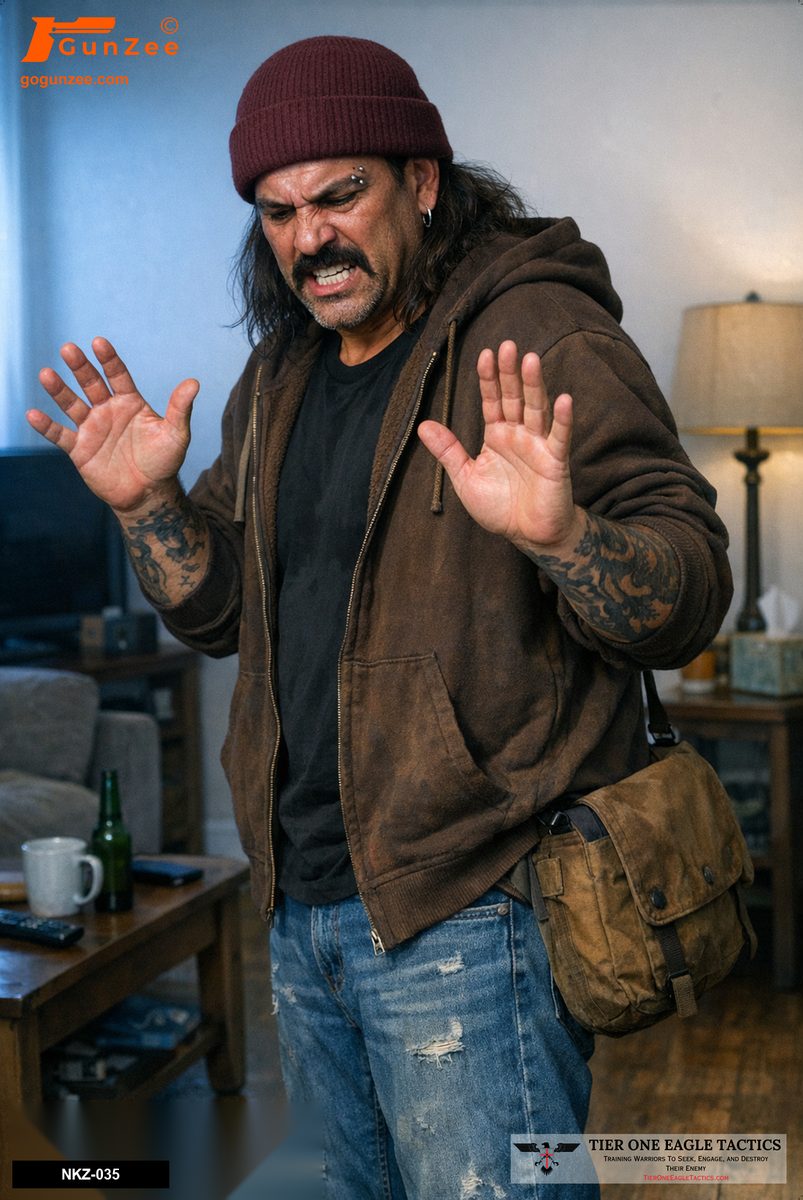
Living Room No-Shoot Scenario Shooting Target [24" x 36"]
each · sold in 5s · mix any designs
Price drops automatically: 50+ $1.85 · 100+ $1.76 · 250+ $1.66 · Up to 25% off at 999+ · Volume quote →
$40 order minimum for your whole cart, not each design. Mix any targets.
Quantity must be in increments of 5
Living Room No-Shoot Scenario
Life-size 24" x 36" scenario target depicting a non-threat subject in the Living Room No-Shoot Scenario scenario. Trains target discrimination, hold-fire discipline, and hesitation avoidance under realistic conditions — the target must be identified as a non-threat and left unengaged. Built for LE officers, instructors running decision-tree and discrimination drills, and defensive-shooting civilians training reflexive threat identification.
This scenario mirrors encounters that law enforcement officers, home defenders, and concealed carriers might face in real-world situations. The presence of common household items and the subject's non-threatening posture require quick assessment and situational awareness. The scene emphasizes evaluating the environment and the subject's intentions, making it an essential training tool for scenarios with compressed decision windows. The domestic setting further challenges the shooter to consider the implications of their actions within a confined space, where bystanders or family members might be present.
Training Purpose
This target is crafted to help shooters apply their anatomical and shot-placement knowledge in a realistic scenario without printed guides. The shooter must interpret the threat's anatomy from posture, orientation, and clothing, as there are no printed cardiac boxes, T-boxes, or scoring zones. This requires reliance on their understanding of human anatomy and threat assessment skills.
Instructors can use this target for cold cognitive drills and timed engagements. By integrating this with other NKZ scenarios, shooters can practice engaging in dynamic scenarios where the subject's intent must be discerned without visual aids. This helps develop the ability to read body language and environmental cues under realistic conditions.
Skills Reinforced
- Applying anatomical shot placement without visual overlays
- Reading vital-zone location from body position
- Precision engagement without diagrammatic guides
- Dynamic threat assessment under realistic conditions
- Situational awareness and environmental scanning
- Decision-making under pressure
- Interpreting body language cues
- Engagement discipline and shot accountability
- Real-time threat identification
NKZ Series — No Printed... ...
Living Room No-Shoot Scenario
Life-size 24" x 36" scenario target depicting a non-threat subject in the Living Room No-Shoot Scenario scenario. Trains target discrimination, hold-fire discipline, and hesitation avoidance under realistic conditions — the target must be identified as a non-threat and left unengaged. Built for LE officers, instructors running decision-tree and discrimination drills, and defensive-shooting civilians training reflexive threat identification.
This scenario mirrors encounters that law enforcement officers, home defenders, and concealed carriers might face in real-world situations. The presence of common household items and the subject's non-threatening posture require quick assessment and situational awareness. The scene emphasizes evaluating the environment and the subject's intentions, making it an essential training tool for scenarios with compressed decision windows. The domestic setting further challenges the shooter to consider the implications of their actions within a confined space, where bystanders or family members might be present.
Training Purpose
This target is crafted to help shooters apply their anatomical and shot-placement knowledge in a realistic scenario without printed guides. The shooter must interpret the threat's anatomy from posture, orientation, and clothing, as there are no printed cardiac boxes, T-boxes, or scoring zones. This requires reliance on their understanding of human anatomy and threat assessment skills.
Instructors can use this target for cold cognitive drills and timed engagements. By integrating this with other NKZ scenarios, shooters can practice engaging in dynamic scenarios where the subject's intent must be discerned without visual aids. This helps develop the ability to read body language and environmental cues under realistic conditions.
Skills Reinforced
- Applying anatomical shot placement without visual overlays
- Reading vital-zone location from body position
- Precision engagement without diagrammatic guides
- Dynamic threat assessment under realistic conditions
- Situational awareness and environmental scanning
- Decision-making under pressure
- Interpreting body language cues
- Engagement discipline and shot accountability
- Real-time threat identification
NKZ Series — No Printed Kill Boxes, No Scoring Zones
NKZ targets are crafted without any printed kill boxes, T-boxes, cardiac boxes, or scoring zones on the threat. The series is designed for shooters who already know shot-placement anatomy and are ready to apply that knowledge without visual aids. This is intermediate-to-advanced training, meant for those who have progressed beyond basic diagrammatic targets.
The realism of the scene replaces the overlay, with body posture, orientation, and clothing becoming the anatomical reference points. The shooter must identify vital-zone location from what they see, not from what's printed, enhancing their ability to engage threats accurately in real-world scenarios.
Instructor Notes
For practical training, set up scenarios at a distance that simulates a typical living room encounter, around 5 to 10 yards. Shooters should start from a low-ready position, focusing on quick assessment and decision-making. This target can be used in a mixed deck with other NKZ targets to create a comprehensive training sequence. Scoring is by shooter self-report or instructor observation, as there is no printed grid to reference.
Who This Target Is For
This target is ideal for law enforcement officers, defensive shooters, and instructors focusing on scenario-based training. It is particularly useful for qualification refreshers, instructor-led scenario immersion, advanced concealed carry, and military pre-deployment. The realistic setting and non-threatening subject make it an essential tool for those ready to enhance their judgment and restraint skills.
Product Details
- Size: 24" x 36" paper — full-size, torso-plus-frame for realistic engagement distance
- Price: $1.95 each · volume tier discounts apply (50-99 = 5% off, 100-249 = 10% off, up to 25% at 999+)
- Print: True-to-life scenario imagery, life-like realism on heavy paper stock
- No printed kill boxes, T-boxes, or scoring zones on the threat figure
- Ships: Same day from Raleigh, NC — orders in by 2pm ET ship the same afternoon
- SKU: NKZ-035
Browse the full NKZ — No Kill Zone Scenario Targets collection for all 59 targets in this series. See also the parent Paper Shooting Targets keystone, and the related Hostage Rescue Targets + Shoot / No-Shoot Targets keystones.
Related NKZ Targets
Pair this target with other NKZ scenarios to build a mixed decision-making deck. Instructors: stringing 3-5 NKZ targets across a training block trains the shooter to process each new scene cold, without knowing whether the next reveal is an armed threat, a no-shoot, or a hostage engagement.
- Indoor Living Room No-Shoot Scenario
- Office Cubicle Cowering Subject
- Rural Wounded Man Reaching for Help
- Bedroom Surrender Gesture
- Living Room Tactical Awareness
Browse the full NKZ — No Kill Zone Scenario Targets collection for all 59 targets in this series. See also the parent Paper Shooting Targets keystone, and the related Hostage Rescue Targets + Shoot / No-Shoot Targets keystones.