Read the Privacy Policy
✓ USED BY 230+ AGENCIES & TRAINING FACILITIES
24" × 36" · $1.95 each
180+ real-world scenarios · Up to 30% off volume · Ships today
Quantity must be in increments of 5
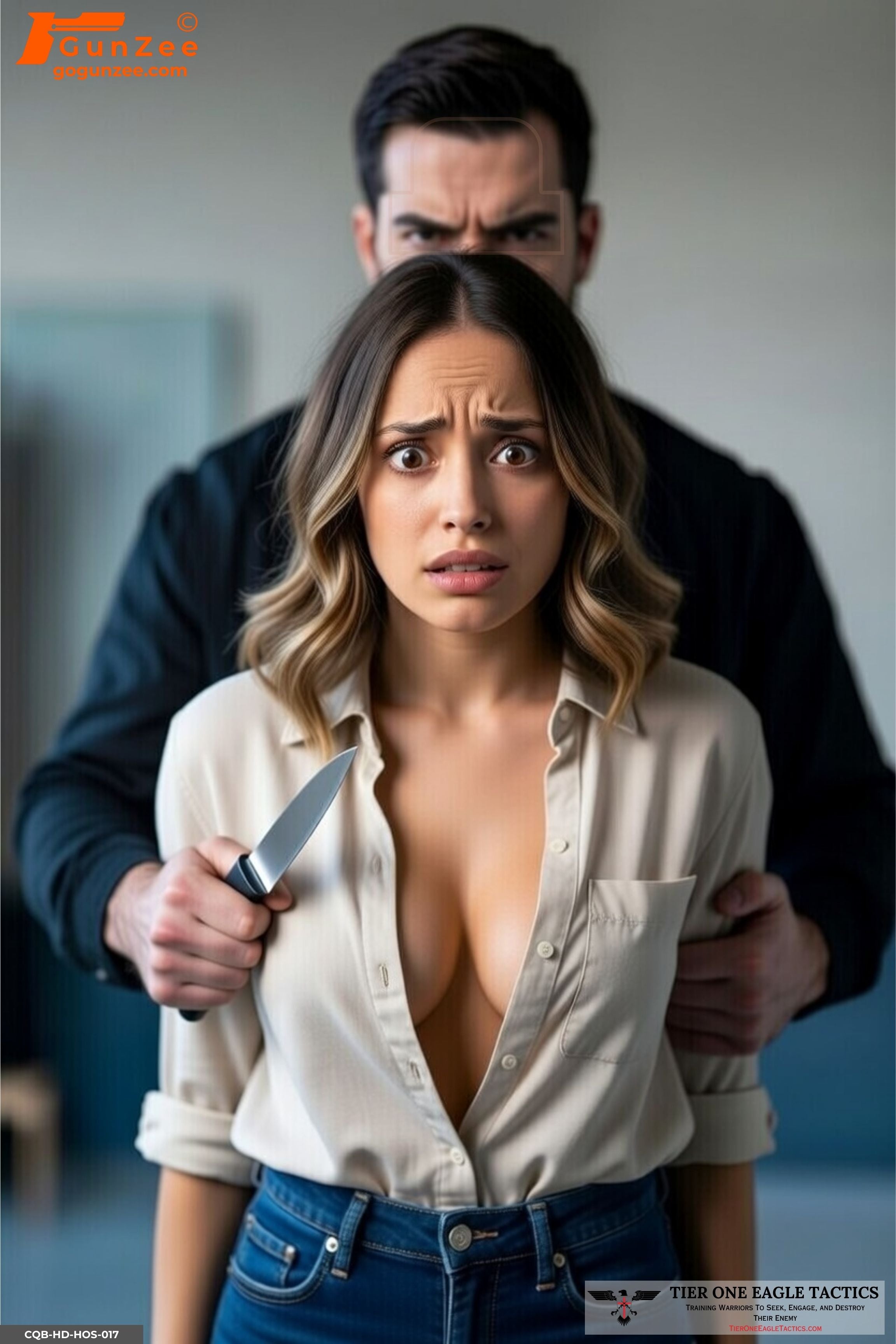
This close-quarters hostage scenario depicts a high-risk edged-weapon assault concealed behind a visibly distressed female hostage. The attacker maintains physical control from the rear while holding a knife in close proximity to the hostage’s torso, creating an immediate lethal threat with minimal reaction time and extremely limited shot options.
This target is intentionally designed to challenge visual discipline. The hostage’s fearful facial expression and revealing, attention-drawing clothing naturally pull the shooter’s focus forward, increasing cognitive load and the risk of visual fixation. The shooter must consciously overcome distraction, identify the true source of lethal intent, and execute precise shot placement under extreme pressure.
A modified T-box is included on the attacker to support disciplined shot accountability in this constrained hostage-rescue geometry.
Edged-weapon hostage encounters offer virtually no margin for error. The attacker’s close proximity to the hostage, combined with partial concealment, delays weapon recognition and compresses decision time.
This target is designed to train shooters to:
The scenario reinforces that attackers may exploit distraction—intentional or incidental—to create hesitation and delay defensive response.
This close-quarters hostage scenario depicts a high-risk edged-weapon assault concealed behind a visibly distressed female hostage. The attacker maintains physical control from the rear while holding a knife in close proximity to the hostage’s torso, creating an immediate lethal threat with minimal reaction time and extremely limited shot options.
This target is intentionally designed to challenge visual discipline. The hostage’s fearful facial expression and revealing, attention-drawing clothing naturally pull the shooter’s focus forward, increasing cognitive load and the risk of visual fixation. The shooter must consciously overcome distraction, identify the true source of lethal intent, and execute precise shot placement under extreme pressure.
A modified T-box is included on the attacker to support disciplined shot accountability in this constrained hostage-rescue geometry.
Edged-weapon hostage encounters offer virtually no margin for error. The attacker’s close proximity to the hostage, combined with partial concealment, delays weapon recognition and compresses decision time.
This target is designed to train shooters to:
The scenario reinforces that attackers may exploit distraction—intentional or incidental—to create hesitation and delay defensive response.
Most hostage targets make the weapon obvious. This one does not.
The hostage’s revealing, high-contrast clothing and intense emotional expression are deliberate design elements. Under stress, the human brain is drawn toward exposed skin, contrast, and facial emotion—often at the expense of threat recognition.
This target forces shooters to break that instinctive fixation. Success requires deliberate visual scanning, confirmation of the attacker’s weapon hand and posture, and disciplined engagement using the modified T-box despite distraction and compressed margins.
The modified T-box on this target is specifically configured for hostage-rescue constraints. Due to the attacker’s rear position and overlap with the hostage, the acceptable engagement zone is narrower and offset compared to traditional frontal targets.
The T-box outlines are intentionally subtle and are not visible at realistic shooting distances. They are intended for post-exercise analysis, allowing shooters to evaluate accuracy, accountability, and decision-making after the drill rather than aiming at visible markings.
Pair this target with related scenarios from across the GunZee catalog:
Public and everyday self-defense: Public Park Kneeling Hostage Execution Threat Shooting Target, Public Knife Assault Disarm – Close-Range Edged Weapon Encounter, Coffee Shop Confrontation Close Range Threat Shooting Target
Home defense, CQB, and hostage: CQB Home Defense Hostage – Knife Threat Rear Control Shooting Target, CQB Home Defense Hostage – Wallet Ambiguity Rear Control Shooting Target, CQB Home Defense Hostage – Rear Control Handgun Threat Shooting Target, CQB Home Defense Hostage – Forward Weapon Presentation Shooting Target
Vehicle and barrier: Vehicle Barrier Daylight Carjacking Shooting Target, Vehicle Barrier Elderly Victim Carjacking Shooting Target, Vehicle Barrier Windshield Assault Shooting Target
Anatomical: Anatomical Semi-Frontal Handgun Threat Precision Shooting Target, Anatomical Head-Out Vehicle Window Engagement Shooting Target, Anatomical Full-System Vital Zone Shooting Target
Also ships in: CQB & Interior 150-pack, Hostage Rescue 150-pack, Shoot / No-Shoot 150-pack — five of each design, priced below singles.