Read the Privacy Policy
Quantity must be in increments of 5
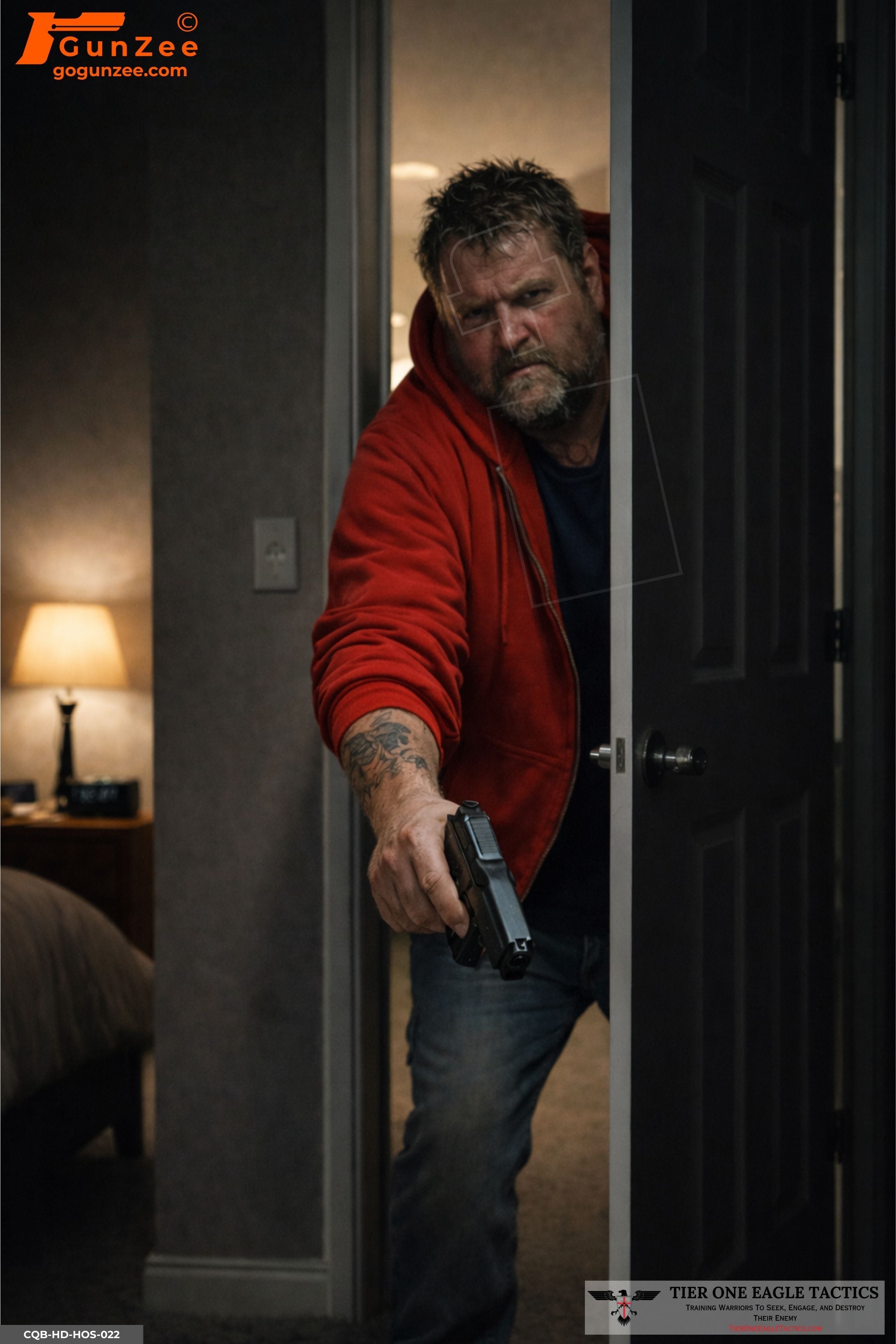
This target depicts a high-risk home-defense scenario involving an armed aggressor entering a bedroom through a partially opened doorway. The subject presents a handgun low and forward while using the doorframe for cover and concealment. Only portions of the head, shoulder, and upper torso are exposed, forcing the shooter to work within narrow visual and ballistic windows.
The dim interior lighting, domestic setting, and limited exposure replicate one of the most common and dangerous home-defense encounters: an armed intruder advancing into an occupied room where angles are restricted and reaction time is minimal.
This target is designed to train disciplined decision-making and precision shot placement during doorway and threshold encounters. The shooter must recognize lethal intent quickly while accounting for partial exposure, hard cover, and the risk of overexposure if positioning or timing is mismanaged.
The aggressor’s posture and slow, deliberate entry reinforce the importance of patience, muzzle discipline, and waiting for a defensible engagement window rather than reacting prematurely.
This target includes both a modified T-box and a cardiac box on the armed aggressor. These outlines are intentionally subtle and are not intended to be visible at typical shooting distances. Their purpose is post-exercise evaluation, allowing shooters and instructors to assess accuracy and decision quality after the drill is complete.
The modified... ...
This target depicts a high-risk home-defense scenario involving an armed aggressor entering a bedroom through a partially opened doorway. The subject presents a handgun low and forward while using the doorframe for cover and concealment. Only portions of the head, shoulder, and upper torso are exposed, forcing the shooter to work within narrow visual and ballistic windows.
The dim interior lighting, domestic setting, and limited exposure replicate one of the most common and dangerous home-defense encounters: an armed intruder advancing into an occupied room where angles are restricted and reaction time is minimal.
This target is designed to train disciplined decision-making and precision shot placement during doorway and threshold encounters. The shooter must recognize lethal intent quickly while accounting for partial exposure, hard cover, and the risk of overexposure if positioning or timing is mismanaged.
The aggressor’s posture and slow, deliberate entry reinforce the importance of patience, muzzle discipline, and waiting for a defensible engagement window rather than reacting prematurely.
This target includes both a modified T-box and a cardiac box on the armed aggressor. These outlines are intentionally subtle and are not intended to be visible at typical shooting distances. Their purpose is post-exercise evaluation, allowing shooters and instructors to assess accuracy and decision quality after the drill is complete.
The modified T-box expands beyond the traditional ocular-nasal window to include a high-probability incapacitation area in the upper forehead, where disruption is known to produce immediate incapacitation. This is particularly relevant in doorway encounters where only the head may be exposed.
The cardiac box provides an additional reference for analyzing alternative precision options when cranial engagement is obstructed by doorframes, angles, or movement.
Unlike static frontal targets, this design emphasizes partial exposure, cover usage, and realistic home-defense geometry. The doorframe compresses available shot angles and punishes sloppy sight alignment or rushed decisions.
The domestic environment adds psychological realism, reinforcing the seriousness of interior defensive encounters where family members, tight quarters, and low lighting are common factors.
Pair this target with related scenarios from across the GunZee catalog:
Public and everyday self-defense: Church Aisle Hostage Crisis Shooting Target, Low-Light Plainclothes Officer Threat Assessment Scenario, Public Festival Armed Threat – Dense Crowd Gunman Scenario
Home defense, CQB, and hostage: Apartment Hostage Close Quarters Control Shooting Target, CQB Home Defense Hostage – Bedroom Doorway Cell Phone Ambiguity Shooting Target, Two-Man Residential Entry Armed Threat Shooting Target, Bathroom Doorway Armed Female Threat Shooting Target
Vehicle and barrier: Vehicle Barrier Closed-Door Armed Driver Shooting Target, Vehicle Barrier Armed Driver Engagement Shooting Target, Vehicle Barrier Multi-Aggressor Carjacking Shooting Target
Anatomical: Anatomical Head-Out Vehicle Window Engagement Shooting Target, Anatomical Hostage Shield Vital Zone Shooting Target, Anatomical Semi-Frontal Handgun Threat Precision Shooting Target
Also ships in: CQB & Interior 150-pack, Shoot / No-Shoot 150-pack, Best Sellers 125-pack — five of each design, priced below singles.