The shot happens in less than a second. The decision before the shot is what trained shooters do not skip and untrained shooters do not see. Identifying an armed subject — under stress, in a crowd, in low light, with the threat partially obscured — is the read that determines whether the encounter becomes a defensive shoot or a tragedy. That read does not happen on a square range with a B-27 silhouette. It happens against a person, in a context, with cues that vary in clarity from obvious to ambiguous.
Training the decision is different from training the placement. The placement layer assumes the decision is already made. The decision layer assumes nothing — and that is exactly the problem most defensive shooters have never solved.

What "armed" actually looks like
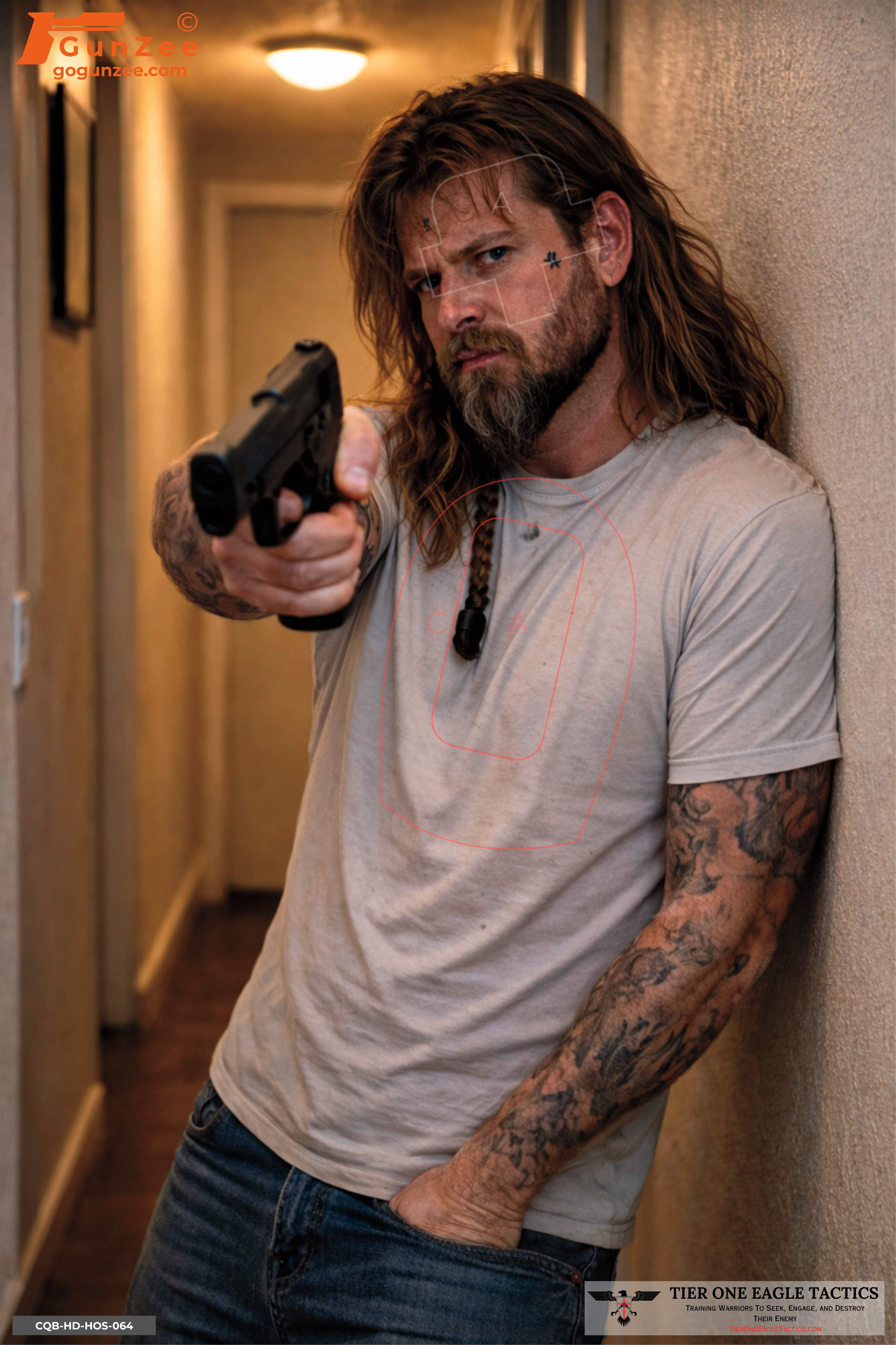
The threat the shooter trains against on most range targets is unambiguously armed — a clear handgun in a clear two-hand grip, presented at the shooter, at chest level, against a contrasting background. Real engagements rarely look like this.
Real armed subjects present a combination of cues. The trained eye reads them in sequence:
Hand position. Hands at the hip, hands under a jacket, hands behind the back, hands inside a bag. The location of the hands carries more information than the rest of the body. A subject with hands fully visible and empty is not the same threat as a subject with one hand hidden.
The object's silhouette. A handgun in profile has a recognizable line — slide, grip, trigger guard, barrel. Under stress that line is what the shooter sees, not detail. Training the silhouette recognition is what produces fast accurate reads.
The presentation angle. A weapon held at the hip is different from a weapon at the chest. A weapon at the chest pointed away is different from a weapon at the chest pointed at the shooter or at a third party. Each angle changes both the threat level and the ethical justification.
The hand-darkness against background. In low light, weapon recognition collapses to silhouette and contrast. A hand against a dark jacket reads different from a hand against a window or a wall.
Verbal cues. Most defensive engagements have a verbal component before the physical one. Aggressive language, commands, threats — these are part of the read, and they appear before the weapon does in many cases.
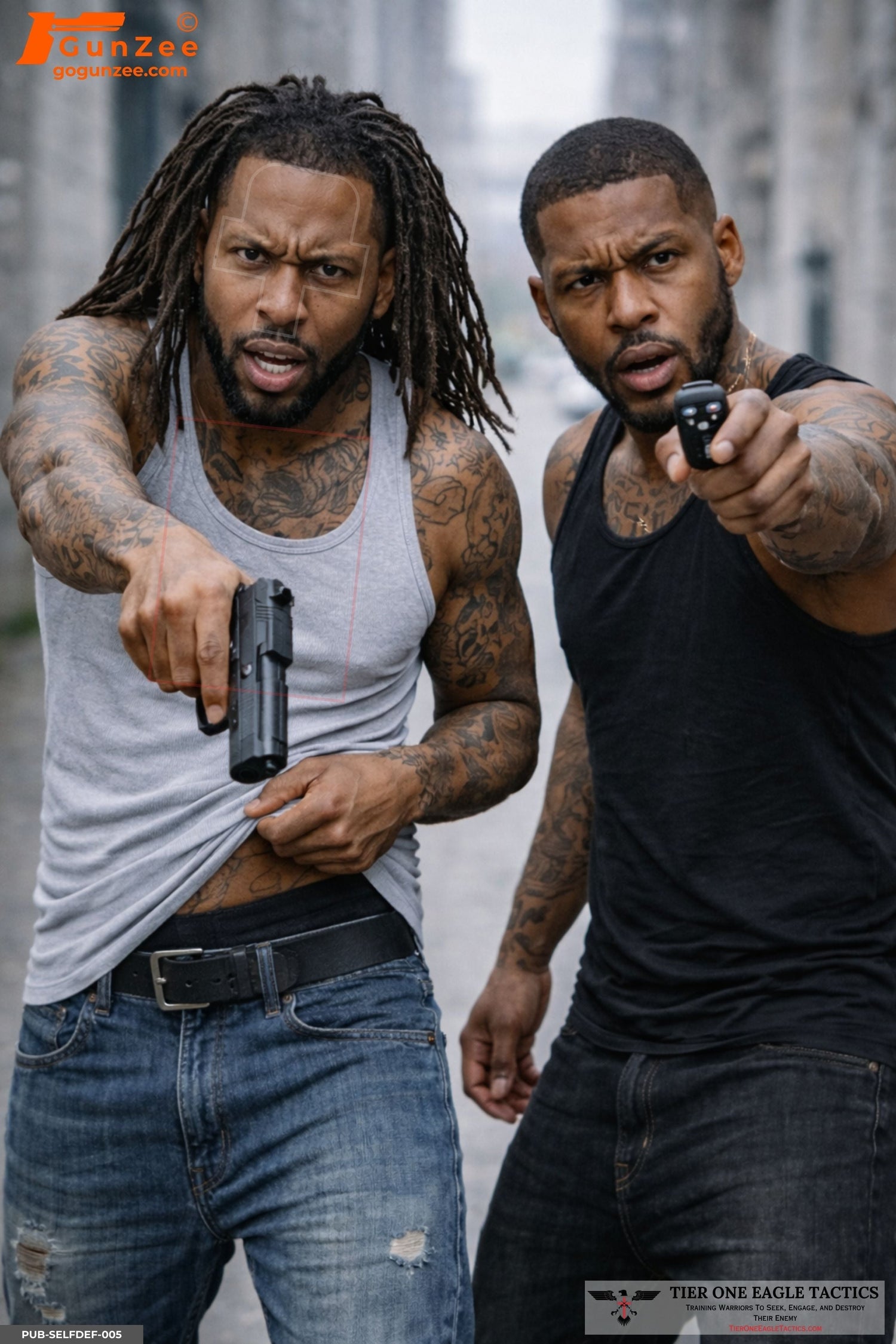
Targets that show the threat in a context — the Urban Street Two-Man Armed Confrontation target, the Crowded Street Knife Threat target, the Dual-Threat Mall Corridor Assault target — train these cues in combination, not in isolation. The shooter sees a person in a place with hands doing something. That picture is what the actual encounter looks like.
What unarmed-but-threatening looks like
The harder discrimination is not "armed vs. clearly unarmed." It is "armed vs. ambiguously unarmed." A verbal aggressor advancing with hands raised, a subject reaching toward a waistband, a hand disappearing into a jacket pocket — all of these present the question that the shoot/no-shoot decision turns on. Most of these encounters do not end in a shooting. Some do. The shooter's read in the first second determines which.
The Verbal Aggressor No Weapon Visible target is built specifically to train the no-shoot decision. The subject is hostile, gesturing, advancing — but no weapon is presented. The shooter who has trained only on armed targets defaults to a shot. The shooter who has trained both reads the absence of the weapon and holds.
This is not a hypothetical risk. It is the most common civilian-shooting wrongful-discharge scenario: a subject who looked threatening, behaved threateningly, and turned out to be unarmed. Training the no-shoot picture is what prevents that.
The two-threat decision
A single armed subject is the simplest threat-discrimination problem. Two subjects, one armed and one ambiguous, is the next layer — and a layer most range training never touches.
The Urban Street Two-Man Armed Confrontation target presents this exact problem. Two subjects in a street encounter, weapons partially visible, posture and angle telling part of the story. The shooter has to identify the primary threat, identify the secondary, and sequence the engagement — all in the same second they would normally use to draw.
The Grocery Aisle Dual-Threat Confrontation target moves the same problem into a public-defense context with a confined environment. Two subjects, two weapons, an environment that compresses the engagement geometry.
The Dual-Threat Mall Corridor Assault target goes further — one subject with a knife, one with a handgun. The discrimination is not just "are they armed" but "what kind of armed, and what does that change about the engagement priority."

Low-light discrimination — the hardest case
Weapons that read as obvious in daylight read as ambiguous shapes in low light. Hands that are clearly empty in good light become indistinguishable from hands holding a small handgun. The decision becomes harder; the consequence of a wrong call stays the same.
The Low-Light Plainclothes Officer Threat Assessment Scenario target trains exactly this — a subject presenting under reduced light, with a weapon-shaped object in hand and the discrimination cue (badge, posture, verbal identification) intentionally subtle. The plainclothes-officer scenario is one of the most catastrophic possible discrimination failures, and it has happened in real-world events more than once.
Low-light discrimination is a skill that compounds on top of basic shoot/no-shoot. A shooter who reads cues fluently in daylight will lose 30 to 50 percent of that fluency under reduced light. The only way to recover the read is to train it under those conditions.
A range structure for shoot/no-shoot drills
Effective threat-discrimination training has a structure. It is not just "set up some targets and decide."
- Identify the cue you are training. Hand position. Weapon silhouette. Two-subject sequencing. Low-light recognition. Pick one per drill.
- Set up at least one no-shoot among the targets. The drill is only valid if the wrong answer is available. If every target is armed, the shooter is training pattern-fire, not discrimination.
- Engage from concealment. The draw under stress is part of the decision time. If the gun is already in hand, the decision is artificially fast.
- Use a verbal command before the shot. "Drop the gun" or equivalent. This is part of the real engagement and it builds the legal habit alongside the physical one.
- Track the wrong-target hit rate, not just the right-target hit rate. Hitting the threat is necessary. Not hitting the non-threat is mandatory. Both numbers belong in the after-action review.
- Rotate the layout between reps. If the shooter knows which target is the threat before the drill starts, the discrimination is rehearsed instead of read. Rotate.
This six-step structure is the skeleton. For a full set of graduated drills built on it — no-shoot ratios, layout rotation, and scoring standards — see Shoot / No-Shoot Decision Drills: Building Judgment Under Stress.
Where this fits in the broader scenario curriculum
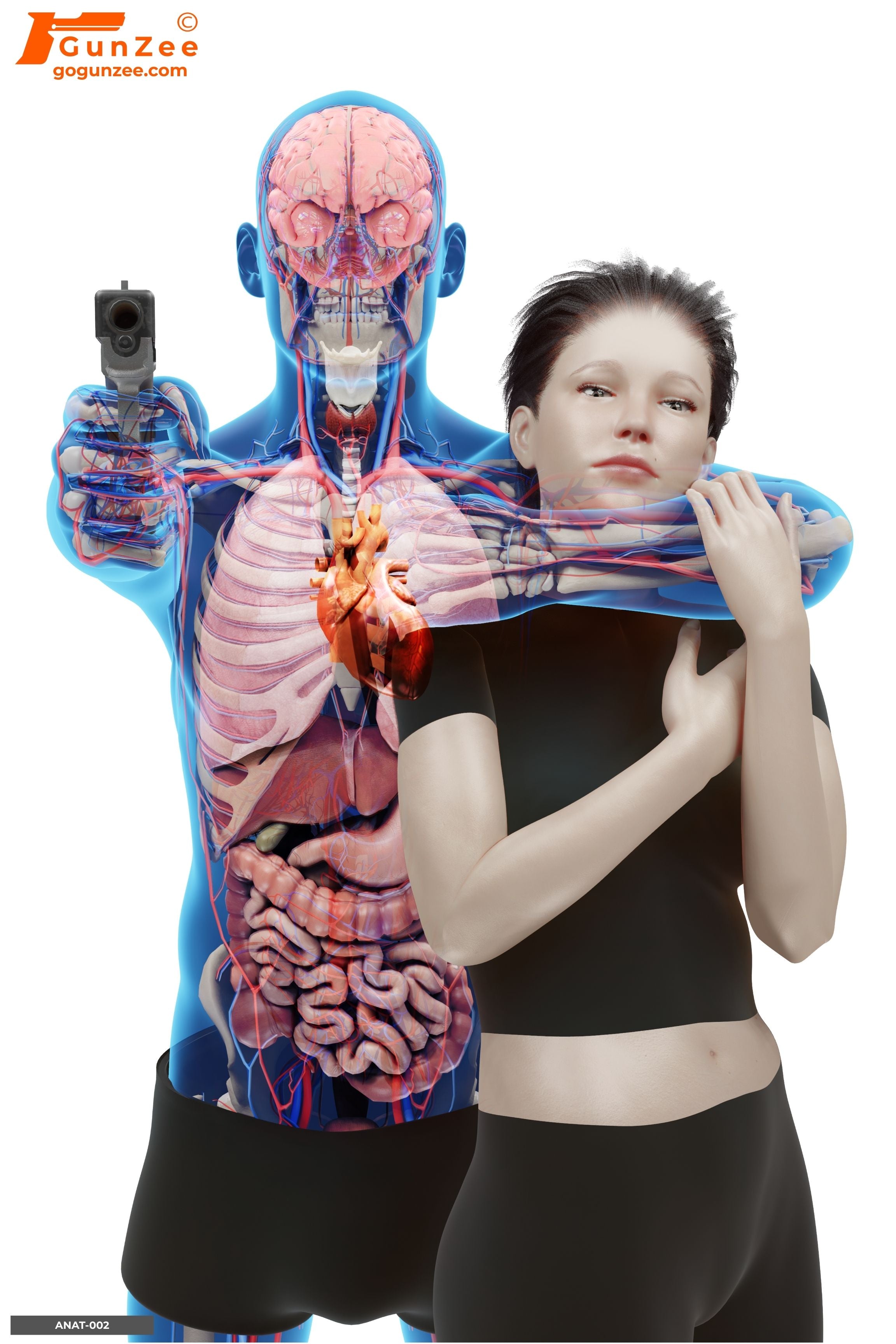
Threat discrimination is the decision layer of defensive shooting. It rests on top of anatomical placement (which is covered in Human Anatomy Shooting Targets: A Complete Training Guide) and feeds into hostage and multi-actor scenarios (covered in Hostage Scenarios: The Decision-Making Drills Most Shooters Skip). The broader case for scenario-based defensive training across multiple environment types is in 10 Defensive Shooting Scenarios Every CCW Holder Should Train For.
Discrimination under time pressure is also the backbone of close-quarters work: the CQB-specific application is covered in CQB Training Targets — Buyer's Guide for Professional Trainers, and the residential scenario library lives in the Home Defense, CQB & Hostage collection.
The full library of public-defense and threat-discrimination targets lives in the Public & Everyday Self-Defense collection.
→ BROWSE THREAT-DISCRIMINATION TARGETS
Frequently asked questions
What is shoot/no-shoot training?
Shoot/no-shoot training builds the visual decision that precedes the shot — identifying whether the subject is armed, whether the weapon is presented as a threat, and whether the engagement is legally and ethically justified. The decision happens in the same second as the draw, and it is the most consequential skill in defensive shooting.
How does the shooter identify an armed subject under stress?
Hand position, hand-darkness against background, the line and angle of the forearm, the silhouette of an object at the hip or under a jacket. Stress narrows attention, so the cues the shooter trains to identify are the cues they will actually see. Generic threat targets train a yes/no read; scenario targets train the cue itself.
Why are unarmed-threat targets important?
Most real encounters are not clean. A verbal aggressor with no weapon visible, a subject reaching toward a waistband, a hand under a jacket — all of these present the question "is this a threat?" before they present a weapon. Training only on clearly-armed targets builds false confidence about the read. The Verbal Aggressor No Weapon Visible target is built specifically to train the no-shoot.
What targets train threat discrimination?
The Urban Street Two-Man Armed Confrontation target presents two subjects with one clearly armed and one ambiguous. The Crowded Street Knife Threat target adds crowd interference. The Dual-Threat Mall Corridor Assault target forces sequencing across two armed subjects. The Verbal Aggressor target trains the no-shoot decision against a subject who appears threatening but is not armed.
Should shoot/no-shoot training happen at every range session?
Not every session, but it should appear in regular rotation — at least one in three sessions for a CCW holder. Pure marksmanship and pure scenario decision-making are different skills. Mixing them on every session degrades both. Block training on the decision pays off.
Does low light change the shoot/no-shoot decision?
Significantly. Weapons that read as obvious in daylight read as ambiguous shapes in dim light. The Low-Light Plainclothes Officer Threat Assessment Scenario target trains exactly this — a subject presenting under reduced light, where the decision is harder and the consequence of a wrong call is identical.
For drill-ready targets, see our dedicated shoot / no-shoot targets collection — every design vetted for weapon clarity so the shoot decision is always unambiguous.
Go deeper: the qualification-to-decision training guide places identification blocks inside a full qualification-to-decision program. Browse the complete collection of paper targets for shooting.