Law enforcement training targets get bought for three different jobs, and most departments fund only one of them well. Qualification targets satisfy the mandated standard. Skill-building targets develop marksmanship mechanics. Scenario targets train the judgment that every police shooting is ultimately judged on. This guide covers all three layers — what qualification actually verifies, where the decision-training gap sits in most programs, how to build a department scenario library, and the procurement math that makes the whole program cost less per officer than a single case of duty ammunition.
The three jobs a department's target budget has to cover
Every agency training program answers to three separate requirements, and each one asks something different of the paper on the stand.
Qualification is the compliance layer: the state POST course or agency-mandated standard, shot on the prescribed target at prescribed distances and times. It produces the record that says an officer can hit to standard.
Skill development is the mechanics layer: draw stroke, recoil control, placement precision, low-light manipulation. It consumes the most rounds and benefits from targets that give honest anatomical feedback rather than arbitrary scoring rings.
Judgment is the decision layer: can the officer read hands, behavior, and context fast enough to make the right call — including the call not to fire? This is the layer that use-of-force review boards, prosecutors, and juries actually examine, and it is the layer most department target budgets barely touch. A flat silhouette cannot train it, because the silhouette's presence alone announces the answer.
A defensible program funds all three deliberately. The rest of this guide takes them in order.
Qualification targets: necessary, and not sufficient
The familiar qualification stock — B-27 silhouettes, FBI-Q bottles, TQ-19s, and their state variants — exists to standardize measurement. Same target, same distances, same par times, every officer, every cycle. That standardization is exactly what makes qualification defensible as a record, and departments should keep shooting the target their standard prescribes.
But it is worth being clear about what the qualification course verifies: placement at distance under time pressure, on a target that is always a threat. It says nothing about whether the officer can identify a threat, discriminate between a weapon and a phone, or hold fire on a subject who turns out to be unarmed. Those are the skills that decide careers and verdicts, and they require a different kind of target.
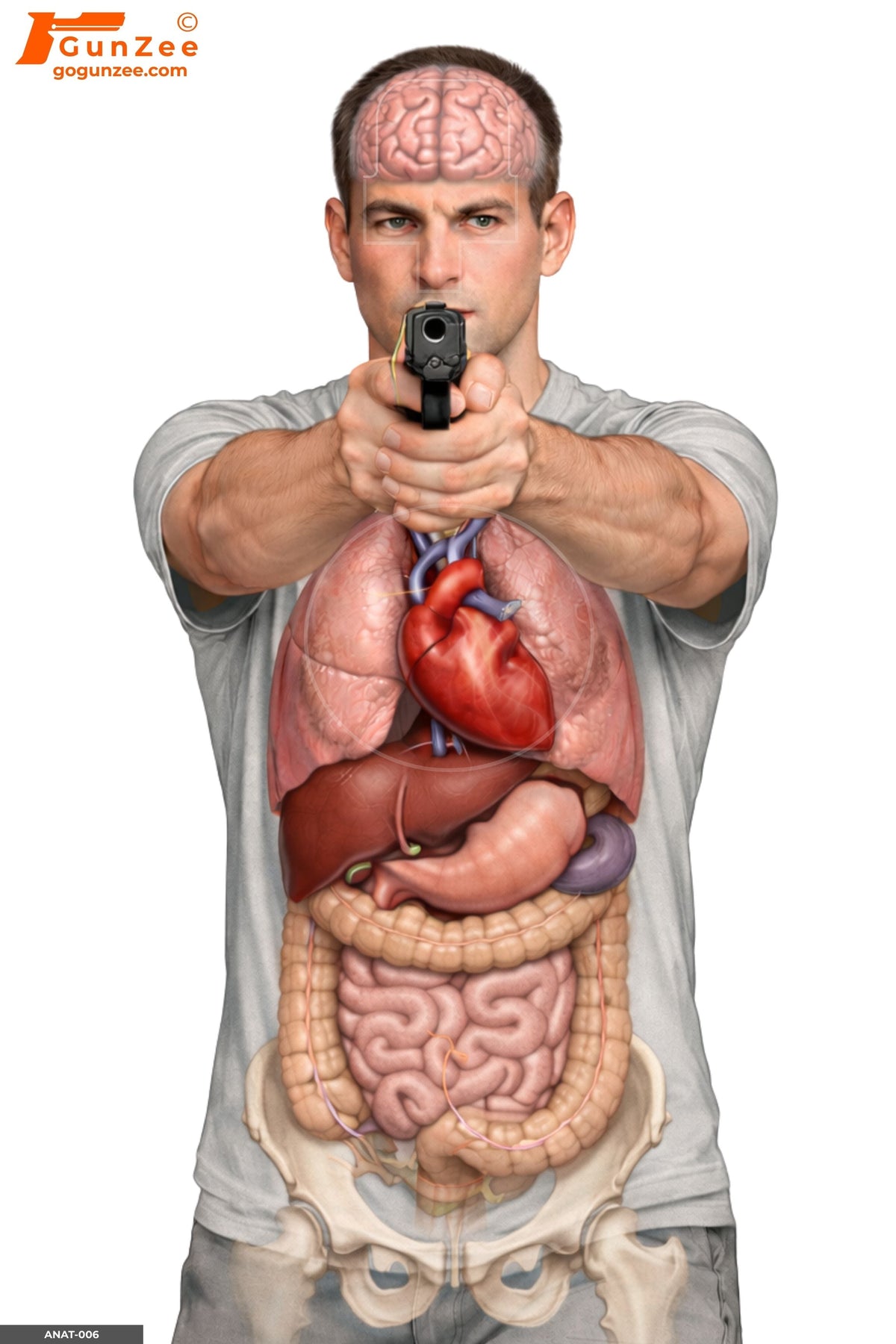
Qualification scoring zones also drift from anatomical truth. The highest-value ring on a B-27 sits noticeably low of the anatomy that actually stops a threat. Officers who train placement only against scoring rings build reference pictures that reward the ring, not the outcome. An anatomically honest target corrects that reference picture:

The full anatomical methodology — cardiac box, cranial T-box, and when to shift between them — is covered in Human Anatomy Shooting Targets: A Complete Training Guide. For a department, the practical move is simple: qualify on the mandated target, then run skills blocks on anatomical targets so placement standards track real incapacitation anatomy.
The decision layer: judgment training that shows up in the record
When an officer-involved shooting reaches review, the questions are about the decision: what did the officer perceive, was the threat identification reasonable, was the force response proportionate? A training file that shows nothing but qualification scores answers none of those questions. A training file that shows documented, scored threat-discrimination work answers all of them.
That is the case for making shoot / no-shoot work a standing block in the in-service calendar, not an occasional novelty. The mechanics are straightforward: life-size scenario targets — some depicting armed threats, some depicting unarmed subjects, phones in hand, or officers in plainclothes — hung in randomized order so the shooter must read the scene before deciding to fire, challenge, or hold. The shoot / no-shoot target collection is the drill-ready library, and the drill structure, decision-scoring method, and program design are covered step by step in Shoot / No-Shoot Decision Drills: Building Judgment Under Stress.
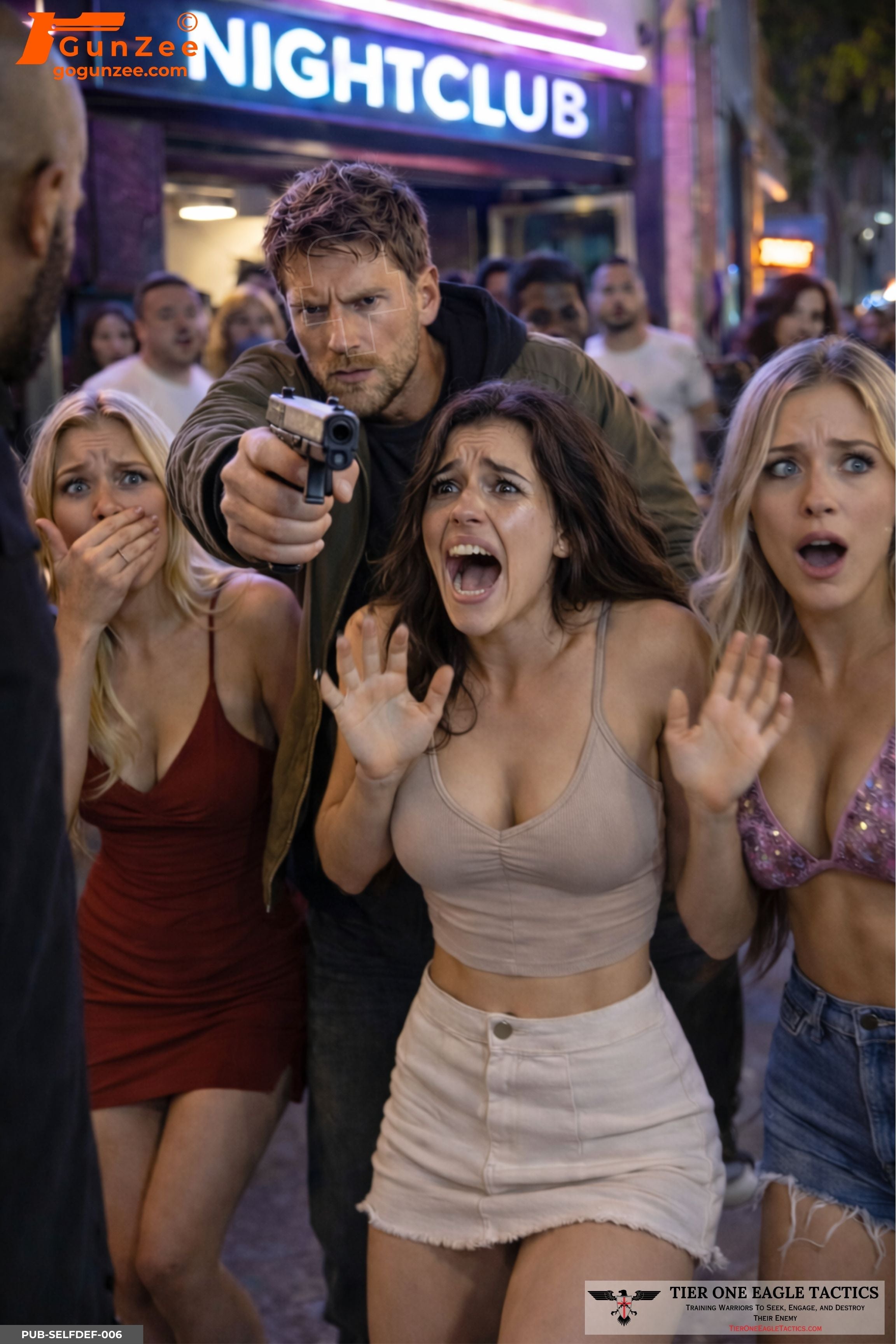
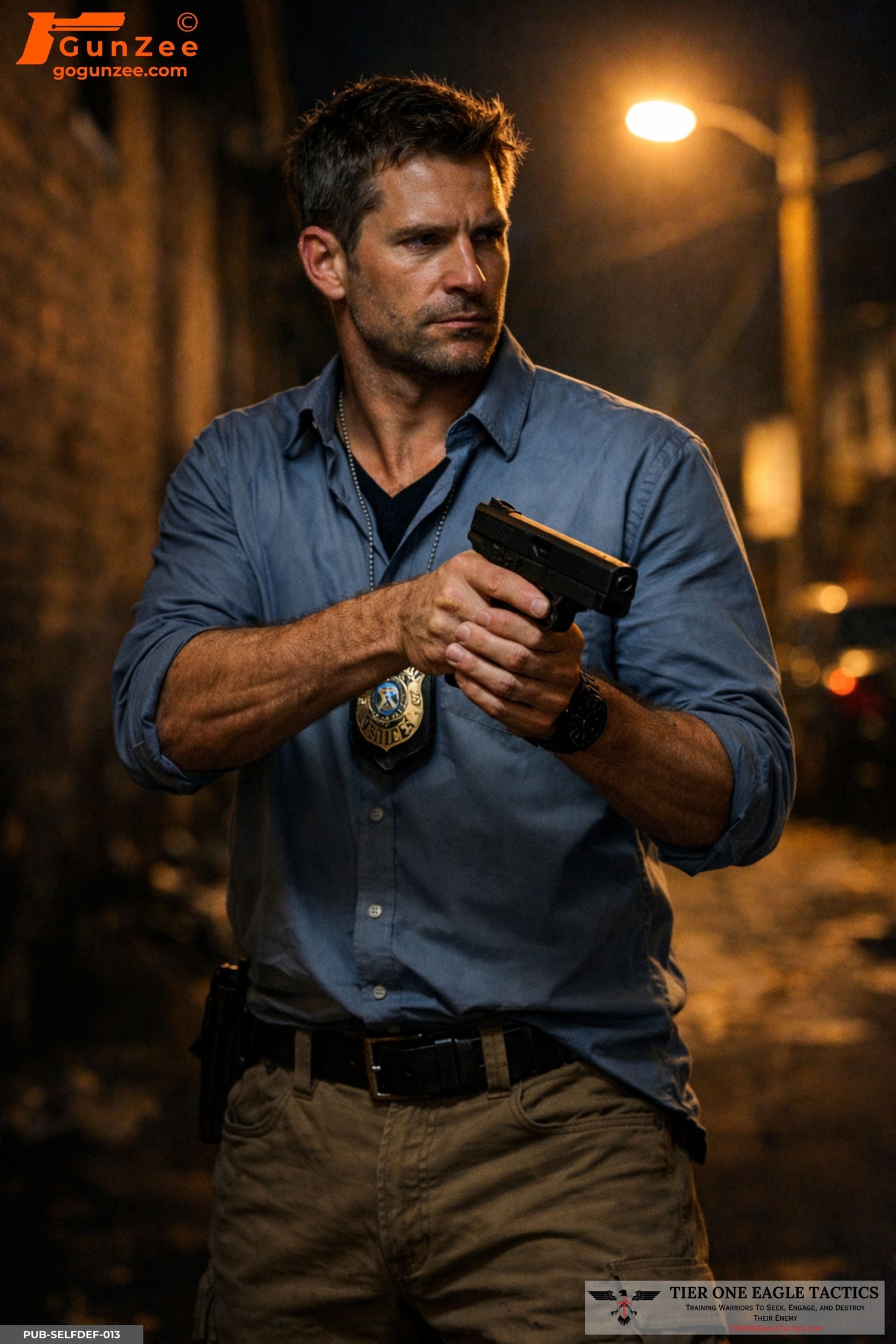
Two scenario classes deserve priority in any LE program. The first is the mistaken-identity problem — the plainclothes officer, the armed citizen who is not the aggressor, the subject whose object reads ambiguous under bad light:

The second is the precision-under-consequence problem — hostage and bystander-adjacent scenes where the shot is justified but the margin is small:

The legal doctrine underneath every one of those decisions — when an officer or armed citizen should and should not engage — is its own study, covered in Use-of-Force Decision Making. Pairing that doctrine with scored live-fire discrimination work is what turns policy language into trained behavior.
Building the department scenario library
A working LE scenario set covers the environments officers actually enter. Four categories carry most of the load:
- Structure interiors. Hallway ambushes, doorway entries, stairwell angles, subjects behind partial cover — the residential and building-clearing problems in the Home Defense, CQB & Hostage collection. Selection by engagement geometry: CQB targets.
- Public spaces. Parking lots, store aisles, crowded sidewalks, workplace and active-threat scenes. The active-threat application — for patrol response as much as for civilian preparation — is covered in the active shooter training guide.
- Vehicle-relative scenes. Traffic-stop geometry, armed drivers, engagements through and around vehicle structure, from the vehicle & barrier collection.
- No-shoot presentations. Unarmed subjects, ambiguous objects, compliant persons — the targets that make every drill an actual decision.
Every target is a life-size 24" x 36" scene depicting a real person in a real environment, printed on heavyweight paper, made in the USA. For agencies that want officers applying anatomical knowledge without printed prompts, the NKZ — No Kill Zone series takes the next step: 59 scenario scenes with no printed scoring zones at all, on matte no-glare stock, so the officer supplies the placement standard from training rather than reading it off the target.
For academies, the same library supports a recruit progression rather than a single block. Early phases run high-clarity scenes — weapon plainly visible, single subject — so recruits build correct reference pictures before speed enters the equation. Middle phases introduce ambiguity: phones and wallets in hand, two-subject scenes where only one is a threat, compliant subjects mixed into the array. Final phases add environmental difficulty — reduced light, partial cover, compressed corridor angles — until the recruit is reading scenes at the pace patrol work actually demands. Because each phase draws from a different slice of the same catalog, an academy can run the entire progression on one standing order and document exactly which scenario classes each recruit class trained against.
Low light deserves specific attention in the library plan. A significant share of officer-involved shootings happen in degraded light, where object identification is the hardest and the consequence of a wrong read is identical. Scenes composed for reduced-light presentation — subjects under sodium light, interiors lit by a single source, the plainclothes problem shown above — should be a standing category in every order, not an afterthought.
Procurement math: what a real program costs
Scenario paper is the cheapest line item in a training budget, and it is worth doing the arithmetic to prove it. Targets are $1.95 each flat, with volume discounts up to 25%. A 40-officer department running four in-service decision blocks a year, at six fresh scenes per officer per block, consumes about 960 targets — roughly $1,870 at list before volume pricing, or under $47 per officer per year. Next to the ammunition line in the same budget, that is a rounding error — attached to the training records that matter most under review.
Fresh scenes matter for decision work — a reused scene is a memorized answer — so plan consumption honestly rather than stretching a small set. For course-volume buying, pre-built bundles are the right unit of purchase:

GunZee targets are used by more than 270 law enforcement agencies and academies. Ordering is direct from the site — volume discounts apply automatically at checkout, and orders ship same day, so a training block scheduled for next week can be stocked this week without a procurement cycle.
A 12-month program that survives review
A defensible annual structure looks like this:
- Qualification cycles as mandated — on the prescribed standard target, unchanged.
- Quarterly decision blocks — randomized shoot / no-shoot strings on scenario targets, scored on the decision as well as the hit, with wrong-target hits logged. Scoring method in the decision drills pillar.
- Skills blocks on anatomical standards — placement work scored against real anatomy rather than ring values.
- Scene rotation every block — no officer sees the same array twice in a training year. Course-volume selection and drill rotation for instructors is covered in the CQB training targets guide.
The paper trail this produces — qualification scores plus quarterly, scored judgment training — is precisely the record a department wants to be able to show after a use-of-force incident: officers trained not just to hit, but to decide.
Or start from the full paper shooting targets library — every scenario category, 24" x 36", $1.95 each.
Frequently asked questions
What targets do police departments use for qualification?
Most agencies qualify on the target their state POST course or agency policy prescribes — commonly B-27 silhouettes, FBI-Q targets, TQ-19s, or a state-specific variant. Scenario targets do not replace the mandated qualification target; they cover the judgment and placement layers the qualification course cannot measure.
What makes a good law enforcement training target?
Life-size scale (24" x 36"), a realistic scene an officer must actually read — a real person, a real environment, a visible or deliberately ambiguous object — and economics that allow fresh scenes every session. A target the officer has memorized trains pattern-fire, not decision-making.
How many targets does a department need per officer per year?
For the decision layer, plan four to six fresh scenes per officer per training block. Four blocks a year puts consumption around 16 to 24 scenario targets per officer annually — roughly $31 to $47 per officer at list pricing before volume discounts, plus whatever the qualification standard consumes.
Do scenario targets satisfy qualification requirements?
No — qualification standards are set by state POST bodies and agency policy, and should be shot on the prescribed target. Scenario targets are the documented judgment-training layer that runs alongside qualification, and the combination is what produces a complete training record.
How do agencies and academies buy in volume?
Directly through the site, the same way individual shooters do. More than 270 law enforcement agencies and academies train on GunZee targets — volume pricing up to 25% off applies automatically at checkout, training packs bundle course-scale quantities into a single line item, and orders ship same day.
Train it as a pack: department-scale rotations start with the Shoot / No-Shoot 150-pack, CQB & Interior 150-pack, Hostage Rescue 150-pack. Browse the law enforcement training targets collection, review purchasing paths on the government & agencies page, or request a quote for a volume price.
Related reading
- Anatomical Shooting Targets: Train Vital Zones, Not Scoring Rings
- How to Set Up Force-on-Force Training at Home Without Live Role-Play
- Gun Targets: The Buyer’s Guide for Serious Training
- Self-Defense Shooting Targets: Train the Decision, Not Just the Shot
- Tactical Shooting Targets: What Counts, What Doesn’t, and How to Choose
- Hostage Scenarios: The Decision-Making Drills Most Shooters Skip
- Paper Shooting Targets: Material and Manufacturing Insights
Related reading published since this pillar: the silhouette shooting targets pillar (what the B-27 era trained and what it missed) and the B-27 spec guide — dimensions, rings, and state qualification scoring for the target most departments still qualify on. Individual officers comparing personal training options: start with the shooting targets buyer’s guide.