
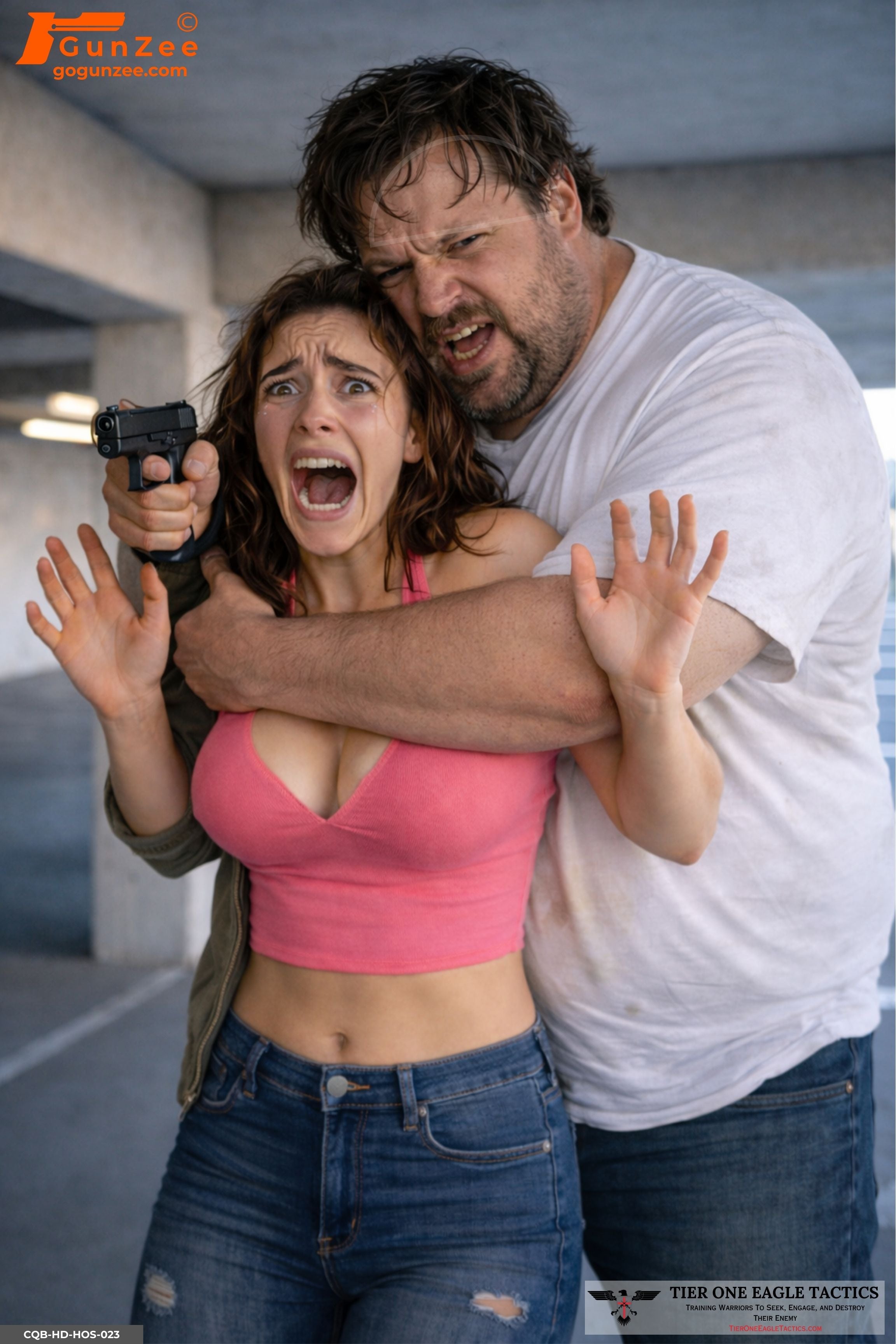
Parking Garage Hostage Crisis – Cranial Incapacitation Training Target [24" x 36"]
each · sold in 5s · mix any designs
Price drops automatically: 50+ $1.85 · 100+ $1.76 · 250+ $1.66 · Up to 25% off at 999+ · Volume quote →
$40 order minimum for your whole cart, not each design. Mix any targets.
Quantity must be in increments of 5
Parking Garage Hostage Crisis – Cranial Incapacitation Training Target
This CQB / home-defense hostage target presents a high-stress, extremely unforgiving scenario in a confined parking garage environment. A violent aggressor restrains a terrified victim at close contact, pressing a firearm near her head while using her body as concealment. The scene forces disciplined visual processing, emotional control, and absolute accountability under pressure.
The aggressor’s posture, facial expression, and physical dominance over the hostage create a powerful psychological distraction. The shooter must manage tunnel vision, emotional interference, and time compression while identifying the only viable resolution point available in the moment.
This target is designed to punish rushed decisions and reward calm, precise execution.
Training Purpose
Hostage situations in tight environments rarely allow margin for error. This target trains shooters to operate when traditional center-mass solutions are unavailable and when precision is dictated by proximity, angles, and innocent life directly in the line of fire.
The scenario emphasizes restraint, shot discipline, and decision-making under emotional stress rather than speed or volume of fire.
Skills Reinforced
- Hostage rescue decision-making under extreme stress
- Visual discrimination with overlapping bodies
- Precision shot placement in confined spaces
- Emotional control during high-stakes scenarios
- Accountability for every round fired
- Threat confirmation and angle management
- Post-engagement shot analysis
Cranial Incapacitation Zone
This target includes a cranial incapacitation zone, shaped as a subtle semicircle on the aggressor’s head.
The outline is intentionally faint and not visible at typical shooting distances. It is designed for after-action analysis, not for aiming during the exercise.
The zone represents a known cranial region where disruption can result in immediate incapacitation when no other options are viable. Shooters are expected to engage based on visual assessment and decision-making, then analyze shot placement after the drill to evaluate precision, accountability, and judgment.
This reinforces real-world conditions where shooters must act without visual aids, overlays, or highlighted zones.
Why This Target Is Different
Most hostage targets simplify the problem by offering obvious aiming points or unrealistic separation between aggressor and victim. This design removes those shortcuts.
The aggressor’s body shields traditional engagement zones.
The hostage’s fear response adds visual and emotional pressure.
The confined garage setting limits angles and time.
The cranial zone exists only for post-exercise evaluation.
This forces shooters to confront the reality of consequence-driven decision-making rather than mechanical shooting.
Related training targets
Pair this target with related scenarios from across the GunZee catalog:
Public and everyday self-defense: Parking Garage Close-Contact Hostage Control Shooting Target, Nightclub Exit Hostage Crowd Crisis Shooting Target, Church Aisle Hostage Crisis Shooting Target, Grocery Store Parking Lot Armed Approach – Public Threat Interception
Home defense, CQB, and hostage: Hallway Threat Civilian in the Doorway Shooting Target, Bathroom Doorway Ambiguous Object Female Threat Shooting Target, Dining Room Table Barricade Male With Inhaler Ambiguous Threat Shooting Target
Vehicle and barrier: Vehicle Barrier Door-Jamb Armed Threat Shooting Target, Vehicle Barrier Dual Gunmen Front-and-Rear Seat Engagement Shooting Target, Vehicle Barrier Elderly Victim Carjacking Shooting Target
Anatomical: Anatomical Side-Profile Rifle Threat Shooting Target, Anatomical Semi-Profile Handgun Threat Vital Zone Shooting Target, Anatomical Rifle Threat Vital Zone Shooting Target
Also ships in: CQB & Interior 150-pack, Hostage Rescue 150-pack, Active Shooter 60-pack — five of each design, priced below singles.