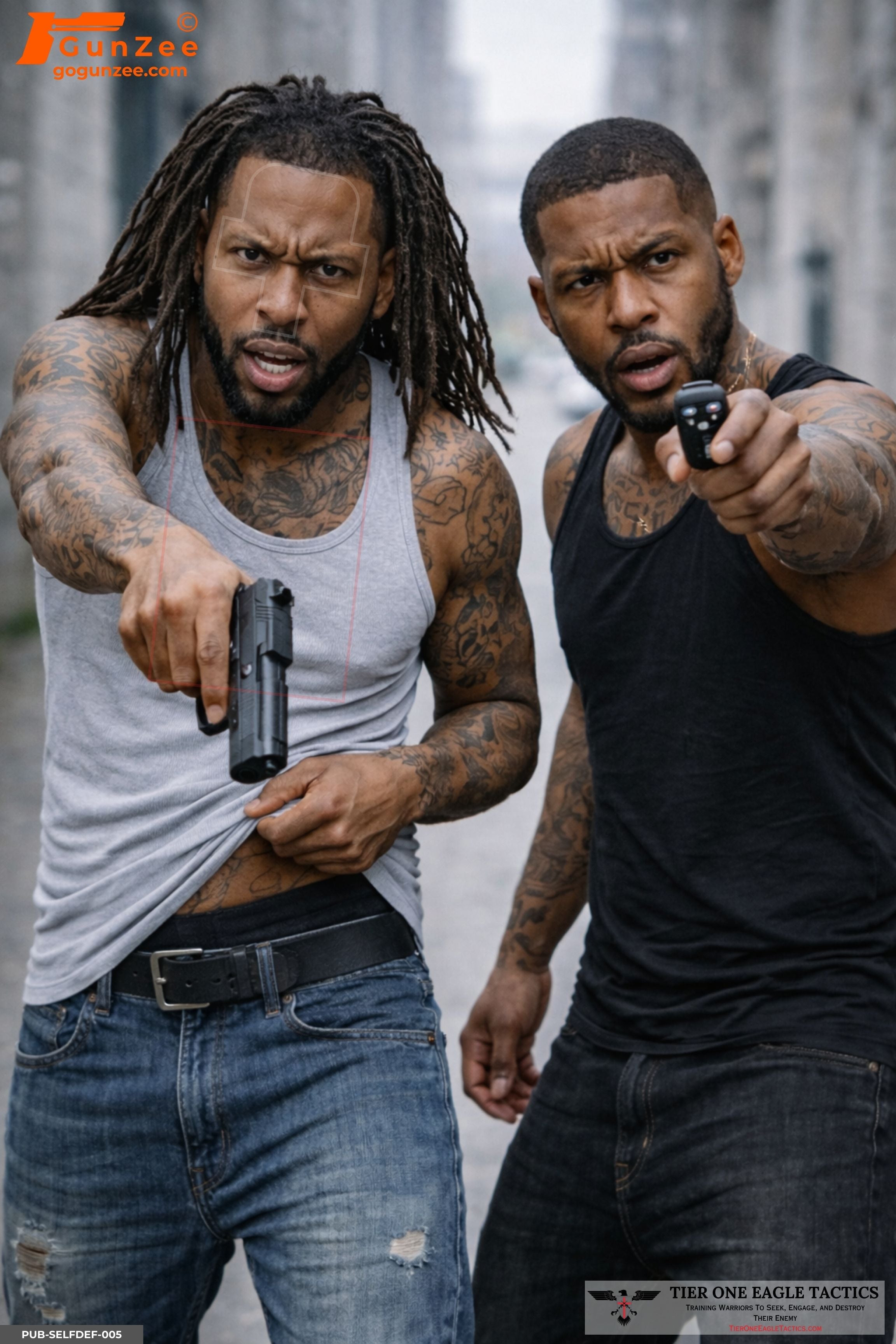
The Urban Street Two-Man Armed Confrontation training target depicts a rapidly escalating public self-defense encounter involving two coordinated aggressors advancing toward the shooter in an outdoor urban environment. One male, wearing a white t-shirt, is actively presenting a firearm, while the second individual displays an ambiguous handheld object that requires immediate identification before any engagement decision is made. For more scenes with a clear armed threat, browse our bad guy shooting targets.
This target is designed to train shooters to confirm weapon type, assess intent, and prioritize threats in a public setting where misidentification can lead to catastrophic consequences. It emphasizes visual discrimination, restraint, and disciplined decision-making under intense pressure.
This target includes intentionally placed transparent cranial and cardiac kill zones on the male wearing the white t-shirt to support post-engagement shot placement evaluation following a training sequence.
Training Purpose
Public encounters involving multiple suspects are rarely clean or symmetrical. Attackers may present different weapons, mixed signals, or deceptive objects, all while operating in close proximity to one another and nearby civilians.
This target was created to reflect that complexity. The shooter must rapidly determine which subject represents the most immediate lethal threat while simultaneously confirming whether the second subject is armed with a firearm, a non-lethal device, or an improvised object. The lack of clear separation between the two individuals forces deliberate visual processing rather than reflexive action.
The purpose of this target is to train shooters to slow cognitive processing while maintaining readiness, making correct decisions in moments where assumptions and haste can produce irreversible outcomes. The kill zones are not intended to dictate engagement decisions, but to provide objective feedback after the drill regarding precision, timing, and accountability.
Skills Reinforced
- Weapon confirmation under stress
- Threat prioritization between multiple subjects
- Visual discrimination of firearms versus ambiguous objects
- Decision-making in close-proximity public encounters
- Cranial and cardiac shot placement evaluation
- Shot accountability with limited visual separation
- Stress management during rapidly evolving threats
Why This Target Is Different
Most shooting targets present a single obvious threat with clear intent. This target deliberately removes that clarity by presenting two advancing individuals with different threat indicators.
The shooter must:
- Interpret hand position, object presentation, and posture
- Avoid tunnel vision and target fixation
- Prioritize threats based on behavior rather than proximity alone
- Make engagement decisions before referencing anatomy
The urban street setting adds realism without theatrics, while the subjects’ proximity challenges assumptions about shot availability and timing. Because the scenario is fixed yet mentally demanding, it supports repeatable drills that consistently expose weaknesses in threat discrimination and judgment.
Scenario Context (Educational)
Real-world public confrontations involving multiple suspects often unfold rapidly, with incomplete information and significant legal consequences for error. One individual may present an obvious lethal threat while another introduces ambiguity that can delay or disrupt correct decision-making.
Kill Zone Reference System
This target includes transparent cranial and cardiac kill zones on the armed male wearing the white t-shirt, used exclusively for post-engagement shot placement evaluation.
Cranial kill zone (modified T-box)
The cranial kill zone is based on the conventional T-box, defined by a horizontal reference across the upper lip or base of the nose and a vertical reference between the eyes. This target uses a modified T-box that expands upward into the lower forehead region, reflecting anatomical areas known to produce immediate neurological incapacitation when disrupted. The expanded region accounts for head movement and real-world presentation angles and is intended strictly for evaluation after the training sequence.
Cardiac kill box (upper thoracic cavity)
The cardiac kill box represents the upper thoracic cavity, encompassing the heart, aortic arch, and major vascular structures associated with rapid physiological incapacitation. Hits within this zone are evaluated for placement, timing, and precision rather than guaranteed outcome.
These kill zones are training references only. They are not scoring rings, not mandatory aim points, and not a substitute for lawful judgment or threat assessment.
Related training targets
Pair this target with related scenarios from across the GunZee catalog:
Public and everyday self-defense: Man on Crutches Armed Confrontation Shooting Target, Storage Unit Armed Confrontation Shooting Target, Crowded Street Knife Threat Shooting Target, Grocery Aisle Dual-Threat Confrontation Shooting Target
Home defense, CQB, and hostage: CQB Home Defense Hostage – Closet Ambush Armed Subject Shooting Target, Hallway Advancing Armed Intruder Decision-Making Shooting Target, Interior Doorway Male With Phone Ambiguous Threat Shooting Target
Vehicle and barrier: Vehicle Barrier Armed Driver Engagement Shooting Target, Vehicle Barrier Door-Jamb Armed Threat Shooting Target, Vehicle Barrier Dual Gunmen Front-and-Rear Seat Engagement Shooting Target
Anatomical: Anatomical Head-Out Vehicle Window Engagement Shooting Target, Anatomical Frontal Handgun Threat Vital Zone Shooting Target, Anatomical Hostage Shield Vital Zone Shooting Target