
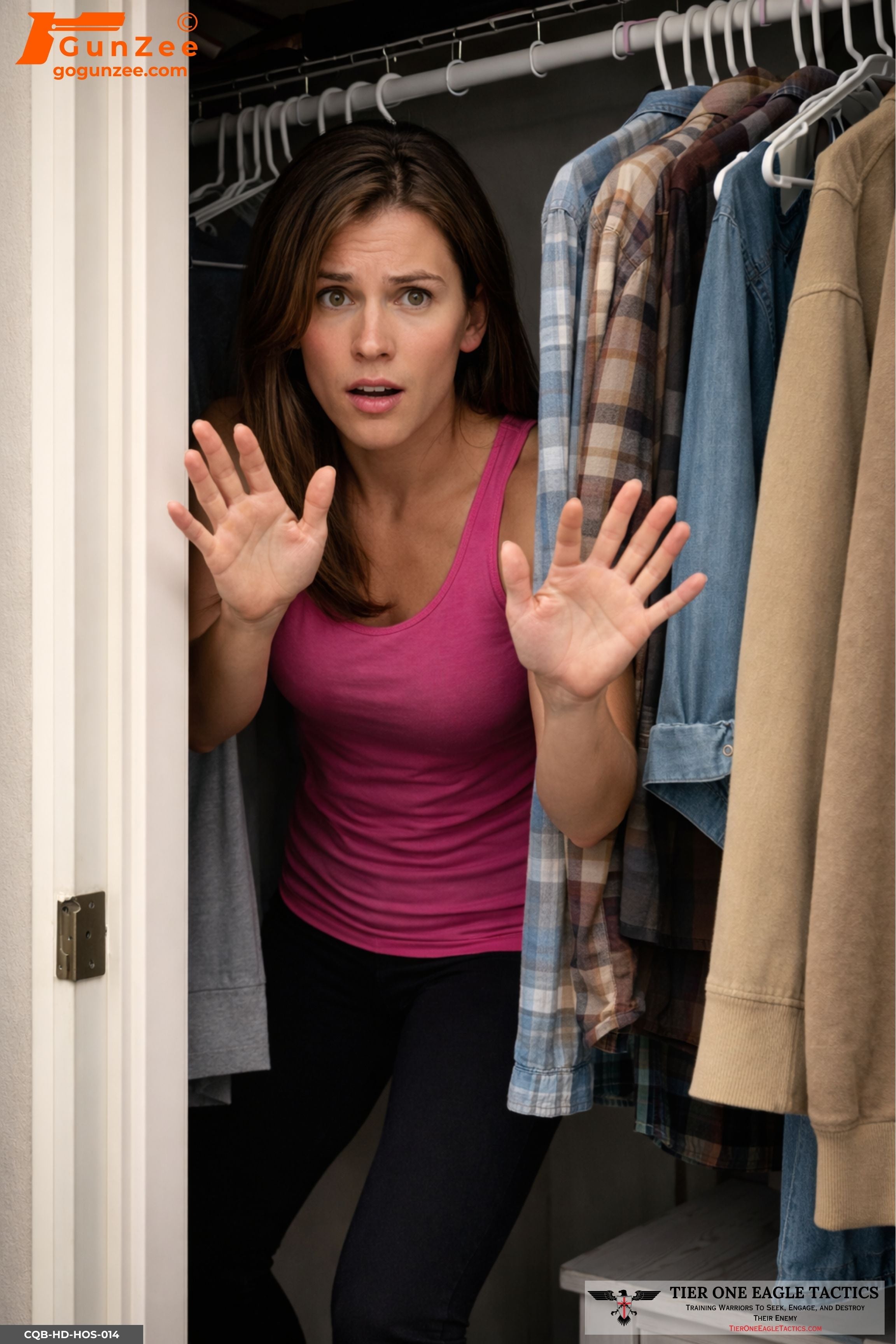
CQB Home Defense Hostage – Closet Ambush Hands-Up Compliance Shooting Target [24" x 36"]
each · sold in 5s · mix any designs
Price drops automatically: 50+ $1.85 · 100+ $1.76 · 250+ $1.66 · Up to 25% off at 999+ · Volume quote →
$40 order minimum for your whole cart, not each design. Mix any targets.
Quantity must be in increments of 5
CQB Home Defense Hostage – Closet Ambush Hands-Up Compliance Shooting Target
This CQB Home Defense Hostage Shooting Target depicts a sudden close-quarters encounter where a female subject emerges from inside a bedroom closet with both hands raised in a clear compliance posture. The environment is identical to a known ambush location, yet the subject’s behavior signals surrender rather than aggression.
The confined space, cluttered background, and unexpected movement from concealment create a powerful psychological trap. At speed, this scenario closely resembles an armed ambush, making it a critical test of visual discipline and emotional control.
Training Purpose
Closets and other concealed interior spaces represent high-risk search areas during home defense or residential clearing. When movement occurs in these spaces, defenders are often primed to expect an ambush.
This target is designed to train shooters to recognize compliance signals even when surprise, proximity, and stress strongly bias the decision toward lethal force. It reinforces that confirmation and restraint are essential skills, especially when identical environments may alternate between lethal and non-lethal outcomes.
Skills Reinforced
- Shoot / no-shoot discrimination under surprise
- Recognition of compliance gestures
- Emotional control in ambush-prone environments
- Threat confirmation before engagement
- Accountability in confined residential spaces
Why This Target Is Different
Many training targets emphasize speed and decisiveness while underrepresenting restraint. This target deliberately places the shooter in a setting that historically conditions aggression, then presents a subject whose posture clearly contradicts that expectation.
The raised hands, open palms, and startled expression require shooters to override environmental bias and respond to behavior rather than assumption. This mirrors real-world incidents where compliant individuals have been misidentified during rapid clearing operations.
No Kill-Zone Overlays
This target intentionally includes no T-box, cardiac box, or other kill-zone outlines. The absence of overlays reinforces the core training objective: determining whether force is appropriate at all, not where a shot would land.
Post-exercise analysis focuses on perception, timing, restraint, and decision accuracy rather than marksmanship.
Related training targets
Pair this target with related scenarios from across the GunZee catalog:
Public and everyday self-defense: Nightclub Exit Hostage Crowd Crisis Shooting Target, Seated Injury Deception – Concealed Handgun Public Encounter Shooting Target, ATM Robbery Gunpoint Ambush – Rear-Aspect Public Threat Scenario
Home defense, CQB, and hostage: CQB Home Defense Hostage – Closet Ambush Armed Subject Shooting Target, CQB Home Defense Hostage – Forward Weapon Presentation Shooting Target, CQB Home Defense Hostage – Woman Armed Forward Presentation Shooting Target, CQB Home Defense Hostage – Cellphone Ambiguity Decision-Making Shooting Target
Vehicle and barrier: Vehicle Barrier Elderly Victim Carjacking Shooting Target, Vehicle Approach Threat Advancing Gunman Shooting Target, Vehicle Barrier Windshield Gunman Engagement Shooting Target
Anatomical: Anatomical Side-Profile Rifle Threat Shooting Target, Anatomical Semi-Profile Handgun Threat Vital Zone Shooting Target, Anatomical Frontal Handgun Threat Vital Zone Shooting Target