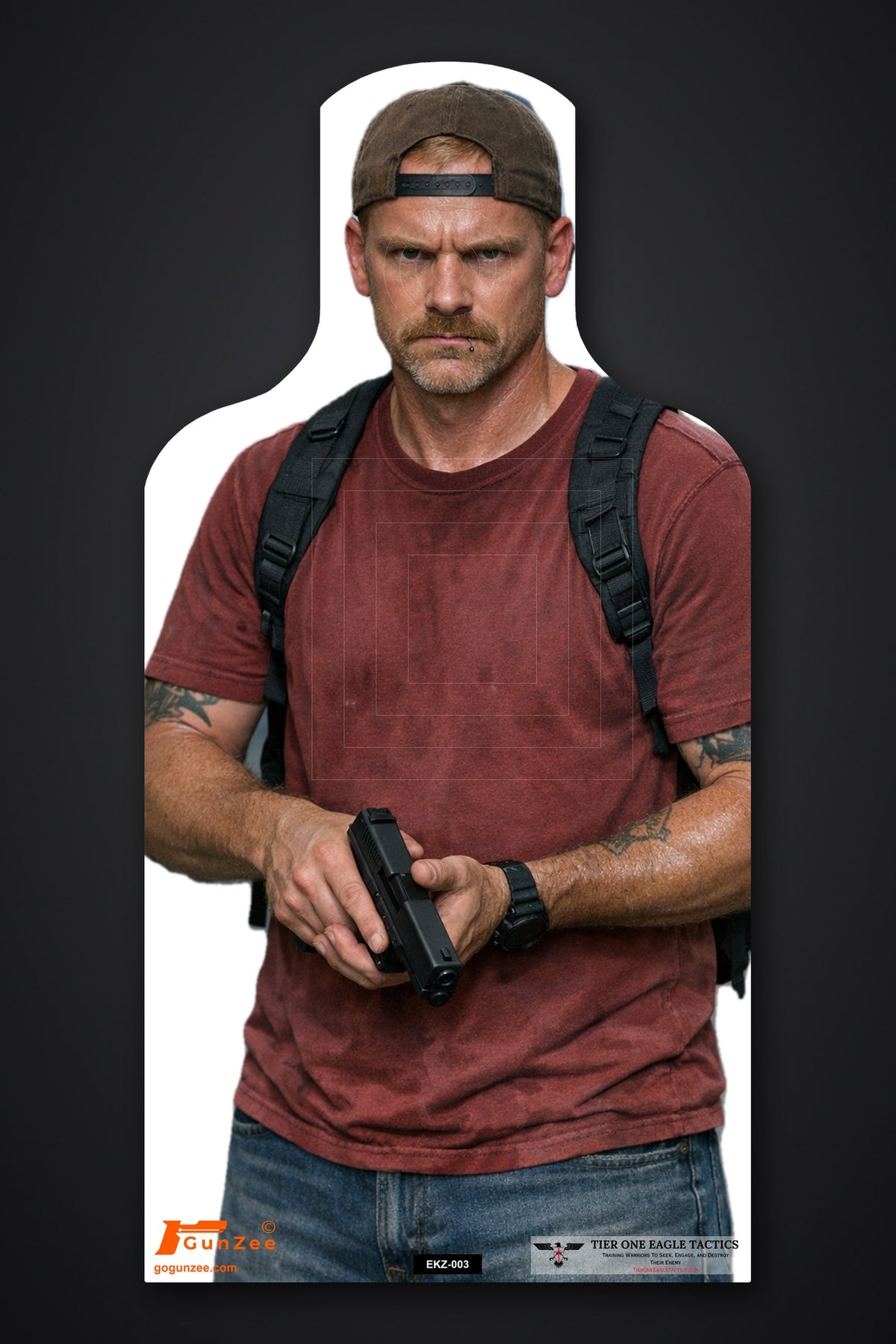
Armed Male Backpack Handgun Low Ready E-Backer Target [19" x 38"]
each · sold in 5s · mix any designs
Price drops automatically: 50+ $2.37 · 100+ $2.24 · 250+ $2.12 · Up to 25% off at 999+ · Volume quote →
$40 order minimum for your whole cart, not each design. Mix any targets.
Quantity must be in increments of 5
Armed Male Backpack Handgun Low Ready E-Backer Target
An armed subject with the pistol out but held low. It gives instructors a use-of-force problem and not only a marksmanship one: a weapon in hand that is not yet pointed at the officer.
What the Trainee Has to Work Out
The weapon is in his hands but not pointed at you. Depending on your rules of engagement and the scenario the instructor sets, this is a shoot, a challenge, or a hold. The shooter has to see the gun at waist level, not just check the face and chest.
Training Purpose
It trains the low scan. Many shooters look at the face and the upper chest and never see hands at the belt. It also opens the discussion of when a drawn but lowered weapon becomes a deadly threat. Hung among no-shoot and hostage targets, it is a threat the shooter has to recognize and stop.
Skills Reinforced
- Scanning the hands and waistband, not only the face
- Applying a use-of-force standard to a weapon at low ready
- Chest-to-head transitions
- Speed, with every round accounted for
- Threat identification on a realistic human figure
Kill Zones: 4-Inch Head Circle and 10-Inch Cardiac Box
Two kill zones are printed on this target. Both are placed on this figure's own anatomy, not at fixed spots on the paper, so they sit where the organs are.
- Head circle. A 4-inch circle placed through the eyes, centered on the bridge of the nose, with the upper lip at its bottom edge. It contains 3-inch, 2-inch and 1-inch rings. Use the 1-inch ring as the X-ring for ties and for confirming zero.
- Cardiac box. A 10-inch square on the upper chest, centered on the heart, with its top edge at the base of the neck just above the notch of the breastbone. Inside... ...
Armed Male Backpack Handgun Low Ready E-Backer Target
An armed subject with the pistol out but held low. It gives instructors a use-of-force problem and not only a marksmanship one: a weapon in hand that is not yet pointed at the officer.
What the Trainee Has to Work Out
The weapon is in his hands but not pointed at you. Depending on your rules of engagement and the scenario the instructor sets, this is a shoot, a challenge, or a hold. The shooter has to see the gun at waist level, not just check the face and chest.
Training Purpose
It trains the low scan. Many shooters look at the face and the upper chest and never see hands at the belt. It also opens the discussion of when a drawn but lowered weapon becomes a deadly threat. Hung among no-shoot and hostage targets, it is a threat the shooter has to recognize and stop.
Skills Reinforced
- Scanning the hands and waistband, not only the face
- Applying a use-of-force standard to a weapon at low ready
- Chest-to-head transitions
- Speed, with every round accounted for
- Threat identification on a realistic human figure
Kill Zones: 4-Inch Head Circle and 10-Inch Cardiac Box
Two kill zones are printed on this target. Both are placed on this figure's own anatomy, not at fixed spots on the paper, so they sit where the organs are.
- Head circle. A 4-inch circle placed through the eyes, centered on the bridge of the nose, with the upper lip at its bottom edge. It contains 3-inch, 2-inch and 1-inch rings. Use the 1-inch ring as the X-ring for ties and for confirming zero.
- Cardiac box. A 10-inch square on the upper chest, centered on the heart, with its top edge at the base of the neck just above the notch of the breastbone. Inside it are 8-inch, 6-inch and 4-inch squares. The 4-inch core lies directly over the heart.
- Faint by design. The lines are thin and printed in a light tone. You can see them when you walk up to score. From the firing line they disappear, so the shooter aims at a person and not at a shape.
The chest is completely clear on this figure, so all four concentric squares of the cardiac box are visible on the shirt when you walk up to score. Because the zones are nested, one target supports a basic standard and a strict one. Count the outer lines for qualification and the inner lines when you are training precision. The Range Manual explains how T-box, cardiac box and A/C scoring zones compare, and when to shift from the cardiac box to the head.
Cut to Fit the E-Type Backer
This target is die-cut to the E-type silhouette, the kneeling-figure outline that military and law enforcement ranges have used for decades. It measures 19" x 38" and is sized to sit on a standard E-type backer (19.5" x 40") with a small margin all around. It staples or glues straight onto the backers your range already owns. There is nothing to trim and no stand to change.
The figure is printed life-size. Heads, shoulders and hands are the size they are on a real person at that distance, so sight pictures and hold-offs carry over.
Instructor Notes
Brief the scenario first: armed subject who has ignored commands, or an unknown. Then run it both ways and compare what the shooters did. Mix it with the no-shoot and hostage designs so the shooter never knows what the next facing will be.
Who This Target Is For
Law enforcement firearms instructors, military police and range cadre who run courses of fire on E-type backers, academy staff building judgment into qualification, and private instructors who want realistic human figures on a silhouette stand.
Product Details
- Size: 19" x 38", die-cut to the E-type silhouette
- Fits: standard E-type backers (19.5" x 40")
- Figure: life-size
- Kill zones: 4-inch head circle with 3-, 2- and 1-inch rings; 10-inch cardiac box with 8-, 6- and 4-inch squares
- Paper: heavy, durable stock with a matte finish, so there is no glare under range lights
- Printed in full color on one side
- Price: $2.49 each. Volume pricing on quotes runs from 5% off at 50 targets to 25% off at 999. Request a quote
- SKU: EKZ-003
- Made in the USA
Related E-Backer Targets
A course of fire needs armed threats, no-shoots and hostage problems side by side. These five come from across the E-backer line:
- Armed Male Denim Jacket Handgun Aiming Forward E-Backer Target
- Armed Female Short Hair Handgun Aiming Forward E-Backer Target
- Armed Male Handgun With Optic Aiming Forward E-Backer Target
- Unarmed Female Holding Infant Hand Raised No-Shoot E-Backer Target
- Hostage Scenario Flat Cap Gunman Handgun To Victim Head E-Backer Target
See all 48 designs in the E-Type Silhouette Targets collection, or browse Scored Shooting Targets and Shoot / No-Shoot Decision Targets. For agency programs, see police qualification targets and courses of fire and silhouette targets from the B-27 to life-size figures.
The same decisions on a 24" x 36" scenario sheet: Storage Unit Armed Confrontation Shooting Target, Anatomical Rifle Threat Vital Zone Shooting Target and CQB Home Defense Hostage – Armed Aggressor Forward Presentation Shooting Target.