Every sworn officer in the country shoots a qualification course at least once a year, and every one of those courses names a target. Ask what a police qualification target actually is, though, and the answers scatter: a black B-27, a gray bottle, a tan silhouette with two boxes, a state sheet nobody outside that state has seen. This guide puts the common qualification targets side by side, lays out how the courses of fire that use them are built, walks through four real standards, and explains what a qualification score does and does not tell a department about its officers. The full dimension sheets for the two most-shot targets live in their own guides, the B-27 target guide and the FBI Q target guide; this article is the map that connects them.
What a police qualification target actually is
A qualification target is a measuring instrument. Its job is to produce a score that can be compared across every officer in an agency, every cycle, and defended later if the officer's shooting is ever questioned. That is why the target is prescribed rather than chosen: the state commission, the federal agency, or the department's own policy names the sheet, the distances, the round count, the time limits, and the passing percentage. Shoot the course on a different target and the score is not a qualification, whatever the hit percentage says.
Three things follow from that. The target has to be standardized, so it is printed to a fixed size with fixed scoring zones. It has to be fast to score, so the zones are simple: rings, boxes, or a single inside-or-outside line. And it has to be always a threat, because the course is measuring marksmanship under time, not judgment. Every qualification target on the list below is a human outline that never holds a phone, never turns out to be unarmed, and never has someone standing behind it. That is not a flaw in the targets. It is what they are for.
The qualification targets you will actually see
Most agencies qualify on one of a handful of sheets. Sizes below are the printed dimensions published by the NRA and the licensed target makers; where makers disagree, the table says so. Measure the silhouette rather than the paper if you are checking a print.
| Target | Size | How it scores | Where it turns up |
|---|---|---|---|
| B-27 | 24" × 45" official NRA sheet; wider 35" × 45" prints and the 22.5" × 35" B-27E economy version are common | Oval rings, X through 7, climbing toward center mass; 10-ring 100 × 150 mm (about 4" × 6"), X-ring 55 × 78 mm | The default police and concealed-carry silhouette for half a century; many state courses and countless agency policies |
| B-21 / B-21E | Full-size silhouette sheet | Zoned scoring by number (the 4 and 5 zones are the scoring area on Florida's standard) | Older than the B-27; still the named target in Florida's commission standard |
| FBI QIT-99 ("the Q") | 23" × 35" sheet, 26" bottle | One point inside the bottle, nothing outside | FBI agent qualification and the agencies and academies that adopted the Bureau's course |
| TQ-15, TQ-19, TQ-21 | Full-size police silhouettes; 23" × 35" is the common print, though sheet size varies by maker | Printed head and center-of-mass zones; the point values depend on the version and the agency overlay (Dallas, San Antonio and Arizona DPS each run their own) | "Training and qualification" silhouettes sold as official NRA police targets and adopted by departments nationwide |
| Texas DPS target | Full-size, green outer silhouette | Inner tan area about 238 square inches scores 2; the outer silhouette is a miss | Texas Highway Patrol; a good example of a modern state-specific sheet |
| IDPA / USPSA cardboard | 18" × 30" | IDPA: 8" -0 circle in the chest, 4" -0 circle in the head. USPSA: A-zone about 6" × 11" | Competition targets; some agencies allow them for in-service courses |
| Reduced-scale versions | Scaled to the lane | Same zones, shrunk so the target subtends the same angle at a shorter distance | Indoor ranges that cannot reach the course's longest line; Florida allows one for its 15-yard stage |
The pattern is worth noticing. The older sheets reward proximity to the center with graduated rings. The newer ones, the Q and the Texas DPS target especially, throw the rings away and ask a single question per round: was it inside the area that matters, yes or no. That is the direction qualification has moved for twenty years, and it is a move toward anatomy, even if the anatomy is still drawn as a box.
How a qualification course of fire is built
Whoever writes the standard is assembling the same handful of parts. Knowing the parts makes any course readable at a glance.
- Distance distribution. Most courses put the bulk of the rounds inside seven yards, where officer-involved shootings actually happen, and reserve a small block for 15 or 25 yards to prove the fundamentals still hold at distance. Texas, for instance, requires at least 20 of the minimum 50 rounds at or beyond seven yards.
- Time limits. Every string carries a par time, and the times are the real difficulty. Two rounds in one second at three yards, as Florida requires, is a presentation test; six rounds in thirty seconds at fifteen yards is a marksmanship test.
- Starting position. From the holster, from a ready position, or from concealment. The FBI draws from concealment on every string. Florida specifies the hip position for its closest stage and a two-hand high point from the holster for the rest.
- Positions and hands. Standing, kneeling, and barricade blocks; strong-hand-only and support-hand-only strings. The FBI course fires its first twelve rounds one-handed.
- The reload. Nearly every standard mandates at least one timed reload, because a course without one never finds out whether the officer can get the gun back into the fight.
- Low light. A growing number of states require a separate night or reduced-light qualification. North Carolina requires officers to qualify for both day and low-light use with each service handgun, every calendar year.
- The passing line. Somewhere between 70 and 90 percent of rounds in the scoring area, with instructors held to the higher figure.
Four standards, side by side
Standards change, and agencies layer their own policy on top of the state minimum, so treat this table as a snapshot of the published rules and confirm the current version with your commission before building a range day around it.
| Standard | Target | Rounds | Distances | Pass | Notes |
|---|---|---|---|---|---|
| FBI pistol qualification (2013 revision) | QIT-99 / QIT-03 | 60 | 3 to 25 yards | 48 of 60 (80%); 54 for instructors | Every string from concealment; 40 of 60 rounds inside 7 yards; barricade and kneeling at 25. Stage table in the FBI Q guide. |
| Texas TCOLE annual proficiency | Agency's choice | 50 minimum | Point blank to 15 yards | 70% | At least 20 rounds at or beyond 7 yards and at least one timed reload; required at least once every 12 months. |
| Florida CJSTC firearms qualification standard | B-21E or equivalent | 40 | 1 to 15 yards | 32 of 40 (80%) | Six stages, all two-hand high point after the first; 12-round string with mandatory reload at 7 yards. Detail below. |
| North Carolina annual in-service (12 NCAC 09E) | Per the Justice Academy manual | Per the manual | Per the manual | 70% per weapon | Day and low-light qualification with each approved service handgun, every calendar year, within three attempts in a single day. |
The Texas DPS trooper course is worth a footnote because it shows where state standards are heading: 50 rounds from 15 yards in to 3, an 18-round block at seven yards fired in ambient light only, and a passing score of 80 percent for recruits and 90 for instructors, all on a target where anything outside the inner area is simply a miss.
Florida's course, stage by stage
Florida publishes its course on the commission's qualification form, which makes it a clean example of how the parts above fit together. Forty rounds, a single B-21E target, and the 4 and 5 zones as the scoring area.
| Stage | Distance | Position | String | Rounds |
|---|---|---|---|---|
| 1 | 1 to 3 yards | Hip position from the holster | 2 rounds in 4 seconds, twice | 4 |
| 2 | 3 yards | Two-hand high point from ready gun | 2 rounds in 1 second, three times | 6 |
| 3 | 7 yards | Two-hand high point from holster, then ready | 2 rounds in 4 seconds from the holster; 2 rounds in 4 seconds from ready, twice | 6 |
| 4 | 7 yards | Two-hand high point from holster | 3 rounds in 5 seconds, twice | 6 |
| 5 | 7 yards | Two-hand high point from holster | 12 rounds in 45 seconds with a mandatory reload | 12 |
| 6 | 15 yards | Two-hand high point from holster | 6 rounds in 30 seconds | 6 |
Thirty-four of the forty rounds are fired at seven yards or closer. The 15-yard stage is the only one that may be shot on a reduced-size target at ten yards when a range cannot reach the full distance. An officer who fails cannot work as a sworn officer until the standard is met, which is the sentence that gives every line above its weight.
Scoring: rings, zones, and the yes-or-no line
Three scoring systems cover every target in this article. Graduated rings, as on the B-27, give partial credit for proximity: a 7-ring hit still counts toward the percentage. Zoned scoring, as on the TQ series and the B-21E, gives full value for the head and center-of-mass boxes and reduced or zero value for the rest of the outline. Hit-or-miss scoring, as on the Q and the Texas DPS sheet, draws one line and counts nothing outside it.
The choice matters because it decides what the officer's eye learns to reward. Rings reward the center of the paper. The center of a B-27's rings sits low on the torso relative to the heart and the great vessels, and an officer who trains on rings alone builds a reference picture aimed at the ring, not at the anatomy that stops a threat. The shooting target kill zones guide lays the cardiac box and the cranial T-box over the common silhouettes and shows how far they drift. The narrower scoring areas on the newer sheets are an attempt to close that gap, and the Texas DPS target goes so far as to print a 3" × 2" eye box and a 4" × 3" heart box for reference, even though they are not scored.
What a qualification score does not measure
A passed qualification says one thing: on that day, under those times, the officer put enough rounds into a defined area of a target that was always a threat. It says nothing about whether the officer can tell a phone from a pistol at seven yards, hold fire on a subject who turns out to be compliant, or place a round on a body that is turned, seated, or partly behind a door. Those are the skills that decide incidents and lawsuits, and no commission course tests them, because a qualification target cannot present them. The law enforcement training targets guide lays out the full qualification-to-decision progression an annual calendar needs; the short version is that qualification is the floor of a firearms program, not its ceiling.

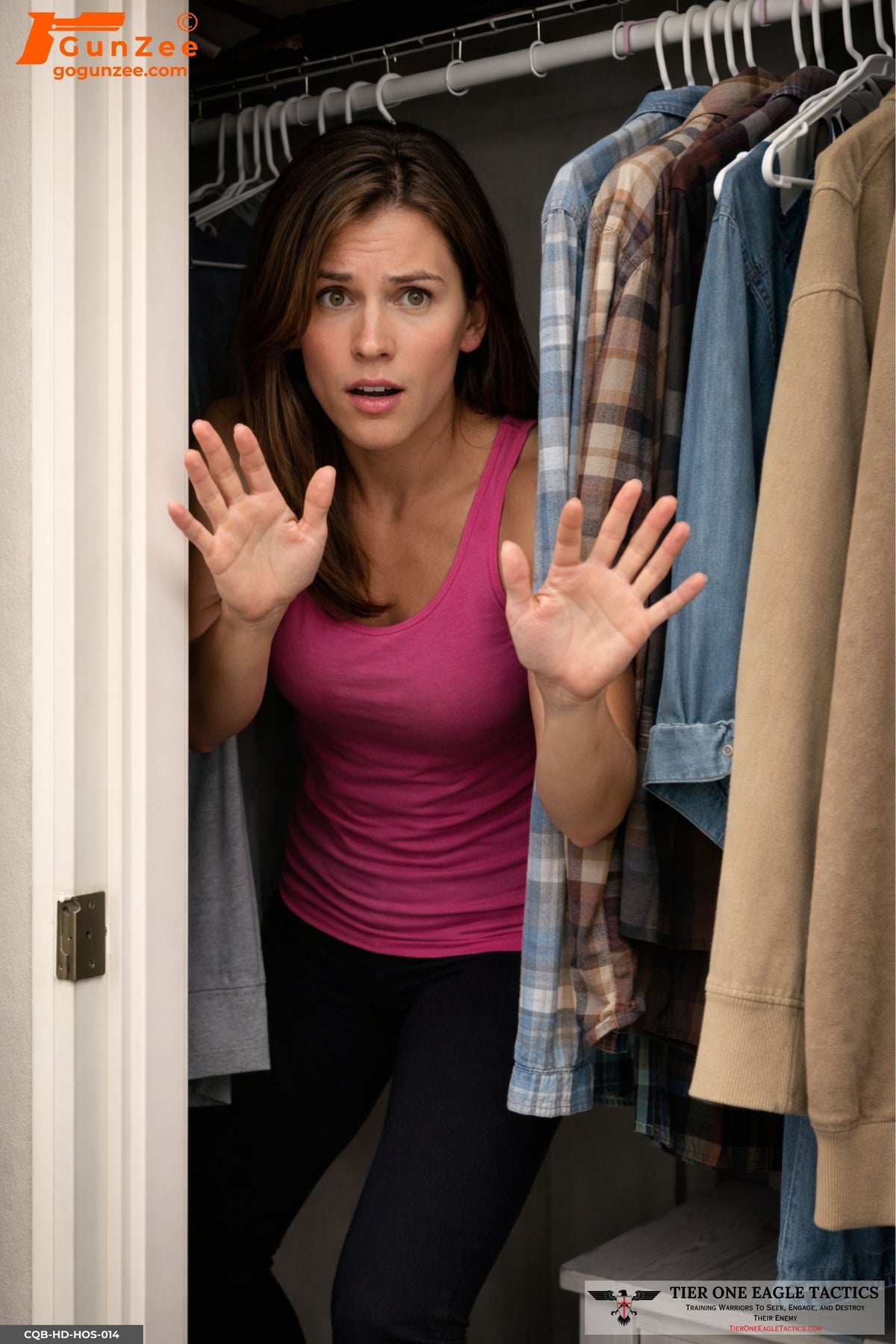
The target above is the kind of sheet a qualification course can never include: a person with both hands up and nothing in them. Put it in the rotation after the qual and the scoring changes from "did the round land in the zone" to "should the round have been fired at all," which is the question the record will eventually ask.
Running the qualification course on a person
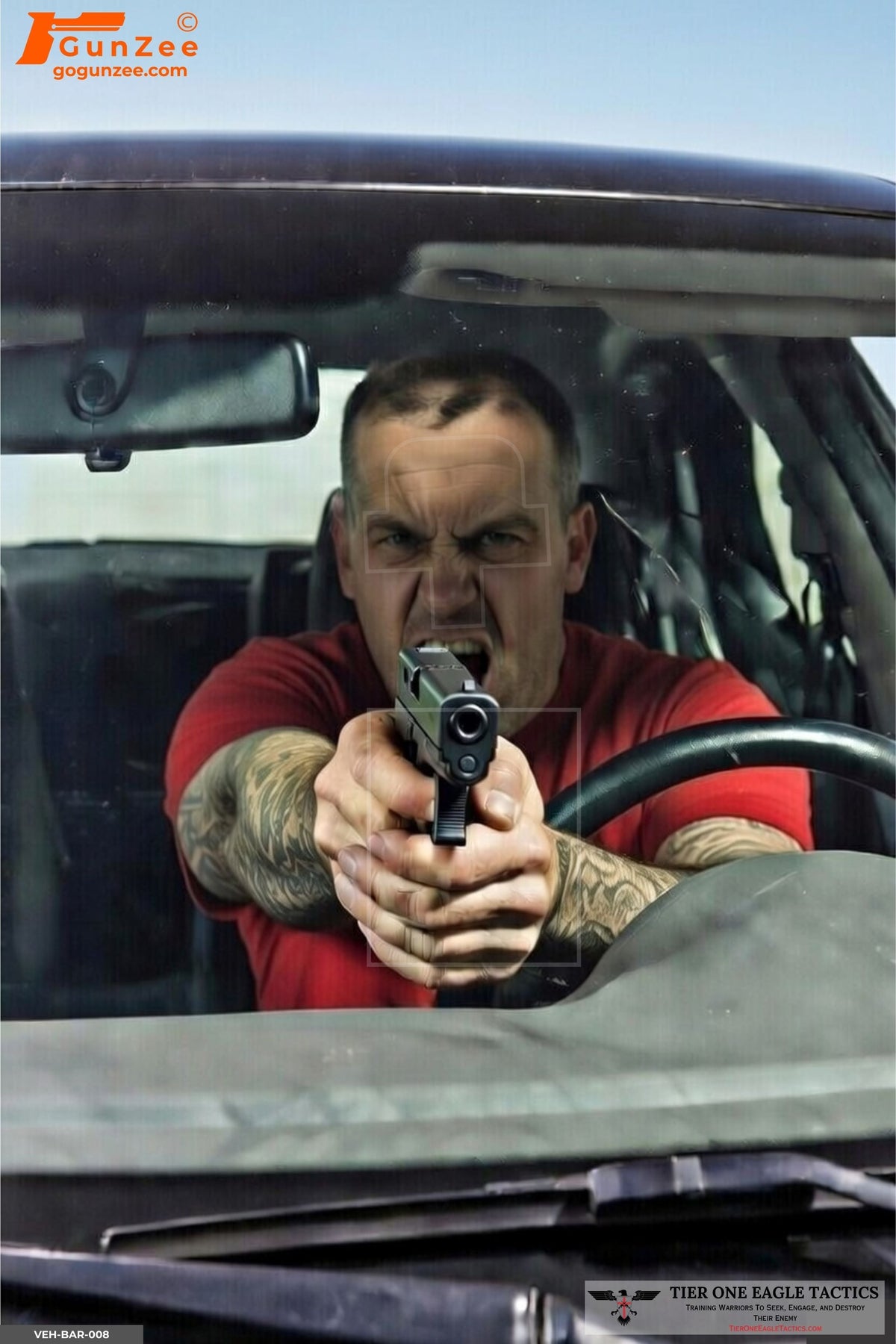
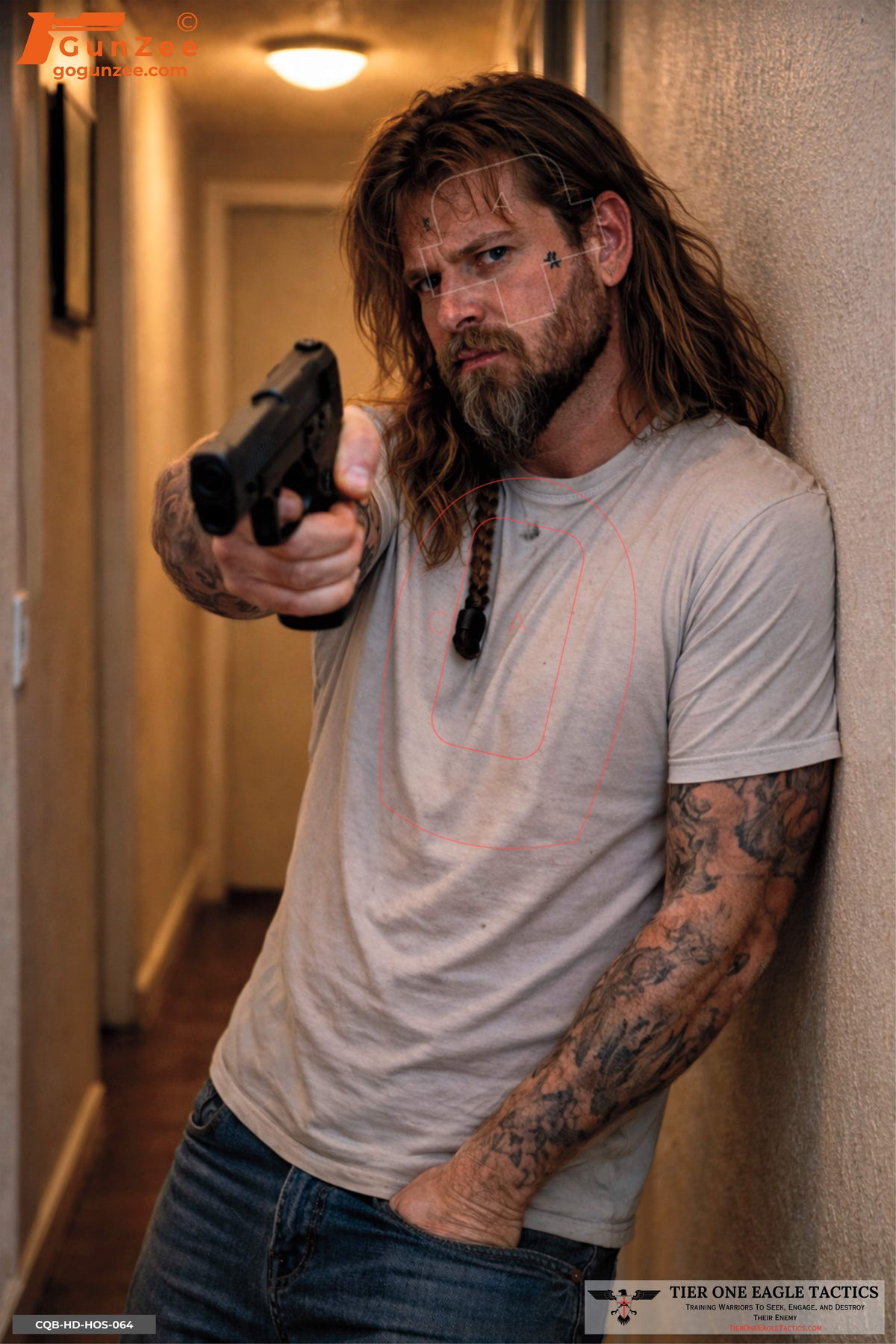
The most useful thing a rangemaster can do with a qualification course is run it twice. First on the mandated target, scored exactly as the standard says, so the record is clean. Then again, same distances, same times, same reload, on a life-size scenario target with anatomical scoring, so the officer finds out where those same rounds land on a body. The drift is usually visible on the first string: a group that scored ten-ring on the B-27 sits at the bottom of the cardiac box, or below it, on a figure drawn to scale.
That second run is what the law enforcement training targets collection is built for. Every design is a 24" × 36" scene with a real person in a place an officer works, and every one carries a cardiac box and a T-box sized to that presentation rather than to a standing outline. For a department-scale program, the Academy 920 pack and the Agency Core 460 rotation are assembled to carry an in-service calendar through a year of post-qualification blocks; the government ordering page covers quotes and tax-exempt accounts for agencies and academies.
A simple rotation that survives review: qualify on the state sheet; re-shoot the course on an anatomical target and record the placement; then run the same round count on shoot / no-shoot scenario targets and record the decisions. Three scores, three skills, one range day.
Reference: every sheet size and scoring zone on this page, plus IDPA, USPSA, B-8, Texas DPS and USALE, is in the printable shooting target dimensions chart.
Frequently asked questions
What target do police officers use to qualify?
Whatever the agency's state commission or department policy names. The B-27 silhouette is the most common, followed by the FBI QIT-99 bottle, the TQ-15 / TQ-19 / TQ-21 police silhouettes, and state-specific sheets such as Florida's B-21E or the Texas DPS target. The target is part of the standard; substituting another invalidates the score.
How many rounds is a police qualification?
Between 40 and 60 for the standards in this guide. Florida's commission course is 40 rounds, Texas requires a minimum of 50, and the FBI course is 60. Agencies often shoot more than the state minimum.
What is a passing score on a police qualification?
Seventy to ninety percent of rounds in the scoring area, depending on the standard. Texas and North Carolina set 70 percent, Florida and the FBI set 80, and instructors are commonly held to 90.
What is the difference between a qualification target and a training target?
A qualification target is a standardized measuring sheet, always a threat, scored by ring or zone so every officer's result is comparable. A training target can be anything that teaches a skill the qualification cannot measure: an anatomical target for placement, or a scenario target for the shoot / no-shoot decision.
Can scenario targets be used for qualification?
Not in place of the mandated target. A qualification shot on a scenario target is not a qualification. Scenario and anatomical targets belong in the training blocks that surround the qual, where they cover the placement and judgment layers the standard leaves out.
The bottom line
Police qualification targets are measuring tools, and the good ones are getting more honest: fewer rings, tighter scoring areas, and boxes that are starting to look like anatomy. Learn which sheet your standard names, shoot the course as written so the record holds, and then shoot it again on a target that looks like the problem the record is really about.
Related reading
FBI Q Target (QIT-99): Dimensions, Scoring & the Qualification Course · B-27 Target: Dimensions, Scoring Rings, and Qualification Standards · Law Enforcement Training Targets: From Qualification to Decision Training · Silhouette Shooting Targets: From B-27 to Life-Size Scenario Realism · Shooting Target Kill Zones: T-Box, Cardiac Box, A/C Zones Explained · Browse: Law Enforcement Training Targets