The silhouette is the most-shot target in America. Every indoor range rents them by the stack, every qualification course prescribes one, and for most shooters the black B-27 torso is simply what a "target" looks like. This guide takes the silhouette seriously: what it was designed to do, what it genuinely trains well, where it quietly falls short of the job most defensive shooters are actually training for — and how to upgrade from outline to realism without abandoning the range habits you already have.
What a silhouette target actually is
The classic silhouettes — the B-27 and its state variants, the B-21, the FBI "Q" bottle, the TQ series — were built for one purpose: standardized measurement. Same shape, same scoring rings, same distances, same par times, for every shooter on every lane. That standardization is why qualification courses use them and why they will not be leaving ranges any time soon. When a course of fire needs to produce a comparable score — police qualification, CCW certification, a league match — the silhouette is the honest tool for the job.
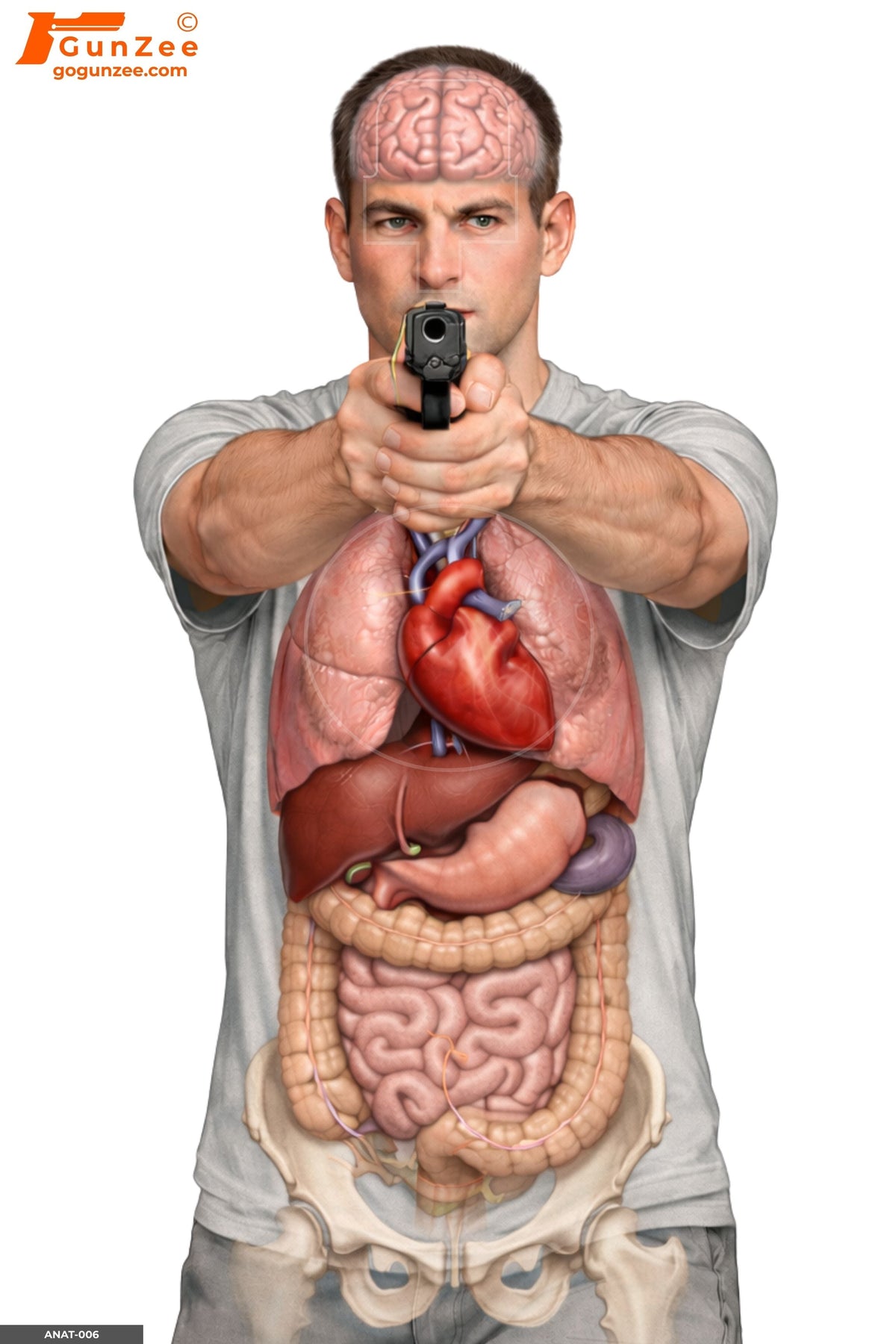
Agencies that train the decision after qualification use life-size law enforcement training targets with photo-realistic people instead of outlines.
Silhouettes also do real work for fundamentals. A high-contrast torso at 15 yards gives clean feedback on grip, trigger press, and group size. For a new shooter learning to keep rounds inside a torso-sized zone at defensive distances, the silhouette is a perfectly good first teacher.
The problems start when the silhouette becomes the only teacher.
The silhouette family: what's actually hanging at the range
"Silhouette" covers a family of targets, and knowing which one is on the stand tells you what the course of fire is measuring:
B-27. The classic black police silhouette — a torso-and-head outline with concentric scoring rings (7 through 10 plus the X-ring) climbing toward center mass. It has anchored police and CCW qualification for over half a century, which is exactly why its ring placement has shaped so many shooters' habits. Full dimensions, ring measurements, and qualification scoring are in our B-27 target guide.
B-21 and state POST variants. Older and state-specific silhouettes — the B-21's zoned scoring predates the B-27, and targets like the TQ-15 and TQ-19 carry individual state qualification standards. Same concept: a standardized human outline with printed scoring zones.
The FBI "Q" target. A bottle-shaped outline with no rings at all — hits inside the bottle count, hits outside don't. It trades granular scoring for speed of assessment, and it is even more abstract than the B-27: not even a head to distinguish.
Competition cardboard. USPSA and IDPA targets are silhouettes scored by zone for a balance of speed and accuracy. Superb for measuring raw gun-handling under time pressure — and subject to every limitation below, by design: competition deliberately removes the decision so the clock can do the ranking.
Steel silhouettes. Instant audible feedback and genuine durability, at the cost of any placement detail at all: a hit is a hit, whether it clipped a shoulder or centered the chest.
Every one of these is a standardization tool. None of them is a person. That distinction is the rest of this guide.
Silhouette target size and dimensions
The most common question about silhouettes is a practical one: how big are they? The answer depends on which sheet is on the stand, and the differences matter, because a course of fire built for one size does not transfer cleanly to another. Measure the silhouette, not the paper: sheet trim varies by printer, and reduced-scale versions are sold for short indoor lanes.
| Target | Sheet size | Silhouette and scoring detail |
|---|---|---|
| B-27 | 24" × 45" official NRA sheet; 35" × 45" wide prints and the 22.5" × 35" B-27E economy version are common | Rings are ovals: 10-ring 100 × 150 mm (about 4" × 6"), X-ring 55 × 78 mm (about 2.2" × 3.1"), 7-ring 400 × 600 mm (about 15.7" × 23.6"). Full table in the B-27 target guide. |
| FBI QIT-99 ("Q") | 23" × 35" | 26" bottle, 12" body width, 6" head cap; 3" × 3" head box and 4" × 6.5" chest box. Full diagram in the FBI Q target guide. |
| TQ-19 (NRA police silhouette) | 23" × 35" common print; sheet size varies by maker | Full-size silhouette with printed head and center-of-mass zones; point values depend on the version and agency overlay. |
| IDPA official | 18" × 30" cardboard | 8" -0 circle high in the chest; 4" -0 circle inside a 6" head box; -1 and -3 zones outside. |
| USPSA metric | About 18" × 30" cardboard | Lower A-zone about 6" × 11", with a smaller upper A-zone in the head; C and D zones outside. |
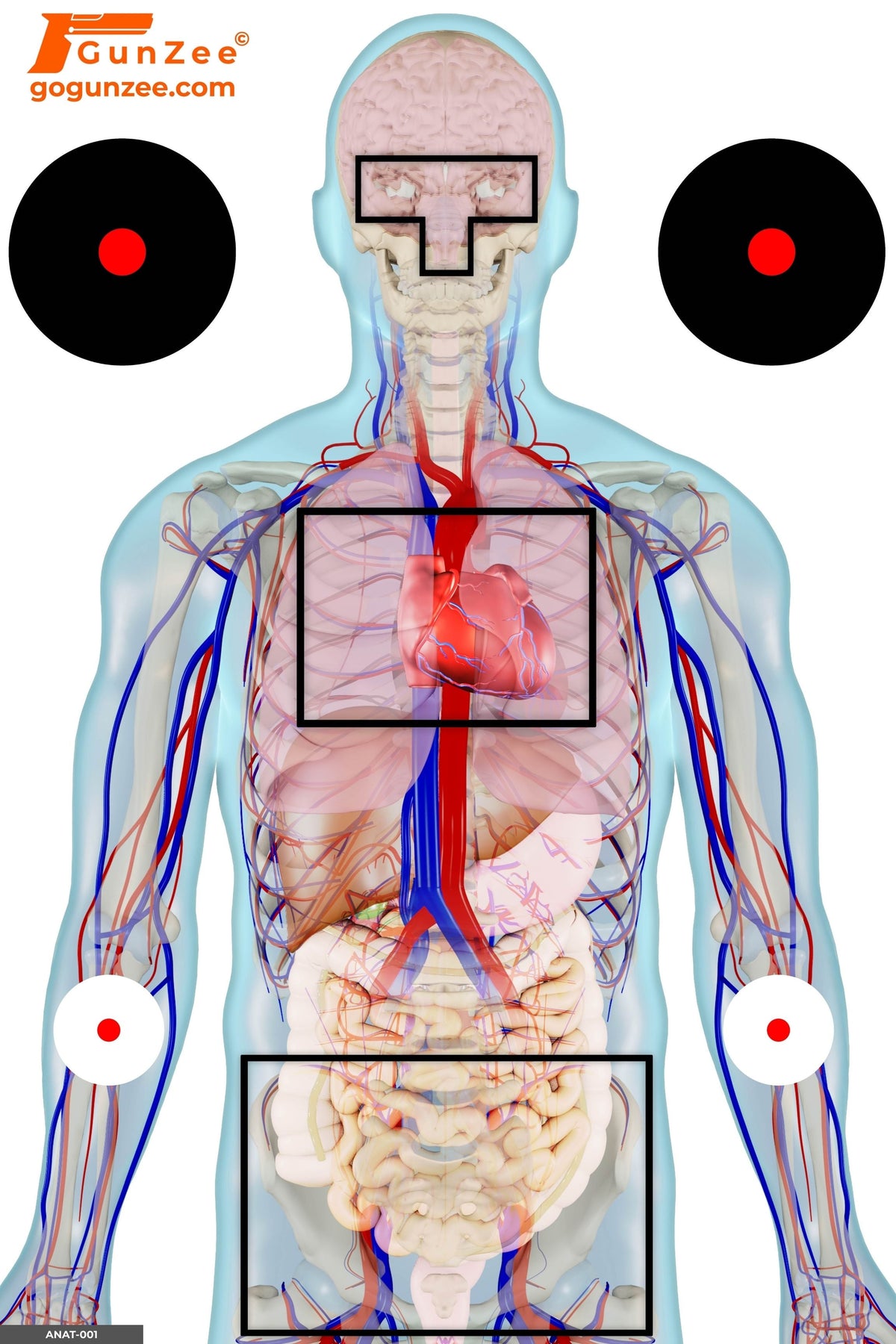
| GunZee scenario and anatomical | 24" × 36" | Life-size figure; the cardiac box and cranial T-box are drawn where they sit on a real adult, not where a ring lands. |
Two things stand out in that table. First, none of the qualification sheets are the same size as each other, so "silhouette distance" is only meaningful when the target is named. Second, every one of them is smaller than a person. A standing adult presents roughly 18 to 20 inches across the shoulders and about 30 to 36 inches from crown to belt, which is why a life-size training print runs 24" × 36": the sheet has to hold the whole torso, the head, and the hands, at the size they will actually appear at seven yards.
Three things a flat silhouette cannot teach
1. Where hits actually matter
The B-27's highest-scoring ring sits noticeably low of the anatomy that actually stops a threat. Score a course on rings long enough and your reference picture rewards the ring, not the outcome. Shooters who train exclusively on scoring zones routinely build a low center-of-mass habit that an anatomically honest target would have corrected years earlier.

The fix is not to throw the silhouette away — it is to alternate it with targets that show the cardiac area and cranial T-box where they actually sit. The full methodology is covered in Human Anatomy Shooting Targets: A Complete Training Guide, and the direct comparison with ring-scored training lives in Anatomical Targets vs. Bullseye.
2. What a threat looks like
A silhouette is always a threat. It has no hands, no face, no context — its presence on the stand is the instruction to fire. That means a shooter can log thousands of silhouette repetitions without once practicing the skill that defines every real defensive encounter: reading a human being. Is there a weapon? Which hand? Is that object a pistol or a phone? A featureless black torso cannot ask any of those questions.
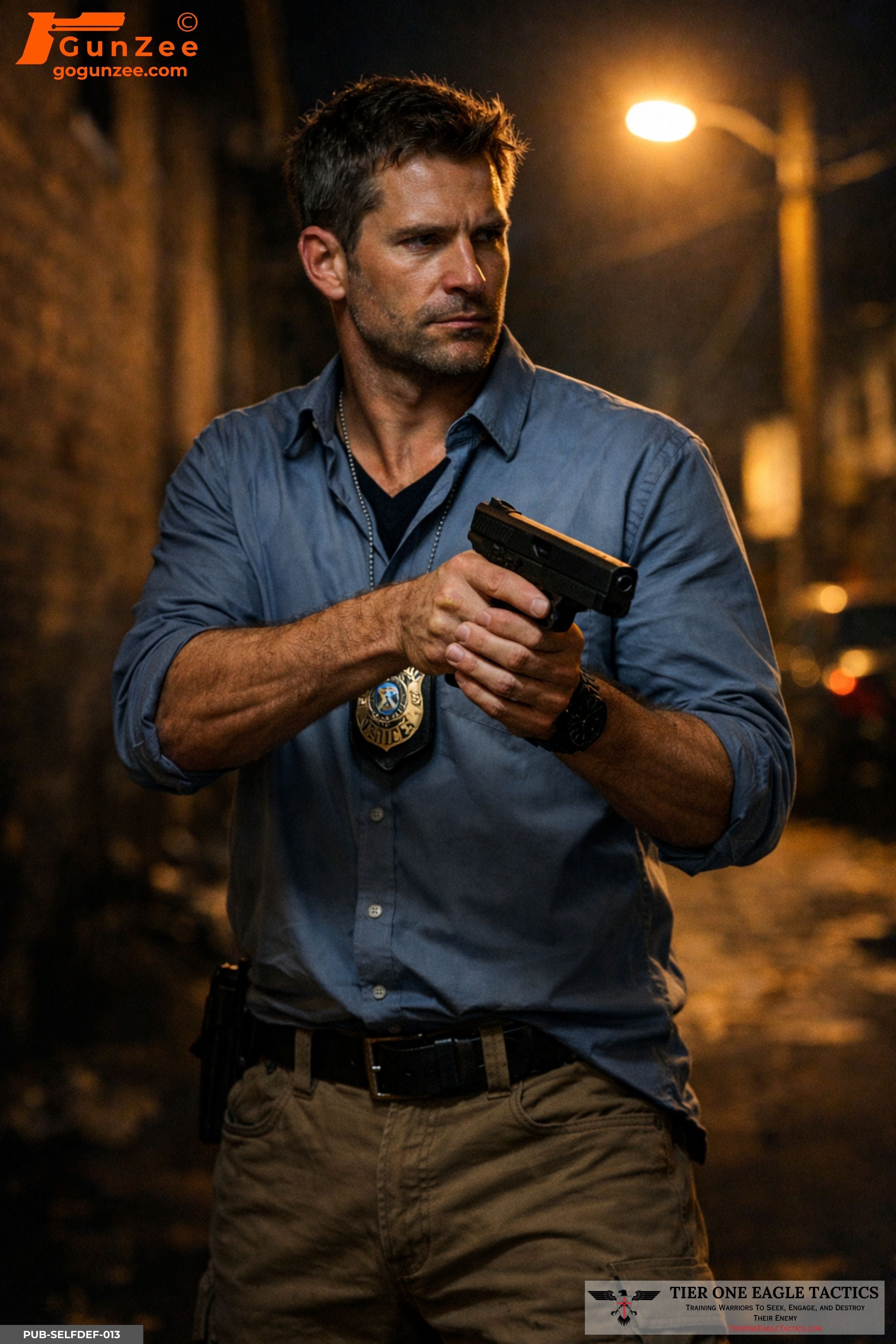
Life-size scenario targets ask them on every repetition. A lifelike printed scene presents a specific person, in a specific posture, holding a specific object, in a specific environment — and your eyes have to do the work they would do in the real event:

For rifle-armed threat presentations, the Anatomical Rifle Threat runs the same bridge at longer engagement profiles.
3. Whether to shoot at all
The highest-stakes skill in defensive shooting is the decision — and the silhouette, by design, removes it. Scenario libraries restore it: some targets depict armed aggressors, others depict unarmed subjects, phones in hand, or bystanders, hung in randomized order so the shooter must decide fire, challenge, or hold before the first press. That drill structure is its own discipline, covered in Shoot / No-Shoot Decision Drills: Building Judgment Under Stress, with the drill-ready library in the shoot / no-shoot collection.
The upgrade path, in the order that works
Nobody needs to abandon the silhouette overnight. The progression that works on a normal range trip looks like this:
Step 1 — keep the silhouette for what it is good at. Warm-ups, qualification prep, and raw group work. If your state course prescribes a B-27, keep shooting the B-27 for score.
Step 2 — correct the anatomy. Run your placement blocks on anatomical targets so your default aim point tracks real incapacitation anatomy instead of a scoring ring. Life-size matters here: a 24" x 36" print presents a torso at true scale, so distance and sight picture translate directly.
Step 3 — add the scene. Finish sessions with scenario targets that put a decision in front of the shot. Start with unambiguous armed threats, then mix in no-shoot presentations:


For home-defense and room-distance work specifically, the Home Defense, CQB & Hostage collection puts the threat in hallways, doorways, and living rooms — the geometry a silhouette stand cannot represent. A full survey of the categories beyond silhouettes — anatomical, scenario, hostage, vehicle, steel and more — is in Types of Shooting Targets: The Defensive Shooter's Guide.
Three drills that expose the gap
The difference between outline and realism is not theoretical — it shows up on the first range trip. Run these back to back:
1. Same drill, two targets. Shoot a six-round string from the draw at 7 yards on a B-27, scoring by ring. Repeat the identical string on an anatomical target, scoring only hits inside the cardiac zone. Most shooters watch a "clean" silhouette score drop sharply — the rings were rewarding hits that real anatomy does not. That delta is the low center-of-mass habit, measured.
2. The failure drill, honestly scored. Two to the body, one to the head. On a silhouette, the head is a featureless blob and any hit "counts." On an anatomical print, the head shot has an actual destination — the cranial T-box — and the drill either delivered it or it didn't. Same trigger presses, entirely different standard.
The cardiac box and T-box guide covers when that head shot is the right call.
3. The mixed hang. Hang three or four scenario targets — some armed, some holding phones or wallets — faced away or covered, and have a partner call the turn. The shooter must identify before deciding, and decide before pressing. No silhouette course of fire can replicate the half-second where the eyes do the work. Training packs bundle scenario sets at volume pricing precisely for this kind of rotation, so no scene gets memorized.
Buying silhouette-class targets: the practical checklist
Size. Life-size means roughly 24" x 36" for a torso-and-head presentation. Smaller prints shrink the anatomy and quietly inflate your confidence at distance.
Material. Paper is the right default for high-volume training — it is the cheapest per repetition and shows clean hits. Heavier stock earns its keep in wind or on repeat hangs; the full breakdown is in the Target Paper Guide.
Finish. A professional matte finish reads clean under indoor range lighting — no glare washing out the scene at an angle, and bullet holes stay crisply visible for scoring and photos.
Cost per repetition. Scenario realism does not carry a premium anymore: life-size scenario prints run $1.95 each with volume pricing on training packs — the same money a range charges for a commodity silhouette rental. The full catalog lives at the paper shooting targets collection, with anatomical options in the anatomical target collection.
Reference: every sheet size and scoring zone on this page, plus IDPA, USPSA, B-8, Texas DPS and USALE, is in the printable shooting target dimensions chart.
Frequently asked questions
Are B-27 silhouette targets good for self-defense training?
B-27 silhouettes are good for standardized scoring, qualification prep, and basic group work. They are not sufficient for defensive readiness on their own: the highest-scoring ring sits low of true incapacitation anatomy, and a featureless outline cannot train threat identification or the decision to fire. Alternate silhouette work with life-size anatomical and scenario targets.
What size is a human silhouette target?
A life-size torso-and-head presentation is roughly 24" × 36", the size of GunZee scenario and anatomical prints, because an adult runs about 18 to 20 inches across the shoulders and 30 to 36 inches from crown to belt. The common qualification silhouettes are smaller: the official B-27 is a 24" × 45" sheet with a 4" × 6" ten-ring, the FBI Q is a 26" bottle on a 23" × 35" sheet, and IDPA cardboard is 18" × 30". Smaller prints shrink the anatomy, which quietly inflates apparent accuracy at distance because the aiming problem is easier than a real presentation would be. The full size table is in the dimensions section above.
What is the difference between silhouette targets and anatomical targets?
A silhouette scores rings on a generic outline; an anatomical target shows the cardiovascular and central-nervous-system zones where hits actually stop a threat. Training placement against real anatomy corrects the low center-of-mass habit that ring scoring builds, and translates directly to scenario targets that depict lifelike armed threats.
Can I still qualify with scenario targets?
Qualification courses prescribe their own target — usually a B-27 variant or state equivalent — so qualify on the mandated target. The practical program is layered: qualification on the prescribed silhouette, skills blocks on anatomical targets, and judgment blocks on shoot / no-shoot scenario targets.
The bottom line
The silhouette earned its place: it standardized scoring, and it still runs every qualification line in the country. Keep it for the job it was built for. But if the goal is defensive readiness rather than a score sheet, the outline is the beginning of training, not the end of it — because the real event will not be a black shape that announces itself. It will be a person, in a place, doing something ambiguous, and the training that prepares you for that has a face, a scene, and a decision printed on it.
Related reading
- Anatomical Shooting Targets: Train Vital Zones, Not Scoring Rings
- Hostage Scenarios: The Decision-Making Drills Most Shooters Skip
- Self-Defense Shooting Targets: Train the Decision, Not Just the Shot
- Shooting Targets: Comprehensive Guide for Professionals
- Tactical Shooting Targets: What Counts, What Doesn’t, and How to Choose
- Carjacking Shooting Target — Buyer’s Guide
- CQB Targets — Buyer’s Guide
- Gun Targets: The Buyer’s Guide for Serious Training
- Browse: Hostage Shooting Targets
- From Qualification to Decision Training: How Agencies Build a Target Program
- Browse: Public & Everyday Self-Defense targets
- Browse: Vehicle & Barrier targets