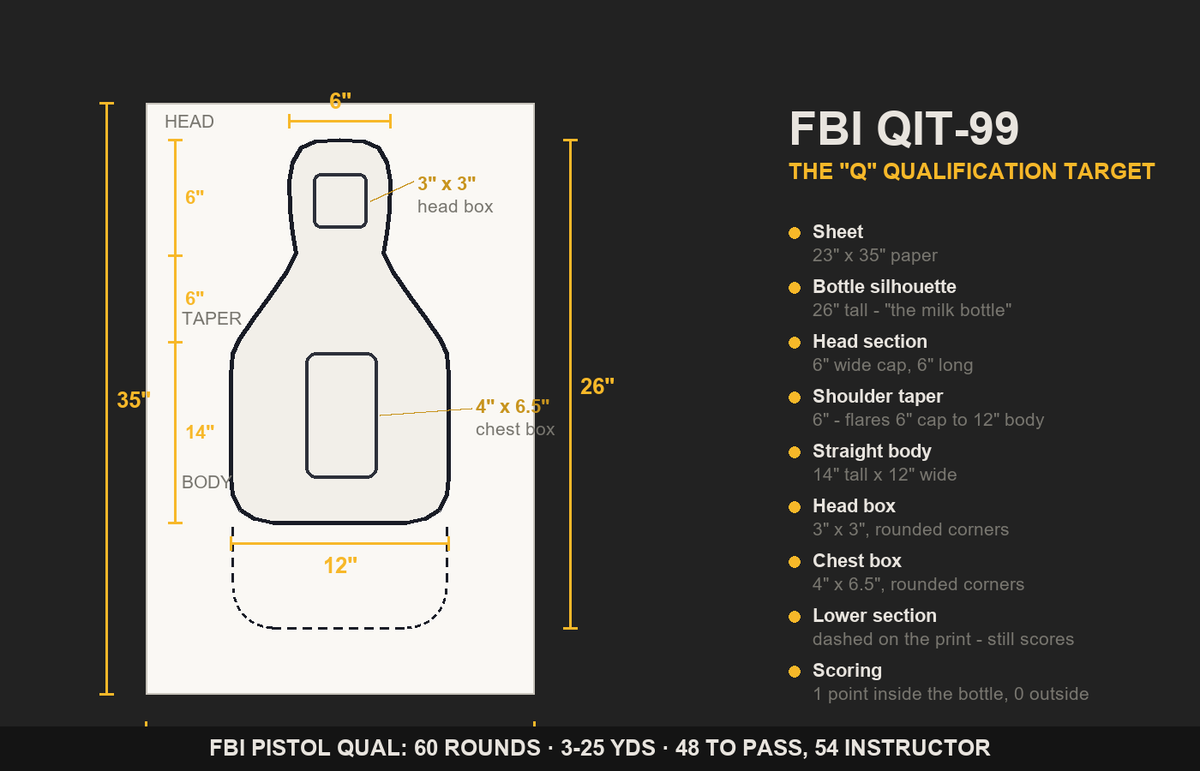

Every printed zone on a serious training target is a claim about human physiology. The T-box, the cardiac box, the A and C zones, the pelvic girdle — none of them started as graphic design. They came out of trauma bays, an Army wound-ballistics laboratory, an FBI report written in the aftermath of a disastrous gunfight, and half a century of competition scoring. This is the reference guide to all of them: what each zone covers, what sits behind it anatomically, why it stops a threat, and where the definitions actually came from. For the tactical question — when to aim at which — the cardiac-box-vs-T-box engagement guide is the companion piece; this article is about what the zones are.
Why zones exist at all: the science of stopping a threat
Modern zone doctrine rests heavily on the work of Dr. Martin L. Fackler (1933–2015), a combat trauma surgeon who treated gunshot wounds at the Naval Support Hospital in Da Nang during Vietnam and went on, as a U.S. Army colonel, to found the Wound Ballistics Laboratory at the Letterman Army Institute of Research at the Presidio of San Francisco, which he led from 1981 to 1991. Fackler standardized 10% ordnance gelatin as the validated tissue simulant, introduced the wound-profile method for documenting what a projectile actually does inside tissue, and spent a career dismantling folklore — showing that "energy dump" and dramatic temporary stretch cavities wound far less than shooters assumed at handgun velocities, and that what reliably matters is the tissue a bullet directly crushes and cuts, and which structures that path passes through. His work shaped NATO's emergency war surgery guidance and, through the International Wound Ballistics Association he founded, the entire modern literature.
The practical translation arrived in 1989. After the FBI's April 1986 Miami firefight — in which agents landed hits that were ultimately fatal but not immediately stopping — Special Agent Urey W. Patrick of the FBI Firearms Training Unit published Handgun Wounding Factors and Effectiveness, a report built directly on the wound-ballistics research of the Fackler era. Its central findings remain the foundation of every vital-zone diagram printed since:
- A projectile incapacitates through exactly two reliable mechanisms: destruction of central nervous system tissue, or blood loss sufficient to collapse blood pressure and starve the brain of oxygen.
- Of the two, only a central nervous system hit stops a determined attacker instantly. Even with the heart destroyed, enough oxygen remains in the brain to fuel voluntary action for roughly 10 to 15 seconds.
- Psychological stops — an attacker quitting because they were shot, not because they could no longer continue — are common but utterly unreliable, and no training doctrine can be built on them.
- Therefore shot placement is paramount: the round must be put through anatomy that bleeds fast or switches the nervous system off.
Law-enforcement trainers later compressed this into a shorthand popularized by emergency physician Dr. James Williams' Tactical Anatomy coursework: the body has timers (structures that stop a fight in seconds-to-minutes through blood loss) and switches (structures that stop it now). Every zone below is one or the other — and knowing which is which is the entire point of training on scored paper.
The cardiac box: a trauma-surgery term that became an aim point
The phrase "cardiac box" was borrowed from the people who repair these wounds, not the people who make them. In penetrating-trauma surgery, the cardiac box is the region of the anterior chest bounded by the sternal notch above, the xiphoid process below, and the nipple lines laterally — and a stab or gunshot wound inside those borders is presumed to involve the heart until proven otherwise. Emergency medicine drew the box because of what sits behind it: the heart, the aortic arch, the great vessels, and the pulmonary vessels, packed into a space not much larger than the heart itself.
Defensive shooting doctrine adopted the same real estate for the same reason, from the opposite direction. A round placed through the high-center chest transects the structures with the highest blood flow per second in the body. The result is the fastest available timer: hemorrhage massive enough to drop blood pressure and, with it, consciousness. What the cardiac box is not — and the FBI report is blunt about this — is a switch. The 10-to-15-second window of voluntary action after even a destroyed heart is why doctrine says a threat is engaged until it stops, not until it is hit, and why the box is trained as a repeatable placement standard under stress rather than a single winning shot.
On target paper, the cardiac box appears as a single scoring box printed high-center-left over the heart and great vessels. On GunZee's first-generation scored targets it is exactly that — one cardiac A-box over the heart — paired with a cranial zone above.

The cranial T-box and the cranial vault
The classic T
The cranial T-box is the region defined by a horizontal bar across the eyebrow line and a vertical bar down the bridge of the nose to the upper lip — a letter T drawn on the face. It exists because of what sits directly behind it on a straight-on presentation: the brainstem, where the pons and medulla control breathing, heart rate, and the motor signals that keep a body standing and a trigger finger moving. Destroy it and voluntary motion ceases immediately — no timer, no 10-second window. The T-box is the body's only true switch, which is why it is the textbook hostage-rescue shot and the doctrine standard for police precision marksmen, for whom "instantly and completely stopped" is the entire job description.
Why the T sits where it does: the cranial vault
The skull is not uniformly vulnerable, and the T's placement is as much about bone as brain. The cranial vault — the domed brain case above the brow — is built from thick, curved, sloped plate, and the frontal bone in particular meets an incoming handgun round at an oblique angle. Documented deflections and non-penetrating skull hits are why head shots outside the T are treated as unreliable. The T region, by contrast, offers the thinner structures of the mid-face — the nasal cavity and the ocular openings — as a more direct, less deflection-prone path to the brainstem. The T-box is not "aim at the head"; it is the specific corridor through the head that the skull does not defend well.
The modified T-box: doctrine meets stress
A strict eyebrows-to-lip T is a small zone, and precision marksmen engage it from supported positions at known distances. A defender or entry officer engages it at speed, under stress, with a moving subject. The modified T-box — the classic T plus the forehead above the eyebrow line — is the practical compromise printed on scenario training targets: at defensive handgun and rifle velocities, square forehead hits still disrupt the central nervous system, and the larger zone is achievable under duress in a way the strict T is not. GunZee prints the strict, classic T only on the Anatomical Full-System target, where it serves as a precision reference; every scored scenario target carries the modified T-box, because that is the zone stress shooting is actually trained to.
The profile problem: the cranial semi-circle
The T is a frontal construct — turn the head ninety degrees and the T disappears, but the brainstem does not move. On side-profile presentations the equivalent corridor is marked as a cranial semi-circle centered near the ear, where the temporal region offers the flattest, thinnest path toward the same cranio-cervical junction. GunZee's scored profile presentations carry the semi-circle in place of the T-box for exactly this reason: the zone follows the anatomy, not the artwork.
A and C zones: the competition lineage
Not every zone came from a hospital. The A/C vocabulary comes from practical competition — the IPSC targets that emerged after the sport's founding in 1976, which divide a humanoid silhouette into a central A-zone and progressively peripheral C and D zones, scoring marginal hits down instead of ignoring them. The insight worth stealing from competition is accountability: a C-zone hit is a hit that would not reliably stop a threat, and the scoring system makes the shooter own that difference at full speed. Ring-scored qualification silhouettes like the B-27 apply a related idea with concentric rings — the B-27 guide covers that lineage and its center-mass criticisms in full.
GunZee's second-generation scored targets merge the competition framework with the medical one: the A-zone is printed over the heart — the cardiac box wearing a competition letter — and a C-zone spans the surrounding torso, so a session produces an honest ledger of stopping hits versus timer-extending hits. The full scored line, both generations, lives in the Scored Shooting Targets collection.

The pelvic girdle: the contested third zone
The third zone on classic anatomical targets is the pelvic girdle — the bony ring of the hips. The argument for it is structural: it is the platform the body stands on, it sits below arms that may be shielding the chest, and it remains available when a threat is behind partial cover or has turned the upper body away. The argument against it comes straight from the wound-ballistics literature: handgun rounds rarely shatter the load-bearing ring outright, a pelvis hit does not stop hands from operating a weapon, and the region is a timer at best — slower than the cardiac box, with no switch anywhere in it. Honest doctrine treats the pelvic girdle as a specialized reference zone — trained for anatomy recognition and as an anchor point in specific problems — not as a co-equal alternative to the chest and the T. It is printed, with the other two classic zones, on the Anatomical Full-System Vital Zone target.
When the zones come off the paper
Printed zones are scaffolding, and scaffolding is supposed to come down. GunZee's NKZ line — No Kill Zone — prints life-size threat presentations with no scoring zones at all: the shooter must find the cardiac box and the T on a realistic figure from anatomy knowledge alone, then justify every hit in the debrief. The pure anatomical reference targets take a parallel path, rendering true-scale internal anatomy so placement is learned against the actual structures rather than a box that stands in for them — the anatomical target guide maps that whole line. The progression is deliberate: learn the zones scored, prove them unscored.

Every zone at a glance
| Zone | Boundaries | Anatomy behind it | Stop mechanism | Origin |
|---|---|---|---|---|
| Cardiac box | Sternal notch to xiphoid, between the nipple lines | Heart, aortic arch, great vessels | Timer — rapid hemorrhage, pressure collapse (10–15 s of action possible) | Penetrating-trauma surgery; adopted via Fackler-era ballistics and the 1989 FBI report |
| Cranial T-box (classic) | Eyebrow line across, nose bridge to upper lip down | Brainstem — pons and medulla | Switch — immediate cessation of voluntary action | Police precision-marksman and hostage-rescue doctrine |
| Modified T-box | Classic T plus the forehead | Brainstem and cranial vault contents | Switch — larger, stress-achievable CNS zone | LE and defensive training adaptation of the classic T |
| Cranial semi-circle | Arc centered near the ear on profile presentations | Temporal path to the brainstem | Switch — profile equivalent of the T | Same doctrine, corrected for presentation angle |
| A-zone / C-zone | A over the heart; C across the surrounding torso | Cardiac structures (A); thoracic periphery (C) | A = fastest timer; C = marginal, accountability hit | IPSC/USPSA competition scoring, 1976 onward |
| Pelvic girdle | The bony ring of the hips | Pelvis, femoral vessels | Contested — structural/timer at best, never a switch | Anatomical training doctrine; disputed in the ballistics literature |
How the zones are printed across the GunZee line
The catalog applies one consistent doctrine. Every scored target, both generations, shares the cranial standard: modified T-box on facing presentations, cranial semi-circle on profiles. The torso marks the generation — first-generation targets print the single cardiac box; second-generation targets print A/C zones. The strict classic T appears only on the Anatomical Full-System precision reference, and the NKZ line prints no zones by design. All ninety-plus scored designs — home-defense, public self-defense, and vehicle scenarios — are gathered in the Scored Shooting Targets collection, printed life-size at 24" x 36" from $1.95 a sheet, and training packs bundle them at session volume.
Reference: every sheet size and scoring zone on this page, plus IDPA, USPSA, B-8, Texas DPS and USALE, is in the printable shooting target dimensions chart.
Frequently asked questions
What is a kill zone on a shooting target?
A printed scoring region marking anatomy that reliably stops a threat — either by massive blood loss (the cardiac box over the heart and great vessels) or by central nervous system disruption (the cranial T-box over the brainstem). The zones come from wound-ballistics research and trauma medicine, not graphic design.
What is the T-box and why is it called that?
The T-shaped facial region formed by a bar across the eyebrows and a bar down the nose to the upper lip. It marks the least-defended corridor to the brainstem, the only structure whose destruction stops all voluntary action instantly. The modified T-box used on scenario targets adds the forehead for a larger, stress-achievable zone.
What is the cardiac box on a shooting target?
A high-center-chest zone borrowed from trauma surgery, where it is defined from the sternal notch to the xiphoid between the nipple lines. It covers the heart, aortic arch, and great vessels — the fastest hemorrhage-based stop available, though not an instant one.
Where do A and C zones come from?
Practical competition. IPSC targets score a central A-zone and peripheral C and D zones so marginal hits cost points. GunZee's second-generation scored targets print the A-zone over the heart and a C-zone across the torso, merging competition accountability with medical aim points.
Who was Martin Fackler?
Dr. Martin L. Fackler (1933–2015), a combat trauma surgeon and U.S. Army colonel who founded the Wound Ballistics Laboratory at the Letterman Army Institute of Research. He standardized ballistic gelatin testing, established the wound-profile method, and produced much of the research base behind the FBI's 1989 Handgun Wounding Factors and Effectiveness report — the document modern vital-zone doctrine is built on.
Why do some GunZee targets have no printed zones at all?
The NKZ (No Kill Zone) line removes the scaffolding on purpose: shooters who have learned the zones on scored paper must find them on a realistic figure using anatomy knowledge alone — the same problem a real encounter presents.
The bottom line
The zones on a training target are compressed medical literature: a trauma-surgery box over the fastest timer in the body, a T over its only switch, competition letters that force accountability, and a contested ring at the hips that honest doctrine keeps in its place. Train them in that spirit — placement as physiology, not decoration — and the paper teaches what it was designed to teach. Start with the scored collection to learn the zones, use the engagement guide to learn when each one is the answer, and graduate to NKZ paper to prove the knowledge is yours.
Put the zones on paper: shop anatomical shooting targets for zone-true scenario training, or drill the rescue margin on hostage shooting targets.