
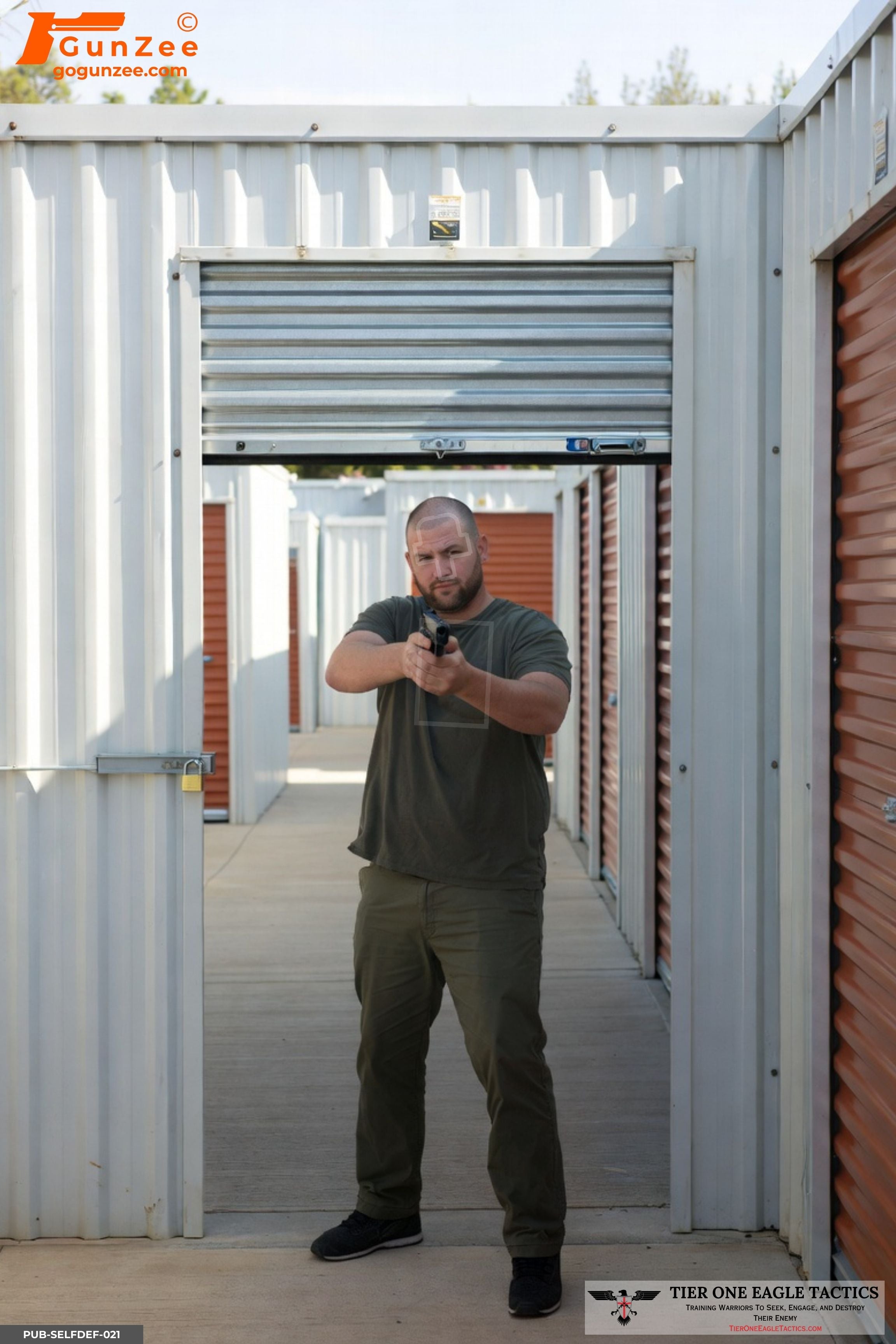
Storage Unit Armed Confrontation Shooting Target [24" x 36"]
each · sold in 5s · mix any designs
Price drops automatically: 50+ $1.85 · 100+ $1.76 · 250+ $1.66 · Up to 25% off at 999+ · Volume quote →
$40 order minimum for your whole cart, not each design. Mix any targets.
Quantity must be in increments of 5
Storage Unit Armed Confrontation Shooting Target
The Storage Unit Armed Confrontation Shooting Target depicts a direct, high-risk public self-defense encounter in a confined commercial storage facility corridor. The subject stands squarely in the shooter’s path with a handgun presented at eye level, framed by narrow walkways, metal doors, and hard structural surfaces that restrict movement and amplify risk.
This target represents a rapidly escalating confrontation with minimal environmental cover and limited lateral escape options. The shooter must process a clear lethal threat while managing tunnel vision, shot accountability, and precision under pressure in a tight, linear space.
Training Purpose
Storage facilities, garages, and similar semi-public corridors create unique defensive challenges. The geometry is restrictive, sound and movement echo, and available cover is minimal or nonexistent. When a firearm is presented directly in these environments, reaction time is compressed and errors are unforgiving.
This target is designed to train shooters to respond decisively to a confirmed lethal threat while maintaining discipline in shot placement and awareness of backdrop risk. The straight-on orientation removes ambiguity, shifting the training focus from threat identification to execution, control, and accountability.
The scenario reinforces the reality that some public encounters offer no warning and no room for repositioning—only the ability to act correctly, immediately.
Skills Reinforced
- Rapid threat confirmation under direct firearm presentation
- Precision shooting in confined linear environments
- Modified cranial T-box shot placement evaluation
- Cardiac box shot placement evaluation
- Shot accountability with hard backdrops and lateral constraints
- Stress management during direct face-to-face armed encounters
- Decision-making when movement and cover options are limited
Anatomical Kill Zones & Shot Evaluation
This target includes defined evaluation zones intended for post-engagement assessment and training review.
Modified cranial T-box
The cranial zone is based on the conventional T-box but expands upward into the upper forehead region. This area corresponds to neurological structures responsible for immediate incapacitation. The zone supports evaluation of precision and timing during high-threat, time-compressed encounters.
Cardiac box
The cardiac box represents the heart and upper vascular structures responsible for rapid circulatory shutdown. This zone allows evaluation of effective center-mass shot placement and physiological incapacitation when cranial shots are not immediately achievable.
Both zones are intended for after-action analysis to assess accuracy, decision timing, and outcome effectiveness.
Why This Target Is Different
Many shooting targets rely on exaggerated motion or dynamic angles to create difficulty. This target does the opposite.
The threat is obvious, centered, and unavoidable. The difficulty lies in executing under pressure in a restrictive environment where every round fired carries elevated risk due to hard surfaces and confined geometry.
By removing ambiguity and movement complexity, this target isolates execution errors—trigger control, sight alignment, hesitation, and poor shot placement—making it a powerful diagnostic training tool.
Related training targets
Pair this target with related scenarios from across the GunZee catalog:
Public and everyday self-defense: Urban Street Two-Man Armed Confrontation Shooting Target, Man on Crutches Armed Confrontation Shooting Target, Storage Unit Ambiguous Encounter Shooting Target, Grocery Aisle Dual-Threat Confrontation Shooting Target
Home defense, CQB, and hostage: CQB Home Defense Hostage – Armed Aggressor Forward Presentation Shooting Target, Kitchen Advancing Knife Threat Shooting Target, Living Room Dispute Armed Escalation Shooting Target
Vehicle and barrier: Vehicle Barrier Multi-Aggressor Carjacking Shooting Target, Vehicle Barrier Carjacking Confrontation Shooting Target, Vehicle Barrier Armed Subject Exiting Vehicle Shooting Target
Anatomical: Anatomical Semi-Frontal Handgun Threat Precision Shooting Target, Anatomical Semi-Profile Handgun Threat Vital Zone Shooting Target, Anatomical Frontal Handgun Threat Vital Zone Shooting Target