
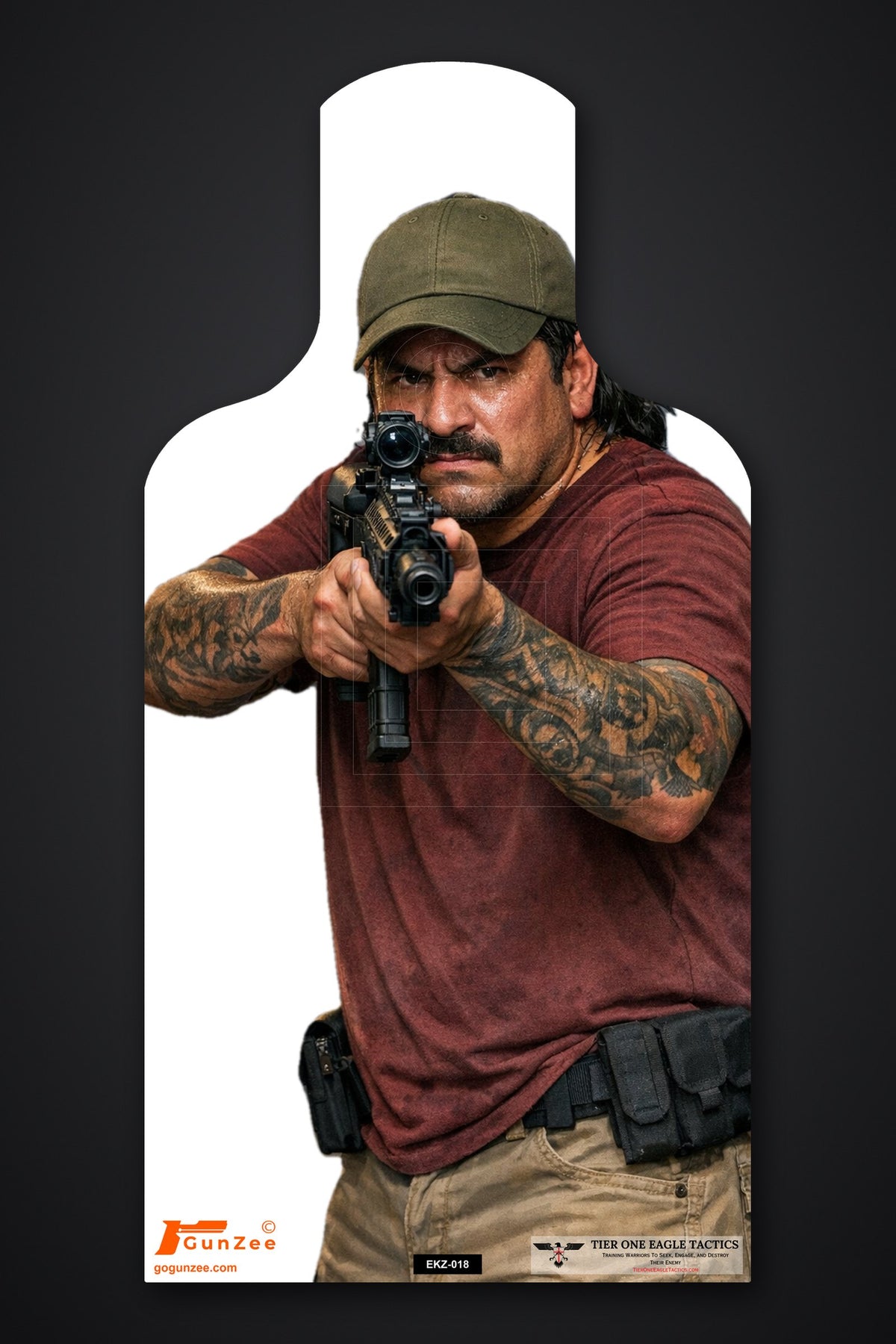
Armed Male Handgun With Optic Aiming Forward E-Backer Target [19" x 38"]
each · sold in 5s · mix any designs
Price drops automatically: 50+ $2.37 · 100+ $2.24 · 250+ $2.12 · Up to 25% off at 999+ · Volume quote →
$40 order minimum for your whole cart, not each design. Mix any targets.
Quantity must be in increments of 5
Armed Male Handgun With Optic Aiming Forward E-Backer Target
An armed threat with an optic-sighted pistol and a loaded belt: a trained, equipped adversary. It raises the standard for speed and suits timed strings and par-time work.
What the Trainee Has to Work Out
This subject has equipment and knows how to use it. The pistol and optic are raised close under his chin, right below the face. Spare magazines on the belt mean he does not expect to be finished after one.
Training Purpose
A trained, equipped threat. It raises the stakes on speed and gives a head zone that is partly blocked by the subject's own weapon. It belongs in any shoot / no-shoot course of fire as a clear armed threat.
Skills Reinforced
- Recognizing a trained and equipped adversary
- Placing a head shot just above a raised optic
- Looking at the hands before the face
- Shot placement in the cardiac box and head circle
- Shoot / no-shoot decisions in a mixed course of fire
Kill Zones: 4-Inch Head Circle and 10-Inch Cardiac Box
Two kill zones are printed on this target. Both are placed on this figure's own anatomy, not at fixed spots on the paper, so they sit where the organs are.
- Head circle. A 4-inch circle placed through the eyes, centered on the bridge of the nose, with the upper lip at its bottom edge. It contains 3-inch, 2-inch and 1-inch rings. Use the 1-inch ring as the X-ring for ties and for confirming zero.
- Cardiac box. A 10-inch square that starts at the base of the neck and covers the upper chest, centered on the heart. It holds 8-inch, 6-inch and 4-inch squares, and the innermost 4-inch square is the heart box.
- Hard to see on purpose. Every line is a light hairline. It is readable at arm's... ...
Armed Male Handgun With Optic Aiming Forward E-Backer Target
An armed threat with an optic-sighted pistol and a loaded belt: a trained, equipped adversary. It raises the standard for speed and suits timed strings and par-time work.
What the Trainee Has to Work Out
This subject has equipment and knows how to use it. The pistol and optic are raised close under his chin, right below the face. Spare magazines on the belt mean he does not expect to be finished after one.
Training Purpose
A trained, equipped threat. It raises the stakes on speed and gives a head zone that is partly blocked by the subject's own weapon. It belongs in any shoot / no-shoot course of fire as a clear armed threat.
Skills Reinforced
- Recognizing a trained and equipped adversary
- Placing a head shot just above a raised optic
- Looking at the hands before the face
- Shot placement in the cardiac box and head circle
- Shoot / no-shoot decisions in a mixed course of fire
Kill Zones: 4-Inch Head Circle and 10-Inch Cardiac Box
Two kill zones are printed on this target. Both are placed on this figure's own anatomy, not at fixed spots on the paper, so they sit where the organs are.
- Head circle. A 4-inch circle placed through the eyes, centered on the bridge of the nose, with the upper lip at its bottom edge. It contains 3-inch, 2-inch and 1-inch rings. Use the 1-inch ring as the X-ring for ties and for confirming zero.
- Cardiac box. A 10-inch square that starts at the base of the neck and covers the upper chest, centered on the heart. It holds 8-inch, 6-inch and 4-inch squares, and the innermost 4-inch square is the heart box.
- Hard to see on purpose. Every line is a light hairline. It is readable at arm's length for scoring and invisible from shooting distance, which keeps the shooter aiming at anatomy.
The pistol and optic are raised to chin level, just under the head circle. The cardiac box is open on the shirt below them. The nested squares and rings give you several standards on one target: the outer lines for a pass, the inner ones for instructors who want more. The Range Manual explains how T-box, cardiac box and A/C scoring zones compare, and when to shift from the cardiac box to the head.
Cut to Fit the E-Type Backer
This target is die-cut to the E-type silhouette, the kneeling-figure outline that military and law enforcement ranges have used for decades. It measures 19" x 38" and is sized to sit on a standard E-type backer (19.5" x 40") with a small margin all around. It staples or glues straight onto the backers your range already owns. There is nothing to trim and no stand to change.
The figure is printed life-size. Heads, shoulders and hands are the size they are on a real person at that distance, so sight pictures and hold-offs carry over.
Instructor Notes
Run it on the clock with a par time. This is the figure that would not miss. Typical distances are 3 to 25 yards with pistol and out to 50 with a carbine.
Who This Target Is For
Agencies and units that already shoot E-type silhouettes and want a person on them. It suits patrol and military police qualification refreshers, academy blocks, and instructor-led threat-identification training.
Product Details
- Size: 19" x 38", die-cut to the E-type silhouette
- Fits: standard E-type backers (19.5" x 40")
- Figure: life-size
- Kill zones: 4-inch head circle with 3-, 2- and 1-inch rings; 10-inch cardiac box with 8-, 6- and 4-inch squares
- Paper: heavy, durable stock with a matte finish, so there is no glare under range lights
- Printed in full color on one side
- Price: $2.49 each. Volume pricing on quotes runs from 5% off at 50 targets to 25% off at 999. Request a quote
- SKU: EKZ-018
- Made in the USA
Related E-Backer Targets
A course of fire needs armed threats, no-shoots and hostage problems side by side. These five come from across the E-backer line:
- Armed Male Gray Hoodie Handgun Aiming Forward E-Backer Target
- Armed Male Tactical Vest Carbine Low Ready E-Backer Target
- Armed Female Stay Back Shirt Handgun Aiming Forward E-Backer Target
- Unarmed Male Shop Rag Hands Occupied No-Shoot E-Backer Target
- Hostage Scenario Hooded Gunman Handgun Aimed Forward Victim Held E-Backer Target
See all 48 designs in the E-Type Silhouette Targets collection, or browse Scored Shooting Targets and Shoot / No-Shoot Decision Targets. For agency programs, see police qualification targets and courses of fire and silhouette targets from the B-27 to life-size figures.
The same decisions on a 24" x 36" scenario sheet: Grocery Store Parking Lot Armed Approach – Public Threat Interception, CQB Home Defense Hostage – Woman Armed Forward Presentation Shooting Target and Anatomical Frontal Handgun Threat Vital Zone Shooting Target.