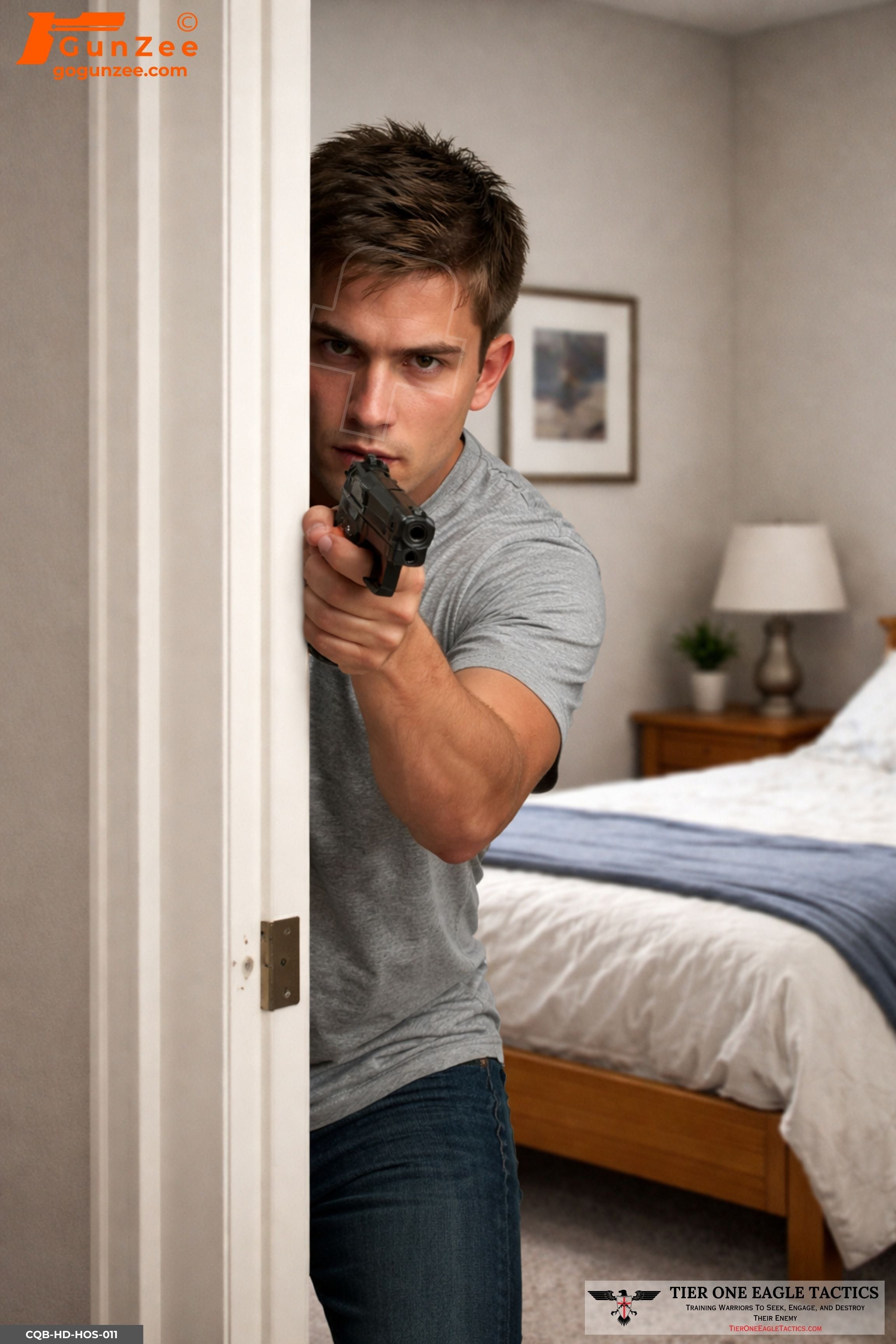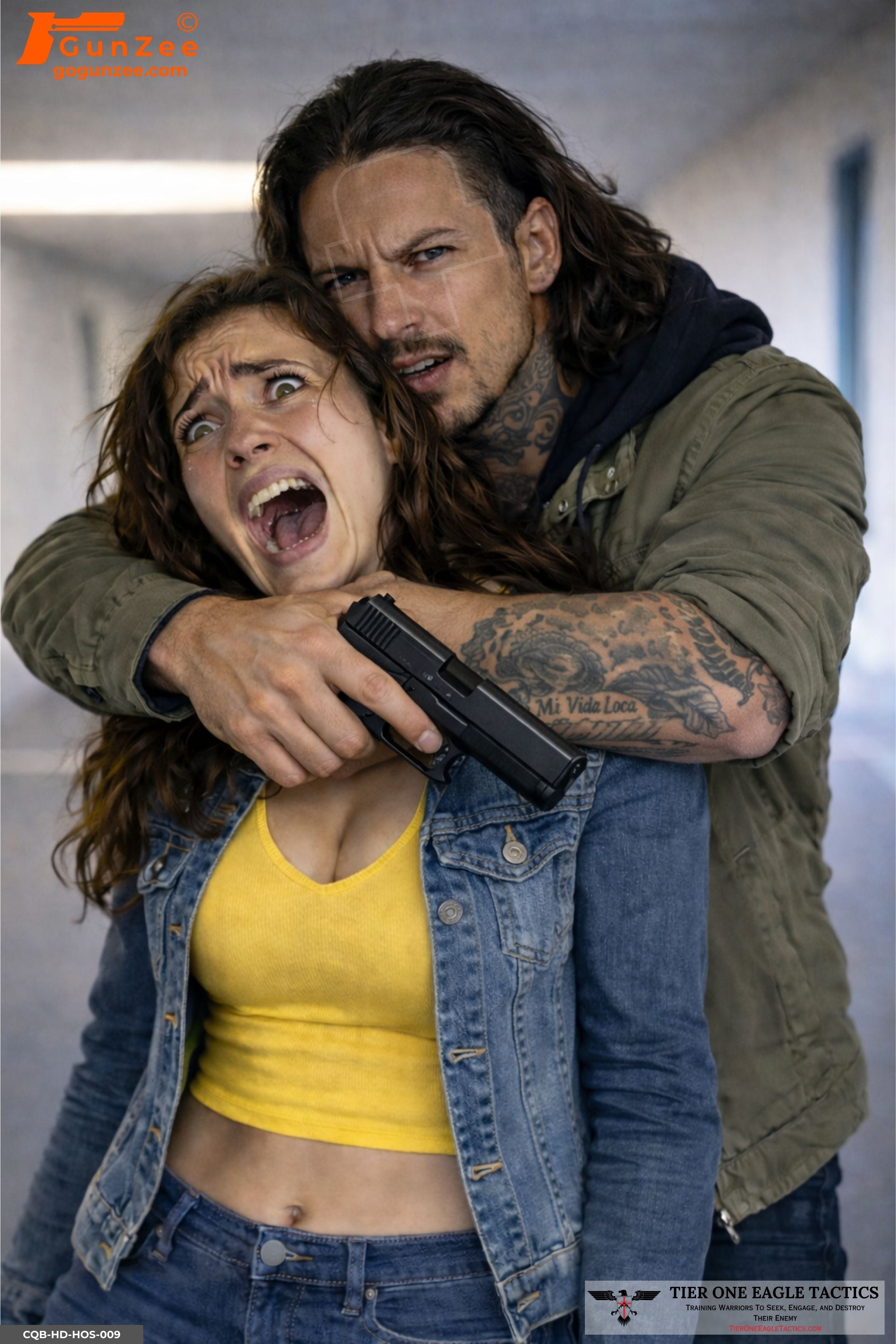
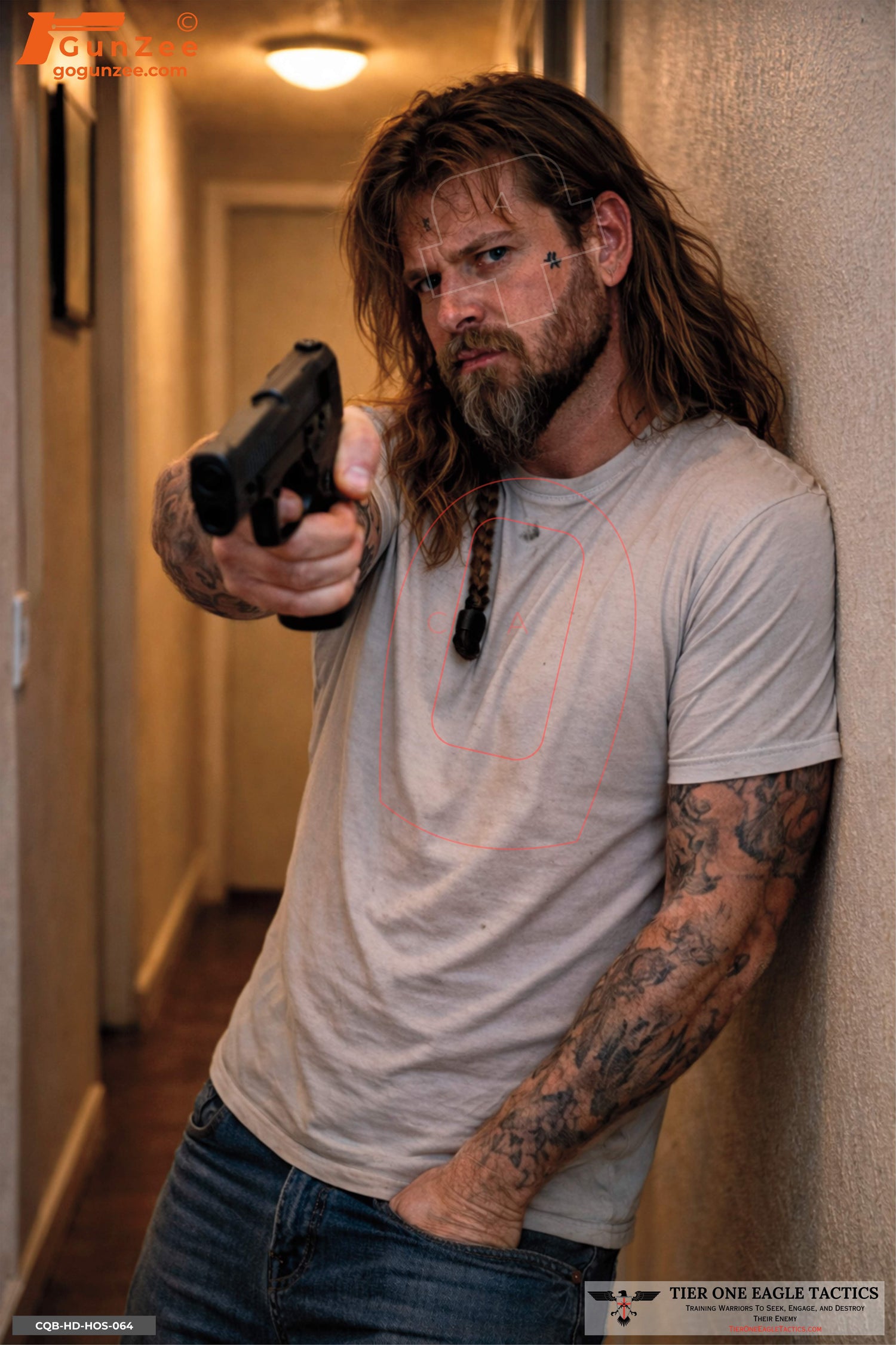
A CQB target is not a silhouette with a room drawn behind it. CQB — close-quarters battle — is a category of engagement defined by confined space, partial threat exposure, and decision pressure inside a few yards. A target that trains CQB has to do what a bullseye cannot: present the threat the way a doorway, hallway, or corner actually presents it, with the partial cover and visual ambiguity that decide whether the shot ever happens. The difference between a generic paper silhouette and a CQB-grade target is the difference between training the shot and training the engagement.
That distinction matters because CQB is where most civilian defensive engagements actually occur. Home defense is almost entirely a CQB problem. Apartment defense compresses it further. Even the workplace, school, and retail scenarios most CCW holders prepare for play out at CQB distances and inside CQB geometry. Training on a bullseye for an engagement that will happen through a bedroom doorway at three yards in reduced light is a category error — and the shooter only discovers the gap when it matters most.

What makes a target CQB-grade
Three properties separate a CQB target from a generic scenario target. Any target marketed for CQB use that doesn't have all three is teaching a different drill than the one the buyer thinks they're training.
Interior context. The threat is positioned inside a recognizable residential or interior space — a bedroom doorway, a hallway, a kitchen confrontation, a closet ambush, a corridor escort. The backdrop is not a featureless gray paper field. The shooter reads the room as part of reading the threat, because in reality the room is half the data.
Partial exposure. The threat is not face-on and fully visible. Real CQB threats present a shoulder, a forearm with a weapon, a face above a hostage, a silhouette through a door frame. The cardiac box is occluded or partial. The cranial T-box may be the only clear shot. A CQB target that draws the threat fully exposed teaches the shooter to expect a presentation that real engagements never deliver.
Decision element. Every CQB-grade target builds in a shoot/no-shoot read. The hand position has to be confirmed — weapon or cellphone, knife or wallet, threat or family member. The shot is not the first thing that happens. The read is. A target that requires no decision before the shot is a marksmanship target wearing CQB clothing.
Why bullseye targets fail at CQB training
Generic bullseyes have one job: provide a clean score zone for marksmanship calibration. That job matters. It is not the CQB job. The bullseye doesn't show a doorway, doesn't present partial cover, doesn't include a hostage or a child or a non-threat figure to discriminate against, and doesn't compress the time-to-decision the way a real room entry does. A shooter who runs only bullseye work develops the muscle memory for a kind of engagement that doesn't happen in the home — face-on, fully exposed, isolated, unambiguous. The first real CQB engagement is then the first time the shooter has ever processed a partial-exposure threat under decision pressure. That is the wrong first time.
The fix is not to abandon bullseye training. Marksmanship fundamentals — grip, sight picture, trigger control — are still the foundation everything else rests on. The fix is to layer CQB-grade scenario reps on top of the marksmanship foundation, so the shooter trains both the shot and the engagement. The two together produce a defender who can read the room, identify the threat, make the decision, and place the round. The bullseye alone produces a defender who can only do the last step.
Room-entry angles, partial cover, and low light — the three CQB problems
Three engagement classes dominate residential CQB training, and the GunZee scenario library is built around each.
Room-entry angles. The doorway is the most common CQB engagement geometry. The shooter approaches a closed or partially open door, the threat is inside the room, and the read has to happen through the frame. The CQB Home Defense Bedroom Doorway Armed Subject target is the workhorse for this geometry — the threat is partially visible through the frame, the weapon is confirmed, the shot solution is clean if the shooter reads correctly. Run it slowly first. Speed is the enemy at the doorway; clean reads are the goal.
Partial-cover threat identification. Most real CQB threats present behind something — a hostage, a piece of furniture, a wall corner, a doorway edge. The CQB Bedroom Doorway Cellphone Ambiguity target trains the no-shoot discipline for the partial-exposure read — same doorway, same lighting, but the held object is a phone, not a gun. Rotating the armed and ambiguity targets unannounced during a training block is the single most valuable CQB drill most shooters never run. The Corridor Hostage Control with Rear Gunman target takes the partial-cover problem further — the threat is behind the hostage, the T-box is the only ethical shot, and the corridor compresses lateral options.
Low-light identification. Most home-defense engagements happen in low light. A CQB target depicting an armed intruder with a flashlight on the shooter trains the worst-case low-light geometry — the threat sees the defender before the defender sees the threat. Run low-light reps with reduced ambient if the range allows. The flashlight discipline — momentary activation, sight picture between flashes, target identification before commit — is the rep that matters and cannot be built on a daylight bullseye.
The GunZee CQB scenario library at a glance
The full residential CQB inventory lives in the Home Defense, CQB & Hostage Scenarios collection. The library is organized around the engagement classes a residential defender actually encounters:
- Doorway scenarios — bedroom doorway armed subject, doorway cellphone ambiguity, two-man residential entry. The highest-frequency residential geometry.
- Hallway scenarios — hallway ambush immediate threat, corridor hostage control, interior two-man deception. Confined linear engagements with no lateral escape.
- Concealed-space scenarios — closet ambush armed subject, closet ambush hands-up compliance. The hardest residential read, frequently the right call is don't engage.
- Kitchen and living-room scenarios — deceptive familiarity kitchen confrontation, living room female hostage scenarios, family-member proximity drills. Domestic geometry where the no-shoot consequences are highest.
- Hostage scenarios — child shield handgun threat, rear control handgun, knife threat rear control, two-man armed coordination. Hostage geometry under residential lighting and distance.
- Low-light scenarios — armed intruder with flashlight, low-ambient doorway reads. The lighting condition most real engagements happen under.
- Volume packs — the CQB Full Structure Rotation 295-pack and the Doorways & Corners CQB 40-pack for instructors and training groups rotating drills across multiple students.
Each target in the library is hand-designed, photorealistic, and printed at 24" x 36" so the engagement distances and visual proportions match what the shooter will see at three to ten yards. The depth of the scenario library — not the unit price — is the point. A CQB training cycle that rotates across twenty distinct engagement scenes builds adaptable judgment in a way a cycle that rotates across two never can.
How to buy CQB targets for the home actually being defended
The right CQB inventory depends on the structure. A few rules:
Match the geometry to the floor plan. A single-family home with long hallways and multiple bedrooms benefits from doorway, hallway, and concealed-space targets. An apartment with a compressed layout benefits from the Apartment Hostage Close-Quarters Control target and shorter-distance doorway drills. A defender with children in the home weights child-shield and family-proximity scenarios heavily — the no-shoot consequences are higher and the reads need to be drilled hardest.
Start with the foundational three. For a defender new to CQB training, three targets cover the highest-frequency residential engagements: bedroom doorway armed subject, bedroom doorway cellphone ambiguity, and hallway ambush immediate threat. Buy the three, run twenty reps on each, and the gaps in current readiness surface quickly.
Layer in decision diversity. Once the foundational three are clean, add a hostage scenario, a low-light scenario, and a concealed-space ambush scenario. The point of the diversification is to build the read pattern across enough engagement classes that no real CQB scenario is the shooter's first encounter with that class of decision.
Don't substitute volume for variety. A hundred reps on the same target is less valuable than ten reps each across ten distinct scenarios. CQB judgment is a pattern-recognition skill — pattern recognition requires varied patterns. Bulk training packs from GunZee are built with that variety in mind.
Where CQB targets fit in the broader training stack
CQB targets sit between marksmanship and live force-on-force training. They are the layer that turns clean shot mechanics into the read-then-shoot cycle a real engagement requires. They are not a replacement for marksmanship fundamentals, and they are not a substitute for force-on-force training when that is available. They are the bridge — the layer where the shooter builds the visual processing, the no-shoot discipline, and the time-compression tolerance that the next step assumes.
Generic bullseye training plus a stack of CQB-grade scenario reps plus periodic structured walkthroughs of the actual home — that combination produces a defender who can handle the engagement when it shows up. Generic bullseye training alone does not.
→ BROWSE THE CQB & HOME DEFENSE SCENARIO LIBRARY
Frequently asked questions
What is a CQB target?
A CQB target is a shooting target built to simulate the visual conditions of a close-quarters battle engagement — a threat presenting through a doorway, behind partial cover, in a hallway, or under low light. The target shows the angles and partial exposures the shooter actually sees in a real room-entry scenario, instead of a clean face-on silhouette that no real engagement ever produces.
How is a CQB target different from a regular bullseye?
A bullseye trains pure marksmanship against a static circular score zone. A CQB target trains the read-then-shoot cycle against a threat that is partially obscured, contextually placed inside a room, and often surrounded by no-shoot elements like family members, hostages, or non-threat objects. Bullseye training builds the shot; CQB training builds the engagement.
What makes a target CQB-grade?
Three things: residential or interior context (doorway, hallway, closet, kitchen — not a featureless backdrop), partial exposure of the threat that forces a confirmation read before the shot, and a shoot/no-shoot decision element built into the scene. A target that has all three trains the engagement a CQB engagement actually is.
Should low-light scenarios be CQB targets?
Yes. Most residential CQB engagements happen in low light. A CQB target depicting an armed intruder with a flashlight, or a doorway under reduced ambient, builds the flashlight-discipline and target-identification reps that pure daylight range work cannot. Train in the lighting the actual engagement will happen in.
Which CQB target should a home defender buy first?
The bedroom doorway armed subject target is the foundational CQB residential target — it covers the highest-frequency home-defense geometry. Pair it with the bedroom doorway cellphone ambiguity variant to add the no-shoot decision rep, and the hallway ambush immediate threat target to add the time-compressed response rep. Those three cover the most common engagement profiles.
Are GunZee CQB targets used by professional trainers?
Yes. The residential CQB library is used by law enforcement training programs, executive protection courses, and civilian instructors running shoot/no-shoot decision drills. The hand-designed scenario depth and photorealistic print quality were built for training environments where the reads have to feel real.
Train it as a pack: the entry-scene rotation ships as the CQB & Interior 60-pack, CQB & Interior 100-pack, CQB & Interior 150-pack.
Related reading in the Range Manual
-
Hostage Shooting Targets — Buyer's Guide
CQB's tightest decision-making problem: friendly right next to the threat, tenths of a second to act. -
Shooting Targets — The Buyer's Guide for Serious Training
The category overview: what makes a training target actually train someone, across every scenario type. -
Paper shooting targets — full collection
Every paper target we make: CQB, hostage, vehicle, anatomical, shoot/no-shoot. 24×36, $1.95. -
CQB Training Targets for Professional Courses
The instructor-side companion: course volume, drill rotation, and curriculum design. -
Shoot / No-Shoot Decision Drills: Building Judgment Under Stress
The decision layer CQB work sits on — graduated judgment drills for threat discrimination. -
Gun Targets — The Buyer's Guide for Serious Training
Comparative guide: paper vs steel vs scenario vs anatomical, and when each earns its range time. -
Paper Shooting Targets: Material and Manufacturing Insights
What CQB targets are printed on, and why the material matters at course volume.
Go deeper: departments structuring CQB blocks should see the law enforcement training targets pillar; for entry scenes without printed kill boxes, run the NKZ threat / no-threat line.
Room entries end at the rescue shot more often than instructors like to admit — the hostage shooting targets collection trains that margin.