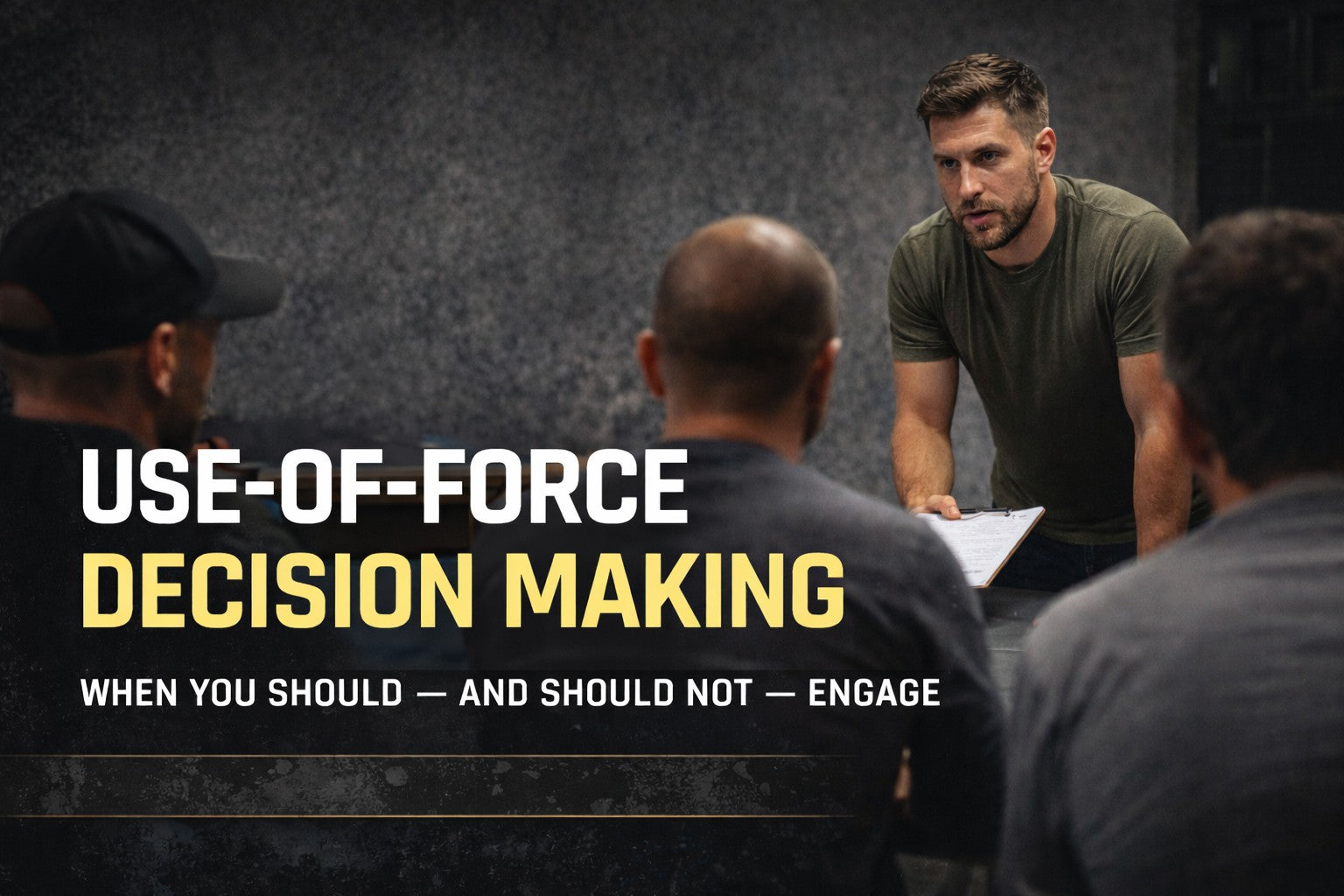
Most shooters can hit a B-27 silhouette at ten yards. Fewer can run a hostage shooting target without freezing, and almost none train the decisions that come before the trigger.
A hostage scenario isn't a marksmanship problem. It's a judgment problem with a marksmanship requirement attached. The shot is the easy part — what costs lives is the time between recognizing the situation and committing to action. That time is where almost no one trains, and it's where the gap between recreational shooters and professionals is the widest.
This is the framework serious students of the gun need before they ever train a hostage scenario. If you're going to train these scenarios at all, train them this way.
Why static targets fail at hostage training
Three reasons.
They don't force a decision. A bullseye, a B-27, even a colored T-box — none of them ask you a question. You walk to the line, you draw, you shoot. The decision was made before you got there. Real hostage scenarios start with a question: Is this a threat? Is the trigger finger on the gun? Is that object a weapon? Is the person behind the threat a hostage or an accomplice? You can't train answer-finding by repeating drills that have no question.
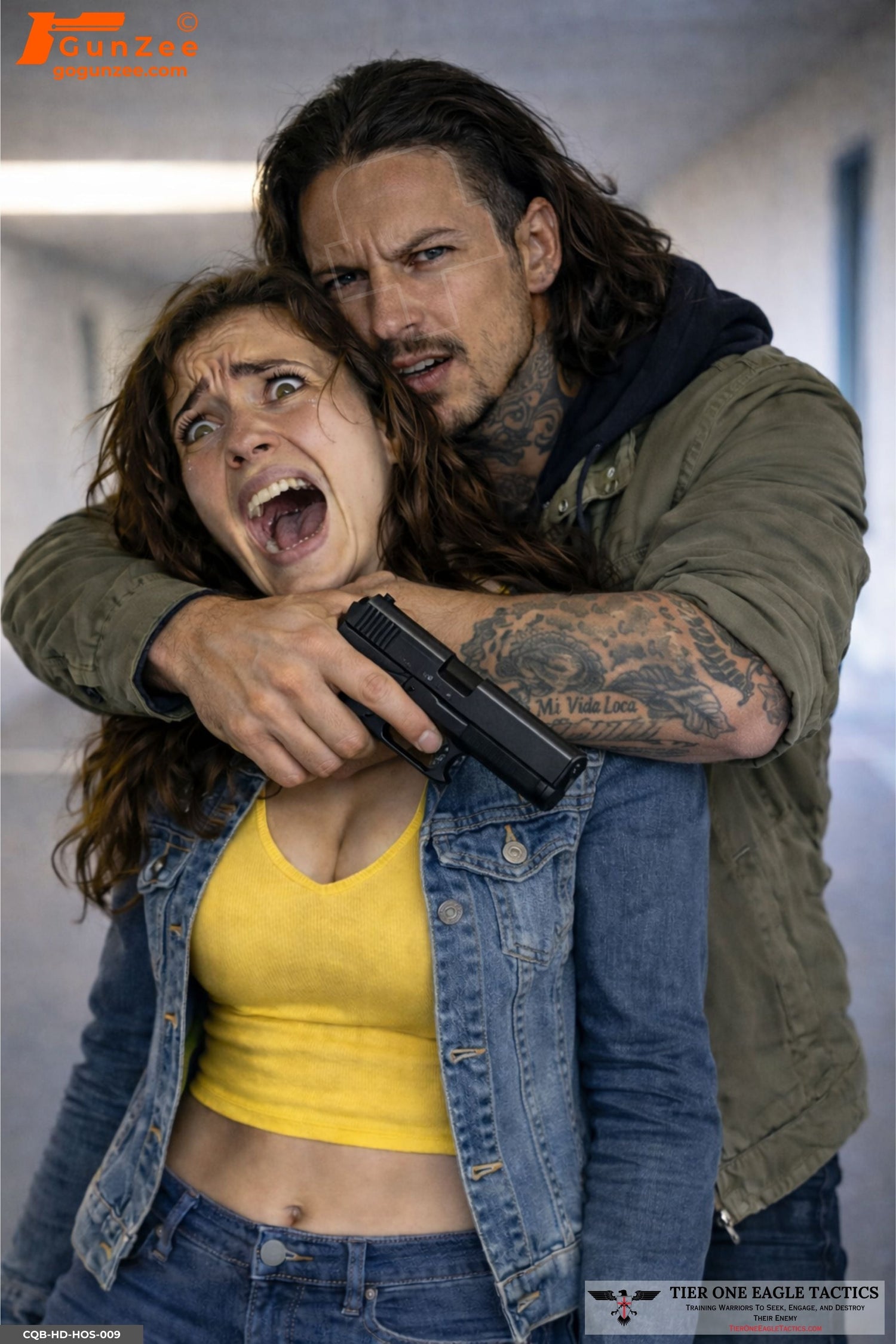
They don't model geometry. The shot opportunity in a hostage scenario is a few square inches of head and upper neck, often partially obscured by the hostage's body. The line between the muzzle and that scoring zone runs across the shoulder of the person you're trying to save. A flat silhouette has none of that. You need a hostage shield target that shows you the angle, the partial exposure, the hard edge between hit zone and disaster zone.
They don't punish the wrong answer. A bullseye gives you a score for any hit. A scenario target that scores a head shot on the threat as success and the same head shot on the hostage as catastrophic failure trains a different muscle. That muscle is judgment under stress, and it's the muscle that decides outcomes when the math gets hard.

The eight decision categories most shooters skip
If you only train hostage scenarios as "headshot at fifteen yards," you're missing the actual training value. Here are the eight decision categories that show up in real engagements — and the kinds of scenario shooting targets that make you train each one honestly.
1. Threat confirmation under ambiguity
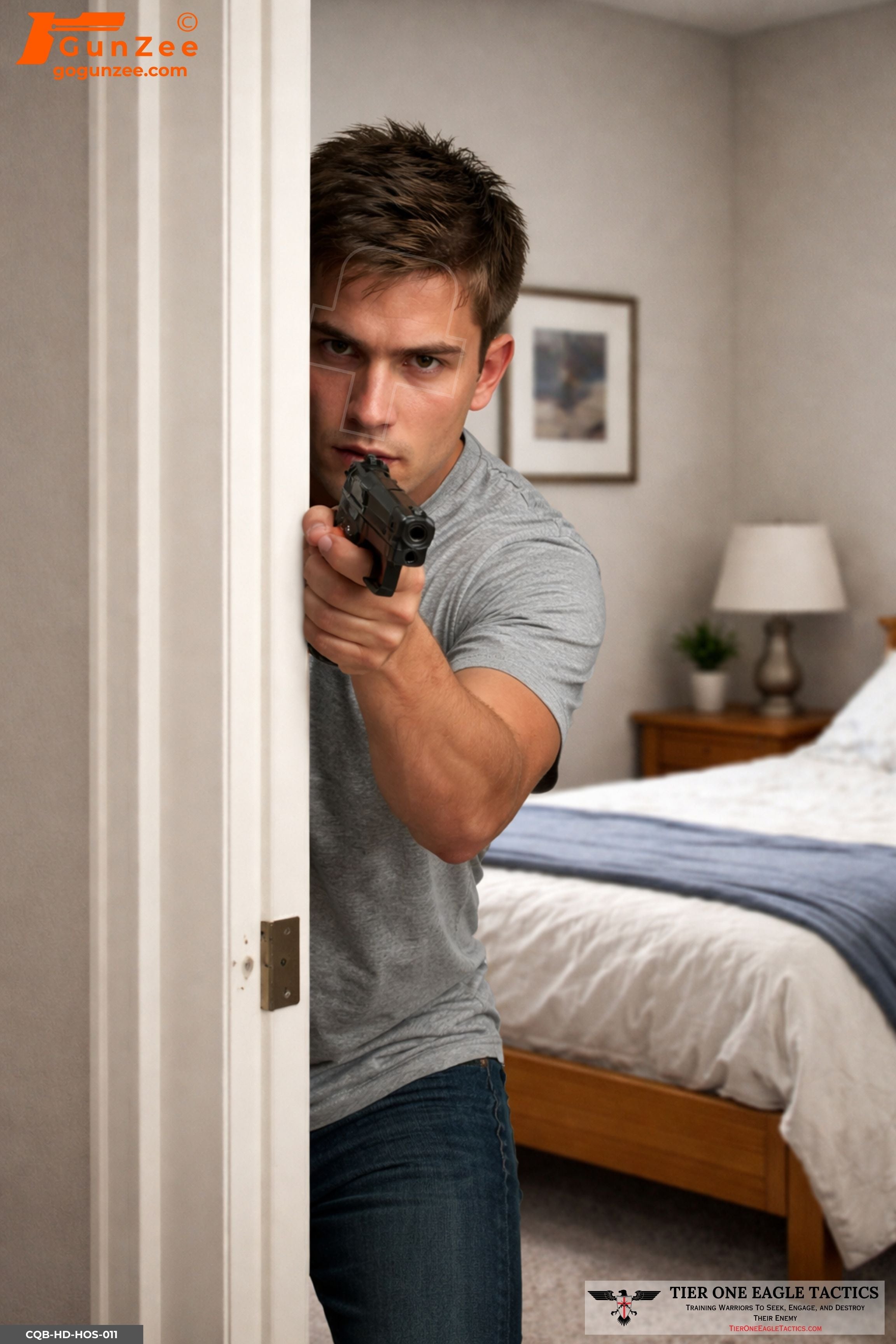
The biggest category, and the one that gets people killed (or charged). A figure in your hallway holds something dark in their hand. Is it a gun? A phone? A remote? A wallet? Photorealistic cellphone ambiguity targets force you to look — actually look — before the trigger moves. The drill isn't "shoot fast." It's "confirm fast."
2. Hostage geometry — the angle problem
When the threat is using a hostage as cover, your viable hit zone shrinks to fractions of the head, and the angle keeps changing as both bodies move. The classic rear-control handgun threat target shows you the geometry that book diagrams can't: the partial exposure, the offset, the way the hostage's shoulder eats into your sight picture. You learn to read the angle, not memorize a fixed sight picture.

3. Multiple-actor sequencing
Two threats. Three. One is the trigger-puller, one is moving toward your family, one is yelling. Where do you point first? A two-man armed threat coordination target gives you the prioritization problem: who is the immediate threat, who is the developing threat, and which one do you address first when you can only address one at a time. This is sequencing, and it has to be drilled until it's automatic.
4. Rear-control restraint and edged-weapon distraction
A rear knife threat scenario teaches a separate muscle: keeping the gun out of the fight while the immediate threat is contact-distance steel. The training value isn't a perfect head shot — it's the discipline of not taking the wrong shot when your nervous system is screaming for any action.
5. Public-space backdrops
You're in a bank lobby and four armed suspects in body armor are in motion. You're at an ATM and a rear-aspect ambush comes from your blind side. You're in a church aisle with civilians behind every threat. Public-space scenarios force you to think about what's behind the threat, what's beside the threat, and whether the round you're about to fire has a clean path to its destination.

6. Compliance recognition — the surrender problem
Maybe the hardest call: the person in front of you was a threat thirty seconds ago and has now lowered the weapon. Hands are coming up. Are they surrendering, or transitioning to a second weapon? A closet ambush hands-up compliance target trains the "stop, hold, assess" decision that lives between "fire" and "holster." Most shooters never practice this at all.
7. Deceptive familiarity
A spouse, a teenager, a roommate — someone you know — appears in your hallway in the middle of the night. They're holding something. The decision-making load is multiplied because your brain is processing identity, not just threat. A deceptive familiarity kitchen confrontation target builds the discipline of confirming hands and weapons before identity short-circuits judgment.
8. Role reversal — the armed victim
Sometimes the person who looks like a victim is the threat. A café hostage role-reversal scenario flips the easy assumption — the "hostage" produces a weapon and becomes the immediate threat. If you've only trained hostages as people to protect, this scenario will lock you up. That's the point.

How to actually train these drills
The structure is the same for any of the eight categories above.
Step 1 — read before you draw. Stand at the firing line and look at the target for a full count of three before you touch the gun. Identify the threat's posture, the hostage's posture, the angle, what's in each hand, and the shot opportunity. Don't train the draw stroke — train the visual processing that has to happen before the draw stroke means anything.
Step 2 — verbalize. Out loud: "armed threat, rear control, hostage left shoulder, shot opportunity is right temple." This sounds silly until you do it under stress and find that you can't. Verbalization is the translation between recognition and action, and it's a trainable skill.
Step 3 — commit. Draw and shoot the assessed target. If the assessment was wrong, the score will tell you. If the assessment was right but the shot wasn't, the score will tell you that too.
Step 4 — debrief immediately. Walk to the target, look at where the rounds went, and reconstruct the sequence. What did you see first? What did you almost miss? What would you do differently?
This is slow training. It feels nothing like running a stage at a match. That's the point — competition shooting is a different sport, with different incentives. Decision-making drills serve a different goal, and they require a different tempo.

A progression that actually works
You can't skip steps. Use this progression:
- Static silhouettes for marksmanship. B-27, IDPA, USPSA — pick any. Build the base mechanics.
- Anatomical targets for shot placement. This is where you stop chasing center-mass scoring and start training cardiac, T-box, and pelvic-girdle fundamentals.
- Single-actor scenario targets for threat confirmation. Cellphone ambiguity, weapon presence, hand position. One actor, one decision.
- Hostage and multi-actor scenarios for the eight categories above. This is where the CQB Home Defense Hostage line lives.
- Force-on-force or simulator work. Once you've built the visual processing on paper, you graduate to live role-players or scenario simulators.
Most people stop at step 1 or 2. The gap between "competent marksman" and "competent decision-maker under stress" lives in steps 3 and 4. That's where almost no one trains, and that's why almost no one is good at it.
Where to start
If you're new to scenario training, three targets will give you a representative cross-section.
- One ambiguity target — cellphone or hand-position ambiguity for the confirmation reps
- One geometry target — rear-control hostage for the angle problem
- One sequencing target — two-man coordinated threat for prioritization
That's a full session of legitimate decision-making work for under a hundred dollars and a single trip to the range. If you train a serious group, the CQB Full Structure Rotation 295-pack is the instructor-grade option that covers every category in a single bundle.
The full hostage and CQB scenario library lives in the Home Defense, CQB & Hostage Scenarios collection. Browse it the way you'd browse a curriculum, not a catalog: pick the decision categories you haven't trained, not the targets you find prettiest.
→ BROWSE THE HOME DEFENSE, CQB & HOSTAGE SCENARIOS COLLECTION
Frequently asked questions
What is a hostage target and how is it different from a regular silhouette?
A hostage target is a photorealistic shooting target that depicts a threat using another person — the hostage — as cover, partial cover, or distraction. The training value is in the geometry (small viable hit zones, partial exposure) and in the decision (when the shot is justified, when it isn't). A regular silhouette tests marksmanship; a hostage target tests judgment under stress.
At what skill level should I start training hostage scenarios?
After you can reliably make headshots at fifteen yards on a static target. Decision-making drills assume the marksmanship is already there. If you're still chasing accuracy, scenario work won't help — you'll just add a layer of decision noise to a foundation that isn't ready.
Can I train these drills with a single target, or do I need a full pack?
You can start with a single target if you're disciplined about reading it before each rep. But the real value of scenario training is variety. Repeating the same hostage target dozens of times creates pattern-matching, which is exactly the opposite of what you're trying to train. A pack of five to ten varied scenarios is the floor for a serious training cycle.
Are these law-enforcement-only, or are they appropriate for civilian concealed-carry training?
Both. Civilian concealed-carry shooters benefit more than law enforcement in many cases, because they're more likely to encounter a high-stakes ambiguous scenario without backup. The legal and ethical environment for civilian armed self-defense is unforgiving of bad decisions, which makes decision-making practice the highest-leverage training a civilian shooter can do.
How often should I run scenario decision-making drills?
At least once per training month, ideally weekly if you have the range time. Decision-making is a perishable skill — more perishable than marksmanship. A shooter who runs scenario drills weekly will outperform a shooter who runs them quarterly, even if the marksmanship is identical.
What's the difference between hostage targets and standard CQB targets?
A CQB target shows the close-quarters shooting environment — doorways, hallways, room corners. A hostage target adds a second human element — typically a non-combatant — that complicates the shot picture. Most modern CQB scenario targets combine both: the geometry of close quarters plus the moral weight of hostage decision-making.
Can I use these for force-on-force preparation?
Yes. Paper-based scenario training is the right preparation phase before live force-on-force, because it lets you build the visual-processing reps without the cognitive overhead of a moving partner. Most professional schools build a paper-scenario week into the curriculum before students go to FoF.
Train it as a pack: the hostage block ships as the Hostage Rescue 60-pack, Hostage Rescue 150-pack. Department programs: the law enforcement training targets collection.
Related reading
- Anatomical Shooting Targets: Train Vital Zones, Not Scoring Rings
- Self-Defense Shooting Targets: Train the Decision, Not Just the Shot
- Silhouette Shooting Targets: From B-27 to Life-Size Scenario Realism
- Tactical Shooting Targets: What Counts, What Doesn’t, and How to Choose
- Browse: Public & Everyday Self-Defense targets
Browse the full hostage rescue library. Every hostage scenario target GunZee makes — residential CQB, public-environment, rear-control, child-shield, ambiguous-threat, and ethics-heavy compositions — is at /collections/hostage-rescue-targets. Each is 24×36 paper, $1.95, built for the decision before it allows a hit.
For related drills, browse GunZee's paper shooting target library — the same $1.95 scenario-target catalog these drills were designed around.
For the broader context on shooting-target selection, see our Shooting Targets Buyer's Guide — the comprehensive rundown of every category, use case, and buying consideration.
Browse the full GunZee paper targets for shooting — 220+ designs across every category, from $1.95 each.
For the material and manufacturing side of paper targets (specs, print quality, cost tiers), see our Target Paper Guide.
Go deeper: shoot / no-shoot judgment drills builds the same decision under wider conditions, the NKZ collection carries hostage scenes with no printed kill boxes, and the qualification-to-decision training guide shows where these drills sit in a department program.