A carjacking almost never plays out the way the square range trains for it. The defender is seated, belted, looking through glass, with a steering wheel between the muzzle and the threat — and the attacker is already inside conversational distance, often with a weapon already presented. The encounter is decided in the first three to five seconds.
A carjacking shooting target presents the attacker at the geometry the threat actually appears — driver's window, passenger window, between cars at an intersection, or closing across a parking lot. This guide walks the four attack patterns CCW holders actually face and the GunZee targets that train each angle.

Why a carjacking target is different from a generic vehicle-defense target
A generic vehicle-defense target shows the shooter using the vehicle from the outside — engine block as cover, wheel hub as a kneeling barrier. That's a valuable rep, but it is not what a carjacking is. A carjacking is the inverse: the defender is inside the vehicle and constrained by it, while the attacker has freedom of movement around it.
The constraints stack fast. Seat belt blocks most carry-position draws. Steering wheel blocks the muzzle. Pillar and mirror cut the sightline. Glass distorts the visual presentation and deflects any shot fired through it. The exit path requires opening a door — a half-second movement that is forever in an engagement already inside three seconds. A carjacking target presents the threat at the angle these constraints actually apply, so the shooter trains under the conditions that decide the engagement.
The four carjacking attack patterns every CCW holder should train
1. Driver's-window approach (the classic)
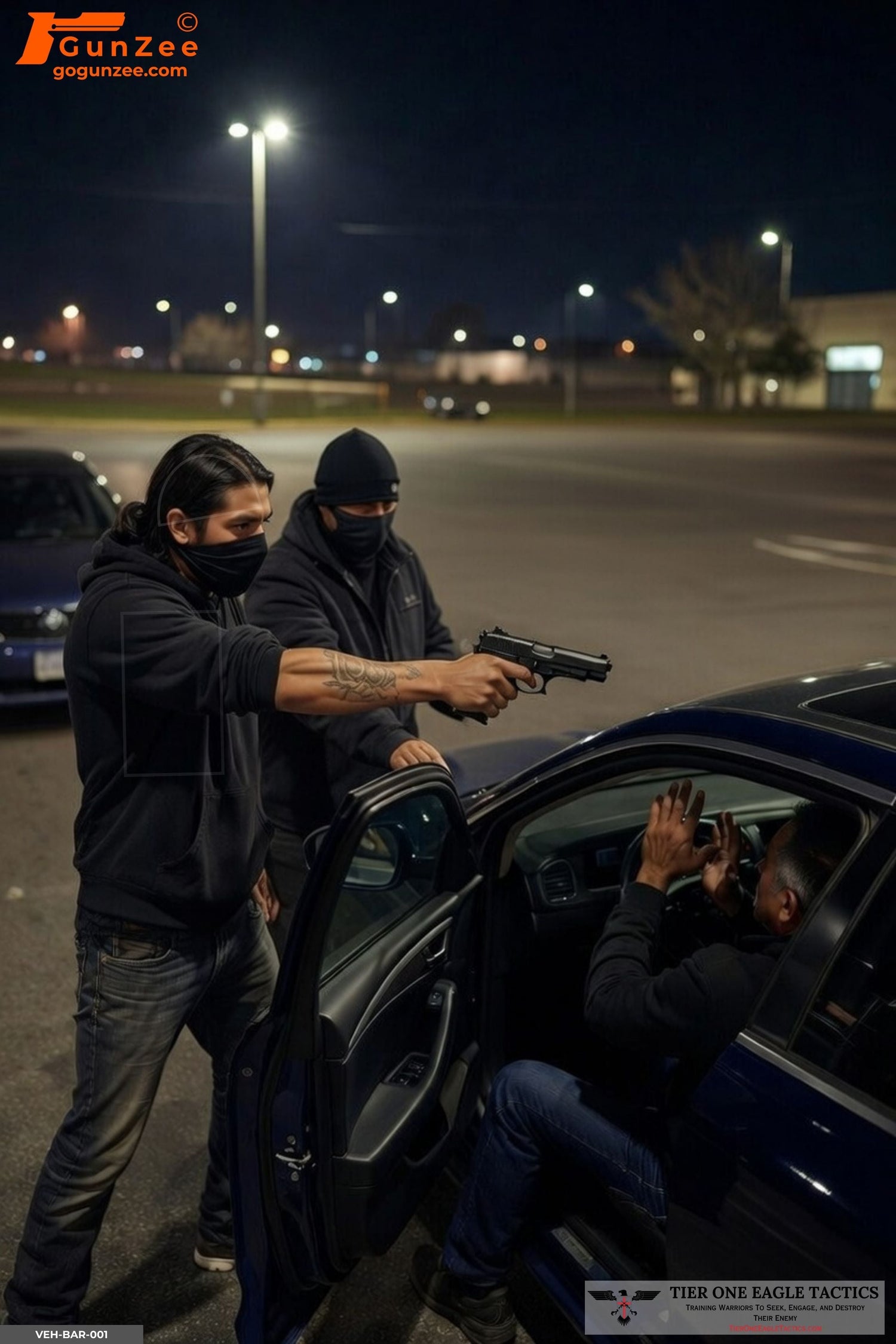
The most common pattern. The vehicle is stationary — stoplight, parking space, drive-through, gas pump — and an attacker approaches the closed driver's window, usually with a weapon already drawn. The defender has roughly two seconds from recognition to decision. The Vehicle Barrier Carjacking Confrontation target trains this geometry directly. Drill it seated in a folding chair with simulated belt restraint, target at three to five yards. Most shooters discover their draw is one to two seconds slower seated than standing — the gap this target exists to close.
2. Passenger-side approach (the mirror-image gap)
Passenger-side attacks are common in drive-through lines, nose-out parking, and any scenario where the attacker reads the driver's side as too exposed. For a right-handed shooter, this is the single hardest engagement geometry in the carjacking library — the shot is across the body, over a passenger seat (and possibly a passenger), with the strong-hand wrist torqued against the seat back. The Vehicle Barrier Armed Driver Engagement and Closed Door Armed Driver targets train variants of this constrained-angle engagement.
3. Intersection trap (the daylight ambush)
The intersection trap uses traffic to box the target vehicle in. A car pulls up parallel at a stoplight; a pedestrian stops at the window; a second vehicle blocks reverse. By the time the engagement window opens, driving away is gone. The Vehicle Barrier Daylight Carjacking target presents the threat at this intermediate distance — close enough to engage, far enough to give the defender one extra second to read the scene, verbalize the threat, and decide engage-or-drive. Train the recognition, not just the shot.

4. Multi-aggressor approach (the prioritization rep)
Two or three attackers converging from different angles is the pattern that decides whether the defender can think under pressure. The Vehicle Barrier Multi-Aggressor Carjacking target presents this at the angle a seated defender actually sees it — peripheral vision narrowed by the pillar, the second attacker partially blocked by the mirror. The drill: read the scene, verbalize the threat order out loud ("threat one driver side, threat two passenger side, primary engagement driver side"), then engage in sequence. The verbalization step is the discipline most shooters skip — and the one that makes the sequence executable under stress.
The scenario subtype that demands its own training time: the family in the car
The decision tree changes the moment a passenger who cannot survive separation is in the car. A spouse with limited mobility, a child in a car seat, an aging parent who cannot exit the vehicle quickly — every one of these collapses the option set. Driving away may not be possible if the attacker can grab a passenger through an open window. Engaging becomes more likely. And the shot-accountability problem expands, because the passenger's body is now in or near the engagement zone.
The Vehicle Barrier Elderly Victim Carjacking target is the rep for this scenario. Most defensive curriculum is built around a healthy, mobile defender who can disengage — a loaded family car is not that scenario.
Inside-the-vehicle constraints the square range never trains
The seated draw. Every common CCW carry position changes character when the shooter is belted in. Appendix inside-the-waistband (AIWB) accommodates the seated draw best — the buckle gap leaves the position accessible. Strong-side hip and shoulder rigs both fight the belt; pocket and ankle carry are effectively unavailable. A defender who has not measured their seated draw time does not know what their actual engagement window is.
Shooting through glass. If the alternative is taking a round, yes. Windshield rounds deflect slightly downward; side-window rounds, slightly outward. Manageable inside five yards (where most carjacking engagements happen), compounds at distance.
The exit-or-engage decision. Drive when possible, engage when boxed in, when the attacker is already inside the engagement window, or when a passenger cannot survive separation. Train the decision tree — not just the trigger.
Anatomical placement under window constraints. Most carjacking engagements present only the attacker's head and upper torso through the window frame. The cardiac box is often partially occluded by the door; the cranial T-box is exposed. The Anatomical Head-Out Vehicle Window Engagement target trains placement against exactly this presentation.
The four-target starting library for carjacking training
A CCW holder building a focused carjacking-defense training cycle gets the highest leverage from four targets — one per attack pattern:
- Vehicle Barrier Carjacking Confrontation — the foundation. Driver's-window single-attacker scenario.
- Vehicle Barrier Daylight Carjacking — the intersection trap. Trains the recognize-and-verbalize step.
- Vehicle Barrier Multi-Aggressor Carjacking — the prioritization rep, two or three converging threats from a constrained seat.
- Vehicle Barrier Elderly Victim Carjacking — the family-in-the-car decision tree.
Pair these with two range sessions per month, run from a seated position with simulated seat belt restraint — a folding chair on the firing line is enough. The full library, including passenger-side, windshield, and dual-gunmen variants, lives in the Vehicle & Barrier collection. For the broader vehicle-as-cover doctrine, see the pillar Vehicle as Cover: How to Train for Carjacking & Roadside Threats.
→ BROWSE THE VEHICLE & BARRIER COLLECTION
Frequently asked questions
What is a carjacking shooting target?
A photorealistic scenario target that shows an attacker at the geometry of a real carjacking — driver's window, passenger window, intersection approach, or parking-lot closing — so the shooter trains from a seated, seat-belted position rather than a square-range stance.
Why train carjacking scenarios on a target instead of just at the range?
A square-range silhouette doesn't teach the constraints that decide a carjacking — seat belt blocking the draw, steering wheel blocking the muzzle, pillar blocking the sightline, glass distorting the shot. A scenario target presents the attacker at the angle the threat actually appears, so the shooter trains the visual recognition and shot placement that match a real engagement.
Which carjacking target should a CCW holder buy first?
The Vehicle Barrier Carjacking Confrontation target. It shows the most common geometry — single attacker at the driver's window, vehicle stationary. Build the seated draw and first-shot placement on this target before adding multi-aggressor or passenger-side variants.
Do I need to train passenger-side carjacking scenarios too?
Yes. Passenger-side approaches are common in drive-through lines and nose-out parking, and the geometry is mirror-image to the driver's-window scenario. A right-handed shooter facing a passenger-side threat must shoot across the body — a skill gap only training exposes. The Vehicle Barrier Armed Driver Engagement and Closed Door Armed Driver targets cover this angle.
What carry position works best for defending against a carjacking?
Appendix inside-the-waistband (AIWB) gives the cleanest seated, belted draw — the buckle gap leaves the position accessible. Strong-side hip and shoulder rigs fight the seat belt and add seconds to the draw. Shooters who carry differently should at minimum measure their seated draw time and know it.
Related reading
- Vehicle Barrier Shooting Targets: The Armed Driver, the Windshield, and the Open Door
- Anatomical Shooting Targets: Train Vital Zones, Not Scoring Rings
- Self-Defense Shooting Targets: Train the Decision, Not Just the Shot
- Silhouette Shooting Targets: From B-27 to Life-Size Scenario Realism
- Tactical Shooting Targets: What Counts, What Doesn’t, and How to Choose
Related reading in the Range Manual
-
Shooting Targets — The Buyer's Guide for Serious Training
Where carjacking fits in the broader defensive-shooting target ecosystem. -
Gun Targets — The Buyer's Guide for Serious Training
Comparative guide: paper vs steel vs scenario vs anatomical, and when each earns its range time. -
Paper shooting targets — full collection
Print, shoot, replace. Every scenario category on 24×36 paper. -
Hostage Shooting Targets — Buyer's Guide
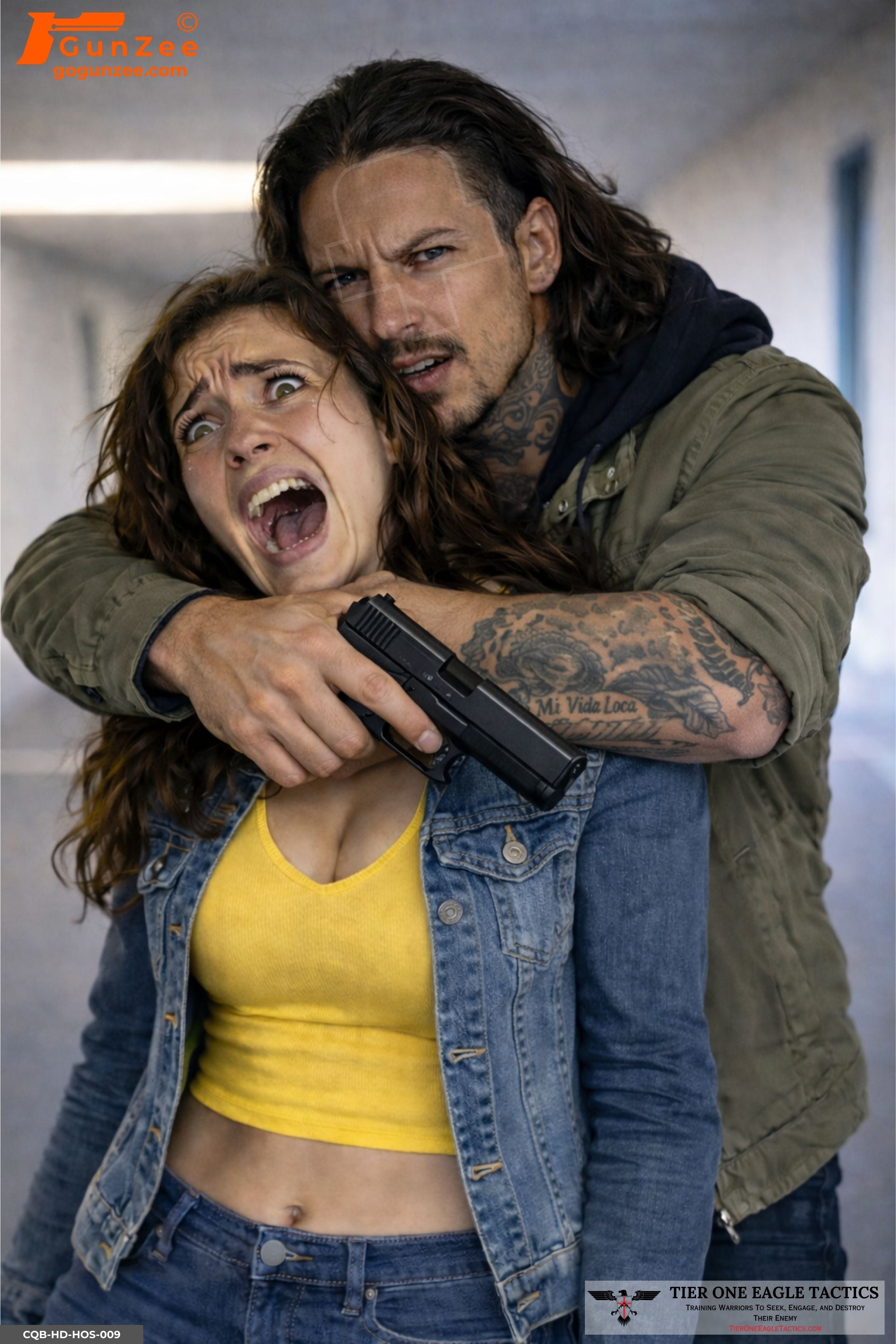
Carjackings with a passenger in the vehicle become hostage problems — the decision layer for friendly-in-frame scenarios. -
Human Anatomy Shooting Targets: A Complete Training Guide
The placement-precision foundation for seated, angled, and compressed-distance engagements. -
Paper Shooting Targets: Material and Manufacturing Insights
Why paper weight, coating, and print quality decide how a target holds up across a training day. -
What Types of Targets Should You Train With? A Defensive Shooter's Guide
Where vehicle scenarios sit among the target types a defensive shooter should rotate through.
Browse related categories: anatomical & shot placement targets for the precision layer, and the public & everyday self-defense collection for parking-lot and street scenarios beyond the vehicle.
Go deeper: shoot / no-shoot judgment drills builds the hold/press call that vehicle encounters compress into seconds, and the NKZ line carries street scenes with no printed zones.