The B-27 is the most widely used qualification target in American shooting — the official NRA police silhouette that anchors law-enforcement quals, state carry-license courses, and rental-range walls in all fifty states. This is the complete reference: exact dimensions, how the scoring rings work, the qualification standards built on it, and what the rings quietly get wrong about real anatomy.
What the B-27 actually is
The B-27 is the NRA's official 50-yard police silhouette: a black, life-size human torso-and-head outline overlaid with concentric oval scoring rings. It was designed for one job — standardized measurement. Same outline, same rings, same distances for every shooter on every lane, so a course of fire produces a comparable score. That is why police qualifications, license-to-carry tests, and league matches keep prescribing it, and why it is worth knowing precisely.
Where it fits in the broader silhouette family — alongside the B-21, the FBI "Q" bottle, the TQ state variants, and competition cardboard — is covered in the companion guide, Silhouette Shooting Targets: From B-27 to Life-Size Scenario Realism. This page is the spec sheet.
B-27 dimensions
Sheet size. The official NRA B-27 prints on a 24" × 45" sheet. Wider 35" × 45" prints of the same silhouette are sold by several makers, and the B-27E economy version puts the same rings on a 22.5" × 35" sheet. Reduced-scale versions (the B-29 for 50 feet, the B-34 for 25 yards) shrink the target so it subtends the same angle as a full-size sheet at the longer distance.
Ring sizes. The scoring rings are ovals, specified in millimeters. Converted to inches:
| Ring | Size (mm) | Size (inches, approx.) |
|---|---|---|
| X | 55 × 78 | 2.2" × 3.1" |
| 10 | 100 × 150 | 4" × 6" |
| 9 | 200 × 300 | 8" × 11.8" |
| 8 | 300 × 450 | 11.8" × 17.7" |
| 7 | 400 × 600 | 15.7" × 23.6" |
Distances. The B-27 is rated as a 50-yard target; in practice most courses built on it run between 3 and 25 yards, with 7 and 15 yards carrying the bulk of the round count.
The scoring rings, explained
The rings score X–10–9–8–7 from center out. The X-ring does not add points — it breaks ties between shooters with equal scores. Hits on the silhouette outside the 7-ring still strike "the target," and whether they count depends entirely on the course of fire.
Most qualification courses do not use the printed values directly; they map ring groups to a simpler point scheme. The best-known example is the Texas License to Carry proficiency test: 50 rounds at 3, 7, and 15 yards, 250 points possible, 175 to pass (70%). Texas scores the B-27 in three zones — hits inside the 8-ring (8, 9, 10, and X) are worth 5 points, the 7-ring is worth 4 points, and any other hit on the silhouette is worth 3 points. Misses off the silhouette score zero. Under that scheme a shooter can pass while never touching the 10-ring — which says everything about what qualification courses are actually measuring: consistency inside a broad zone, not precision placement.
Qualification standards built on the B-27
Agencies and states prescribe the B-27 or a local variant — color versions, state-specific overlays, and the TQ series all descend from the same concept: a standardized human outline with printed zones. If a qualification course names the B-27, qualify on the B-27; substituting a different target invalidates the score. How departments layer qualification against actual decision training — and what a documented training program looks like beyond the qual sheet — is covered in From Qualification to Decision Training: How Agencies Build a Target Program.
The scenario targets departments pair with the B-27 are in the law enforcement targets collection.
Where the rings sit versus real anatomy
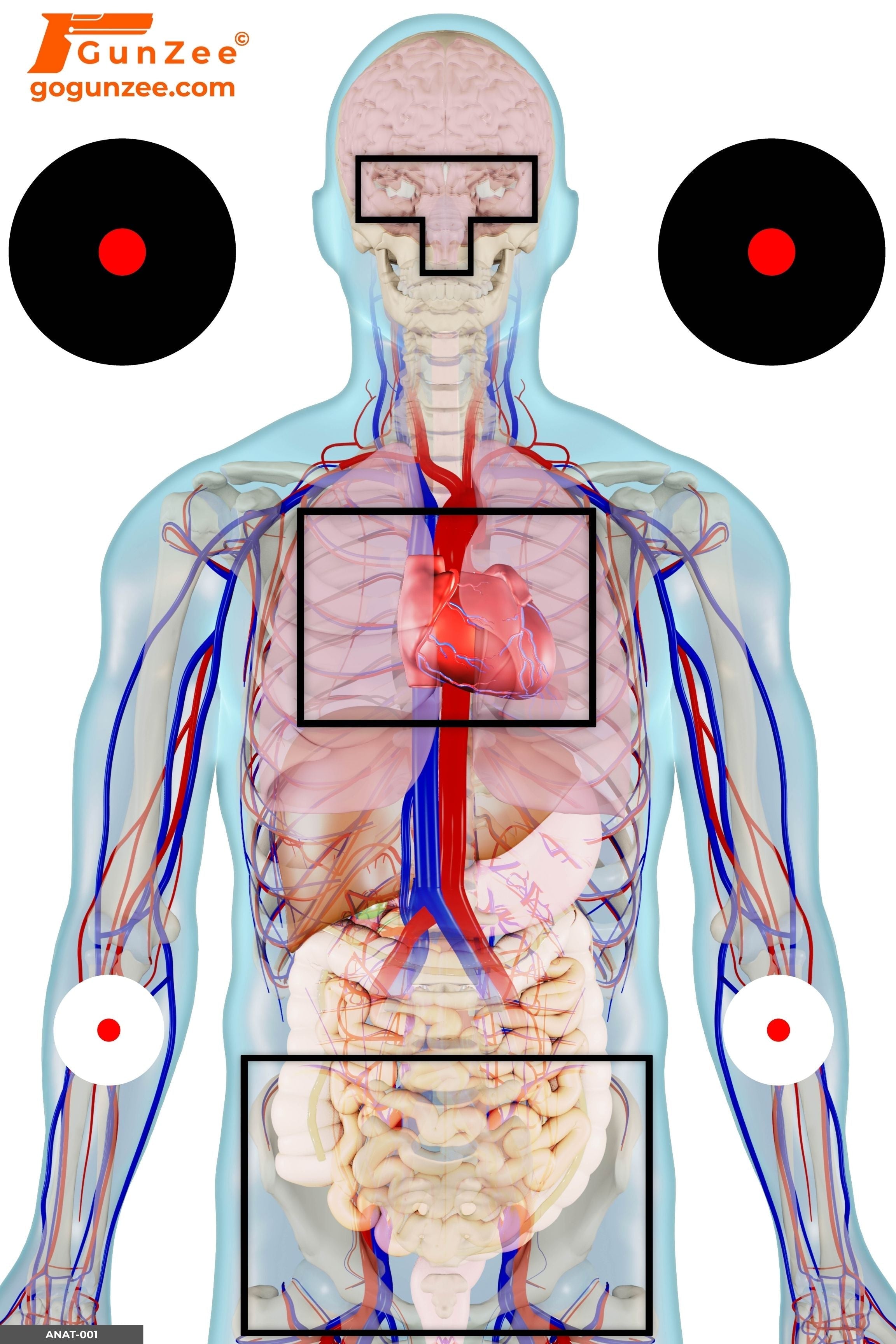
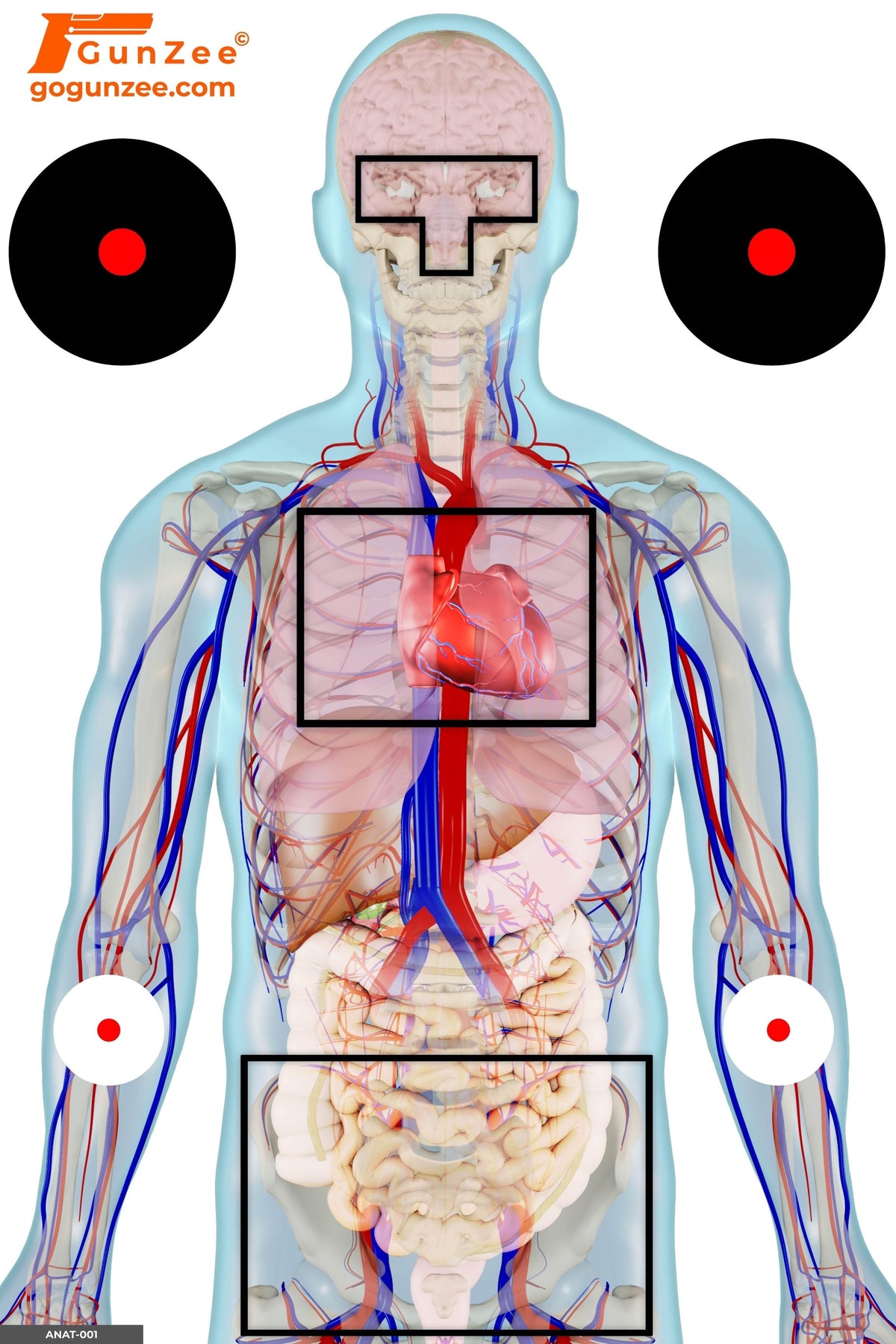
Here is the criticism that has followed the B-27 for decades: the scoring ovals are centered low on the torso, around the solar plexus. The anatomy that actually stops a threat — the heart and great vessels of the high chest, and the central nervous system above them — sits measurably higher than the X-ring. Score enough courses on the rings and the rings become your reference picture: shooters who train exclusively on B-27s routinely build a low center-of-mass habit without ever knowing it.

The full comparison between ring-scored and anatomy-referenced training is in Anatomical Targets vs. Bullseye, and the specific aim-point correction — cardiac box versus T-box, and when to shift between them — is in Cardiac Box vs. T-Box.
What to hang next to a B-27
The practical answer is not to abandon the B-27 — qualification courses require it, and it remains a fine tool for group work. The answer is to stop letting it train your aim point. A range session that starts on the B-27 for score and then moves to life-size anatomical and scenario targets keeps the qualification skill and fixes the placement habit:

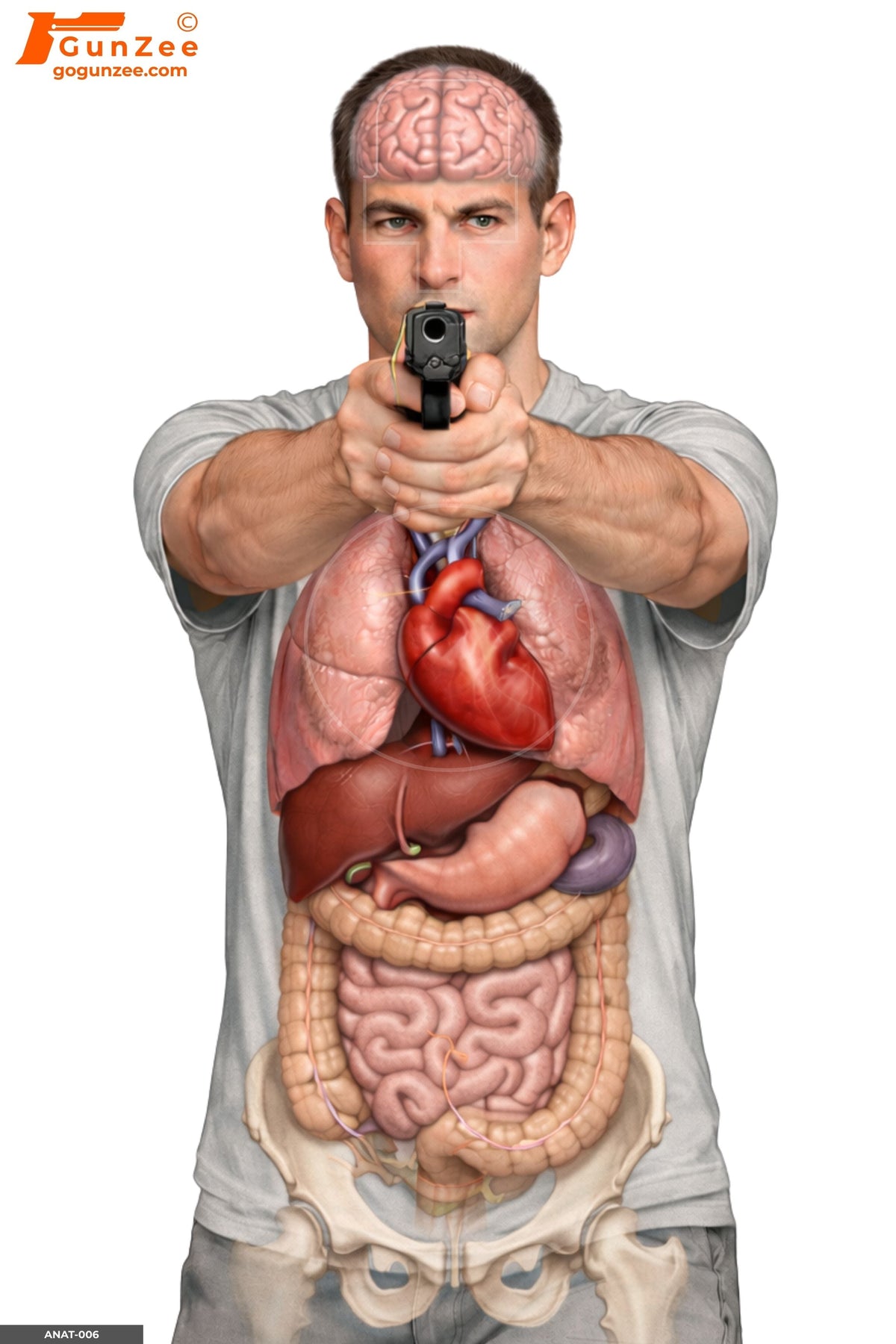
For placement blocks, the Anatomical Rifle Threat runs the same correction against a rifle-armed presentation. For the decision layer the B-27 cannot touch — reading a scene, identifying a weapon, choosing to fire — scenario prints like the Workplace Active Shooter Response put a specific person in a specific environment at true scale. All of it runs on the same economics as commodity silhouettes: life-size 24" × 36" prints at $1.95 each in the paper shooting targets catalog, with the anatomical line in the anatomical target collection and course-scale bundles in training packs. See all our active shooter training targets.
Reference: every sheet size and scoring zone on this page, plus IDPA, USPSA, B-8, Texas DPS and USALE, is in the printable shooting target dimensions chart.
Frequently asked questions
What size is a B-27 target?
The full-size B-27 prints on a 35" × 45" sheet; a 24" × 45" economy width is also common. The silhouette itself is a life-size human torso-and-head presentation. Reduced-scale versions exist for short indoor distances.
What are the B-27 scoring rings worth?
The rings run X–10–9–8–7 from center out, with the X-ring used as a tiebreaker rather than for points. Most qualification courses map the rings to a simpler scheme — Texas LTC, for example, scores 8-ring and better as 5 points, the 7-ring as 4, and any other silhouette hit as 3, with 175 of 250 required to pass.
Is the B-27 good for self-defense training?
It is good for what it was built for: standardized scoring, qualification prep, and group work. It cannot teach where hits actually stop a threat — its rings center low of true incapacitation anatomy — and a featureless outline cannot train threat identification or the decision to fire. Alternate B-27 work with life-size anatomical and scenario targets to cover what the rings miss.
For the scenario side, start with the everyday scenario shooting targets: photo-realistic armed subjects in public settings, printed life size.
What distance is the B-27 designed for?
It is rated as a 50-yard target. In practice, the qualification courses built on it run mostly between 3 and 25 yards — Texas LTC fires at 3, 7, and 15 yards; many police courses add stages to 25.
The bottom line
The B-27 is a measurement instrument, and a good one: known dimensions, known rings, comparable scores across every lane in the country. Use it for exactly that. Just do not let a scoring oval centered on the solar plexus become your definition of a good hit — the anatomy that ends a fight sits higher, and the decision that precedes the shot is not printed on the paper at all. The B-27 measures your shooting; it was never meant to finish your training.