"Tactical" is the most abused word in the shooting-sports catalog. It gets printed on zombie heads, neon splatter grids, and the same flat silhouette that has hung at qualification ranges since the 1960s — none of which train a single tactical skill. A tactical shooting target is not a style. It is a job description: paper that forces you to solve a problem before and while you press the trigger. This guide gives you a working definition you can test any target against, shows how to match targets to the tactical skills you are actually trying to build, and finishes with a checklist for assembling a target set that earns its place in the range bag.
What "tactical" actually means on a shooting target
Strip away the marketing and tactical training is three things: reading an environment, making a decision under pressure, and delivering accurate fire from whatever position the problem allows. A target qualifies as tactical only if it makes at least one of those three demands. That gives you a simple test to hold against any product page:
- Context. Does the target place the threat in an environment — a doorway, a vehicle, a bank lobby, a parking lot — that changes how you approach the shot? Backstops, angles, and bystanders only exist when there is a scene.
- Decision. Does the target make you evaluate before you fire? Weapon or phone. Threat or bystander. Shoot or no-shoot. A target you can engage on sight without a judgment call trains marksmanship, not tactics.
- Geometry. Does the target present the threat at an angle, behind cover, or partially exposed, so the correct hold changes? Real threats rarely stand square. Paper that always faces you teaches a hold you may never get to use.
One demand makes a target tactical. The best scenario targets stack all three — and that stack, not camouflage borders or crosshair graphics, is what separates a tactical shooting target from a decorated bullseye.
Why most targets sold as "tactical" fail the test
Run the common candidates through those three demands and the field thins fast. Zombie and novelty targets: no context, no decision, no geometry — entertainment, not training. Splatter bullseyes: instant feedback on marksmanship, zero tactical demand. Plain silhouettes, including the venerable B-27: a scoring standard, not a scenario — the silhouette family is covered in depth here, and the short version is that a flat shape cannot teach discrimination, positioning, or anatomy. Even "tactical" hostage prints fail when the artwork is cartoonish: a drawn figure with a drawn gun presents no ambiguity to resolve, and ambiguity is the entire point.
None of this makes those targets useless — fundamentals work belongs on fundamentals paper, and the full gun-target taxonomy lays out where each category belongs. It makes them insufficient. The moment your training goal includes the word "defensive" or "real-world," the paper has to carry a problem, not just a point of aim.
Matching tactical targets to the skill you are building
The right tactical target depends on the environment you are training for. Four skill lanes cover most shooters, and each has a dedicated scenario family.
Home defense and CQB
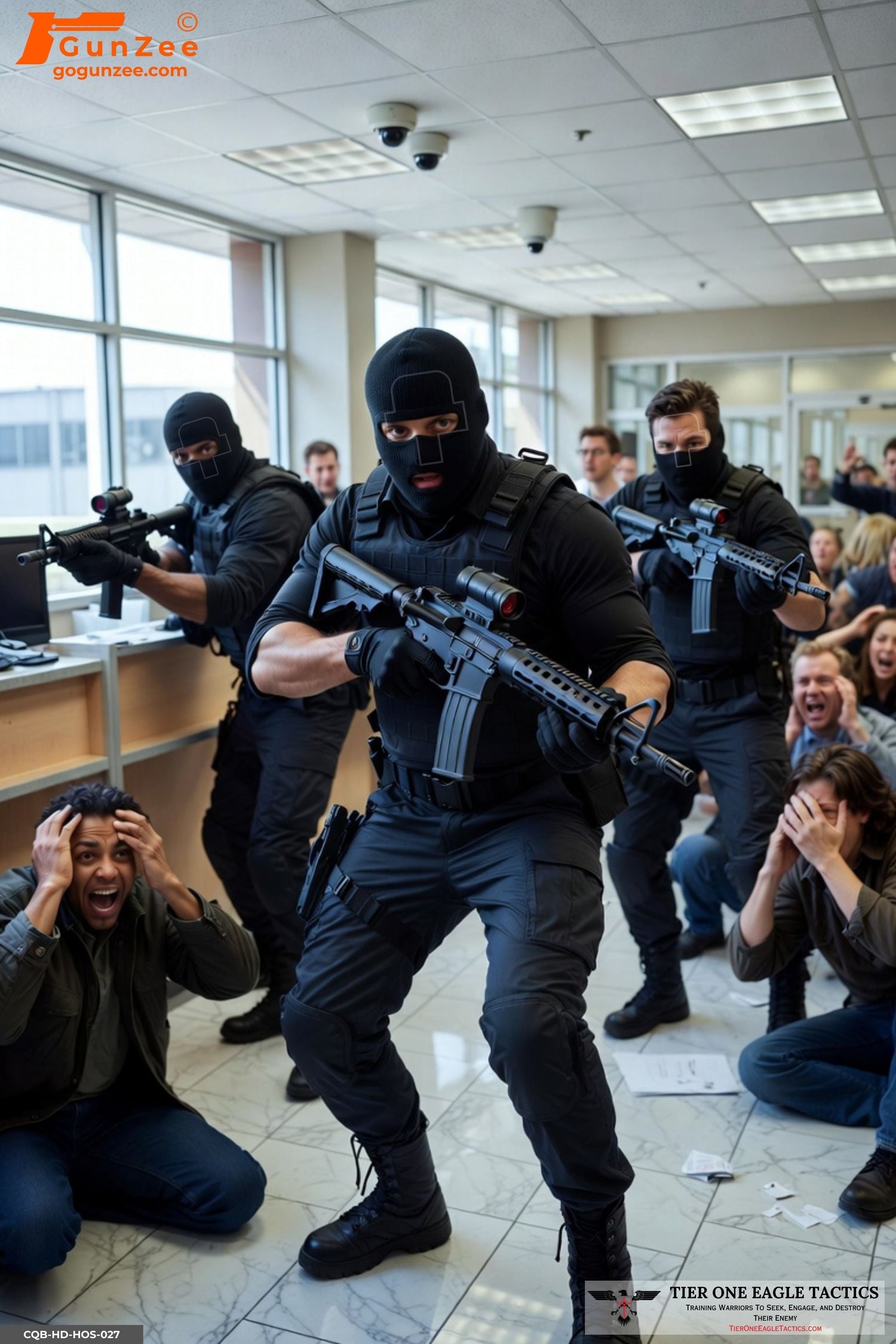
Interior problems: doorways, hallways, partial exposure around frames, and the hardest version — a threat using a family member as cover. Targets in the CQB & home-defense scenario collection present armed intruders at true interior distances and angles, including hostage presentations where the no-shoot occupies most of the frame.

Public-space and everyday-carry defense
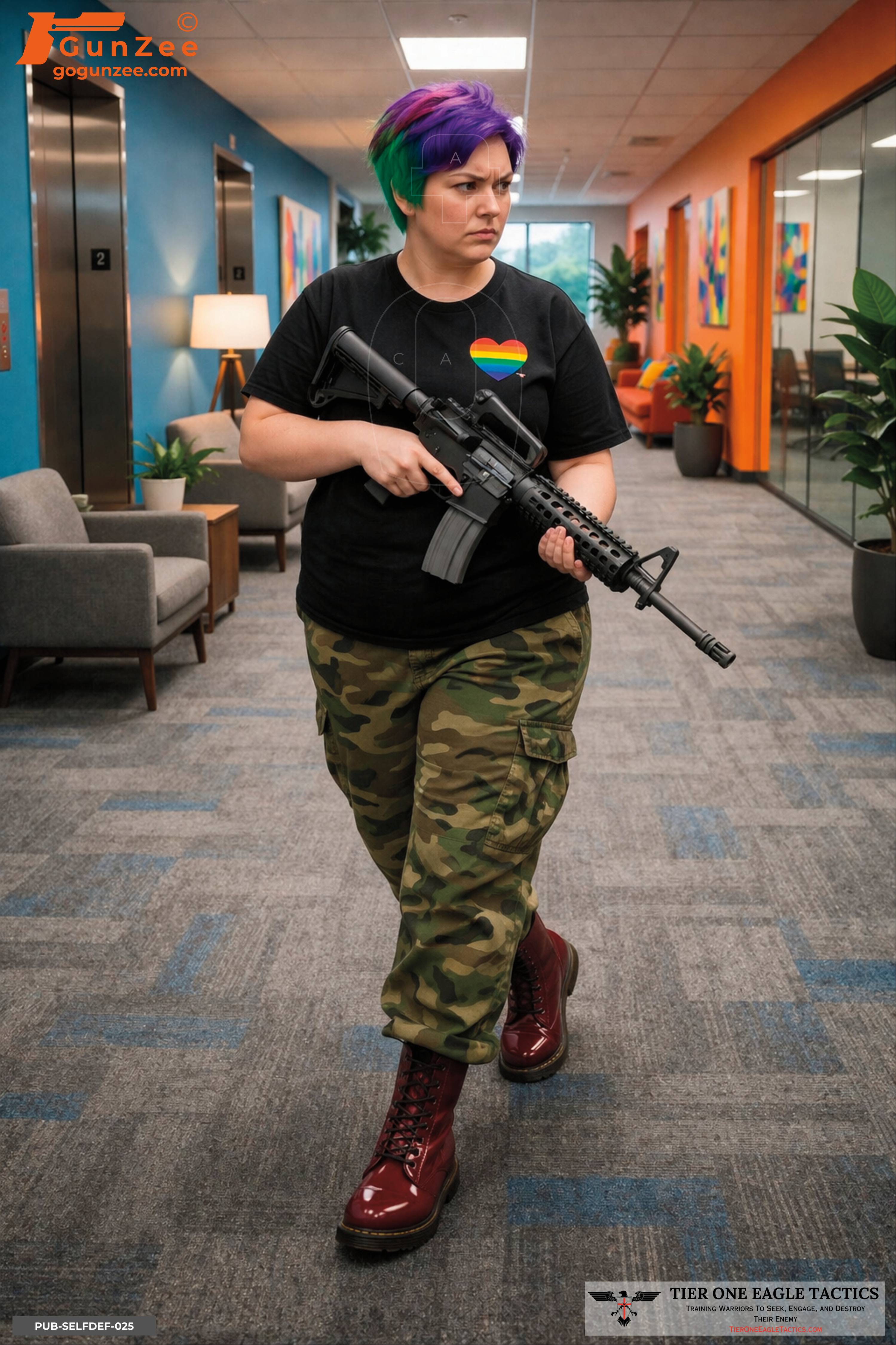
The concealed carrier's problem set lives in parking lots, workplaces, grocery aisles, and ATM lines — crowded scenes where the threat is embedded among people you must not hit. The public & self-defense scenario collection builds those scenes at life size, from workplace active-threat response to rear-aspect ambush recognition.

Vehicle engagement
Cars change everything: glass, door skins, raked angles, and a seated threat whose vital zones sit lower and turned. The vehicle & barrier collection puts armed drivers and door-jamb presentations on paper so the geometry problem is trained, not imagined.

Precision under realism
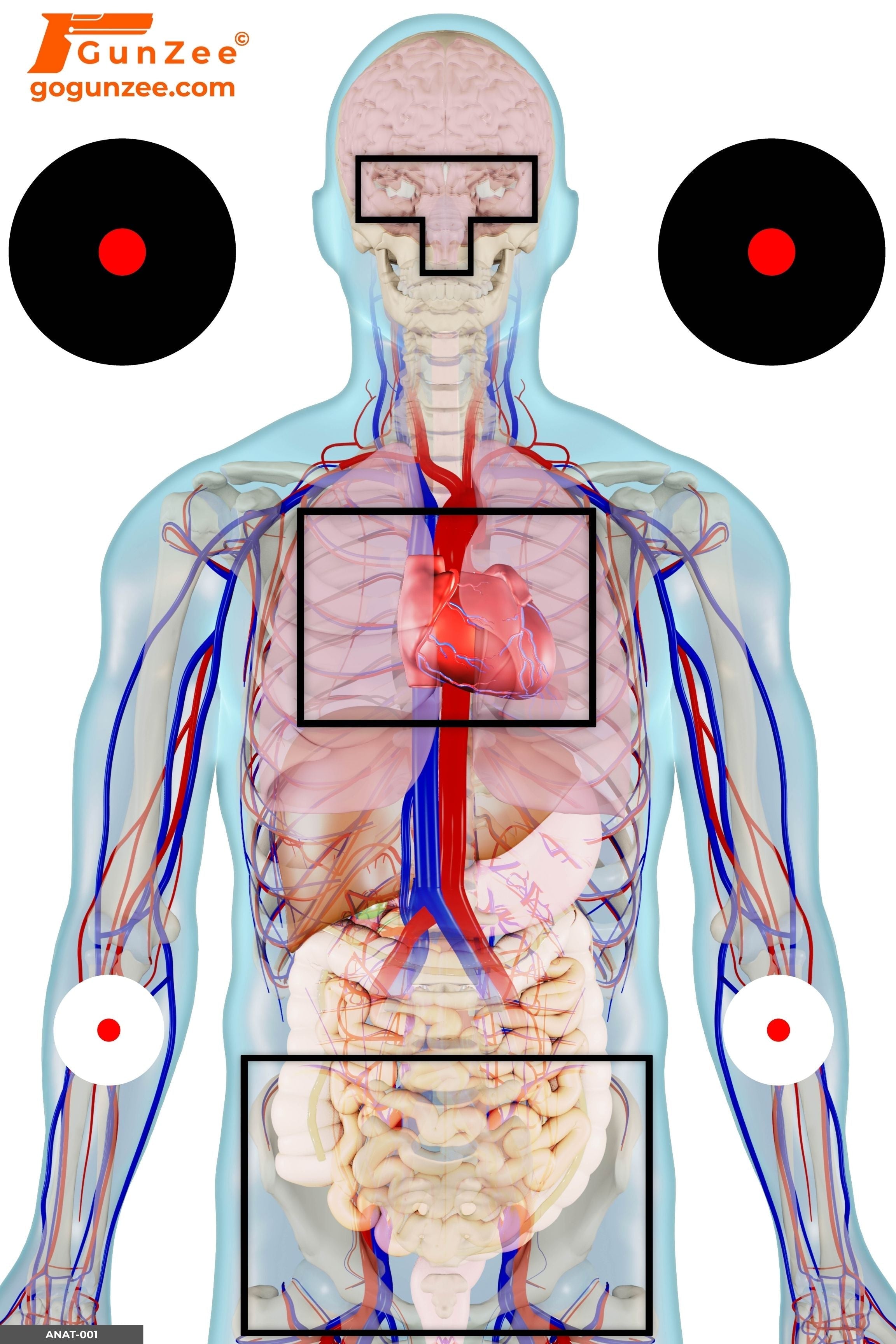
Tactical accuracy means putting rounds into fight-stopping anatomy on a lifelike figure, not the center of a shape. Anatomical vital-zone targets overlay the cardiac box and cranial T-box at true size on realistic threat presentations — the bridge between marksmanship and every scenario lane above.
Scale is not optional
A tactical target only teaches real holds if the threat is rendered at real size. Every GunZee scenario target prints at 24" x 36" — a life-size adult at realistic engagement proportion, with weapons rendered clearly enough to drive honest threat identification. Shrink the figure to notebook size and every skill on this page degrades: the sight picture lies, the anatomy lies, and the decision cues become unreadable at distance. Full-size paper is the cheapest fidelity upgrade in tactical training, which is why the entire GunZee target catalog is built on it at $1.95 a sheet.
Five drills that need the right paper
Tactical targets pay for themselves in the drills they unlock. Five that require scenario paper and cannot be run on a bullseye:
- Call the threat. A partner hangs three scenario targets face-away; on the turn command, you identify armed versus unarmed before any draw. Run it with mixed shoot / no-shoot decision paper and the drill trains the judgment layer directly.
- Doorway percentage. Engage a CQB target from progressively narrower angles of exposure, holding only for the anatomy the "doorway" allows. Scores drop; honesty rises.
- Bystander penalty. Any hit outside the threat on a crowded public-space scene costs the string. The paper defines the penalty zone for you — no shot timer required.
- Vehicle transition. Two rounds on the anatomical figure, move laterally, re-engage the seated driver presentation at its true, lower hold.
- Scenario cold start. First string of the day, no warm-up, one unfamiliar scenario target: draw, decide, deliver. The realism of the scene is what makes the cold read meaningful.
Buyer's checklist: building a tactical target set
A working set covers every lane you train, in enough quantity that fresh paper never rations the session:
- Pass the three-part test. Every target should demand context, decision, or geometry — most of your set should demand two or more.
- Life-size or it lies. 24" x 36" scenario prints, weapons clearly visible, anatomy at true proportion.
- Cover your lanes. A civilian defender's baseline: a handful each from CQB, public-space, and vehicle scenarios, plus anatomical targets to anchor placement.
- Include no-shoots. If every sheet in the stack is a threat, the decision layer evaporates. Mix in no-shoot and ambiguous presentations.
- Buy in training quantity. Scenario drills consume paper — a proper session burns a target every few strings. Training packs price the volume problem away, and volume pricing runs up to 25% off for bulk and department orders.
For teams, departments, and instructors
The same three-part test scales to program level: qualification paper keeps the record, tactical scenario paper builds the judgment the record never captures. GunZee scenario targets are in use at 270+ agencies and training facilities; the law-enforcement target program guide covers the procurement math, and the CQB course-design guide shows how instructors rotate scenario libraries through a curriculum.
Frequently asked questions
What is a tactical shooting target?
A target that adds a tactical demand to the shot: environmental context, a shoot/no-shoot decision, or realistic threat geometry such as angles, cover, or a hostage presentation. Targets that only provide a point of aim — bullseyes, plain silhouettes, novelty prints — are marksmanship targets regardless of how they are branded.
Are silhouette targets tactical?
By themselves, no. A flat silhouette provides a humanoid point of aim but no scene to read, no decision to make, and no geometry to solve. Silhouettes remain the right tool for qualification scoring; tactical skill lives one layer up, on scenario paper.
What size should tactical targets be?
Life size. GunZee scenario targets print at 24" x 36", presenting adult figures at true proportion so holds, anatomy, and decision cues match what a real encounter presents.
What tactical targets should a beginner start with?
Start with anatomical vital-zone targets to build placement against a realistic figure, then add scenario targets from the lane that matches your life — home defense for most, public-space scenarios for daily carriers.
Do professionals train on scenario targets?
Yes. GunZee scenario and anatomical targets are used by 230+ law-enforcement agencies and training facilities as the decision-training layer alongside standard qualification targets.
How many targets does a tactical range session need?
Plan on a fresh sheet every few strings — call it five to ten targets per shooter per serious session. Training packs exist precisely because scenario work consumes paper faster than qualification work.
The bottom line
Tactical is a test, not a style. If the paper does not make you read a scene, make a call, or solve an angle, it is not training the skill its label promises. Hold every target against that standard, build your set across the lanes you actually need, and let the full catalog of life-size scenario targets — from $1.95 a sheet — supply the problems worth solving.
Train it as a pack: the decision-training rotation ships as the CQB & Interior 150-pack, Shoot / No-Shoot 150-pack. Proven singles to start with: Church Aisle Hostage Crisis, Anatomical Frontal Handgun Threat and CQB Forward Weapon Presentation.
Related reading
- Scenario Shooting Targets: What Makes a Target a Scenario, and How to Run One
- Anatomical Shooting Targets: Train Vital Zones, Not Scoring Rings
- Paper Shooting Targets: Material and Manufacturing Insights
- Self-Defense Shooting Targets: Train the Decision, Not Just the Shot
- Shooting Targets: Comprehensive Guide for Professionals
- B-27 Target: Dimensions, Scoring Rings, and Qualification Standards
- Carjacking Shooting Target — Buyer’s Guide
- CQB Targets — Buyer’s Guide
- Browse: Hostage Rescue targets
- Hostage Scenarios: The Decision-Making Drills Most Shooters Skip