Most self-defense practice is marksmanship practice wearing a different name. Tight groups on a bullseye at seven yards feel like readiness, but a defensive encounter is not a shooting problem with a decision attached — it is a decision problem with a shot attached, made at conversational distance, under stress, usually with people nearby who must not be hit. The paper on the stand decides which of those two problems your range time actually trains. This guide lays out what self-defense demands from a shooting target, how to build a progression from fundamentals to full scenarios, and which targets belong in a civilian defender's library.
What a self-defense encounter demands from training
Strip a defensive encounter to its skeleton and four demands appear in order. First, recognition: reading that something is wrong before it is undeniable — covered in depth in the situational-awareness guide, and it happens before any target matters. Second, the decision: armed or unarmed, threat or bystander, shoot or hold. Third, the shot: fast, close, and placed in anatomy that stops a fight, not in the middle of a shape. Fourth, restraint: recognizing the moment the justification ends. A bullseye trains the third demand only. A target earns a place in self-defense training by how many of the other three it loads onto the same trigger press.
That is the standard this guide applies throughout: does the target make you decide, or only aim?
The realism ladder: four rungs from scoring rings to scenarios
Self-defense targets are best understood as a ladder, with each rung adding one layer of realism — and one of the four demands above.
- Bullseyes and scoring grids isolate the mechanics: grip, sight picture, trigger press. Necessary, and never finished — but nothing on the sheet resembles a threat.
- Silhouettes add a human outline and a scoring standard. They are the qualification workhorse, and the silhouette family guide covers where they stop: an outline has no anatomy, no scene, and no decision.
- Anatomical targets put true-scale vital zones — the cardiac box, the cranial T-box — on a realistic figure, so placement is trained against what actually stops a threat. The anatomical target guide covers this rung in full.
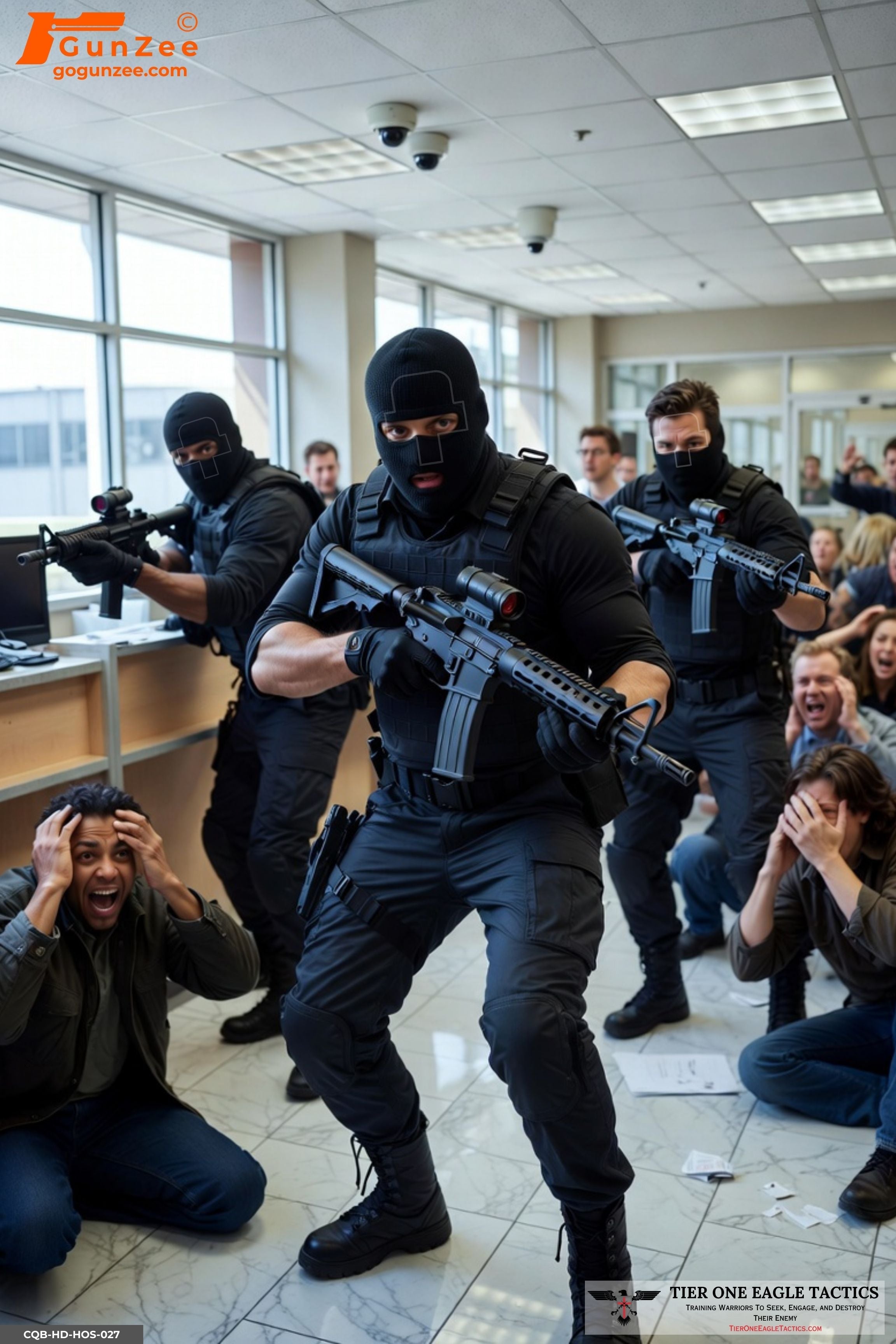
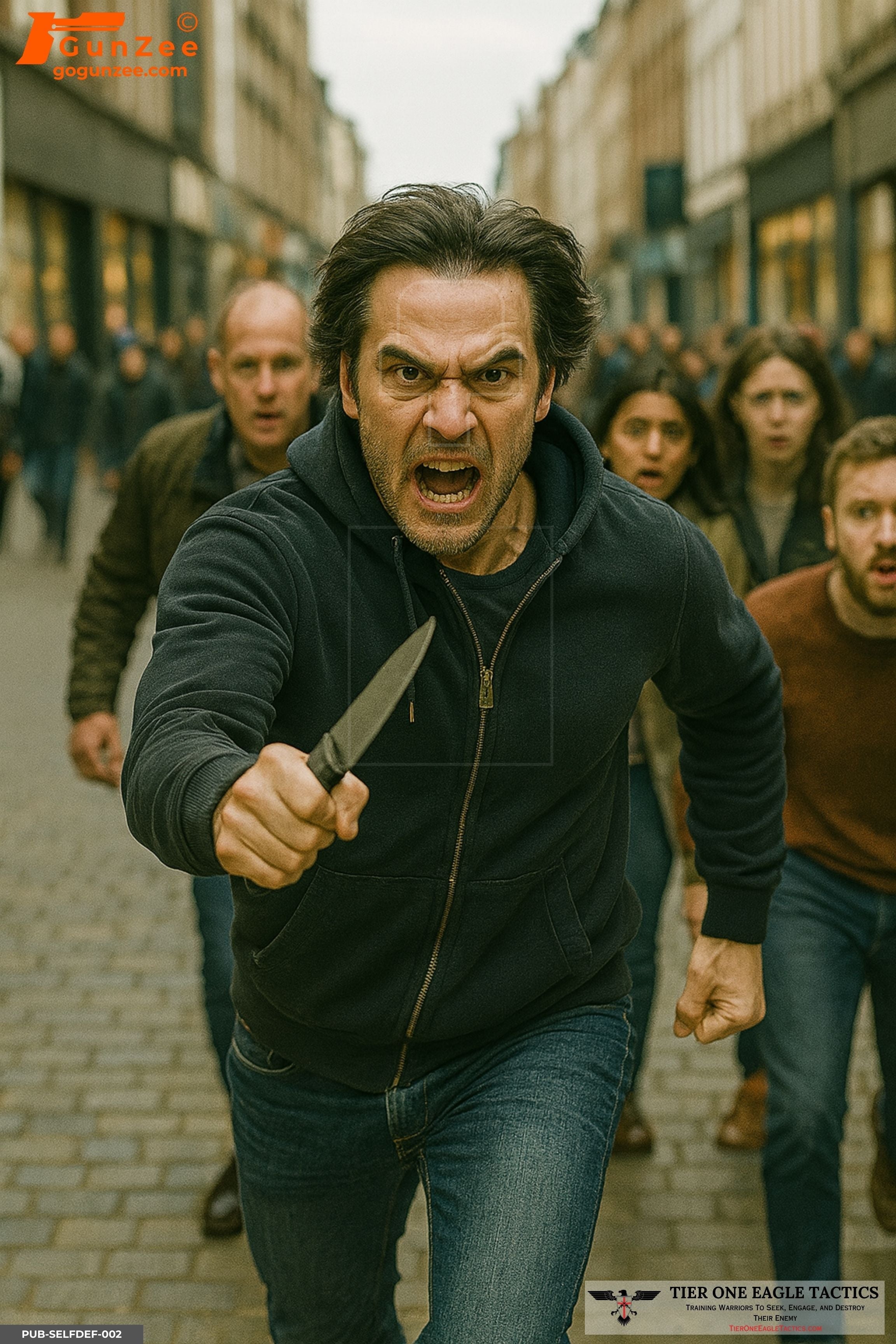
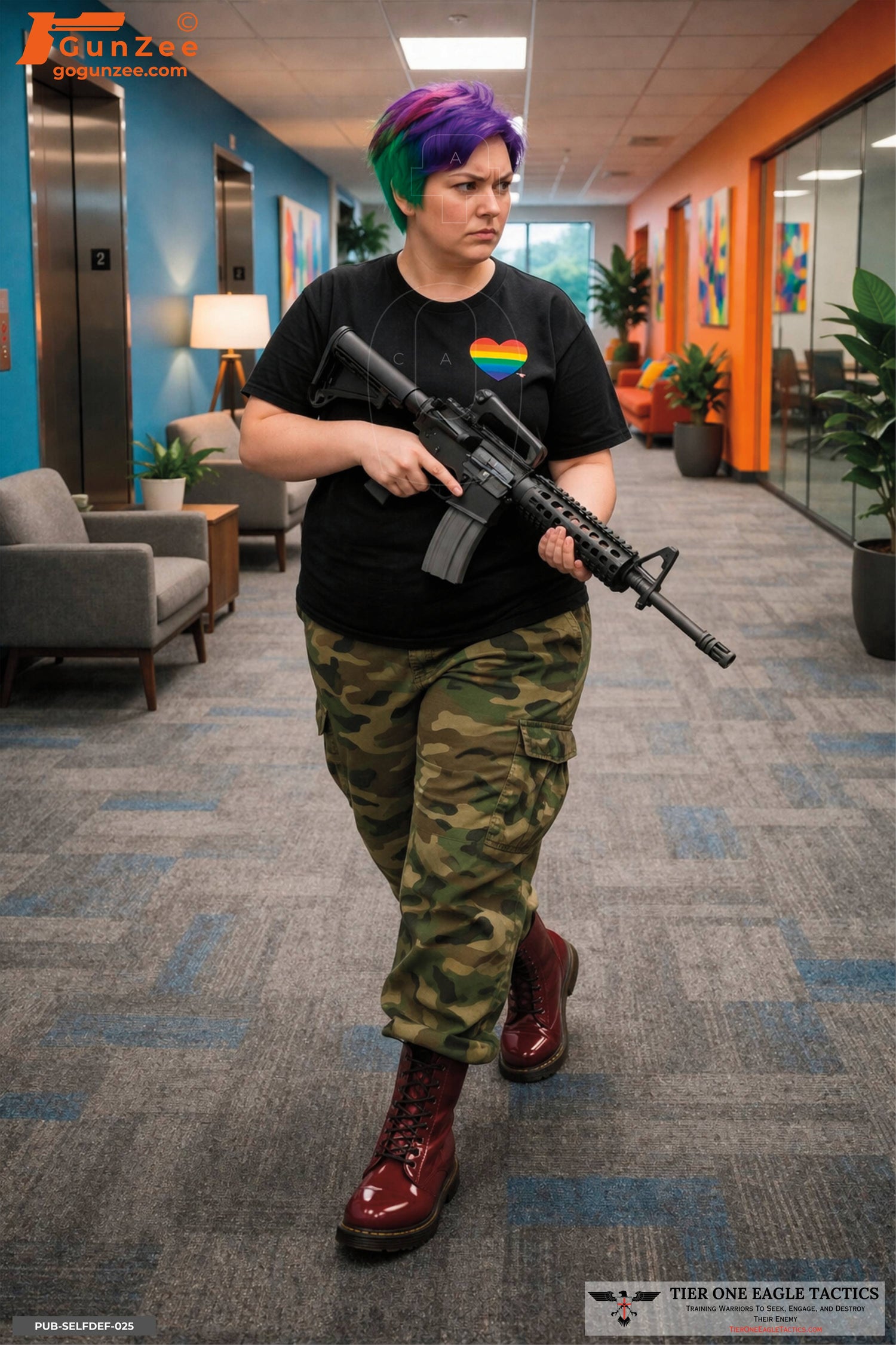
- Scenario targets add the scene: a doorway, a parking lot, a workplace corridor, a threat whose hands must be read before the draw. This is the only rung where the decision — the defining demand of self-defense — is on the paper.
The ladder is a progression, not a ranking. Defenders climb it and keep every rung: fundamentals stay on fundamentals paper, placement stays anatomical, and judgment lives on scenario prints. What a self-defense program cannot be is a program that never leaves the first two rungs.
Match the paper to your actual day
A civilian's threat profile is not hypothetical — it is a map of where your hours go. The honest selection question is not "which scenarios look serious," it is "where would this actually happen to me." Three environments cover most lives:
At home
Interior distances, doorways and hallways, family members in the frame. The home-defense & CQB scenario collection presents armed intruders — and ambiguous non-threats — at the angles and partial exposures a house actually creates.

In and around vehicles
Commuters spend hours a day seated, belted, and boxed in by glass and steel. Carjacking and roadside confrontations present seated threats at raked angles with holds nothing like a square range. The vehicle & barrier collection puts those presentations on paper, and the vehicle-as-cover training guide covers the tactics side.
In public spaces
Grocery aisles, parking lots, ATM lines, the workplace — scenes where the threat is embedded among people you are accountable for missing. The public & everyday self-defense collection is built for exactly this problem set, from workplace active-threat response to rear-aspect ambush recognition.

Weight your library toward the environment you actually occupy. A rural homeowner and an urban daily carrier should not own the same stack of paper — and for the drill structures that bring these scenes to life, the ten defensive scenarios every CCW holder should train is the companion piece.
Training the "no" — half of self-defense is not shooting
Every defensive encounter contains two ways to fail: shooting too late, and shooting when you should not have. Range time overwhelmingly trains against the first failure and almost never against the second — because on most targets there is nothing to evaluate. Fixing that requires paper where the answer is not always yes: unarmed presentations, ambiguous objects, a phone instead of a pistol, a plainclothes officer holding a badge. The shoot / no-shoot decision-drills guide covers the methodology, and the armed-vs-unarmed identification guide breaks down the visual cues themselves.
For shooters building the read itself, the NKZ line takes scaffolding off the sheet: no printed scoring boxes at all, so the shooter must find anatomy and justify the decision with nothing pre-marked. It is the difference between reading with a highlighter and reading the page.
Why realistic human presentation matters under stress
A defensive shooting is performed by a body under alarm: elevated heart rate, narrowed vision, degraded fine motor control. Training inoculates against that state only to the degree the training resembles the trigger for it — and a neon grid does not resemble anything. A life-size, realistic human figure holding a visible weapon carries a weight that a shape does not: hesitation shows up on the first cold read, exactly where it should be discovered and trained away. That emotional realism is not a style choice. It is the mechanism by which scenario training transfers to the day it is needed, and it is why every GunZee scenario target renders threats — and non-threats — as convincing human presentations rather than symbols.
Scale honesty: life-size or the training lies
Every hold, every anatomical reference, and every decision cue on this page assumes the figure is presented at true adult proportion. GunZee scenario and anatomical targets print at 24" x 36" — life size at realistic engagement distance. Shrink the threat to notebook scale and the sight picture lies, the anatomy lies, and the weapon-versus-phone read becomes trivially easy in a way no real encounter is. Full-size paper at $1.95 a sheet is the cheapest honesty available in defensive training.
A starter self-defense target library
A working civilian library is smaller than most shooters expect — the volume comes from repetition, not variety:
- Anatomical vital-zone targets to anchor placement on a realistic figure — the rung every scenario stands on.
- A home-defense set: two or three armed-intruder presentations plus at least one hostage or family-member no-shoot.
- A public-space set matched to your routine: workplace, parking lot, ATM, grocery — with bystanders in frame.
- A vehicle presentation if you commute armed.
- Deliberate no-shoots mixed in at a ratio that keeps the decision honest — if every sheet is a threat, there is no decision left to train.
Fresh paper is part of the method: a serious session consumes a sheet every few strings, and training packs exist to price that consumption away. For shooters who want the selection made for them, the packs bundle the best-selling scenarios across all three environments.
Frequently asked questions
What are self-defense shooting targets?
Paper targets designed to train defensive skills rather than pure marksmanship: realistic human presentations, true-scale vital anatomy, environmental context, and shoot/no-shoot decision content. They range from anatomical placement targets to full scenario prints of home, public, and vehicle encounters.
How are self-defense targets different from regular range targets?
A regular target gives you a point of aim; a self-defense target gives you a problem. The difference is decision content — threat identification, bystander accountability, restraint — which is the layer a defensive encounter is actually decided on.
What self-defense targets should a beginner start with?
Start on anatomical vital-zone targets to build placement against a realistic figure, then add scenario targets from the environment you spend the most time in — home defense for most people, public-space scenarios for daily carriers.
Do I need no-shoot targets for self-defense training?
Yes. Half of defensive judgment is recognizing when not to fire, and that cannot be trained on paper that is always a threat. Mix unarmed and ambiguous presentations into every scenario session.
What size should self-defense targets be?
Life size. GunZee scenario targets print at 24" x 36" so figures, weapons, and vital zones appear at true proportion — holds and decision cues only transfer when the scale is honest.
Are these the same targets professionals train on?
Yes. GunZee scenario and anatomical targets are used by 230+ law-enforcement agencies and training facilities as the decision-training layer of their programs — the same sheets are available to civilian defenders from $1.95.
The bottom line
Self-defense is a decision discipline, and paper that cannot carry a decision cannot train it. Keep fundamentals on fundamentals targets, build placement on anatomy, and put the bulk of your defensive training where the encounter will actually be decided — on life-size scenario paper that makes you read, choose, and account for everyone in the frame. The full GunZee catalog supplies every rung of that ladder from $1.95 a sheet.
Train it as a pack: civilian defenders can start with the Knife & Edged Weapon 80-pack, Public Threat Discrimination 110-pack, Best Sellers 125-pack. Or start with three proven singles — Church Aisle Hostage Crisis, Anatomical Frontal Handgun Threat and CQB Forward Weapon Presentation.
Build the fundamentals first: The fundamentals of accurate shooting: grip, stance, sight alignment & trigger control · Trigger control under pressure · Recoil management & follow-up shots · Dry-fire training guide · Situational awareness in public spaces · Realistic CQB drills for the solo shooter.
Related reading
- Paper Shooting Targets: Material and Manufacturing Insights
- Shooting Targets: Comprehensive Guide for Professionals
- Tactical Shooting Targets: What Counts, What Doesn’t, and How to Choose
- Browse: Anatomical & Shot Placement targets
- B-27 Target: Dimensions, Scoring Rings, and Qualification Standards
- Carjacking Shooting Target — Buyer’s Guide
- CQB Targets — Buyer’s Guide
- Gun Targets: The Buyer’s Guide for Serious Training
- Browse: Hostage Rescue targets
- Hostage Scenarios: The Decision-Making Drills Most Shooters Skip
- Law Enforcement Training Targets: From Qualification to Decision Training