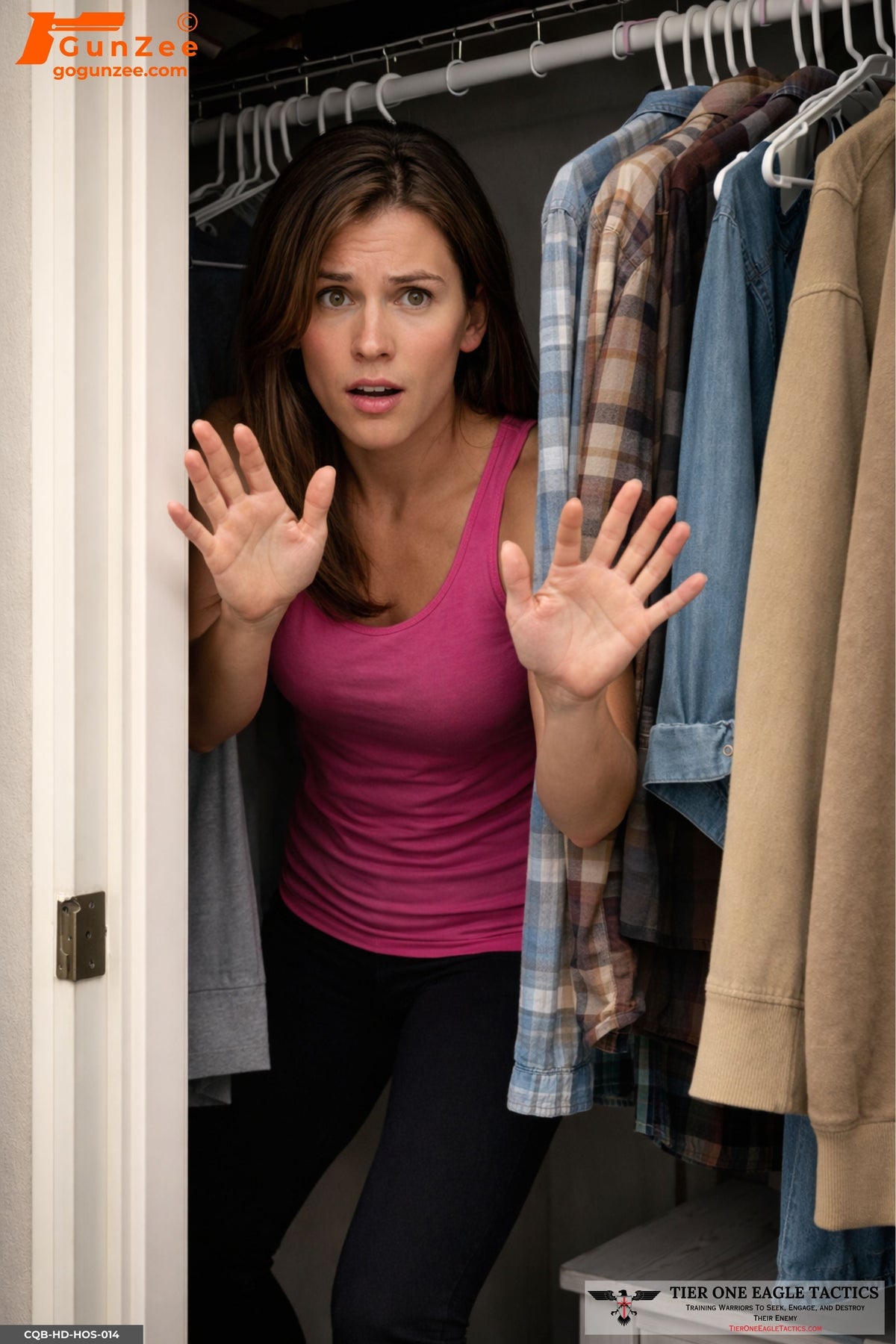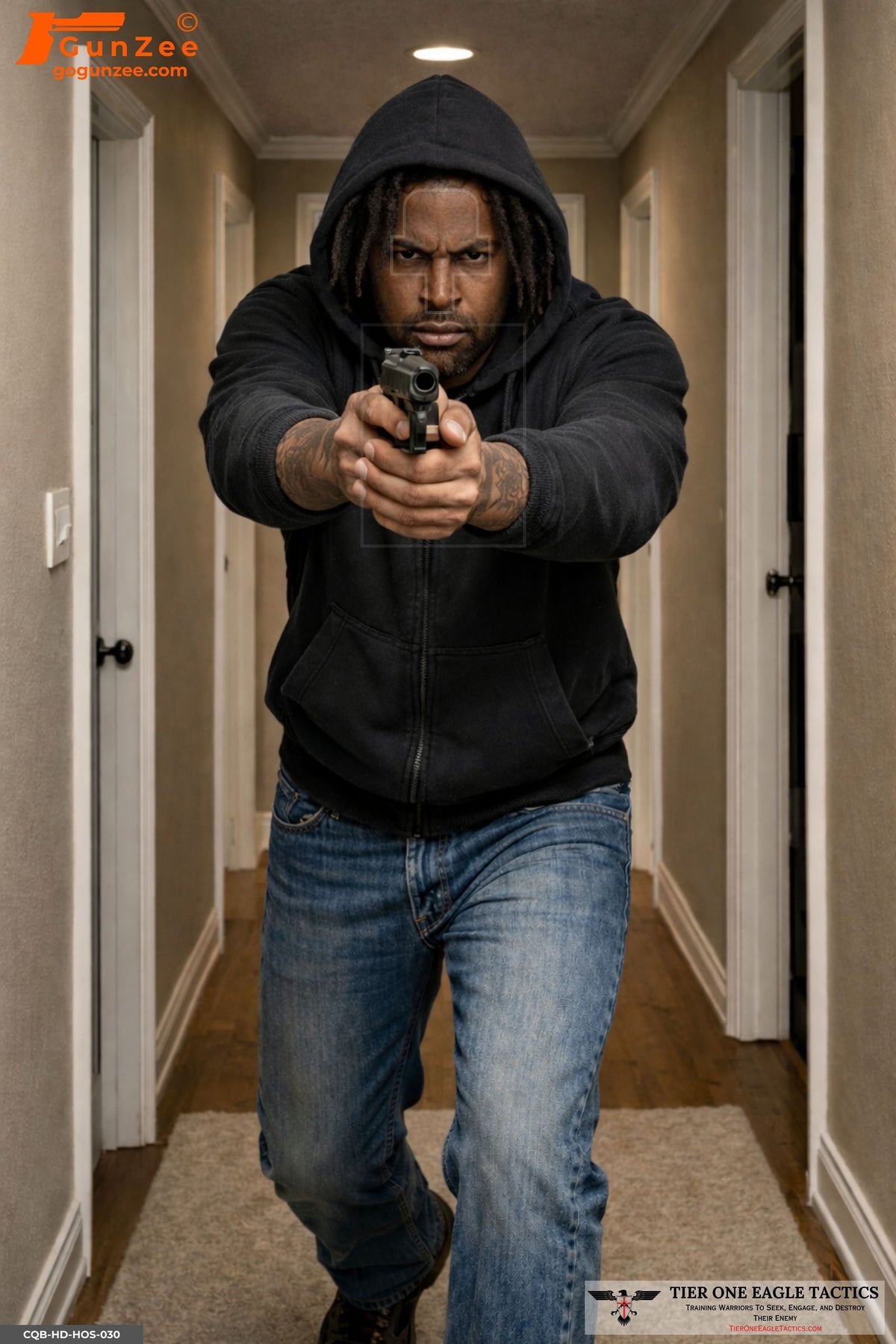
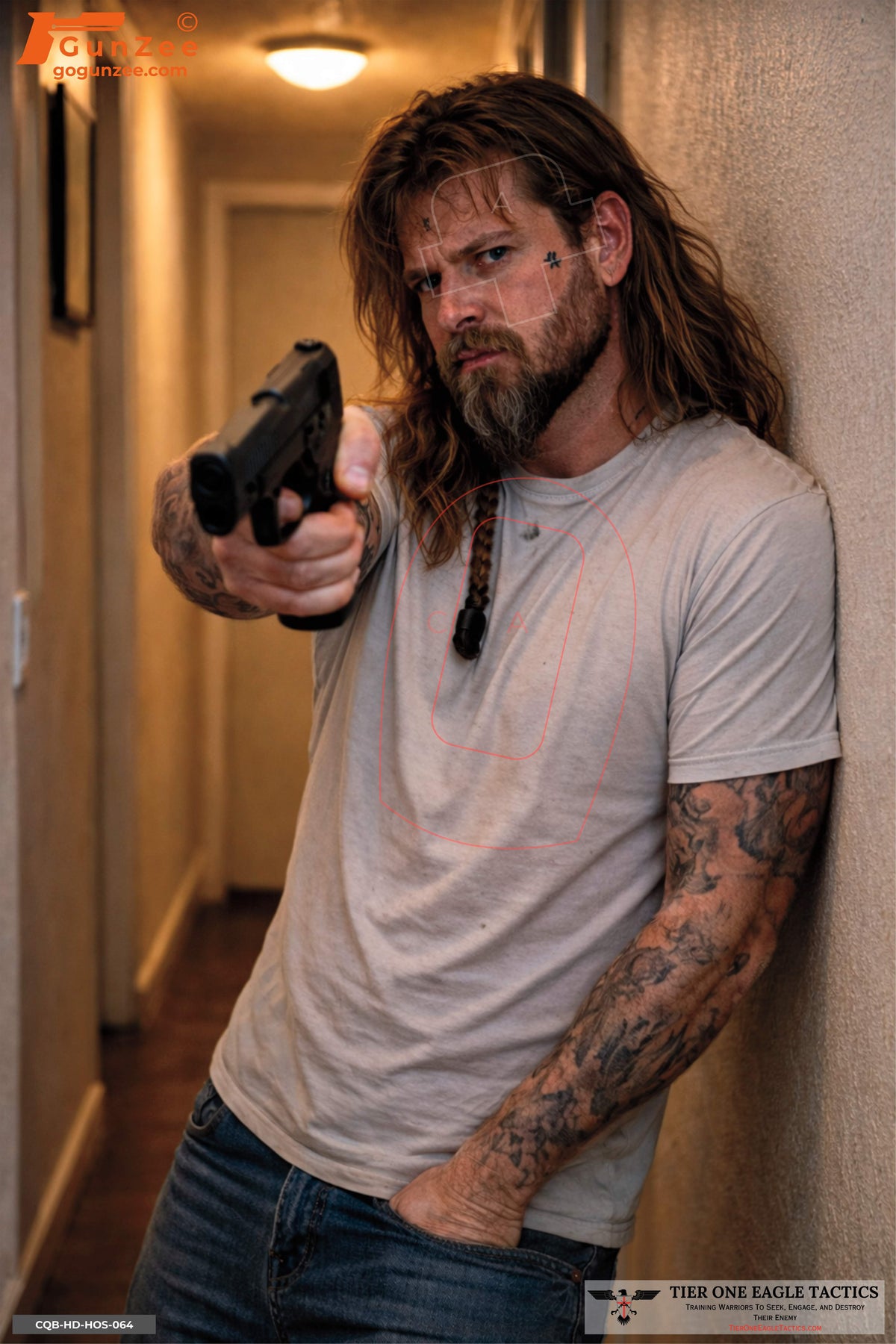
Every course of fire is built on a sheet size and a scoring zone, and the numbers are scattered across rulebooks, state standards, and product pages. This chart puts them in one place: the qualification silhouettes, the competition cardboard, the precision bullseye, and the life-size scenario sheets, with the sheet size and the zone geometry for each. It is free to print and share.
Download the printable chart (PDF, landscape letter)
Qualification silhouettes
The sheets agencies qualify on. Sheet sizes are the common print; ring and zone sizes are the published standard.
| Target | Sheet size | Silhouette / scoring geometry | Typical use |
|---|---|---|---|
| NRA B-27 | 24 x 45 in (official); 35 x 45 wide prints; B-27E economy 22.5 x 35 | Oval rings X-10-9-8-7 climbing to center mass. X 2.2 x 3.1 in (55 x 78 mm); 10-ring 4 x 6 in (100 x 150 mm); 9-ring 8 x 11.8; 8-ring 11.8 x 17.7; 7-ring 15.7 x 23.6 | Police and concealed-carry qualification; rated 50 yd, most courses 3-25 yd |
| NRA B-21 / B-21E | Full-size silhouette sheet | Zoned scoring by number; the 4 and 5 zones are the scoring area on Florida's standard | Older than the B-27; still named in Florida's commission standard |
| FBI QIT-99 (the Q) | 23 x 35 in | 26 in bottle: body 12 in wide, head cap 6 x 6 in, 6 in shoulder taper, 14 in straight body; head reference box 3 x 3 in; chest reference box 4 x 6 in where printed. One point inside the bottle, nothing outside | FBI agent qualification and the academies that adopted the course |
| TQ-15 / TQ-19 / TQ-21 | 23 x 35 in common print; varies by maker | Full-size police silhouette with printed head and center-of-mass zones; point values depend on version and agency overlay | NRA police training and qualification silhouettes; many state courses |
| Texas DPS | Full-size, green outer silhouette | Inner tan area of about 238 sq in scores 2; outer silhouette is a miss. Reference eye box 3 x 2 in and heart box 4 x 3 in printed, not scored | Texas Highway Patrol |
| US Army LE (USALE) dwg 13071180 | 19.5 x 29 in, two-sided | Body side: FBI-Q-style silhouette 12 in wide with 5.5 in head cap, 5 x 3 in head box, five 3 in bullseyes (2 in ring, 1 in center). Zero side: four 8 in bulls with 5.5 in black, 3.5 and 1.75 in rings, 1 in grid; 10 m zero panel, dots 1.9 in apart | Army Law Enforcement Training Division qualification and 10 m zero |
Competition and precision targets
Match cardboard and the bullseye that most 10 and 25 yard pistol standards are scored on.
| Target | Sheet size | Scoring geometry | Typical use |
|---|---|---|---|
| IDPA official | 18 x 30 in cardboard | 8 in -0 circle high in the chest; 4 in -0 circle inside a 6 in head box; -1 and -3 zones outside | IDPA matches; some agencies allow for in-service courses |
| USPSA metric | About 18 x 30 in cardboard | Lower A-zone about 6 x 11 in; smaller upper A-zone in the head; C and D zones outside | USPSA / IPSC matches |
| NRA B-8 | Letter-size bullseye repair center | 8-ring 8.0 in, 9-ring 5.54 in, 10-ring 3.36 in, X-ring 1.695 in; black to the 9-ring | 25 yd timed and rapid fire; common 10 yd pistol standard |
Life-size scenario and anatomical targets
Decision and placement training sheets. The zones here follow anatomy on the printed person rather than a fixed ring.
| Target | Sheet size | Zone geometry | Typical use |
|---|---|---|---|
| GunZee scenario target | 24 x 36 in (life-size) | A real person in a real place; cardiac box about 6 x 6 in over the heart and great vessels; cranial T-box about 3 in wide across the eyes and nose; pelvic girdle on anatomical sheets | Decision (shoot / no-shoot) and placement training for LE, academies, and civilians |
| GunZee anatomical overlay | 24 x 36 in | Medically placed cardiac box, T-box, and pelvic girdle drawn where they sit under the skin on that presentation (frontal, semi-profile, rifle, hostage shield, vehicle window) | Placement layer between qualification and scenario work |
| Reduced-scale qualification sheets | Scaled to the lane | Same zones, shrunk so the target subtends the same angle at a shorter distance | Indoor ranges that cannot reach the course's longest line (Florida allows one for its 15 yd stage) |
How to use the chart
- Building a course: pick the sheet the standard names, then confirm the zone sizes above against the stock you actually have; makers vary sheet size.
- Reduced-scale lanes: keep the zone in the same angular size. A 4 x 6 in ten-ring at 25 yd is a 1.6 x 2.4 in ring at 10 yd.
- Moving from rings to anatomy: the B-27 ten-ring (4 x 6 in) and the FBI Q chest box (4 x 6 in) are close to the cardiac box on a life-size figure; the Q head box (3 x 3 in) and the T-box (about 3 in wide) are close cousins. That is the bridge from qualification paper to scenario paper.
Related guides
- B-27 Target: Dimensions, Scoring Rings, and Qualification Standards
- FBI Q Target Dimensions
- Police Qualification Targets by State and Agency
- Silhouette Shooting Targets: Types, Sizes, and What They Miss
- Shooting Target Kill Zones: T-Box, Cardiac Box, A/C Zones
- Shooting Targets: The Buyer's Guide for Serious Training
GunZee makes life-size 24 x 36 in scenario and anatomical shooting targets at $1.95 each. Agencies order through the request-a-quote page.