Ask a range for "the FBI target" and you'll get a gray bottle. The QIT-99 — the Bureau's qualification silhouette, usually just called the FBI Q target — is one of the most-shot pieces of paper in American law enforcement, and one of the least documented. Shooters searching for its exact dimensions mostly find forum threads and guesswork. This is the complete reference: the sheet and silhouette measurements, how the scoring actually works, the full current qualification course of fire, and where the Q fits in a modern training progression. It's the companion spec sheet to our B-27 dimensions guide in the silhouette target family.
What the FBI Q target actually is
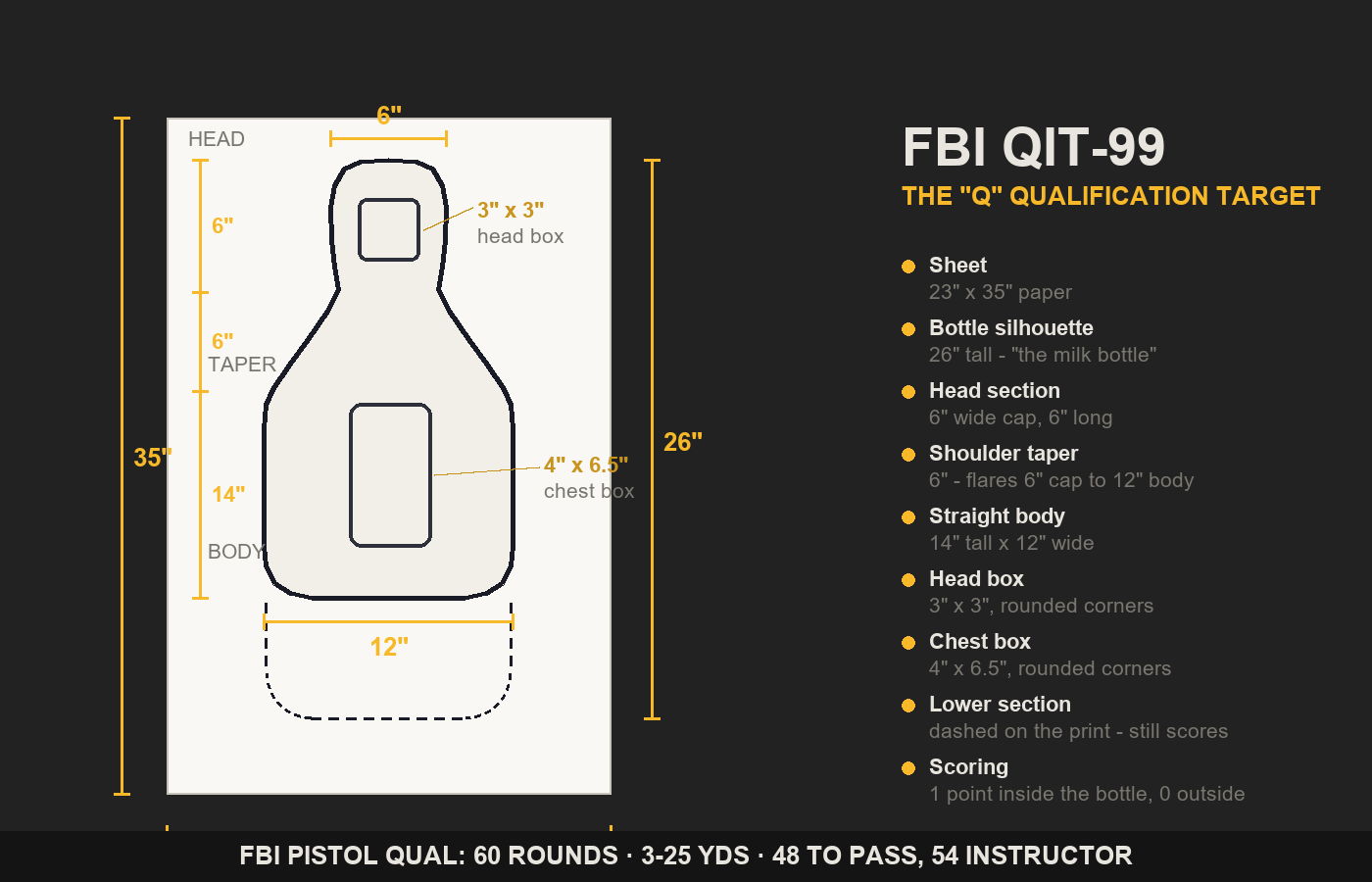
The QIT-99 ("Qualification Intermediate Target," 1999 revision) is the silhouette the FBI adopted for agent pistol qualification, replacing the older FBI-Q design it closely resembles. Where the B-27 is a full human silhouette wrapped in scoring rings, the Q is deliberately minimal: a narrow, bottle-shaped outline — shooters have called it "the milk bottle" for decades — printed either as a heavy outline on white or as a light gray/tan fill, depending on the manufacturer. Most prints add two rounded-corner interior reference boxes (head and high chest) and finish the bottom of the bottle in a dashed line — hits in the dashed section still count; the dashes just mark where the silhouette runs off the useful paper.
That minimalism is the point. The bottle traces the vertical corridor of a squared-up threat — head, neck, and the center chest — and everything outside it is a miss. There are no consolation rings.
FBI Q target dimensions

The FBI has never published an official public spec sheet for the QIT-99, so the numbers below are the printed dimensions used across licensed target manufacturers and confirmed measurements of production sheets. If you're checking a print against this table, measure the silhouette, not the paper margins — sheet trim varies by printer.
| Element | Dimension |
|---|---|
| Sheet (standard print) | 23" × 35" |
| Bottle silhouette, total height | 26" |
| Body (bottom section) width | 12" |
| Head section (cap), width × length | 6" × 6" |
| Shoulder taper (6" cap flaring to 12" body) | 6" |
| Straight body section from the bottom | 14" |
| Head reference box (where printed) | 3" × 3" |
| Chest reference box (where printed) | 4" × 6.5" |
The geometry to remember: a 6"-wide head column flaring through a shoulder taper into a 12"-wide body column, 26" top to bottom. At 25 yards, that 12" body column is a demanding but honest measure of service-pistol accuracy — roughly the vital width of an adult torso, with none of the B-27's generous 7-ring real estate around it.
How the Q scores: one point or nothing
Scoring on the QIT-99 is binary. Any hit inside the bottle outline counts one point. Any hit outside it — even touching the line's outer edge on a sheet with visible paper all around — counts zero. There are no ring values to add up and no X-count tiebreakers. A 60-round course has 60 possible points, and the question for every shot is the same one a gunfight asks: was it in the corridor that matters, or not?
This is the sharpest philosophical difference from the B-27's graduated rings, which award 7, 8, or 9 points for hits that drift well outside vital anatomy. The Q simply refuses to pay for those.
The FBI pistol qualification course of fire (current standard)
The course below is the FBI's revised standard (April 2013), fired on a single QIT-99 or QIT-03 target with 60 rounds of service ammunition. Every string starts from the holster, drawn from concealment — a cover garment is required. Passing is 48 of 60 (80%) for agents and 54 of 60 (90%) for firearms instructors.
| Stage | Distance | Strings | Rounds |
|---|---|---|---|
| 1 | 3 yards | Draw, 3 rounds in 3 seconds, strong hand only — twice. Then draw, 3 rounds strong hand, transfer, 3 rounds support hand only, all in 8 seconds. | 12 |
| 2 | 5 yards | Draw, 3 rounds in 3 seconds — four times. (Two hands from here on.) | 12 |
| 3 | 7 yards | Draw, 4 rounds in 4 seconds — twice. Then draw, 4 rounds, empty-gun reload, 4 more rounds, all in 8 seconds. | 16 |
| 4 | 15 yards | Draw, 3 rounds in 6 seconds — twice. Then draw, 4 rounds in 8 seconds. | 10 |
| 5 | 25 yards | Move to the barricade, draw, 2 rounds standing then 3 rounds kneeling in 15 seconds — twice. | 10 |
Two details separate this course from most state qualifications: the concealment draw on every single string, and the round distribution — 40 of 60 rounds inside 7 yards, where agent-involved shootings actually happen, but with times tight enough that a lazy presentation fails the string.
The legacy FBI-Q course
Before the 2013 revision, the Bureau qualified on the original FBI-Q bottle with a 50-round course scored at two points per bottle hit (100 possible, 85% to pass, 90% for instructors), with heavy emphasis at 25 yards — including prone and barricade positions. You'll still find agencies and academies running versions of it, which is why "the FBI qual" means different things at different ranges. If a course description mentions prone at 25 yards, it's the legacy version.
Why the bottle trains differently than rings
The Q's narrow corridor and pass/fail scoring build a specific habit: accept only center hits, and own the misses. Nothing about the target, though, asks the shooter to make a decision — the bottle is always a threat, every day, from every distance. That's exactly what qualification should isolate, and exactly where qualification stops being training. The zones the bottle implies are made explicit on scored targets with printed kill zones — the cranial T-box the Q's 3" head box approximates, and the cardiac box its 4" × 6.5" chest box roughly traces.
After the Q: putting the corridor on a person
Once a shooter holds the bottle standard, the progression that actually changes outcomes is moving those same corridors onto life-size scenario prints — a threat with hands, a weapon, an angle, and bystanders, where the "bottle" has to be found before it can be hit. That's the design brief behind our anatomical shooting targets and the wider scenario line: 24" × 36" scenes with the scoring zones of a scored target placed on real anatomy, at $1.95 a sheet. Agencies running Q-based quals typically pair them with law enforcement training targets for the judgment block the qualification course deliberately leaves out.
Reference: every sheet size and scoring zone on this page, plus IDPA, USPSA, B-8, Texas DPS and USALE, is in the printable shooting target dimensions chart.
Frequently asked questions
What size is the FBI Q target?
The standard QIT-99 print is a 23" × 35" sheet. The bottle silhouette itself is 26" tall, 12" wide through the body, and 6" wide through the head.
How is the FBI Q target scored?
One point for any hit inside the bottle outline, zero for anything outside it. On the current 60-round course, agents need 48 points (80%) and instructors need 54 (90%).
What distance is the FBI qualification shot at?
The current course runs from 3 to 25 yards across five stages — 12 rounds at 3 yards, 12 at 5, 16 at 7, 10 at 15, and 10 at 25 behind a barricade. Every string starts from a concealment draw.
What's the difference between the QIT-99 and the B-27?
The B-27 is a full-width human silhouette with graduated scoring rings (X through 7); the QIT-99 is a narrow bottle scored hit-or-miss. The B-27 rewards proximity, the Q only rewards the corridor — which is why many instructors consider the Q the more honest qualification target.
Is the FBI Q target good for home practice?
It's a strong accuracy standard — the course needs only one target, 60 rounds, a shot timer, and 25 yards of range. Shooters without a concealment garment can run it from open carry and treat the times as generous. For the decision-making layer the Q doesn't test, add scenario targets to the same session.
The bottom line
The FBI Q is the anti-B-27: less silhouette, no rings, no partial credit. A 23" × 35" sheet, a 26" bottle, and a single question per shot. Learn its dimensions to build or check your own prints, run the 2013 course as written for an honest read on your presentation and accuracy — then take the corridor it teaches and go find it on a target that looks like the problem you're actually training for.
Related reading
B-27 Target Dimensions, Scoring Rings & Qualifications · Silhouette Shooting Targets: From B-27 to Life-Size Scenario Realism · Shooting Target Kill Zones: T-Box, Cardiac Box, A/C Zones Explained · Law Enforcement Training Targets: The Complete Guide