

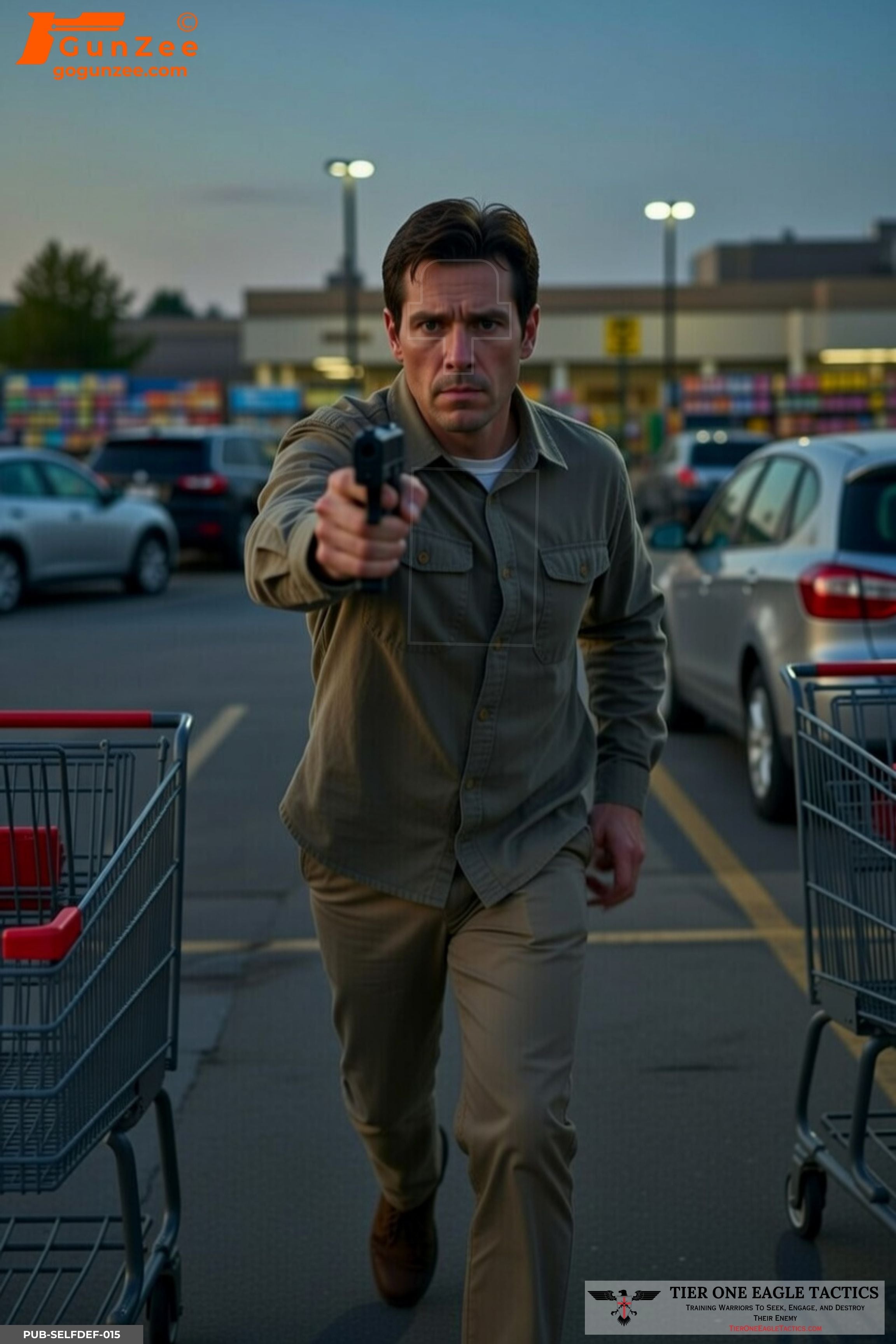
Grocery Store Parking Lot Armed Approach – Public Threat Interception [24" x 36"]
Quantity must be in increments of 5
Grocery Store Parking Lot Armed Approach – Public Threat Interception
This training target depicts an armed individual advancing through a grocery store parking lot with a firearm presented, surrounded by civilian vehicles, shopping carts, and everyday public infrastructure. The setting reflects a common transitional space where defensive encounters occur suddenly, with limited cover and significant backdrop risk.
This target incorporates intentionally placed transparent kill zones to support post-engagement shot placement evaluation following a training event or decision-making sequence.
Training Purpose
Parking lots are among the most frequent locations for violent encounters due to open sightlines, constant civilian movement, and transitional behavior such as loading vehicles or returning shopping carts. These environments compress reaction time while dramatically increasing the consequences of poor judgment.
This target is designed to train shooters to recognize an imminent lethal threat while processing forward movement, environmental clutter, and closing distance. The kill zones are not intended to dictate engagement decisions, but to provide objective feedback after the drill regarding shot placement, effectiveness, and accountability.
Skills Reinforced
- Rapid visual identification of an armed threat in a public environment
- Threat intent recognition during forward movement
- Distance and closing-speed assessment
- Muzzle discipline with vehicles and bystanders in the background
- Shoot / no-shoot decision discipline under pressure
- Cognitive control and accountability in transitional, everyday locations
Why This Target Is Different
Many training targets either omit anatomical reference entirely or rely on bold scoring rings that oversimplify real-world decision-making. This target uses subtle, transparent kill zones to preserve realism while still allowing meaningful post-event evaluation.
The shooter must:
... ...Grocery Store Parking Lot Armed Approach – Public Threat Interception
This training target depicts an armed individual advancing through a grocery store parking lot with a firearm presented, surrounded by civilian vehicles, shopping carts, and everyday public infrastructure. The setting reflects a common transitional space where defensive encounters occur suddenly, with limited cover and significant backdrop risk.
This target incorporates intentionally placed transparent kill zones to support post-engagement shot placement evaluation following a training event or decision-making sequence.
Training Purpose
Parking lots are among the most frequent locations for violent encounters due to open sightlines, constant civilian movement, and transitional behavior such as loading vehicles or returning shopping carts. These environments compress reaction time while dramatically increasing the consequences of poor judgment.
This target is designed to train shooters to recognize an imminent lethal threat while processing forward movement, environmental clutter, and closing distance. The kill zones are not intended to dictate engagement decisions, but to provide objective feedback after the drill regarding shot placement, effectiveness, and accountability.
Skills Reinforced
- Rapid visual identification of an armed threat in a public environment
- Threat intent recognition during forward movement
- Distance and closing-speed assessment
- Muzzle discipline with vehicles and bystanders in the background
- Shoot / no-shoot decision discipline under pressure
- Cognitive control and accountability in transitional, everyday locations
Why This Target Is Different
Many training targets either omit anatomical reference entirely or rely on bold scoring rings that oversimplify real-world decision-making. This target uses subtle, transparent kill zones to preserve realism while still allowing meaningful post-event evaluation.
The shooter must:
- Make engagement decisions based on behavior, context, and legality
- Execute shots without relying on overt visual cues
- Review results after the sequence, not during it
- Assess whether shots landed in anatomically decisive areas
This approach reinforces judgment first and precision second—mirroring real defensive encounters.
Scenario Context (Educational)
Grocery store parking lots are common locations for robberies, assaults, and armed confrontations due to accessibility, distraction, and civilian density. Threats may emerge suddenly and advance rapidly, often leaving little margin for error.
Kill Zone Reference System (Intentional Feature)
- This target includes transparent cranial and cardiac kill zones used for post-engagement shot placement evaluation:
- Cranial Kill Zone (Expanded T-Box)
The cranial kill zone is based on the conventional T-Box, defined by a horizontal line across the upper lip/base of the nose and a vertical line between the eyes. This target uses a modified T-Box that expands upward into the lower forehead region, reflecting anatomical regions known to produce immediate neurological incapacitation when disrupted.
The expanded area accounts for head movement and real-world angles and is intended for evaluation after the event, not as a pre-programmed aiming reference. - Cardiac Kill Box (Upper Thoracic Cavity)
The cardiac kill box represents the upper thoracic cavity, encompassing the heart, aortic arch, and major vascular structures associated with rapid physiological incapacitation.
These kill zones are:
- Purpose-built training references
- Used to judge shot placement after a drill or sequence
- Not scoring rings
- Not mandatory aim points
- Not a substitute for judgment, legality, or threat assessment
Related training targets
Pair this target with related scenarios from across the GunZee catalog:
Public and everyday self-defense: Public Festival Armed Threat – Dense Crowd Gunman Scenario, Grocery Aisle Dual-Threat Confrontation Shooting Target, Urban Street Two-Man Armed Confrontation Shooting Target, Public Knife Assault Disarm – Close-Range Edged Weapon Encounter
Home defense, CQB, and hostage: Interior Male Wearing Body Armor With Concealed Handgun Shooting Target, Hallway Threat Civilian in the Doorway Shooting Target, Hallway Threat Active Shooter Movement Shooting Target
Vehicle and barrier: Vehicle Barrier Door-Jamb Armed Threat Shooting Target, Vehicle Barrier Windshield Gunman Engagement Shooting Target, Vehicle Barrier Armed Subject Exiting Vehicle Shooting Target
Anatomical: Anatomical Side-Profile Rifle Threat Shooting Target, Anatomical Full-System Vital Zone Shooting Target, Anatomical Hostage Shield Vital Zone Shooting Target
Also ships in: Shoot / No-Shoot 150-pack, Active Shooter 60-pack, Best Sellers 125-pack — five of each design, priced below singles.