Active Shooter Training: The Realistic-Scenario Guide for Civilians, Instructors, and LE
Active shooter training is one of the most demanding disciplines in modern defensive shooting. The scenarios are fast, the environments are complex, and the consequences for missing a shot or hesitating at the wrong moment are severe. The skills that actually transfer from range to real-world are not the ones you build with a bullseye. They come from working through realistic scenarios that force the shooter to identify, decide, and engage under the specific conditions the encounter will present. See all our active shooter training targets.
This guide walks through what active shooter training actually prepares you for, which skills realistic scenario targets are designed to build, and how instructors sequence drills so that shooters develop those skills in the right order. It also lists the specific GunZee Public & Everyday Self-Defense scenario targets that we recommend for each part of the progression.

What Active Shooter Training Actually Prepares You For
The phrase "active shooter" covers a wide range of encounters. Most involve a lone armed subject in a public or semi-public environment with a mix of bystanders, limited cover, and compressed decision windows. The FBI's own after-action reviews show that the environments where active shooter incidents most commonly happen are workplaces, schools, retail spaces, transit venues, and social gathering places. Each of those environments carries specific tactical constraints — hallway geometry, cubicle sight-lines, dense crowds, low-light interiors — and each demands a slightly different response. Workplaces sit at the top of that list, which is why we recommend the workplace active shooter target as the first scene in a training progression — an office is the environment where most working adults would actually face the encounter.
Effective active shooter training builds three overlapping capabilities in the shooter: scenario recognition — the ability to read a scene and identify the threat, non-threats, and bystanders quickly; discrimination — the discipline to hold fire when the situation calls for it, even under time pressure; and precision engagement under realistic conditions — the technical skill to place shots accurately when the target may be partially covered, moving, or standing near a non-threat. All three have to work together. A shooter who can put ten rounds into a saucer at fifteen yards but freezes at the reveal of a chaotic scene has not actually trained for the encounter.
Because the demand crosses so many domains at once, active shooter training is naturally intermediate-to-advanced work. It assumes a foundation in shot placement, safe weapon handling, and drawing from concealment. The next step is applying that foundation to specific scenarios. See our Shooting Targets Buyer's Guide for a broader walkthrough of how to pick targets for each training goal.
The Skills Realistic Scenario Targets Build
A traditional silhouette target trains one skill: precision shot placement to a known aim point. It is a valuable tool for building fundamentals, but it does not train the perceptual, cognitive, or decision-making side of a defensive encounter. A realistic scenario target changes what the shooter has to do the moment the target is revealed.
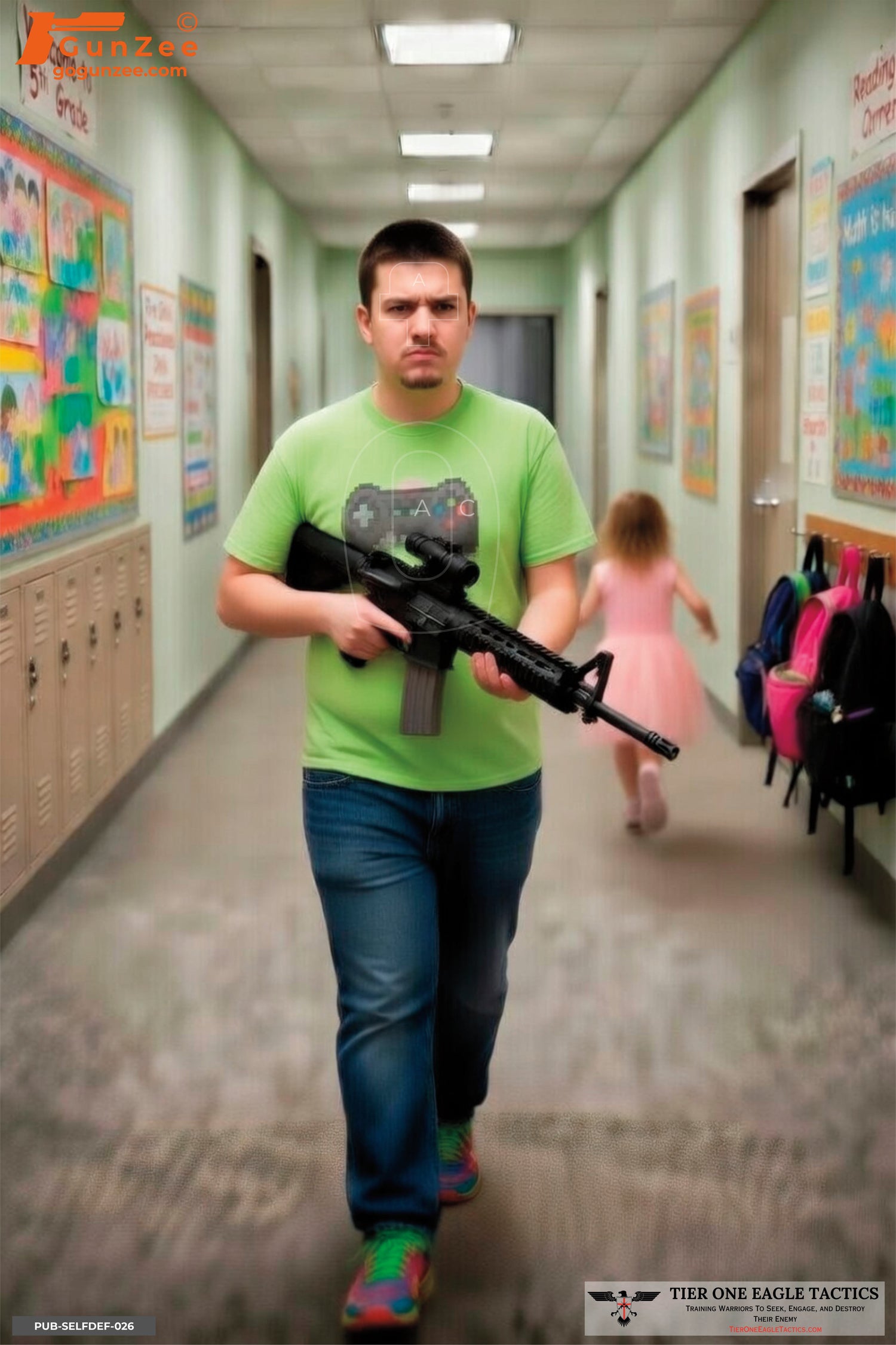
When a shooter walks up to a scenario target — a workplace with an armed subject moving through a corridor, or a pool hall with an armed threat and unarmed bystanders — the first thing they have to do is read the scene. Where is the threat? What is the threat doing? Are there non-threats in the frame? What is behind the threat if they engage? All of that has to happen before the first shot goes off. Reading a real scene from posture, orientation, weapon, and body position is a fundamentally different skill from lining up a printed sight picture on a bullseye.

Realistic scenario targets also train threat discrimination — the ability to distinguish an armed threat from a non-threat, or a threat from an unarmed bystander. This is where our Shoot / No-Shoot Targets collection comes in. Discrimination is a perceptual skill; you cannot build it with a target that only has one interpretation. The shooter needs to be presented with scenes where the correct answer might be "shoot," "hold fire," or "engage the specific figure and not the others" — and each answer has to be defended.
Finally, scenario targets build the engagement geometry muscle memory that fundamentals-only training misses. Shooting a threat behind partial cover, a threat moving through a doorway, or a threat standing close to a hostage requires the shooter to identify a shot placement that is not centered on a torso silhouette. Anatomical accuracy has to come from the shooter's prior training — the scene provides the context, and the shooter provides the placement. For foundational anatomical work, our Anatomical Targets & Overlays are the correct starting point before layering scenario complexity on top.
Recommended GunZee Scenario Targets for Active Shooter Training
The following six targets are the ones we most often recommend for building an active shooter training block. Each covers a different environment or discrimination challenge, and together they give a shooter or instructor a curriculum that spans workplace, public venue, mass-gathering, transit-adjacent, and no-shoot scenarios. All are 24" x 36" full-size paper prints at $1.95 each, ship same day from Raleigh NC, and are drawn from our Public & Everyday Self-Defense keystone collection. The workplace active shooter response target shown earlier anchors the office-environment block — the setting where most working adults would actually face the scenario.

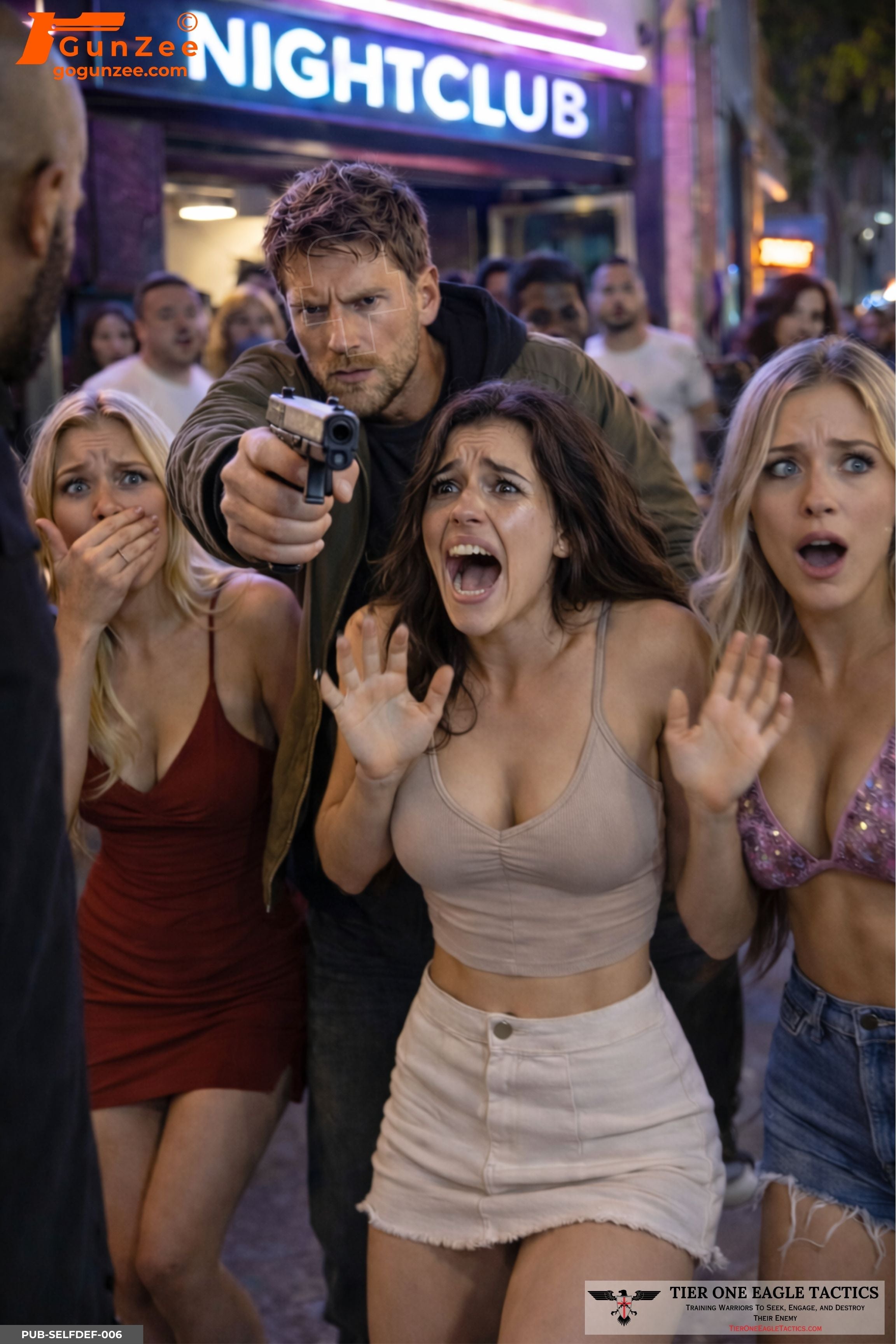
Public venues introduce challenges that are hard to simulate any other way. In a pool hall or a bar, the lighting is uneven, cover is scarce, and there are almost always bystanders in the frame. The target above is designed to make the shooter work through those specific conditions.

Dense-crowd scenarios like a public festival are among the most difficult defensive situations a civilian can face. The shooter has to identify the threat, plan an engagement that does not endanger bystanders in the background, and execute it before the threat can act on the crowd. This target compresses that entire decision into a single scene.

Rear-quarter ambushes are the encounters most civilians actually train for the least, and they are among the most common attack patterns in public spaces. The ATM scenario above trains reactive awareness in a moment when most people are cognitively occupied with a transaction rather than their surroundings.

Every active shooter training block should include no-shoot scenarios. The reason is straightforward: if a shooter has only trained on threats, they will develop a bias toward engagement, and that bias becomes dangerous when the reveal is actually a non-threat. Integrating no-shoot targets like the one above breaks the pattern and reinforces the discrimination step.
For instructors running LE training blocks or advanced civilian courses, our NKZ (No Kill Zone) series is worth considering as the next progression. NKZ targets carry no printed T-boxes or scoring zones on the threat figures, so shooters have to apply anatomical knowledge without visual guides — a natural extension of active shooter scenario work once the fundamentals are in place. See our Target Paper Guide for background on why paper is the correct medium for scenario training in the first place.
Building a Training Progression: Foundational to Advanced
The right way to structure an active shooter training block depends on where the shooter is starting. For a shooter with a strong foundation in shot placement but limited scenario experience, the progression looks something like this: start with single-threat scenarios in familiar environments (workplace, apartment interior, hallway) at moderate distance, then add discrimination by mixing threat and non-threat targets in the same block, then compress the decision window with movement or time pressure, then introduce mass-gathering and dense-crowd targets that stress background management.
For LE and instructor-led courses, the progression usually moves faster and integrates from-holster draws, movement to cover, and multi-target engagement from the start. The scenarios above pair well with our Home Defense, CQB & Hostage Scenarios for the interior/CQB portion, and with the NKZ series for the more advanced work where the shooter is applying anatomy without printed guides.
Across all progressions, the principle to hold onto is that scenario recognition is a perceptual skill that only gets better with reps. Ten cold reveals in a training block will do more for a shooter's real-world response than a hundred rounds fired at a static bullseye. The targets are cheap enough — $1.95 each with volume tier discounts — that instructors can run full mixed decks of ten to twenty scenarios in a single class without touching the training budget.
Instructor Notes for Scenario Immersion
The most effective way to run these targets is with cold reveals. The shooter does not know what scene is coming until the target is presented. The instructor times the reveal, the draw, and the engagement — and evaluates both the shot placement and the decision quality. If a shooter draws and engages a no-shoot target, that is a coaching moment as significant as a missed threat.
Mixed decks work best. Instructors typically pull three to five targets from a set of ten to twenty, rotate them through a stringer or turner system, and require the shooter to process each new scene without prior knowledge. Because these are paper targets at $1.95 each, running a mixed deck of ten different scenarios costs less than the ammunition to shoot them, and shooters can rotate through the same instructor-designed sequence multiple times to build the perceptual muscle.
For scoring, most instructors observe rather than paper-tape. The critical evaluation is whether the shooter identified the threat correctly, executed the right decision (shoot, hold, or engage-with-discrimination), and placed the shot in an anatomically appropriate location. Because active shooter training is scenario work, "hits" as a numeric score are less useful than a decision-quality rubric.
Frequently Asked Questions
What is the difference between active shooter training and regular defensive shooting training?
Defensive shooting training covers the general skills a civilian, LE officer, or military member needs to survive an armed encounter — draw, sight picture, shot placement, and follow-through. Active shooter training is a specialized subset of that curriculum focused on public-space, mass-casualty, or workplace scenarios where the shooter is likely to face an armed subject in an environment with bystanders, limited cover, and compressed decision windows. The core fundamentals are the same, but active shooter training layers in scenario recognition, discrimination, and engagement geometry as the primary training objectives.
Do I need to be a law enforcement officer to benefit from active shooter training?
No. Civilians who carry concealed, work in public-facing roles, or spend meaningful time in the environments where active shooter incidents occur (workplaces, retail, transit) benefit directly from this kind of training. The scenarios are constructed around civilian encounters as much as LE ones. That said, active shooter training is intermediate-to-advanced material and assumes a foundation in shot placement and safe weapon handling. Foundational work should come first.
How often should I run active shooter drills in my training?
The answer depends on your training frequency. For a shooter who trains weekly, integrating one active shooter or scenario block per month is a reasonable baseline. For instructors running LE or advanced civilian courses, active shooter scenarios usually feature in every training block once the fundamentals are established. The key is consistent exposure over time, not intensity in a single session. Scenario recognition is a perceptual skill that decays without practice.
Can I use these targets for indoor range training?
Yes. Every GunZee scenario target in this guide is 24" x 36" paper, printed with life-like realism, and compatible with standard indoor and outdoor range target-stand systems. The targets are indoor-friendly and hold up well to normal range use.
How do I integrate no-shoot targets into an active shooter training block?
Mix them into a deck of five to ten scenarios and reveal them cold. The shooter should not know whether the next reveal is a threat or a no-shoot. The discrimination step happens in the first fraction of a second after the reveal, and the shooter's job is to identify what they are looking at before making an engagement decision. Our Shoot / No-Shoot Targets collection covers the full range of discrimination scenarios.
What is the fastest way to build a mixed-scenario training deck?
Start with the six targets above as your core, then add two or three targets from the Home Defense, CQB & Hostage collection for interior work and two from the NKZ series for advanced no-printed-guide practice. Ten total targets at $1.95 each is under $20 for a full mixed deck, and volume discounts apply at 50+ units for instructors building bulk training packages.
Closing: Train for What You'll Actually Face
Active shooter incidents remain statistically rare, but the consequences of being unprepared are catastrophic. The training that transfers is the training that resembles the encounter — scenario recognition, discrimination, and precision engagement under realistic conditions. Bullseyes build fundamentals; scenarios build the response. GunZee's Public & Everyday Self-Defense targets are designed specifically for this work, and the full Paper Shooting Targets catalog covers every scenario category a civilian, instructor, or LE professional would train through. Every target ships same day from Raleigh, NC and pairs cleanly with the broader GunZee scenario library.
Train for what you will actually face. Rotate through scenarios cold. Let the targets do the perceptual work while you build the response. That is what active shooter training is for.
Related deep-dives
These related guides go deeper on specific corners of active shooter and defensive-scenario training:
- Shooting Targets Buyer's Guide
- Target Paper Guide
- Hostage Decision-Making Drills
- Types of Shooting Targets — Defensive Shooter's Guide
- Gun Targets Buyer's Guide
Go deeper: the qualification-to-decision training guide covers response-program structure, shoot / no-shoot judgment drills builds the crowd-discrimination layer, and training packs stock a full team session.
Train it as a pack: the public-space scenes ship as the Active Shooter 60-pack, 150-Target Training Pack — the 30 best sellers, 5 each.