Read the Privacy Policy
Quantity must be in increments of 5
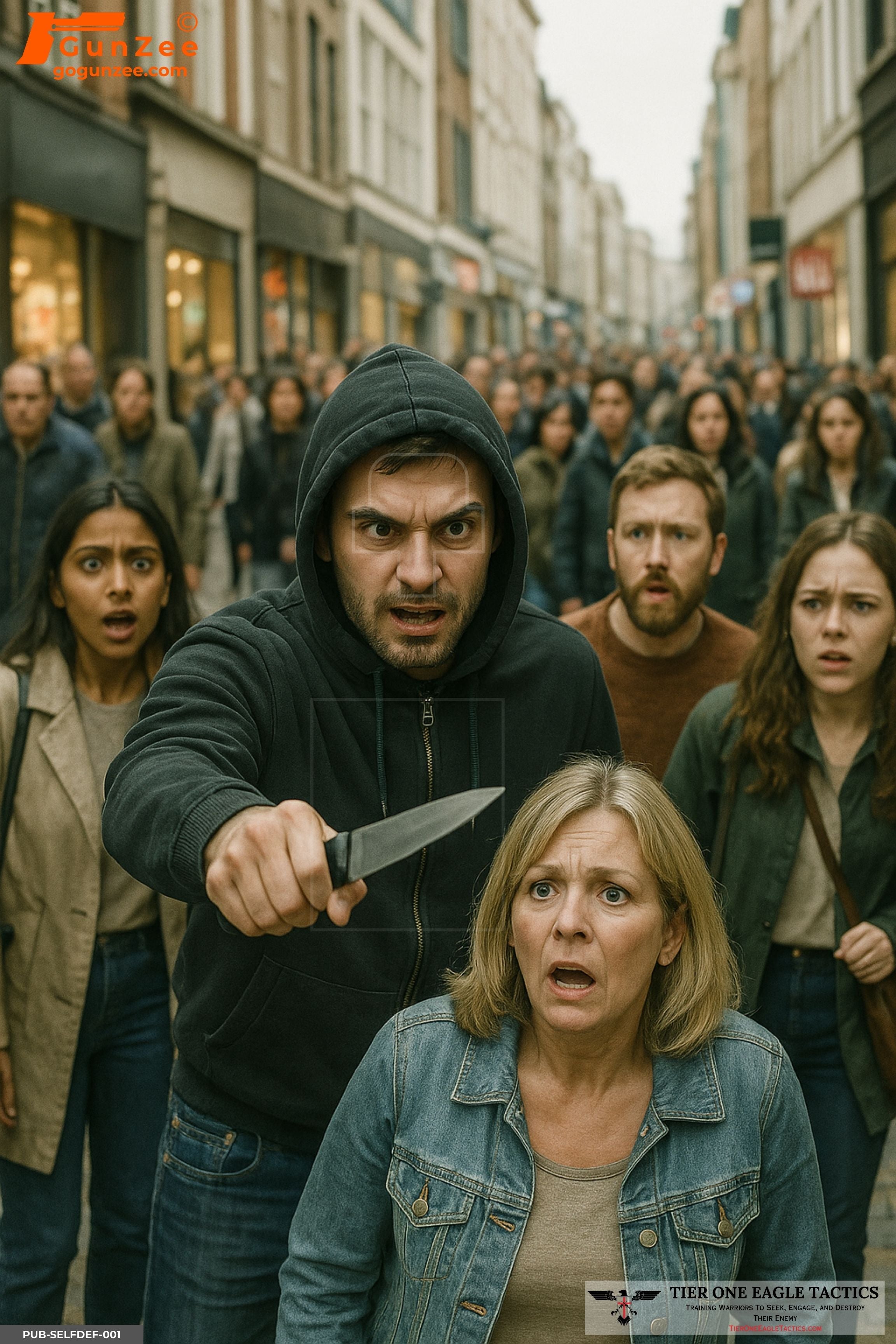
The Crowded Street Knife Threat Shooting Target depicts a high-risk public self-defense encounter in which a knife-wielding aggressor uses an innocent civilian as a physical shield while advancing through a dense crowd. The attacker’s lethal intent is unmistakable, but the environment is chaotic, compressed, and unforgiving, demanding disciplined threat recognition and precise decision-making under extreme pressure.
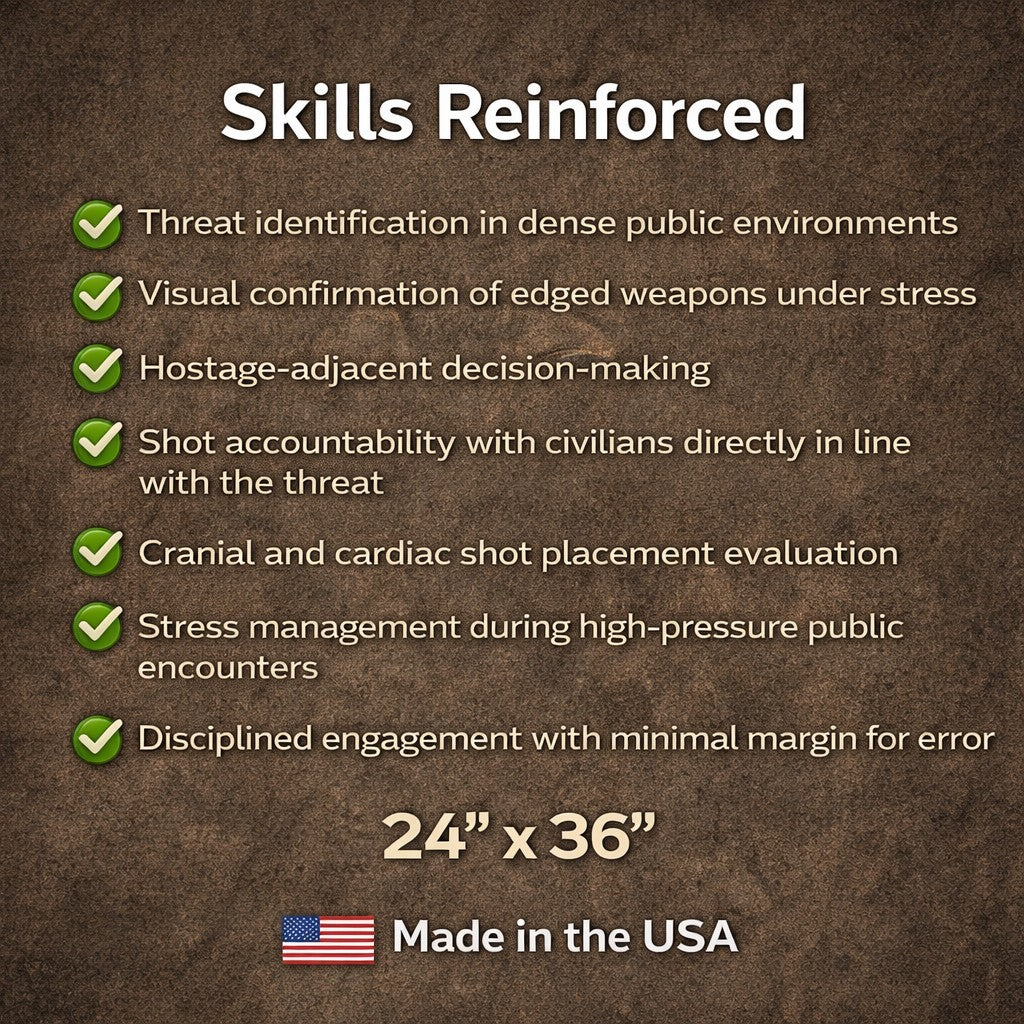
This target is designed to train shooters to identify and respond to an imminent edged-weapon threat in a public setting where bystanders are directly behind, beside, and in front of the threat. It emphasizes restraint, accountability, and visual discipline in scenarios where even a correct decision carries enormous consequence.
This target includes intentionally placed transparent cranial and cardiac kill zones for post-engagement shot placement evaluation.
Public hostage-adjacent assaults are among the most complex self-defense problems a shooter may ever face. The presence of an innocent person directly in front of the attacker collapses engagement options and magnifies the cost of poor judgment.
This target was created to replicate that reality. The shooter must simultaneously process the aggressor’s posture, the edged weapon, the victim’s position, and the movement of surrounding bystanders. The crowd adds visual and emotional overload, while the hostage positioning forces extreme accountability and patience.
The purpose of this target is to train shooters to confirm lethal intent, manage visual chaos, and make responsible engagement decisions when hesitation, haste, or poor shot placement could result in catastrophic outcomes.
The Crowded Street Knife Threat Shooting Target depicts a high-risk public self-defense encounter in which a knife-wielding aggressor uses an innocent civilian as a physical shield while advancing through a dense crowd. The attacker’s lethal intent is unmistakable, but the environment is chaotic, compressed, and unforgiving, demanding disciplined threat recognition and precise decision-making under extreme pressure.
This target is designed to train shooters to identify and respond to an imminent edged-weapon threat in a public setting where bystanders are directly behind, beside, and in front of the threat. It emphasizes restraint, accountability, and visual discipline in scenarios where even a correct decision carries enormous consequence.
This target includes intentionally placed transparent cranial and cardiac kill zones for post-engagement shot placement evaluation.
Public hostage-adjacent assaults are among the most complex self-defense problems a shooter may ever face. The presence of an innocent person directly in front of the attacker collapses engagement options and magnifies the cost of poor judgment.
This target was created to replicate that reality. The shooter must simultaneously process the aggressor’s posture, the edged weapon, the victim’s position, and the movement of surrounding bystanders. The crowd adds visual and emotional overload, while the hostage positioning forces extreme accountability and patience.
The purpose of this target is to train shooters to confirm lethal intent, manage visual chaos, and make responsible engagement decisions when hesitation, haste, or poor shot placement could result in catastrophic outcomes.
Most shooting targets remove innocent people from the engagement space or place them safely off-axis. This target does the opposite. It positions the victim directly in front of the attacker, forcing shooters to confront the true difficulty of real-world public violence.
The attacker’s proximity, body language, and weapon orientation communicate immediate danger without exaggeration. The surrounding crowd adds visual noise and emotional weight, exposing weaknesses in patience, target discrimination, and judgment that traditional silhouettes and bullseyes never reveal.
Because the scenario remains consistent but mentally demanding, shooters can run repeatable drills while still being challenged to maintain restraint and accountability every time the target is used.
Knife attacks involving hostages or human shields often unfold at extremely close distances and escalate rapidly. In such encounters, precision and timing matter more than speed alone.
This target incorporates two intentionally placed transparent evaluation zones on the attacker:
Cranial kill zone (modified T-box)
The head includes a modified T-box based on the conventional cranial reference area. The horizontal reference aligns across the upper facial region, while the vertical reference runs between the eyes. The modified design expands upward into the lower forehead to account for anatomical structures associated with immediate neurological incapacitation, particularly relevant when the attacker is leaning forward behind a hostage.
Cardiac kill box
The upper thoracic cavity includes a cardiac kill box representing the heart, aortic arch, and major vascular structures associated with rapid physiological incapacitation.
These zones are not aiming instructions and are not intended to override judgment or legal considerations. They exist solely to allow objective post-engagement evaluation of shot placement, precision, and timing after the training sequence is complete.
Pair this target with related scenarios from across the GunZee catalog:
Public and everyday self-defense: Crowded Street Hostage Control with Concealed Gunman Shooting Target, Advancing Crowd Knife Assault Shooting Target, Urban Street Two-Man Armed Confrontation Shooting Target, Backyard Pool Knife Assault – Crowd Chaos Scenario
Home defense, CQB, and hostage: Kitchen Interior Female With Glasses Ambiguous Threat Shooting Target, Hallway Threat Civilian in the Doorway Shooting Target, CQB Home Defense Hostage – Child Shield Handgun Threat Shooting Target
Vehicle and barrier: Vehicle Barrier Carjacking Confrontation Shooting Target, Vehicle Barrier Armed Driver Engagement Shooting Target, Vehicle Barrier Dual Gunmen Front-and-Rear Seat Engagement Shooting Target
Anatomical: Anatomical Semi-Frontal Handgun Threat Precision Shooting Target, Anatomical Side-Profile Rifle Threat Shooting Target, Anatomical Full-System Vital Zone Shooting Target