Read the Privacy Policy
Quantity must be in increments of 5
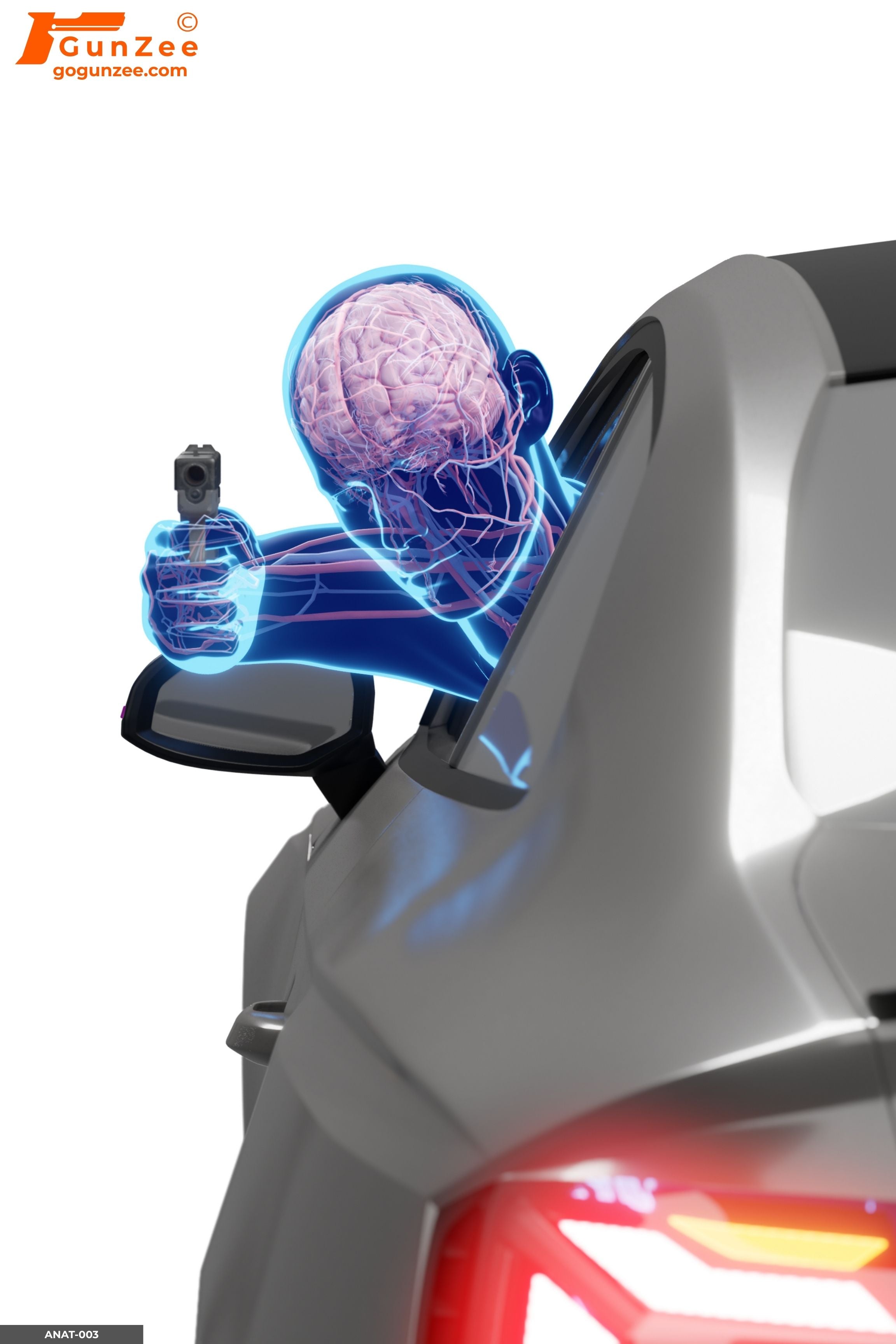
The Anatomical Head-Out Vehicle Window Engagement Shooting Target depicts an armed aggressor leaning out of a vehicle window while actively presenting a handgun. Only the head, hands, and a narrow portion of the upper body are exposed, with the vehicle door, window frame, and roofline acting as hard barriers. The transparent anatomical overlay reveals the internal cranial structures and vascular pathways within the limited visible area, forcing precise, anatomically informed engagement.
This scenario represents a high-risk, low-exposure threat profile where traditional torso-based aiming is unavailable. The target emphasizes disciplined visual processing, angle awareness, and cranial precision when lethal force is unavoidable and time is severely compressed.
Vehicle-based threats that expose only the head are among the most difficult defensive problems to solve. This target is designed to train shooters to recognize immediate lethal intent and engage accurately when the viable target area is small and partially framed by vehicle structures.
The anatomical overlay provides critical context for understanding how head position, tilt, and posture affect internal alignment of the brain and major vessels. Shooters are trained to account for these variables rather than relying on abstract or idealized cranial references.
This target is especially effective for reinforcing patience, discipline, and anatomical accountability in barrier-dominated encounters.
The Anatomical Head-Out Vehicle Window Engagement Shooting Target depicts an armed aggressor leaning out of a vehicle window while actively presenting a handgun. Only the head, hands, and a narrow portion of the upper body are exposed, with the vehicle door, window frame, and roofline acting as hard barriers. The transparent anatomical overlay reveals the internal cranial structures and vascular pathways within the limited visible area, forcing precise, anatomically informed engagement.
This scenario represents a high-risk, low-exposure threat profile where traditional torso-based aiming is unavailable. The target emphasizes disciplined visual processing, angle awareness, and cranial precision when lethal force is unavoidable and time is severely compressed.
Vehicle-based threats that expose only the head are among the most difficult defensive problems to solve. This target is designed to train shooters to recognize immediate lethal intent and engage accurately when the viable target area is small and partially framed by vehicle structures.
The anatomical overlay provides critical context for understanding how head position, tilt, and posture affect internal alignment of the brain and major vessels. Shooters are trained to account for these variables rather than relying on abstract or idealized cranial references.
This target is especially effective for reinforcing patience, discipline, and anatomical accountability in barrier-dominated encounters.
Most anatomical targets present full or partial torsos. Most vehicle targets lack internal anatomical context. This target combines both constraints.
By limiting exposure to the head while revealing internal cranial anatomy, this design forces shooters to understand exactly what they are aiming at beneath the surface. The aggressor’s posture, forward lean, and window framing introduce real-world variables that defeat simplistic aiming habits.
This target exposes overconfidence in head shots without anatomical understanding and replaces it with precise, consequence-driven decision-making grounded in physiology and geometry.
Pair this target with related scenarios from across the GunZee catalog:
Public and everyday self-defense: Storage Unit Armed Confrontation Shooting Target, ATM Robbery Gunpoint Ambush – Rear-Aspect Public Threat Scenario, Workplace Active Shooter Response Shooting Target
Home defense, CQB, and hostage: Living Room Dispute Armed Escalation Shooting Target, Close Quarters Bedroom Gun Threat Shooting Target, Two-Man Interior Advance Dual Threat Shooting Target
Vehicle and barrier: Vehicle Barrier Windshield Gunman Engagement Shooting Target, Vehicle Barrier Armed Driver Engagement Shooting Target, Vehicle Barrier Daylight Carjacking Shooting Target
Anatomical: Anatomical Full-System Vital Zone Shooting Target, Anatomical Hostage Shield Vital Zone Shooting Target, Anatomical Rifle Threat Vital Zone Shooting Target, Anatomical Side-Profile Rifle Threat Shooting Target