

Grocery Aisle Dual-Threat Confrontation Shooting Target [24" x 36"]
Quantity must be in increments of 5
Grocery Aisle Dual-Threat Confrontation Shooting Target – Public Space Threat Discrimination & Control
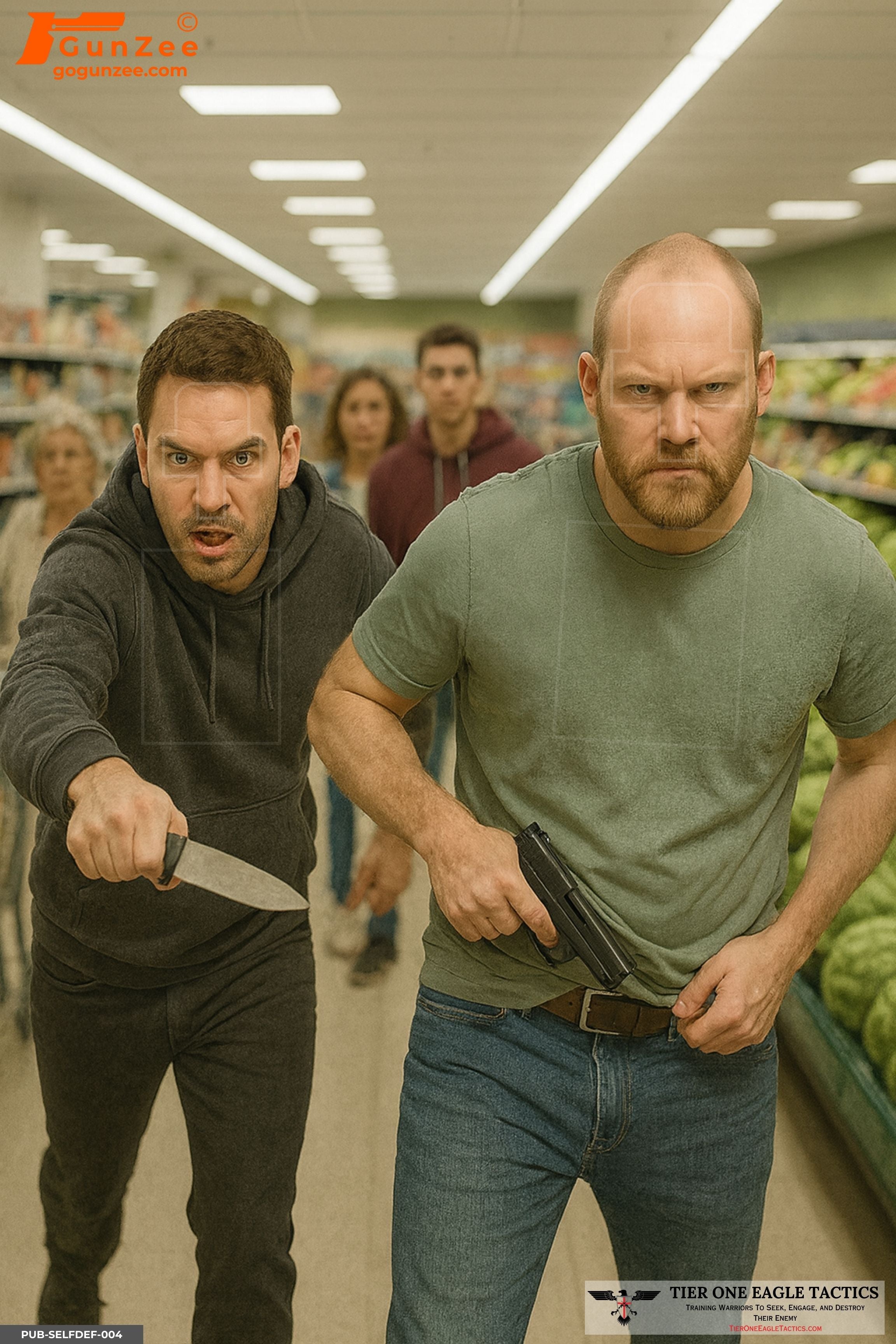
The Grocery Aisle Dual-Threat Confrontation training target depicts a rapidly unfolding public self-defense encounter inside a retail grocery store, where two advancing adult males present different lethal threat cues within arm’s-length proximity. One subject presents an edged weapon, while the second displays indicators of a concealed firearm, with uninvolved civilians positioned directly behind them in a confined aisle.
This target is intentionally designed to reflect the compressed space, visual clutter, and immediacy of real-world retail violence. It forces shooters to process multiple threats simultaneously while maintaining strict accountability in an everyday environment where bystanders cannot be avoided.
This target includes intentionally placed transparent cranial and cardiac kill zones on both male subjects to support post-engagement shot placement evaluation following a training sequence.
Training Purpose
Public retail environments are among the most challenging settings for defensive decision-making. Narrow aisles restrict movement, lateral displacement is limited, and the presence of uninvolved shoppers significantly increases cognitive load while reducing reaction time.
This target was created to replicate those conditions. The shooter must rapidly identify weapon types, assess intent, determine which subject presents the most immediate lethal threat, and make engagement decisions while civilians remain directly in the line of fire. The proximity of all subjects prevents reliance on speed alone and demands deliberate visual processing and restraint.
The kill zones are not intended to dictate engagement decisions. Their purpose is to provide objective, anatomy-based feedback after the drill regarding precision, timing, and accountability once the scenario has concluded.
Skills Reinforced
- Threat discrimination between edged-weapon and firearm cues
- Rapid intent recognition in close-proximity encounters
- Decision-making under... ...
Grocery Aisle Dual-Threat Confrontation Shooting Target – Public Space Threat Discrimination & Control
The Grocery Aisle Dual-Threat Confrontation training target depicts a rapidly unfolding public self-defense encounter inside a retail grocery store, where two advancing adult males present different lethal threat cues within arm’s-length proximity. One subject presents an edged weapon, while the second displays indicators of a concealed firearm, with uninvolved civilians positioned directly behind them in a confined aisle.
This target is intentionally designed to reflect the compressed space, visual clutter, and immediacy of real-world retail violence. It forces shooters to process multiple threats simultaneously while maintaining strict accountability in an everyday environment where bystanders cannot be avoided.
This target includes intentionally placed transparent cranial and cardiac kill zones on both male subjects to support post-engagement shot placement evaluation following a training sequence.
Training Purpose
Public retail environments are among the most challenging settings for defensive decision-making. Narrow aisles restrict movement, lateral displacement is limited, and the presence of uninvolved shoppers significantly increases cognitive load while reducing reaction time.
This target was created to replicate those conditions. The shooter must rapidly identify weapon types, assess intent, determine which subject presents the most immediate lethal threat, and make engagement decisions while civilians remain directly in the line of fire. The proximity of all subjects prevents reliance on speed alone and demands deliberate visual processing and restraint.
The kill zones are not intended to dictate engagement decisions. Their purpose is to provide objective, anatomy-based feedback after the drill regarding precision, timing, and accountability once the scenario has concluded.
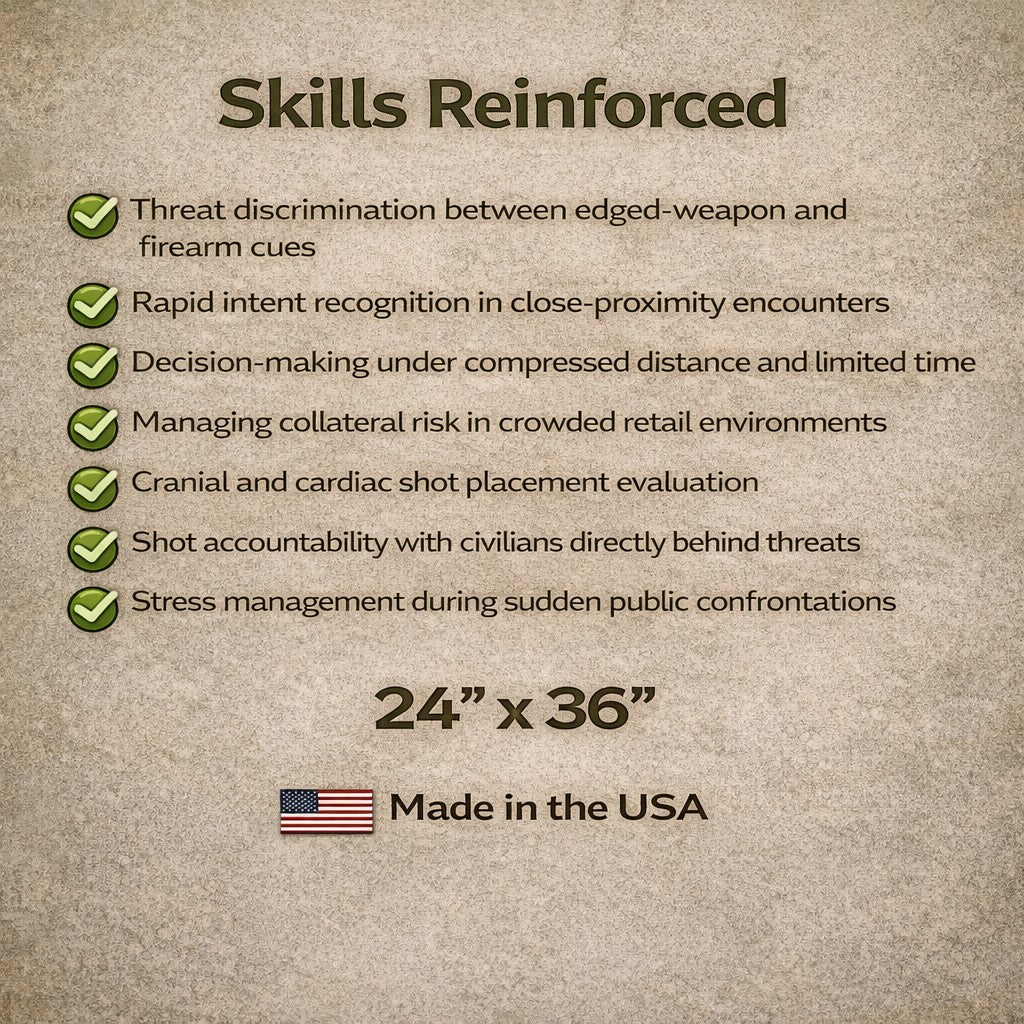
Skills Reinforced
- Threat discrimination between edged-weapon and firearm cues
- Rapid intent recognition in close-proximity encounters
- Decision-making under compressed distance and limited time
- Managing collateral risk in crowded retail environments
- Cranial and cardiac shot placement evaluation
- Shot accountability with civilians directly behind threats
- Stress management during sudden public confrontations
Why This Target Is Different
Most training targets reduce public encounters to a single, clearly defined threat. This target deliberately removes that simplicity by presenting two advancing individuals with competing threat indicators.
The shooter must:
- Interpret posture, hand position, and weapon presentation in real time
- Prioritize threats based on behavior and immediacy rather than appearance alone
- Control muzzle discipline and engagement angles in a confined space
- Make lawful engagement decisions before referencing anatomical outcomes
The grocery aisle setting removes unrealistic movement options and amplifies pressure. Because the scenario is fixed yet cognitively demanding, it supports repeatable drills that consistently expose weaknesses in threat prioritization, visual discipline, and judgment.
Scenario Context (Educational)
Violence in retail environments often erupts without warning and at extremely close distances. Attackers may advance rapidly while civilians remain directly behind or beside them, leaving no safe margin for error.
Kill Zone Reference System (Intentional Feature)
This target includes transparent cranial and cardiac kill zones on both male subjects, used exclusively for post-engagement shot placement evaluation.
Cranial kill zones (modified T-boxes)
Each subject includes a cranial kill zone based on the conventional T-box, defined by a horizontal reference across the upper lip or base of the nose and a vertical reference between the eyes. The modified T-box expands upward into the lower forehead region, reflecting anatomical areas known to cause immediate neurological incapacitation when disrupted. The expanded regions account for head movement and real-world presentation angles and are intended strictly for evaluation after the training sequence.
Cardiac kill boxes (upper thoracic cavities)
Each subject also includes a cardiac kill box representing the upper thoracic cavity, encompassing the heart, aortic arch, and major vascular structures associated with rapid physiological incapacitation. Hits in this zone are evaluated for placement, timing, and precision rather than guaranteed outcome.
These kill zones are training references only. They are not scoring rings, not mandatory aim points, and not substitutes for lawful judgment or threat assessment.
Related training targets
Pair this target with related scenarios from across the GunZee catalog:
Public and everyday self-defense: Grocery Aisle Explosive Vest Imminent Threat Shooting Target, Dual-Threat Mall Corridor Assault Shooting Target, Urban Street Two-Man Armed Confrontation Shooting Target, Grocery Store Parking Lot Armed Approach – Public Threat Interception
Home defense, CQB, and hostage: Kitchen Interior Female With Glasses Ambiguous Threat Shooting Target, CQB Home Defense Hostage – Forward Weapon Presentation Shooting Target, Interior Doorway Male With Phone Ambiguous Threat Shooting Target
Vehicle and barrier: Vehicle Barrier Dual Gunmen Front-and-Rear Seat Engagement Shooting Target, Vehicle Barrier Multi-Aggressor Carjacking Shooting Target, Vehicle Barrier Windshield Assault Shooting Target
Anatomical: Anatomical Side-Profile Rifle Threat Shooting Target, Anatomical Rifle Threat Vital Zone Shooting Target, Anatomical Hostage Shield Vital Zone Shooting Target