
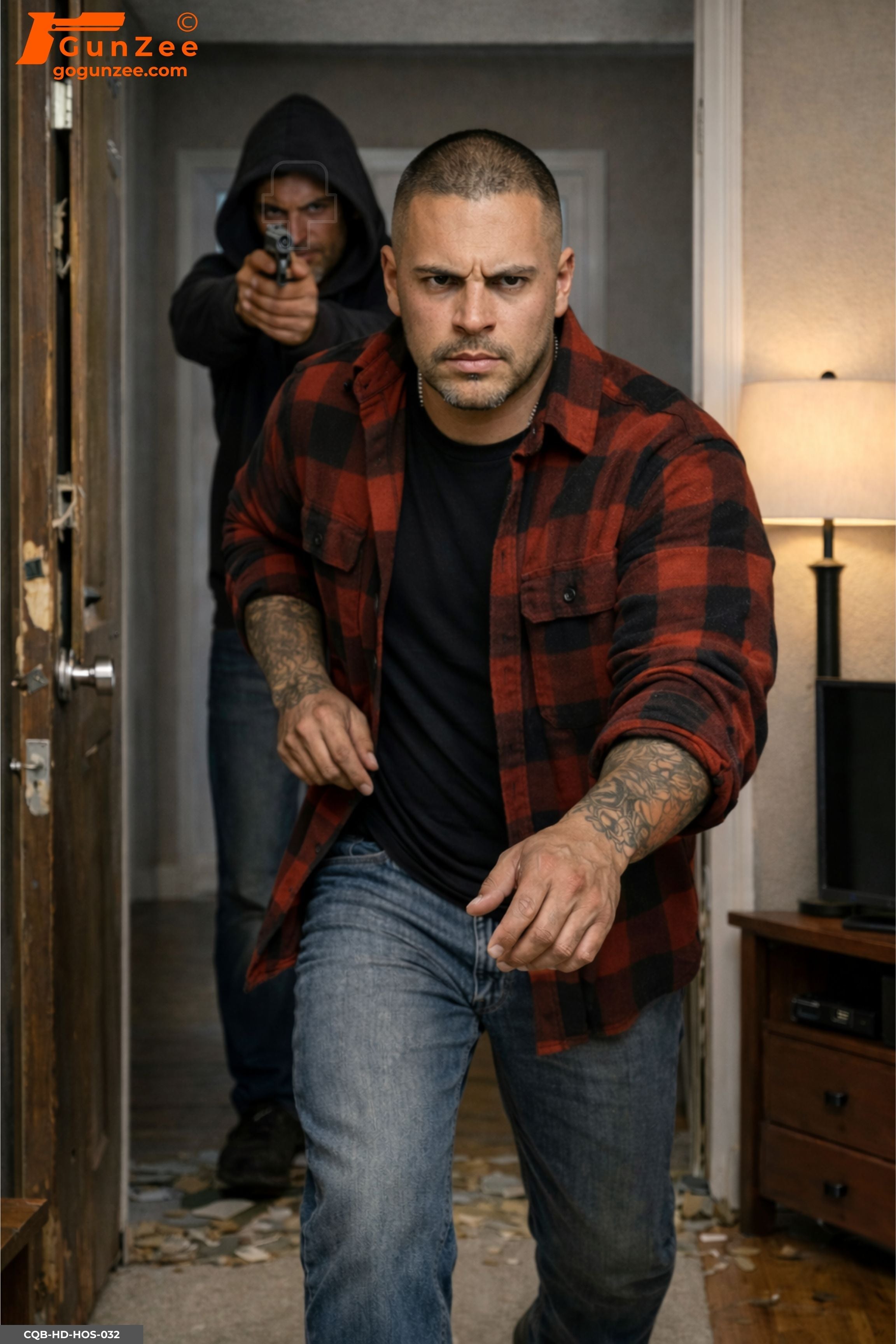
Two-Man Residential Entry Rear Gunman Threat Shooting Target [24" x 36"]
each · sold in 5s · mix any designs
Price drops automatically: 50+ $1.85 · 100+ $1.76 · 250+ $1.66 · Up to 25% off at 999+ · Volume quote →
$40 order minimum for your whole cart, not each design. Mix any targets.
Quantity must be in increments of 5
Two-Man Residential Entry Rear Gunman Threat Shooting Target
Scenario Overview
This target depicts a residential interior breach involving two intruders advancing through a damaged doorway into a confined hallway. The front individual appears unarmed and moves forward aggressively, while a second intruder in the rear presents a concealed but clearly aimed handgun, creating a deceptive and dangerous layered threat.
The scene is intentionally designed to challenge visual discipline and threat discrimination. The most obvious subject is not the most dangerous one. The shooter must look past the forward movement and body language of the lead individual to identify and address the true lethal threat emerging from behind.
This scenario reflects real-world residential encounters where depth, obstruction, and human shielding complicate rapid decision-making under extreme time pressure.
Training Purpose
This target is designed to train shooters to defeat visual deception and tunnel vision during interior CQB encounters. In residential environments, threats often emerge from behind or around more visually dominant subjects, and failure to properly assess depth can lead to catastrophic outcomes.
The shooter must process multiple human actors, determine intent, and correctly prioritize the armed aggressor positioned in the rear while maintaining awareness of the unarmed individual in front.
Skills Reinforced
- Threat discrimination between armed and unarmed subjects
- Visual processing through layered human obstacles
- Identifying rear-positioned lethal threats in confined spaces
- Maintaining depth awareness in hallway and doorway environments
- Precision shot placement under extreme time compression
- Avoiding target fixation on the most visually dominant subject
- Accountability and restraint in multi-person residential encounters
Modified T-Box Analysis
The rear aggressor includes a modified T-box positioned to represent a high-probability neurological incapacitation zone. The modified geometry accounts for realistic cranial anatomy and head positioning during forward weapon presentation.
This reference zone is intended to support post-engagement evaluation of hit placement, timing, and threat prioritization rather than serve as an aiming aid during live fire. Its purpose is to provide objective feedback on decision quality once the drill is complete.
Related training targets
Pair this target with related scenarios from across the GunZee catalog:
Public and everyday self-defense: Storage Unit Ambiguous Encounter Shooting Target, Man on Crutches Armed Confrontation Shooting Target, Church Aisle Hostage Crisis Shooting Target
Home defense, CQB, and hostage: Two-Man Residential Entry Armed Threat Shooting Target, Two-Man Corridor Hostage Escort with Primary Gunman Shooting Target, Interior Two-Man Deception & Rear Threat Shooting Target, CQB Home Defense Hostage – Two-Man Armed Threat Coordination Shooting Target
Vehicle and barrier: Vehicle Barrier Windshield Gunman Engagement Shooting Target, Vehicle Barrier Multi-Aggressor Carjacking Shooting Target, Vehicle Barrier Armed Subject Exiting Vehicle Shooting Target
Anatomical: Anatomical Side-Profile Rifle Threat Shooting Target, Anatomical Semi-Frontal Handgun Threat Precision Shooting Target, Anatomical Frontal Handgun Threat Vital Zone Shooting Target
Also ships in: CQB & Interior 150-pack, Shoot / No-Shoot 150-pack, Best Sellers 125-pack — five of each design, priced below singles.