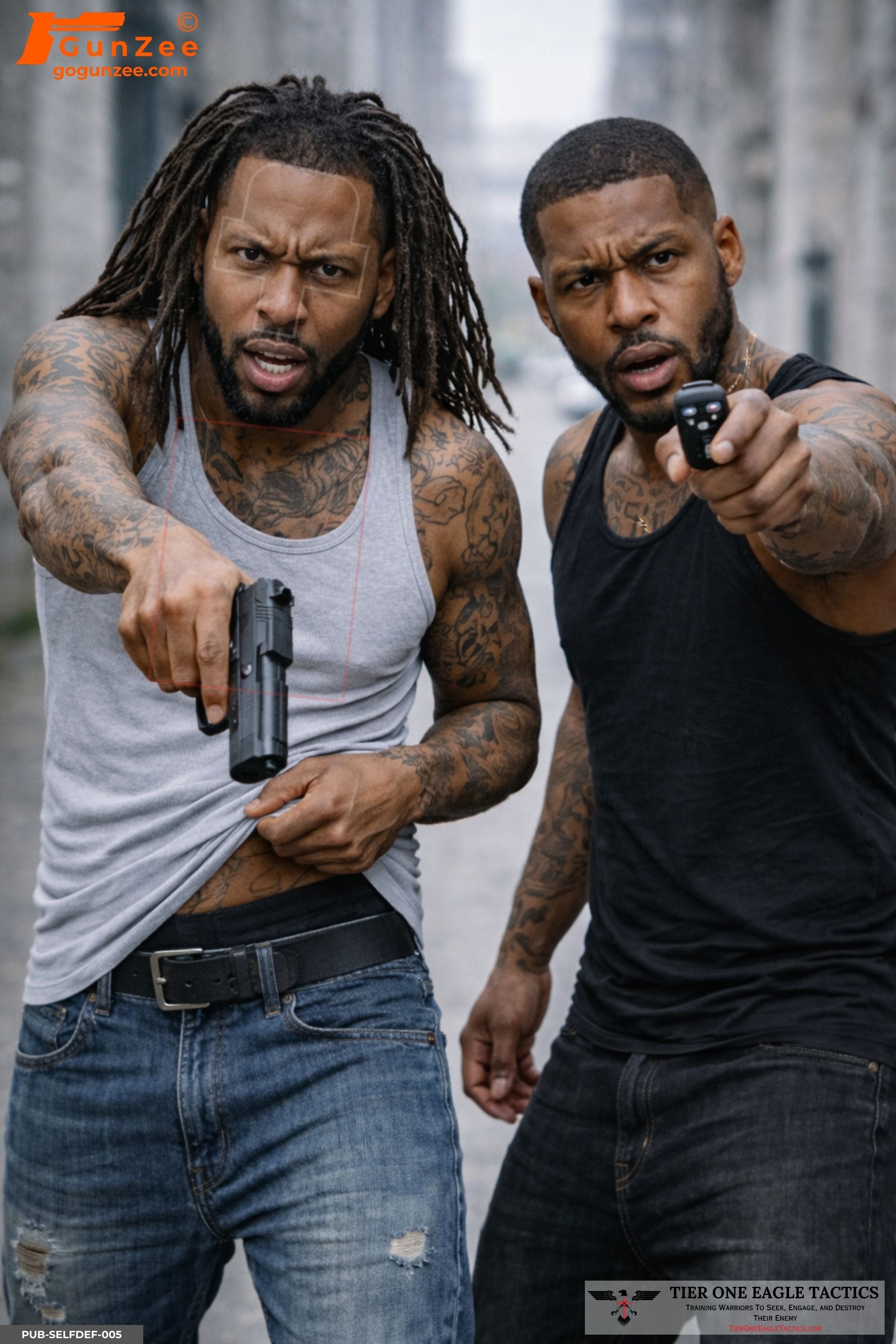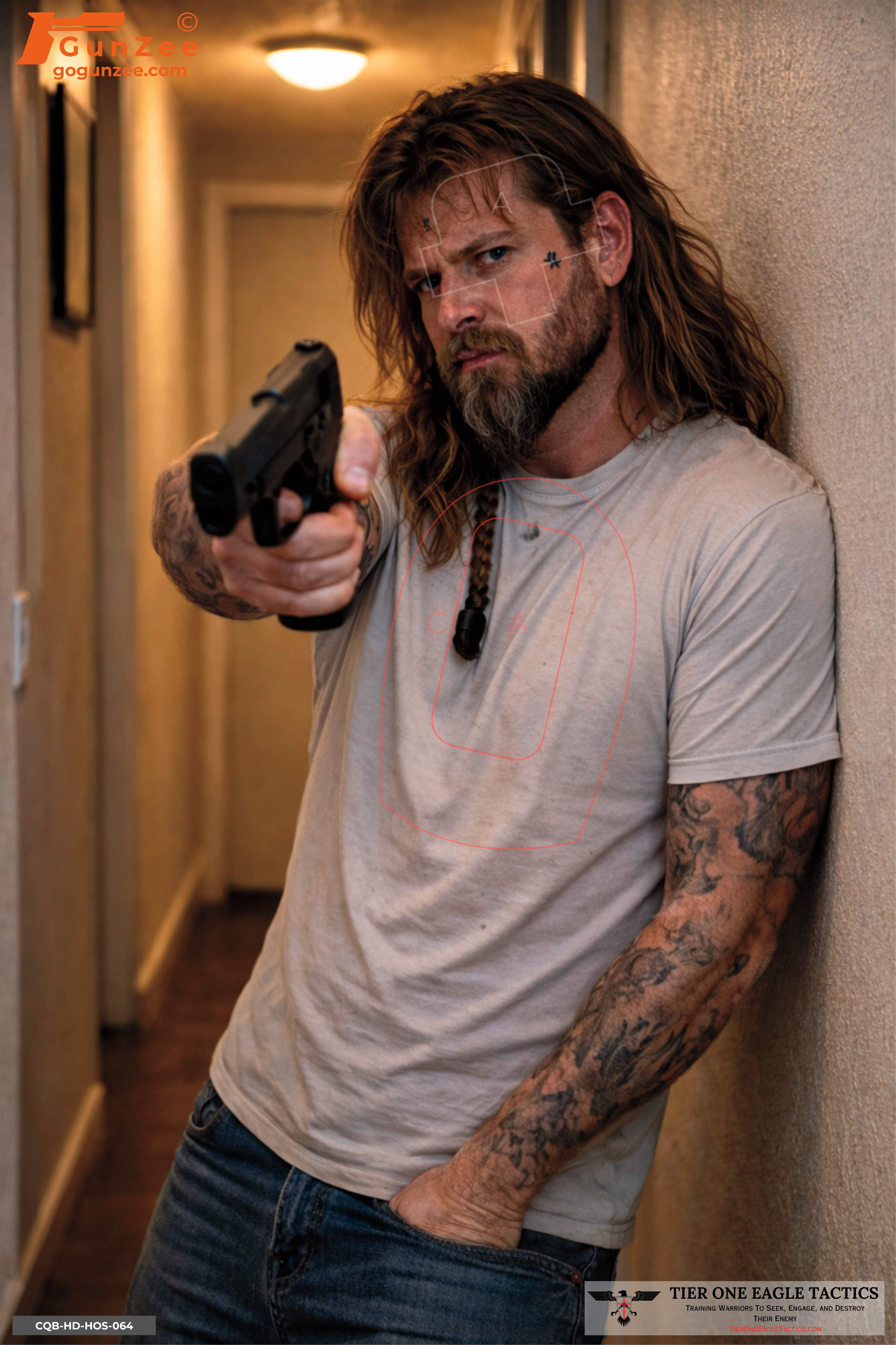
CQB training targets selected for an individual CCW holder and CQB training targets selected for a structured professional course are not the same purchase. The individual is buying a handful of prints, rotating them across personal range time, and replacing them when they wear out. The course director is buying inventory for ten to sixty shooters running simultaneous rotations across multiple scenarios, with the same prints expected to absorb hundreds of rounds in a single day before retirement. The selection criteria, the volume math, and the scenario coverage are different problems. Individual shooters choosing their first prints should start with the CQB targets buyer’s guide instead.
This buyer's guide is written for the second group — the LE academy curriculum lead, the contracted training company building a new CQB block, the advanced civilian program director sequencing a multi-day course. The targets discussed below are the ones that hold up to course volume and that map cleanly onto instructor-led drill design.

What "professional CQB training target" actually means
A professional-grade CQB target meets three thresholds that a casual range target does not.
Durability per shooter. A B-27 holds up to one shooter's range session. A photorealistic CQB target in a course rotation has to absorb hits from multiple shooters across consecutive iterations without losing the visual cues the drill depends on. The print substrate, ink saturation, and image contrast all matter. GunZee CQB prints are sized 24" by 36" on a heavy substrate specifically because the cues — hand position, weapon silhouette, hostage facial expression, ambient lighting — have to remain readable after fifty rounds at three to seven yards.
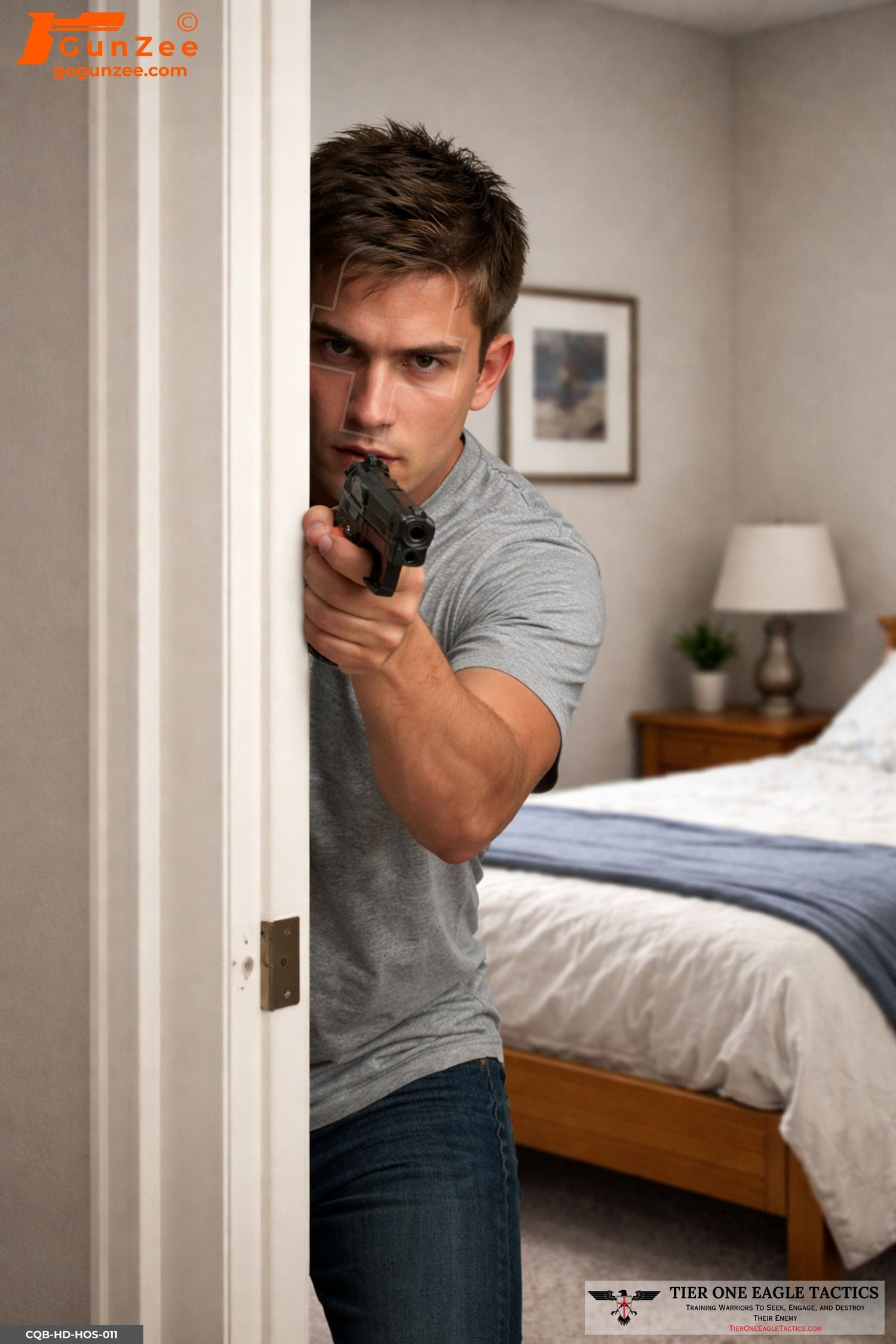
Scenario authenticity. A target that reads as "person in generic room with gun" trains generic responses. A target that reads as "bedroom doorway, low-mounted bedside lamp, armed subject in defensive posture" trains the actual visual processing the shooter will need in a real engagement. Authenticity is a quality differentiator, not a luxury — and it is exactly what separates the prints that programs adopt from the prints that get bought once and abandoned.
Coverage of the no-shoot. A library of CQB targets in which every figure is armed teaches pattern-fire. A library that includes ambiguity variants — cellphone in hand, hands raised in compliance, no-weapon child-shield confirmation — teaches the read. Structured CQB curriculum is unteachable without no-shoot prints in the rotation.
The five scenario categories every CQB course needs
A CQB course built on fewer than these five categories is teaching incomplete CQB. The categories below map to drill blocks; each block should have at least two targets in rotation so shooters cannot memorize the layout.
1. Doorway processing and threat reads
The doorway is where most residential and interior engagements happen. The drill: shooter at three yards outside the door, target reveals on call, shooter reads the scene for one to three seconds before deciding. The bedroom doorway armed subject target is the workhorse for this block. Paired with the cellphone-ambiguity variant (next category), it produces the two-target rotation that keeps shooter reads honest.
2. Shoot/no-shoot ambiguity inserted into the same scenario
The discrimination problem is harder than the engagement problem. The bedroom doorway cellphone ambiguity target uses the same setup as the armed-subject doorway target — same room, same lighting, same posture — but the object in hand is a cellphone, not a weapon. Course instructors mix the two targets unannounced. Shooter wrong-target hit rate is the metric that matters: hitting an armed subject is necessary, not hitting the ambiguous subject is mandatory. Both numbers belong in the after-action review.

3. Hallway ambush — compressed-time response
The OODA-compressed engagement: threat appears already drawn, already moving, already inside the decision window. The hallway ambush immediate threat target trains the response when read-the-scene time is under a second. Course directors run this drill from concealment at the holstered draw. Time-to-first-good-hit is the metric, not group size. Most shooters discover their realistic engagement window is shorter than they assumed, which is exactly the training value.
4. Low-light flashlight integration
Most defensive CQB engagements happen in low light. A flashlight in the support hand changes draw stroke, sight picture, and grip mechanics in ways pure live-fire range work does not expose. The armed intruder with flashlight target shows the threat illuminating the shooter's position — the worst-case low-light geometry — and trains the flashlight discipline that programs running only daylight blocks never build.
5. Closet and concealed-space ambush — the worst-case entry
The hardest CQB problem for a solo or two-person stack: a threat in a closet, behind a curtain, in a corner the team cannot pre-clear. The closet ambush armed subject target trains the rep that matters most — recognizing the situation before the gunfight, often deciding not to enter. Many drills on this target end in "hold position." That is the correct answer for a structured curriculum to teach, and it is the answer most untrained shooters never arrive at.
Scenario rotation strategy — how to use the library in a course
Course directors who buy the full CQB library and rotate randomly across drills produce less competent shooters than directors who follow a deliberate rotation. The strategy:
Day one foundation reads. Doorway and hallway targets at slow tempo, three to five yards, with the shooter reading the scene out loud to the instructor before the engagement decision. The verbal call surfaces the cues the shooter is actually processing and lets the instructor correct the read before the shot.
Day two ambiguity insertion. Same scenarios as day one, but cellphone-variant and no-weapon-variant targets are mixed in unannounced. Shooter wrong-target rate is tracked across the block. A wrong-target rate above five percent means the shooter is pattern-firing, not reading — and the drill is repeated until the rate drops.
Day three low-light overlay. The same drills from days one and two, run under reduced ambient or red-light conditions, with flashlight integration required. Cue recognition collapses for most shooters in the first iteration; the day's training is rebuilding it.
Day four hostage and concealed-threat scenarios. Layered on top of the foundation only after the prior days' wrong-target rates are inside tolerance. Hostage scenarios trained without the prior discipline produce wishful precision and dangerous shots — the worst possible curriculum outcome.
The full Home Defense, CQB & Hostage Scenarios collection covers every category above with multiple variants per scenario, which is what scenario rotation requires.
Target turnover math for course directors
Two-to-three targets per shooter per scenario for a half-day course. Three-to-five for a full-day course. Twenty shooters across five rotating scenarios in one day works out to three hundred to five hundred prints. A standard sixty-shooter LE academy class running a daily CQB block burns eight hundred to twelve hundred prints per week.
The scenario set academies order for that block is collected under law enforcement training targets.
Bulk packs sized for course volume are the correct unit of purchase at this scale. The CQB Full Structure Rotation 295-target pack covers a single academy week without re-ordering, and includes the scenario mix that maps to the five categories above. Programs running monthly courses should plan on two to four packs per month depending on class size and drill density.
Instructor-led drill design — what the targets enable
The targets are the medium; the curriculum is the work. Instructor-led drills built around the CQB library follow a structure that the targets are designed to support.
Identify the cue the drill is training — hand position, weapon silhouette, two-target sequencing, low-light recognition. Set up at least one no-shoot among the targets so the wrong answer is genuinely available. Engage from concealment so the draw is part of the decision time. Require a verbal command before the shot ("Drop the gun" or equivalent) to build the legal habit alongside the physical one. Track wrong-target hit rate in the after-action review — hitting the threat is necessary, not hitting the non-threat is mandatory. Rotate the layout between reps so shooters cannot pre-rehearse the discrimination.
This drill structure rests on having a target library with the right variants in inventory. Programs that build curriculum first and select targets second consistently arrive at the GunZee CQB line because the scenario coverage matches the drill blocks structured courses actually need.
Why programs adopt the GunZee CQB line over alternatives
The CQB target market is competitive. The largest producers ship higher print volume at lower unit cost. What programs choose GunZee for is the quality differentiation that matters at the instruction level — scenario depth that maps to real residential and interior geometry, ambiguity variants that enable the no-shoot block, and image authenticity that holds up at three-to-seven-yard engagement distances where the shooter is reading detail, not silhouettes.
The line is in active use at LE academies, contracted training companies, and advanced civilian programs — including Tier One Eagle Tactics, whose instructors have publicly cited the GunZee CQB targets for the doorway and ambiguity scenarios specifically. Programs adopt the line because the curriculum it supports is the curriculum that produces decision-disciplined shooters, not just accurate ones.
For the underlying drill methodology that the CQB target library supports, see Realistic CQB Drills for the Solo Shooter. For the threat-discrimination layer that runs across every CQB block, see Shoot/No-Shoot: Armed Subject Identification Under Stress. For the placement-precision foundation every CQB course assumes, see Human Anatomy Shooting Targets: A Complete Training Guide.
→ BROWSE THE CQB TRAINING TARGET LIBRARY
Frequently asked questions
What is a CQB training target?
A CQB training target is a photorealistic paper target depicting a close-quarters threat in a residential or interior environment — doorways, hallways, corridors, closets, vehicle interiors. Used in structured CQB courses to train threat reading, shoot/no-shoot discrimination, and precision placement at the three-to-seven-yard engagement distances CQB requires.
How many CQB targets does a 20-shooter course need?
Plan on two to three targets per shooter per scenario for a half-day course, three to five for a full-day course. Twenty shooters across five rotating scenarios in one day equals three hundred to five hundred prints. Bulk packs sized for course volume — like the CQB Full Structure Rotation 295-pack — are the right unit of purchase. Every multi-target bundle lives in the training packs collection. Single-target ordering is for individual practitioners, not programs.
What's the target-turnover rate at LE academies running daily CQB blocks?
A standard sixty-shooter academy class running a daily CQB rotation burns through eight hundred to twelve hundred prints per week depending on drill intensity. Scenario rotation cuts the rate per individual target — no single scenario gets repeated to destruction — and keeps shooter pattern-recognition honest at the same time.
Which CQB targets are non-negotiable for a structured course?
Five categories cover ninety percent of course curriculum: doorway processing, hallway ambush response, closet and concealed-space ambush, low-light flashlight integration, and the shoot/no-shoot ambiguity target. Without all five categories represented, the course teaches incomplete CQB.
How do CQB training targets fit into a multi-day curriculum?
Day one: foundation reads on doorway and hallway targets at slow tempo. Day two: ambiguity insertion (cellphone variant, no-weapon variant) into the same scenarios. Day three: low-light overlay across all prior drills. Day four: hostage and concealed-threat scenarios layered on top. The curriculum is the rotation, not any single target.
Are GunZee CQB targets used by professional training programs?
Yes. The GunZee CQB library is in use at LE academies, contracted training companies, and advanced civilian programs including Tier One Eagle Tactics. The scenario depth, residential authenticity, and shoot/no-shoot ambiguity coverage are why programs adopt the line for structured curriculum rather than ad-hoc target purchases.
Train it as a pack: course-ready CQB rotations: CQB & Interior 60-pack, CQB & Interior 100-pack, CQB & Interior 150-pack. Instructors buying for a class: request a quote.
Related reading in the Range Manual
-
CQB Targets — Buyer's Guide
The product-side companion: which CQB targets exist, dimensions, and why each one is designed the way it is. -
Hostage Shooting Targets — Buyer's Guide
The single hardest CQB scenario: no-shoot standing next to shoot. Curriculum, drills, target picks. -
Shooting Targets — The Buyer's Guide for Serious Training
Broader target-selection framework for instructors building multi-scenario curriculums. -
Active Shooter Training: The Realistic-Scenario Guide
Structure-clearing under time pressure scaled to the public-space problem — for instructors running active-threat blocks. -
Force-on-Force Training at Home
How students keep CQB skills alive between formal courses — worth assigning as homework. -
Gun Targets — The Buyer's Guide for Serious Training
Comparative guide: paper vs steel vs scenario vs anatomical, and when each earns its range time. -
Paper Shooting Targets: Material and Manufacturing Insights
Why paper weight, coating, and print quality decide how a target survives a full course day. -
Paper shooting targets — full collection
Every scenario category on 24" x 36" paper — CQB, hostage, vehicle, anatomical, shoot/no-shoot.
Go deeper: the law enforcement training targets pillar covers program structure beyond the CQB block, and shoot / no-shoot judgment drills adds the decision layer every entry rep needs.