Read the Privacy Policy
Quantity must be in increments of 5
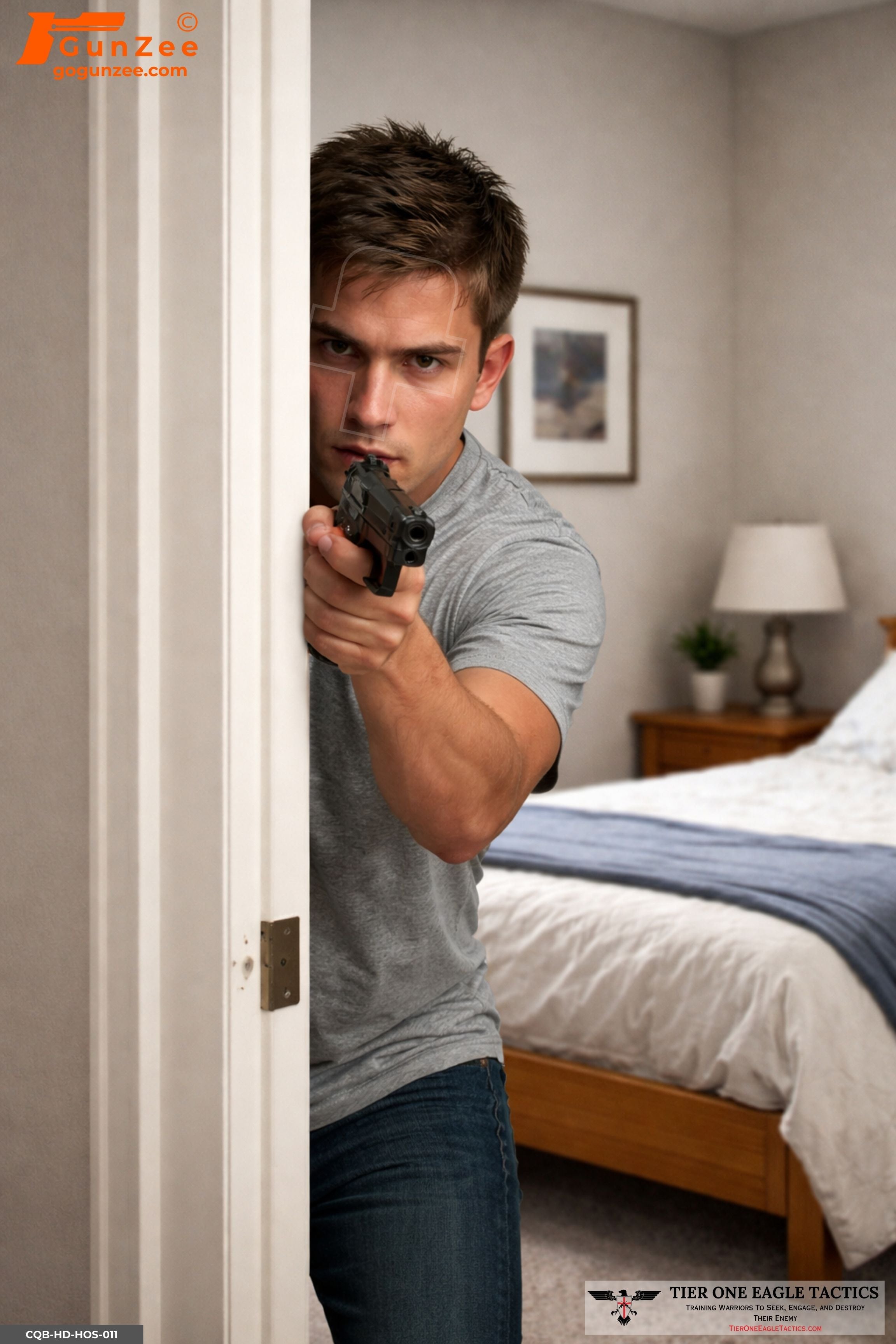
This CQB Home Defense Hostage Shooting Target depicts a high-risk residential encounter where a male subject emerges from a bedroom doorway while presenting a handgun toward the defender. The environment is familiar, confined, and emotionally charged, with limited visibility and extremely compressed distance.
The doorway acts as both concealment and funnel. The subject’s partial exposure, focused gaze, and deliberate weapon presentation create a scenario where reaction time is minimal and misinterpretation carries severe consequences. This target is designed to train disciplined threat recognition and accountability in one of the most common and dangerous locations inside a home.
Doorway encounters inside residential structures are among the most lethal and unpredictable defensive scenarios. The defender must process limited visual information while deciding whether the subject represents an immediate lethal threat or a mistaken or non-hostile presence.
This target trains shooters to recognize confirmed weapon presentation under tight spatial constraints while maintaining control and judgment. The emphasis is on visual discipline, muzzle awareness, and understanding how partial exposure alters both engagement options and acceptable margins for error.
Many CQB targets show fully exposed threats with exaggerated posture. This target intentionally limits visibility and context. Only part of the subject is exposed, forcing shooters to process posture, grip, eye focus, and muzzle alignment rather than relying on full-body... ...
This CQB Home Defense Hostage Shooting Target depicts a high-risk residential encounter where a male subject emerges from a bedroom doorway while presenting a handgun toward the defender. The environment is familiar, confined, and emotionally charged, with limited visibility and extremely compressed distance.
The doorway acts as both concealment and funnel. The subject’s partial exposure, focused gaze, and deliberate weapon presentation create a scenario where reaction time is minimal and misinterpretation carries severe consequences. This target is designed to train disciplined threat recognition and accountability in one of the most common and dangerous locations inside a home.
Doorway encounters inside residential structures are among the most lethal and unpredictable defensive scenarios. The defender must process limited visual information while deciding whether the subject represents an immediate lethal threat or a mistaken or non-hostile presence.
This target trains shooters to recognize confirmed weapon presentation under tight spatial constraints while maintaining control and judgment. The emphasis is on visual discipline, muzzle awareness, and understanding how partial exposure alters both engagement options and acceptable margins for error.
Many CQB targets show fully exposed threats with exaggerated posture. This target intentionally limits visibility and context. Only part of the subject is exposed, forcing shooters to process posture, grip, eye focus, and muzzle alignment rather than relying on full-body cues.
The domestic bedroom setting further complicates decision-making by introducing familiarity and emotional hesitation. This target reinforces that lethal threats can emerge from ordinary spaces and that correct decisions must be based on behavior, not environment.
This target includes a modified T-box outline that expands beyond the traditional eye-to-eye reference by incorporating a defined area in the upper forehead. This modification reflects established understanding that disruption in this region is associated with immediate incapacitation due to proximity to critical central nervous system structures.
The modified T-box is not intended to be visible or used as an aiming reference at shooting distance. It exists strictly for post-exercise analysis and instructor-led review. After the drill, the outline allows shooters to evaluate whether a precision opportunity truly existed given the doorway geometry, partial exposure, and subject movement.
Pair this target with related scenarios from across the GunZee catalog:
Public and everyday self-defense: Parking Garage Hostage Crisis – Cranial Incapacitation Training Target, Coffee Shop Confrontation Close Range Threat Shooting Target, Forest Trail Advancing Knife Threat Shooting Target
Home defense, CQB, and hostage: CQB Home Defense Hostage – Bedroom Doorway Cell Phone Ambiguity Shooting Target, CQB Home Defense Hostage – Closet Ambush Armed Subject Shooting Target, CQB Home Defense Hostage – Woman Armed Forward Presentation Shooting Target, CQB Home Defense Hostage – Armed Aggressor Forward Presentation Shooting Target
Vehicle and barrier: Vehicle Barrier Armed Subject Exiting Vehicle Shooting Target, Vehicle Barrier Windshield Gunman Engagement Shooting Target, Vehicle Barrier Dual Gunmen Front-and-Rear Seat Engagement Shooting Target
Anatomical: Anatomical Head-Out Vehicle Window Engagement Shooting Target, Anatomical Semi-Frontal Handgun Threat Precision Shooting Target, Anatomical Semi-Profile Handgun Threat Vital Zone Shooting Target