
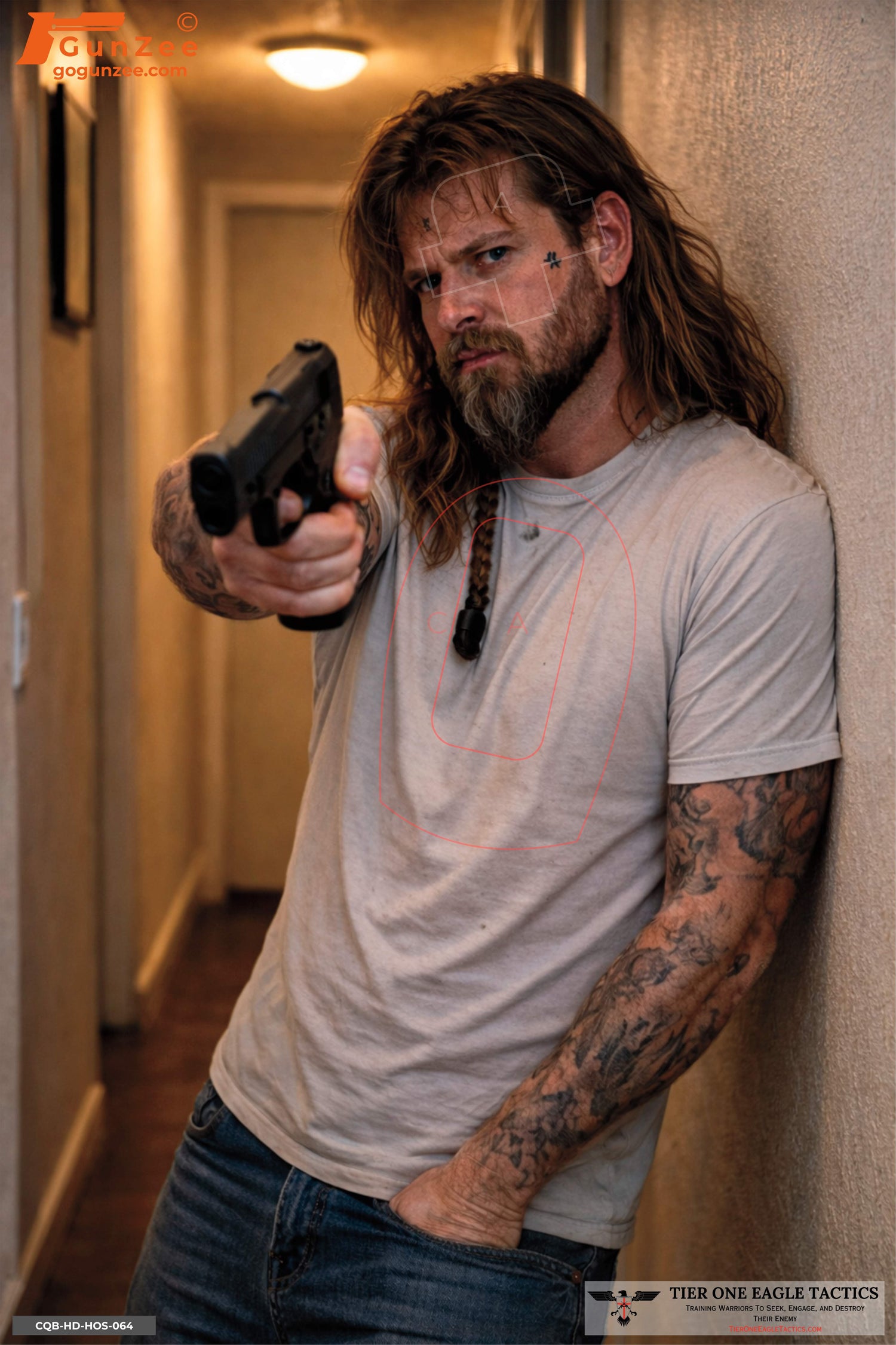
Search "gun targets" and the shopping results collapse into two piles: black silhouettes with numbered scoring rings, and orange-dot bullseyes on printer paper. Both have a place — but neither trains what a defender, officer, or student in a scenario course actually needs to train. This guide breaks down the full landscape of gun targets, the five categories that matter, what separates training-grade paper from scoring paper, and how to build an order that matches how a range day actually runs.
What a gun target actually is (and what most sold today are not)
A gun target is a printed surface used to record where rounds land and to drive a specific training outcome. That's the honest definition. The problem is that the market has quietly narrowed the word to mean one of two things: a bullseye for zeroing and a B-27 silhouette for qualifications. Both are scoring tools. Neither teaches the shooter anything about the moment before the trigger breaks.
The trained operator, the department instructor, and the serious home defender need paper that teaches something on the way to the hit — recognition, discrimination, angle, placement. That's what changes when the target changes.
The five categories of gun targets that matter
The catalog most retailers show is padded with novelty prints and qualification variants for every state. Strip that down and there are five categories a serious buyer actually chooses between:
- Fundamentals and zero targets — bullseyes, grids, diagnostic circles.
- Anatomical targets — medically accurate human figures showing cardiac box, cranial T-box, pelvic girdle.
- Scenario targets — a real person in a real place: a parking lot, a store aisle, a hallway, a driver's seat.
- Vehicle and barrier targets — engagements built around a car, a doorway, a piece of cover.
- CQB and hostage targets — partial exposure, third-party in the frame, discrimination under time.
Every serious range day pulls from at least two of these. The all-bullseye range day is a marksmanship maintenance session, not training.
Fundamentals and zero targets: where they belong, where they stop
Bullseyes and grid sheets are the right tool for confirming a red-dot zero, diagnosing a group, and teaching a new shooter to build a clean sight picture. They should be in the range bag. They should not be the whole range bag.
What a bullseye cannot do: it cannot teach the shooter to read hands, to notice a second person in the frame, to hold on the pelvic girdle when the chest is behind a door edge, or to break a shot at a T-box that's turned 20 degrees off center. A shooter who lives on bullseyes trains a scoring habit and calls it defensive skill. It is not.
Anatomical gun targets: shot placement against real structures
An anatomical target replaces geometric scoring zones with a medically accurate human figure. The reason to train against one is simple: a real threat doesn't fail because a round crossed a scoring line. It fails because a round crossed a specific structure.
- Cardiac box — roughly a 6×6 inch area over the heart and great vessels. The default defensive shot.
- Cranial T-box — the nasal-orbital region, about 3 inches wide, that reliably reaches the brainstem. The answer when the cardiac box is denied by cover or by a hostage.
- Pelvic girdle — the structural stopper when the upper body is armored or obscured.
GunZee's anatomical targets and overlays depict these regions as they actually sit under the skin, not as painted rectangles. See the full breakdown in the anatomy pillar.
Scenario gun targets: training the decision, not just the hit
A scenario target depicts a real person in a place a defender would actually encounter that person — a grocery parking lot, a convenience-store aisle, a bedroom doorway, a driver's seat with the belt still buckled. The point isn't decoration. The point is that scene-accurate composition forces the shooter to process what most targets skip: is there a weapon, where are the hands, who else is in the frame, what's the angle, what's behind the target.
The public and everyday self-defense collection and the home defense / CQB / hostage collection are the core of the GunZee scenario library. Every sheet in those two collections is a lifelike scene at 24×36 inches, printed for the shooter who wants the target to look like the situation, not like a silhouette.
Vehicle and barrier gun targets: the geometry the square range ignores
The square range trains standing, squared, unbelted, on flat ground. That geometry doesn't survive contact with a real carjacking, a roadside argument, or a curbside approach at a red light. The vehicle and barrier collection exists because seated draws through a belt, engagements through glass, and shots taken with the A-pillar as cover are their own skillset — and they need paper that respects the geometry.
Buyers moving into this category should also read the vehicle-as-cover pillar and the carjacking target buyer's guide before ordering.
CQB and hostage gun targets: partial cover and no-shoot discrimination
Close-quarters engagements collapse three problems into one: the shooter is close, the target is often partially obscured, and a third party — hostage, child, family member — is frequently in the frame. A CQB-grade target has to give the shooter something to discriminate against. A blank silhouette can't.
Products in the CQB and hostage line show the threat behind a doorway, over a shoulder, next to a partner in the frame, holding a weapon or a phone — deliberate ambiguity, so the shooter's eye has to solve the problem before the trigger finger does. See the CQB targets guide and the hostage decision-making pillar for the training progression that goes with them.
What separates a training-grade gun target from a $0.80 silhouette
Price alone tells the buyer nothing. Four things separate paper worth training on from paper that's just cheaper:
- Size. A 24×36 sheet gives the shooter the full human presentation at realistic proximity. Anything smaller compresses the decision.
- Scene accuracy. Lighting, framing, distance, and setting have to look like a place the defender would actually be. A studio-lit silhouette teaches nothing about a night parking lot.
- Human variety. Age, build, dress, and region variation across the catalog matter. A department that only trains against one demographic is training a bias, not a skill.
- Anatomical honesty. Even when the outer scene is a full-color environment, the shooter needs to know that the cardiac box and T-box under the ink are where they'd actually be on that person.
GunZee targets hit all four. That's the moat. Cheaper competitors ship one or two of those; almost none ship all four.
How to build a gun target order for a real range day
GunZee targets are 24×36, $1.95 each, with 25-pack bundles available in the training packs collection. The right mix depends on the shooter:
- Home-defense civilian, one range day: 6 fundamentals sheets for warm-up, 6 residential-hallway scenarios, 3 hostage/partial-cover scenarios, 3 anatomical overlays for post-course review. Around $35 in paper.
- CCW holder training public-defense scenarios: 4 fundamentals, 8 parking-lot / store-aisle / sidewalk scenarios from the public collection, 4 vehicle scenarios, 2 anatomical.
- Instructor running a 12-student course: two 25-packs of scenario targets, one 25-pack of anatomical, and a run of qualification sheets underneath. Bulk order, single invoice, at $1.95/unit.
Gun targets for law enforcement and military buyers
Department and unit buyers already have qualification stock. That stock teaches the standard. It doesn't teach the job. Scenario paper is the layer that goes on top: after the officer or operator has cleared the qual, the scenario progression trains what qual can't — reading hands in a doorway, discriminating a phone from a weapon, hitting the cardiac box on a target turned 30 degrees behind a partial wall.
At $1.95 per 24×36 sheet, GunZee scenario targets are priced for the department buyer who's used to paying custom-print prices for far less realistic paper. Layered use — qual day for the standard, then scenario day for the decision — is the model that gets the most training value per paper dollar spent.
Where to start in the GunZee catalog
The fastest path in depends on what the shooter is training for:
- Home defense: start in the home defense / CQB / hostage collection.
- CCW / public defense: start in the public and everyday self-defense collection.
- Vehicle-focused training: start in the vehicle and barrier collection.
- Instructors and departments: start in training packs and layer in the anatomical overlays.
Every GunZee target is 24×36, printed on heavy stock, priced at $1.95 each, and built to look like the situation the shooter is actually training for. Browse the full library in new releases or jump directly into the scenario collection that matches the range day.
Train it as a pack: skip the picking and start with the 150-Target Training Pack — the 30 best sellers, 5 each, Best Sellers 125-pack. Three singles most shooters begin with: Church Aisle Hostage Crisis, Anatomical Frontal Handgun Threat and CQB Forward Weapon Presentation.
Related reading
- Anatomical Shooting Targets: Train Vital Zones, Not Scoring Rings
- Law Enforcement Training Targets: From Qualification to Decision Training
- Self-Defense Shooting Targets: Train the Decision, Not Just the Shot
- Tactical Shooting Targets: What Counts, What Doesn’t, and How to Choose
- CQB Training Targets for Professional Courses
See the complete range of paper shooting targets we manufacture — CQB, hostage, no-shoot, vehicle-barrier, and anatomical designs at $1.95 each.
For the broader context on shooting-target selection, see our Shooting Targets Buyer's Guide — the comprehensive rundown of every category, use case, and buying consideration.
Browse the full GunZee paper shooting targets collection — 180+ designs across every category, printed on 24×36 paper at $1.95 each.
For the material and manufacturing side of paper targets (specs, print quality, cost tiers), see our Paper Shooting Targets: Trainer's Guide.
Go deeper: the silhouette shooting targets pillar covers the most-bought category in this guide in full, the target-type rotation guide shows how to mix them, and shoot / no-shoot judgment drills adds the layer no static target teaches.


