Most range days follow the same script: hang a bullseye or a silhouette, shoot it until the center is gone, pack up. The shooting gets better for a while, and then it stops getting interesting. The shooter already knows the answer before the first round, because the answer is always "shoot."
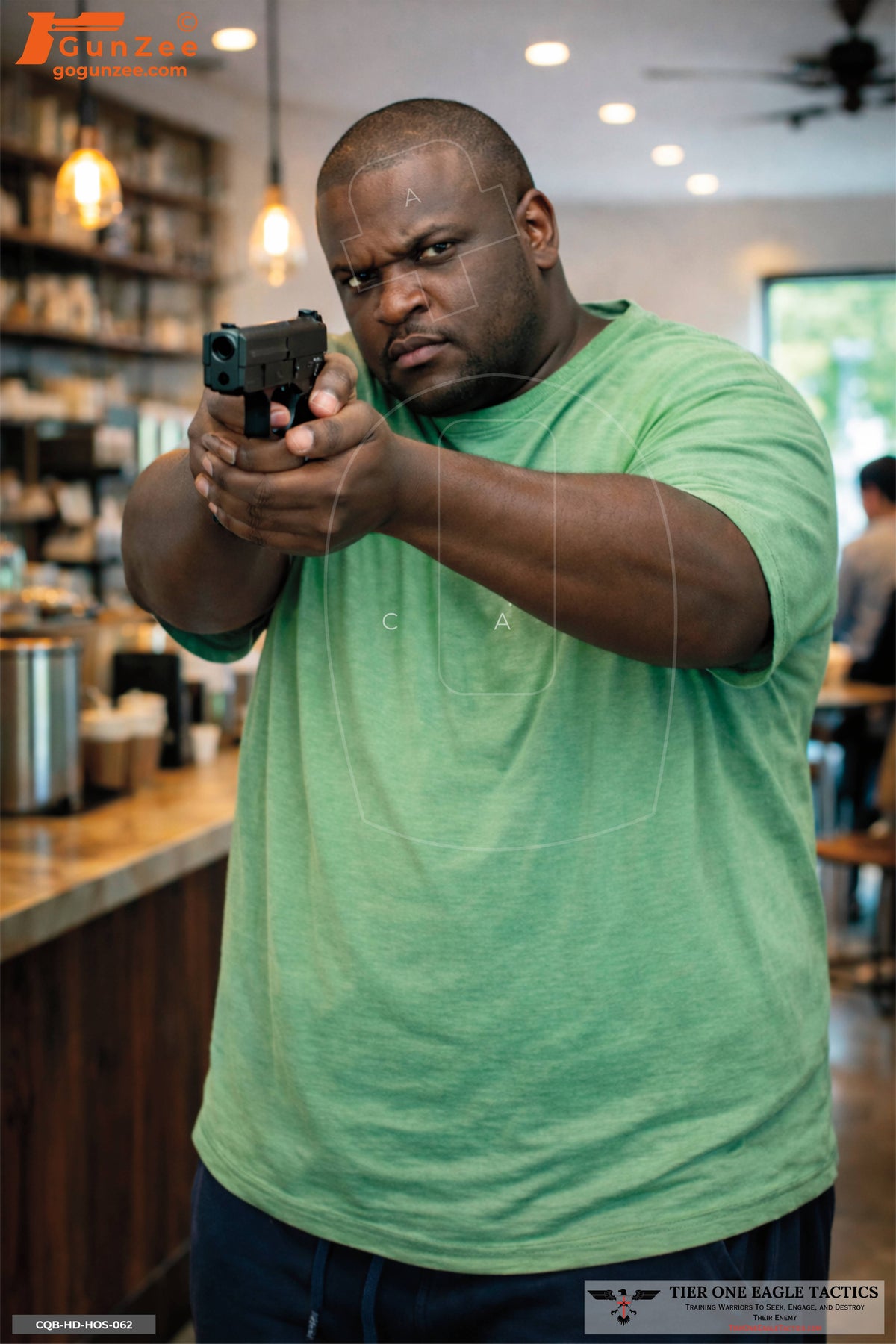
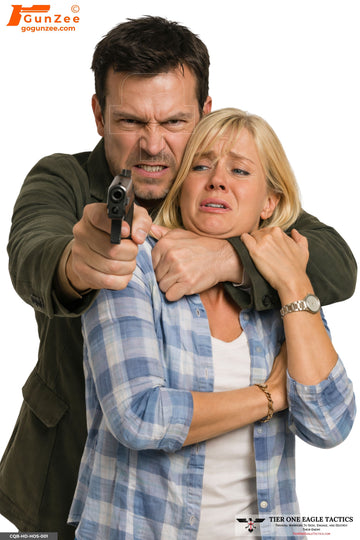
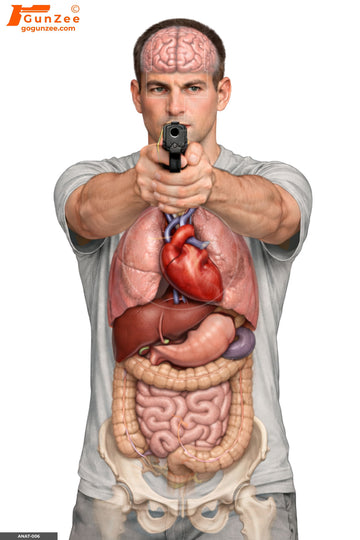
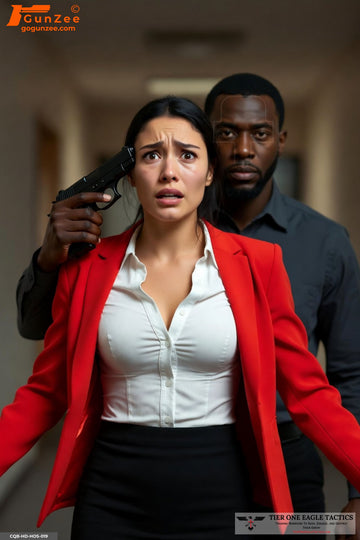
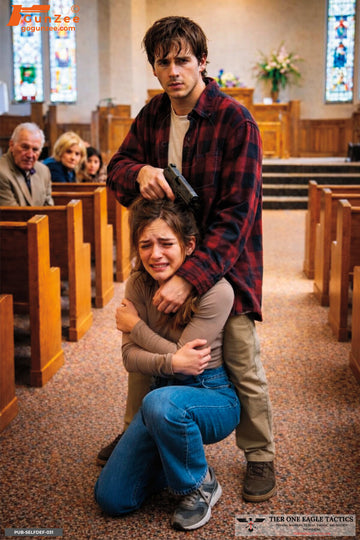
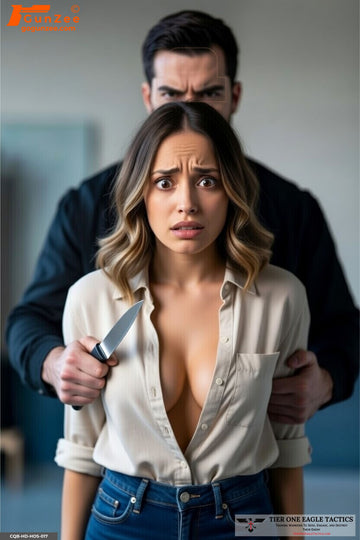
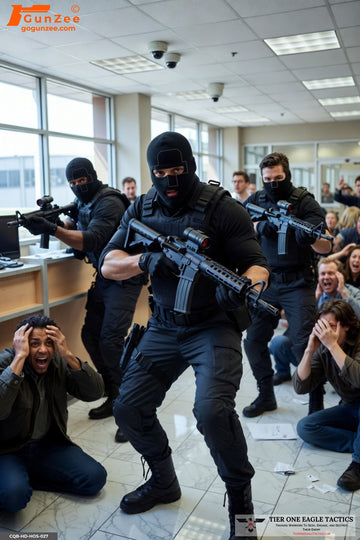
A scene sheet changes the question. Instead of "can you hit it," it asks "should you, and where are the hands?" That is the idea behind our unique shooting targets: photo-realistic people in real-world places, some armed and some not, each one built around a decision. Below are some of the more unusual scenes in the catalog, what each one tests, and a simple two-person format that turns them into a range day people talk about on the drive home.
Shop these targets
Photo-realistic 24″ × 36″ designs · sold in 5s per design · mix any designs · $45 order minimum
What makes a scene worth hanging
A good scene forces the shooter to look before shooting. Police training puts the hands first: the California POST academy workbook lists "Always be aware of the suspect's hands" among its officer-safety basics, and Police Magazine notes that "from basic training to field training, officers are told, 'Watch the suspect's hands.'" A sheet earns its place when the hands are the hard part: something is in them, and the shooter has to work out what.
That matters because people get it wrong under pressure. In a Force Science eye-tracking study reported by Police1, rookie officers fired at a suspect holding a cell phone in more than 60 percent of trials, against about 18 percent for veteran team officers. One study, one scenario, but the lesson holds for any range day: a dark object in a hand is a question, not an answer.
Unusual scenes and what each one tests
The man on crutches
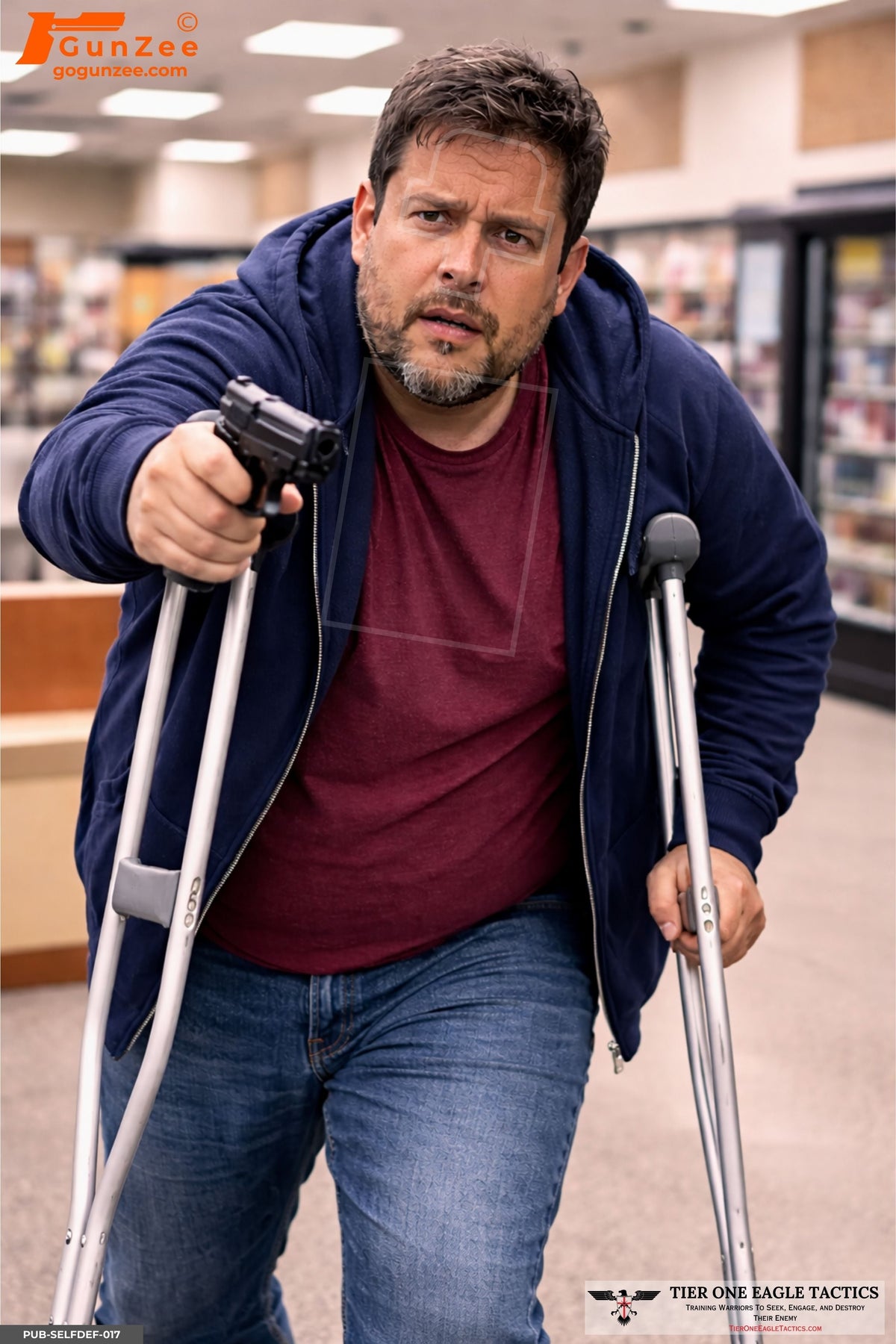
A man on crutches in a store aisle grips a handgun against one crutch handle and points it at the viewer. The injury pulls the eye and invites sympathy; the gun in his hand is what decides the scene. It teaches shooters that an injury or a disability says nothing about intent. See the crutches scene, and pair it with the seated injury deception sheet, where the handgun sits low and is easy to miss.

The TV remote
A man in a hoodie leans over the back of a couch and points a black TV remote straight at the viewer. At a glance and in a hurry, the shape and the gesture read like a pistol. It is not one. This is the sheet that catches the shooter who reacts to motion instead of the object. Hang it in the same stack as its twin, the living room couch armed male scene, so the setting gives nothing away.

The key fob at the storage unit
A man stands in the doorway of a storage unit, eyes on the viewer, a small black key fob held in both hands at his waist. Nothing in the scene is a weapon, but a shooter who has just seen an armed sheet will want it to be one. Its twin is the storage unit armed confrontation scene. See the key fob scene.

Body armor, empty hands
A bearded man in a plate carrier stands behind a couch, looking straight ahead, hands empty at his sides. The vest makes him look dangerous, and that is the test: armor is not a weapon. The shooter has to find the hands and see that they are empty. See the body armor scene.
The twin rule
The remote and the key fob work best when they are never alone. Each unarmed scene above has an armed twin in the same setting, so a shooter cannot learn "living room means gun" or "storage unit means safe." Shuffle twins into the same stack and the only way through is to read the hands, sheet by sheet. Our articles on unarmed scenes and armed scenes list more of both.

The zombie dog
Not every sheet needs a hard decision. The zombie dog is a snarling, bloodied dog charging down a hallway, low and fast. There is no judgment call; it is pure speed and placement on a small, low target. It makes a good warm-up or the last sheet of the day, the fun shooting targets end of a session that keeps newer shooters coming back.
A two-person range-day format
The scenes do their best work when the shooter does not know which one is coming. A simple way to run them with a friend, on a range that allows it:
- Check the range rules first. Rules on drawing from a holster, rapid fire and target stands differ from range to range, and the range's rules come first. The format below works from the low ready with no draw at all.
- The partner builds the stack. Six to eight sheets, armed and unarmed mixed, twins included. The shooter does not see the order.
- One sheet at a time. The partner hangs or turns the next sheet while the shooter faces downrange at the low ready, finger off the trigger.
- Call it out loud. On the start signal, the shooter says what is in the hands ("gun," "phone," "remote," "empty") and then shoots or does not.
- Score the call first, then the hits. A clean no-shoot on the remote counts as much as good hits on the armed twin. A round on an unarmed sheet is a miss, however well placed.
For more on running decision drills, see live-fire judgment drills and what makes a target a scenario.
Building the stack
Each design is sold in sets of 5, which gives a two-person session enough of each sheet for several rounds. A practical first order is three armed-and-unarmed twin pairs plus one or two odd ones out like the crutches or the zombie dog. Shooters who want to bring their own shot placement can mix in the No Kill Zone line, which has no printed scoring boxes on the face or chest. Groups that train often can save with our training packs.
Frequently asked questions
What makes a scenario target different from a silhouette?
A silhouette has no hands to check and no object to identify, so the answer is always "shoot." A scenario sheet shows a person in a real-world setting holding something, or nothing, so the shooter has to decide first.
Can I use these targets at an indoor range?
Most indoor ranges accept 24" x 36" paper sheets, but rules on drawing, rapid fire and target types differ. Ask the range before the session.
Are the unarmed scenes meant to be shot?
No. The right answer on an unarmed sheet is no shots fired. They exist so the shooter practices holding fire as well as shooting.
How many designs do I need for a range day?
Six to eight designs, mixed armed and unarmed, is enough that a shooter cannot guess the next one. Each design comes in a set of 5.
Related reading
- Hands First, Then the Face: What a Real Face Adds to a Training Sheet
- Armed vs. Unarmed: Training to Identify the Subject Before the Shot
- 10 Defensive Shooting Scenarios Every CCW Holder Should Train For
Ready to run this drill? Shop these targets
Photo-realistic 24″ × 36″ designs · sold in 5s per design · mix any designs · $45 order minimum
See all designs → · Agencies: Request a Quote