Read the Privacy Policy
Quantity must be in increments of 5
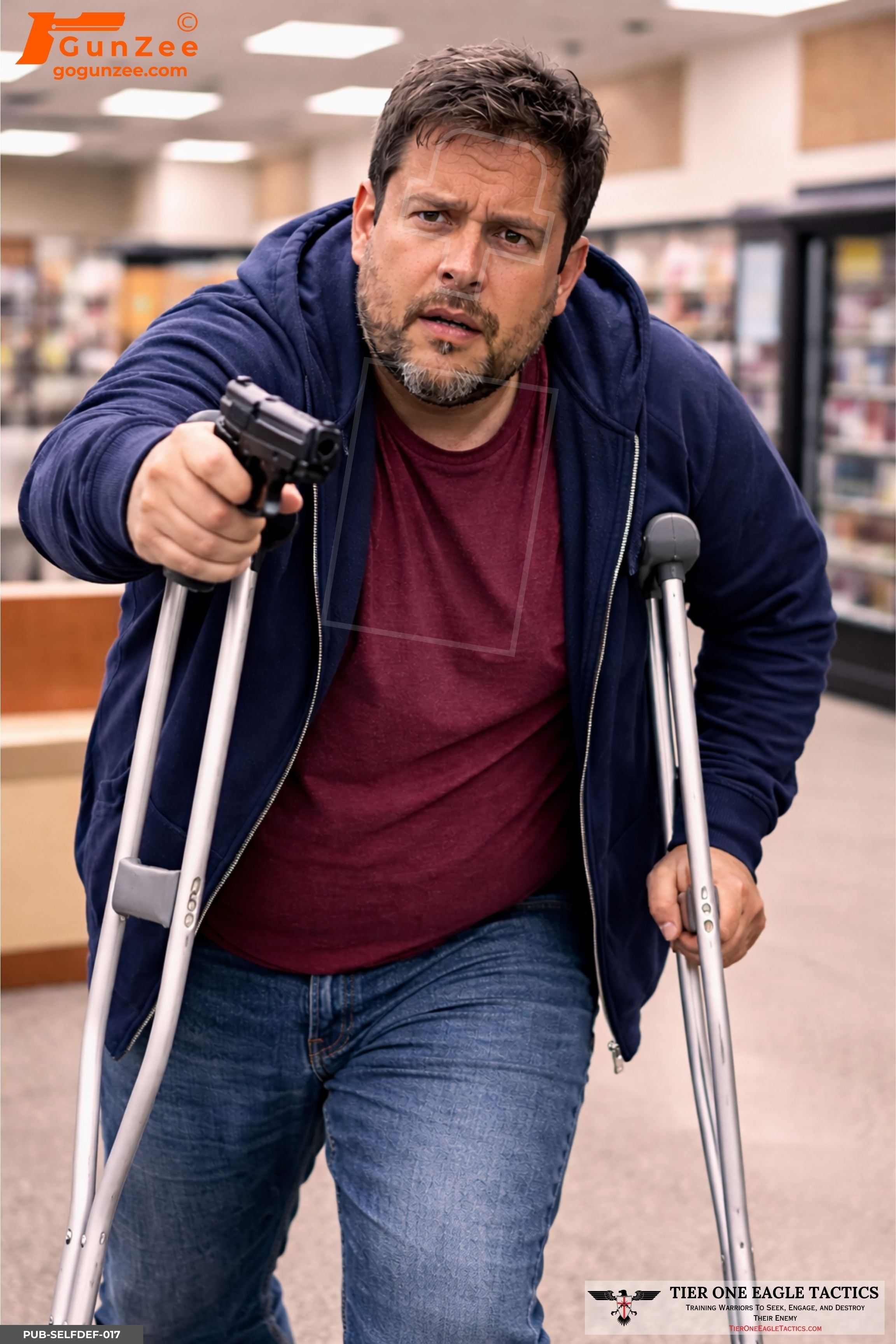
The Man on Crutches Armed Confrontation Shooting Target presents a deceptive and high-risk public self-defense scenario involving an apparently mobility-impaired individual who is actively armed and presenting a lethal firearm threat. The subject’s use of crutches creates a powerful visual contradiction that can delay threat recognition, distort judgment, and induce hesitation at the worst possible moment.
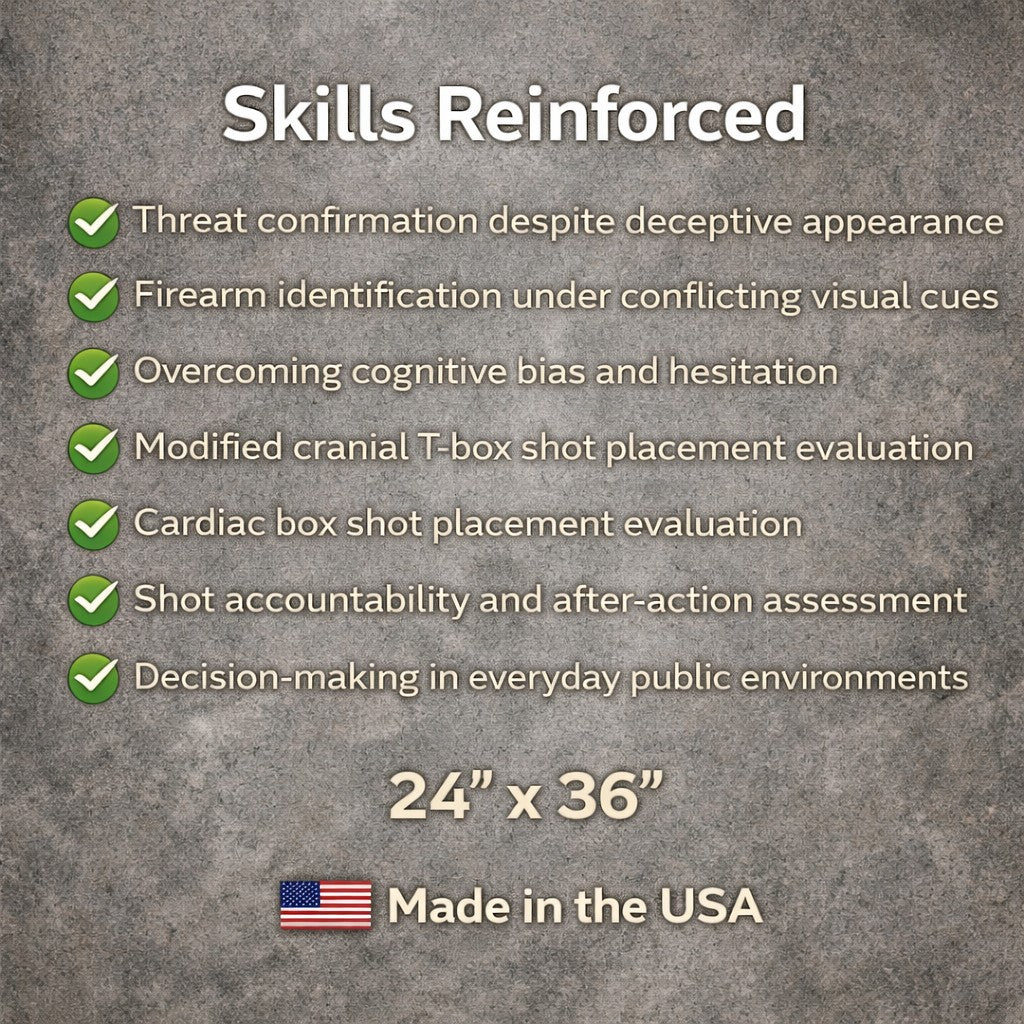
This target is designed to train shooters to confirm lethal intent despite misleading visual cues and to apply disciplined, accountable shot placement in a realistic public environment. A modified cranial T-box and a clearly defined cardiac box are integrated to support post-engagement shot placement evaluation and training analysis.
Attackers do not always appear physically dominant, healthy, or capable. Real-world threats may exploit sympathy, confusion, or subconscious bias to gain time, distance, or compliance.
This target forces the shooter to:
The scenario reinforces that physical impairment does not negate lethal capability and that delayed recognition can have irreversible consequences.
Most shooting targets portray threats as obviously capable, aggressive, or physically dominant. This target deliberately challenges that expectation.
The attacker’s use of crutches creates:
The Man on Crutches Armed Confrontation Shooting Target presents a deceptive and high-risk public self-defense scenario involving an apparently mobility-impaired individual who is actively armed and presenting a lethal firearm threat. The subject’s use of crutches creates a powerful visual contradiction that can delay threat recognition, distort judgment, and induce hesitation at the worst possible moment.
This target is designed to train shooters to confirm lethal intent despite misleading visual cues and to apply disciplined, accountable shot placement in a realistic public environment. A modified cranial T-box and a clearly defined cardiac box are integrated to support post-engagement shot placement evaluation and training analysis.
Attackers do not always appear physically dominant, healthy, or capable. Real-world threats may exploit sympathy, confusion, or subconscious bias to gain time, distance, or compliance.
This target forces the shooter to:
The scenario reinforces that physical impairment does not negate lethal capability and that delayed recognition can have irreversible consequences.
Most shooting targets portray threats as obviously capable, aggressive, or physically dominant. This target deliberately challenges that expectation.
The attacker’s use of crutches creates:
The integrated modified cranial T-box defines a neurologically critical incapacitation zone expanded into the frontal cranial region, representing areas known to produce immediate neurological shutdown when effectively engaged.
The cardiac box outlines the heart and upper thoracic vascular structures associated with rapid physiological incapacitation. Together, these zones elevate training from simple hit confirmation to meaningful evaluation of decision-making and shot placement effectiveness.
Modified Cranial T-Box:
A refined neurological incapacitation zone based on the conventional T-box, expanded into the forehead region to account for frontal structures associated with immediate central nervous system disruption.
Cardiac Box:
A defined thoracic zone encompassing the heart and major vascular structures used to evaluate physiological incapacitation during post-training analysis.
These markings are intended strictly for training evaluation and educational purposes.
Pair this target with related scenarios from across the GunZee catalog:
Public and everyday self-defense: Urban Street Two-Man Armed Confrontation Shooting Target, Storage Unit Armed Confrontation Shooting Target, Grocery Aisle Dual-Threat Confrontation Shooting Target, Public Festival Armed Threat – Dense Crowd Gunman Scenario
Home defense, CQB, and hostage: Living Room Couch Armed Male Home Defense Shooting Target, Two-Man Kitchen Armed Intrusion Shooting Target, Indoor Multiple Aggressive Dogs Charging Home Defense Shooting Target
Vehicle and barrier: Vehicle Barrier Windshield Assault Shooting Target, Vehicle Barrier Windshield Gunman Engagement Shooting Target, Vehicle Barrier Daylight Carjacking Shooting Target
Anatomical: Anatomical Full-System Vital Zone Shooting Target, Anatomical Semi-Profile Handgun Threat Vital Zone Shooting Target, Anatomical Semi-Frontal Handgun Threat Precision Shooting Target