Read the Privacy Policy
Quantity must be in increments of 5
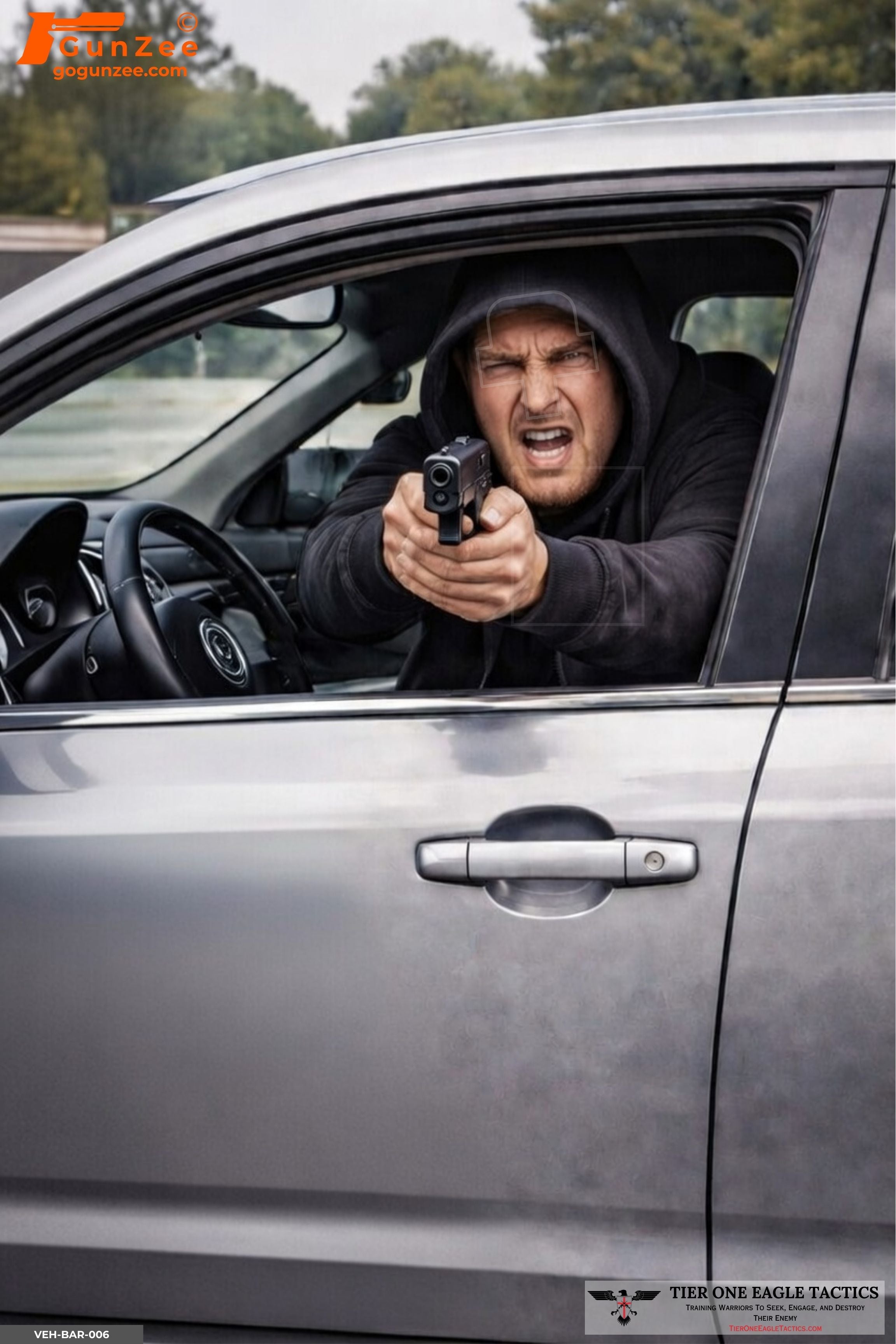
The Vehicle Barrier Closed-Door Armed Driver Shooting Target depicts a high-risk confrontation where an armed aggressor is seated inside a vehicle with the door closed, actively aiming a firearm outward. The vehicle door, window frame, and interior geometry create partial concealment and complex angles that must be processed immediately. Distance is minimal, intent is unmistakable, and reaction time is severely compressed.
This scenario represents a common but undertrained threat profile: an armed subject using a vehicle as both cover and firing platform. The presence of a modified T-box and cardiac box reinforces precise, accountable shot placement when lethal force is justified, even when engagement angles are awkward and visual cues are partially obstructed.
This target emphasizes disciplined execution when the threat is already oriented, committed, and protected by vehicle structure.
Armed threats originating from within vehicles present unique ballistic, visual, and cognitive challenges. This target is designed to train shooters to recognize immediate lethal intent and respond decisively while accounting for vehicle doors, window lines, and offset body positioning.
The closed-door configuration forces shooters to process limited target exposure, altered head and torso angles, and the psychological pressure of a suspect who is already prepared to fire. The scenario reinforces that clear intent does not eliminate the requirement for precision and shot accountability.
The Vehicle Barrier Closed-Door Armed Driver Shooting Target depicts a high-risk confrontation where an armed aggressor is seated inside a vehicle with the door closed, actively aiming a firearm outward. The vehicle door, window frame, and interior geometry create partial concealment and complex angles that must be processed immediately. Distance is minimal, intent is unmistakable, and reaction time is severely compressed.
This scenario represents a common but undertrained threat profile: an armed subject using a vehicle as both cover and firing platform. The presence of a modified T-box and cardiac box reinforces precise, accountable shot placement when lethal force is justified, even when engagement angles are awkward and visual cues are partially obstructed.
This target emphasizes disciplined execution when the threat is already oriented, committed, and protected by vehicle structure.
Armed threats originating from within vehicles present unique ballistic, visual, and cognitive challenges. This target is designed to train shooters to recognize immediate lethal intent and respond decisively while accounting for vehicle doors, window lines, and offset body positioning.
The closed-door configuration forces shooters to process limited target exposure, altered head and torso angles, and the psychological pressure of a suspect who is already prepared to fire. The scenario reinforces that clear intent does not eliminate the requirement for precision and shot accountability.
Most vehicle targets depict open-door or external threats. This target introduces the complexity of a closed-door engagement, where metal, glass, and body panels influence visibility and angles without fully obscuring the threat.
The modified T-box and cardiac box demand disciplined shot placement despite constrained sightlines. The aggressor’s posture, facial expression, and direct weapon presentation create urgency, while the vehicle itself forces shooters to abandon idealized shooting assumptions.
This target is designed to expose poor angle management, hesitation, and overreliance on center-mass shooting, replacing them with intentional, realistic decision-making.
Pair this target with related scenarios from across the GunZee catalog:
Public and everyday self-defense: ATM Robbery Gunpoint Ambush – Rear-Aspect Public Threat Scenario, Low-Light Plainclothes Officer Threat Assessment Scenario, Plainclothes Officer Contact & Crossfire Control – Partner Coordination Scenario
Home defense, CQB, and hostage: Group Conflict Knife Escalation Shooting Target, Two-Man Kitchen Armed Intrusion Shooting Target, Trailer Execution Imminent Knife Overhead Threat Shooting Target
Vehicle and barrier: Vehicle Barrier Armed Driver Engagement Shooting Target, Vehicle Barrier Door-Jamb Armed Threat Shooting Target, Vehicle Barrier Armed Subject Exiting Vehicle Shooting Target, Vehicle Barrier Carjacking Confrontation Shooting Target
Anatomical: Anatomical Side-Profile Rifle Threat Shooting Target, Anatomical Rifle Threat Vital Zone Shooting Target, Anatomical Semi-Frontal Handgun Threat Precision Shooting Target
Also ships in: Shoot / No-Shoot 150-pack, 150-Target Training Pack — the 30 best sellers, 5 each — five of each design, priced below singles.