Read the Privacy Policy
Quantity must be in increments of 5
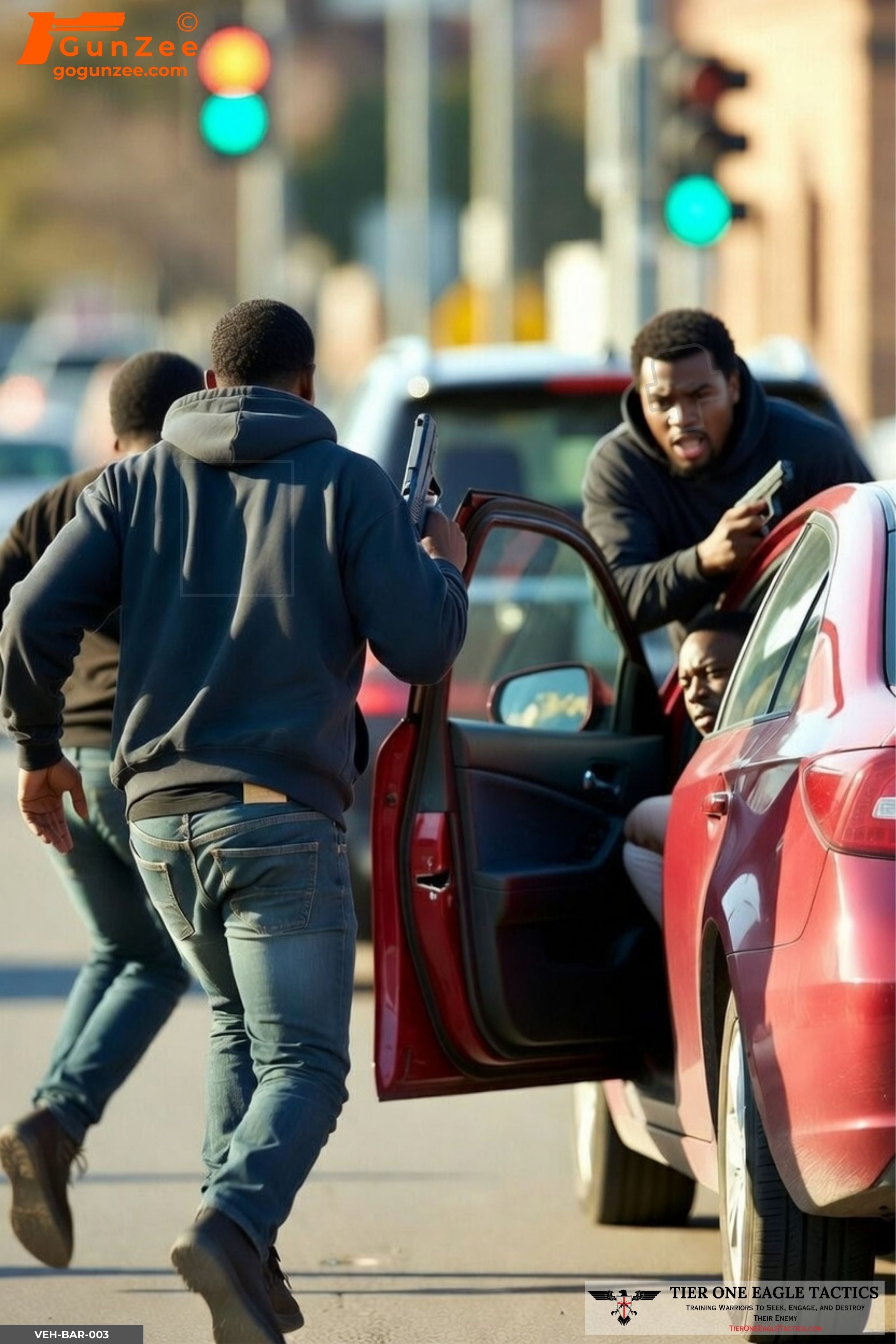
The Vehicle Barrier Multi-Aggressor Carjacking Shooting Target depicts a rapidly unfolding daylight carjacking involving multiple armed attackers converging on a vehicle stopped in traffic. One aggressor advances aggressively at the open driver’s door while a second applies pressure from a different angle, creating an immediate, overlapping lethal threat environment.
This scenario is designed to overwhelm simplistic decision-making. Movement, proximity, and divided attention force the shooter to determine which threat must be addressed first, rather than reacting to the most obvious or closest individual. The inclusion of a modified T-box and cardiac box on one aggressor, and a cardiac box on the second, reinforces disciplined shot placement and target discrimination under extreme stress.
This target reflects the reality that vehicle-based attacks often involve coordination, momentum, and compressed timelines rather than isolated, single-threat encounters.
Multi-attacker vehicle confrontations present some of the most difficult defensive problems a shooter can face. Confined space, vehicle barriers, public surroundings, and converging threats drastically reduce reaction time and margin for error.
This target trains shooters to rapidly assess threat hierarchy, recognize lethal intent, and engage with precision rather than panic. The shooter must process movement patterns, angles, and weapon presentation while accounting for the vehicle as both a barrier and an obstacle.
The differing engagement zones across the two aggressors intentionally reinforce decision-making discipline, preventing shooters from defaulting to identical shot placement assumptions when multiple lethal threats are present.
The Vehicle Barrier Multi-Aggressor Carjacking Shooting Target depicts a rapidly unfolding daylight carjacking involving multiple armed attackers converging on a vehicle stopped in traffic. One aggressor advances aggressively at the open driver’s door while a second applies pressure from a different angle, creating an immediate, overlapping lethal threat environment.
This scenario is designed to overwhelm simplistic decision-making. Movement, proximity, and divided attention force the shooter to determine which threat must be addressed first, rather than reacting to the most obvious or closest individual. The inclusion of a modified T-box and cardiac box on one aggressor, and a cardiac box on the second, reinforces disciplined shot placement and target discrimination under extreme stress.
This target reflects the reality that vehicle-based attacks often involve coordination, momentum, and compressed timelines rather than isolated, single-threat encounters.
Multi-attacker vehicle confrontations present some of the most difficult defensive problems a shooter can face. Confined space, vehicle barriers, public surroundings, and converging threats drastically reduce reaction time and margin for error.
This target trains shooters to rapidly assess threat hierarchy, recognize lethal intent, and engage with precision rather than panic. The shooter must process movement patterns, angles, and weapon presentation while accounting for the vehicle as both a barrier and an obstacle.
The differing engagement zones across the two aggressors intentionally reinforce decision-making discipline, preventing shooters from defaulting to identical shot placement assumptions when multiple lethal threats are present.
Most paper targets isolate a single problem. This target presents simultaneous lethal threats that must be addressed in sequence, not in isolation. The aggressors’ positions, posture, and movement paths force shooters to actively determine who poses the most immediate danger.
The modified T-box and cardiac zones reinforce accountability and precision, while the secondary aggressor’s cardiac-only zone requires deliberate confirmation before engagement. Environmental context, traffic surroundings, and vehicle geometry add realism that flat silhouettes cannot replicate.
This target is designed to expose hesitation, fixation, and poor threat prioritization, then correct those deficiencies through realistic repetition.
Pair this target with related scenarios from across the GunZee catalog:
Public and everyday self-defense: Grocery Aisle Dual-Threat Confrontation Shooting Target, Wheelchair Ambiguous Threat – Concealed Handgun Public Encounter Shooting Target, ATM Robbery Gunpoint Ambush – Rear-Aspect Public Threat Scenario
Home defense, CQB, and hostage: CQB Home Defense Hostage – Self-Directed Gun Threat Decision-Making Shooting Target, Living Room Couch Male With Remote Ambiguous Threat Shooting Target, Hallway Threat Active Shooter Movement Shooting Target
Vehicle and barrier: Vehicle Barrier Carjacking Confrontation Shooting Target, Vehicle Barrier Daylight Carjacking Shooting Target, Vehicle Barrier Elderly Victim Carjacking Shooting Target, Vehicle Barrier Armed Driver Engagement Shooting Target
Anatomical: Anatomical Head-Out Vehicle Window Engagement Shooting Target, Anatomical Frontal Handgun Threat Vital Zone Shooting Target, Anatomical Semi-Frontal Handgun Threat Precision Shooting Target