Read the Privacy Policy
Quantity must be in increments of 5
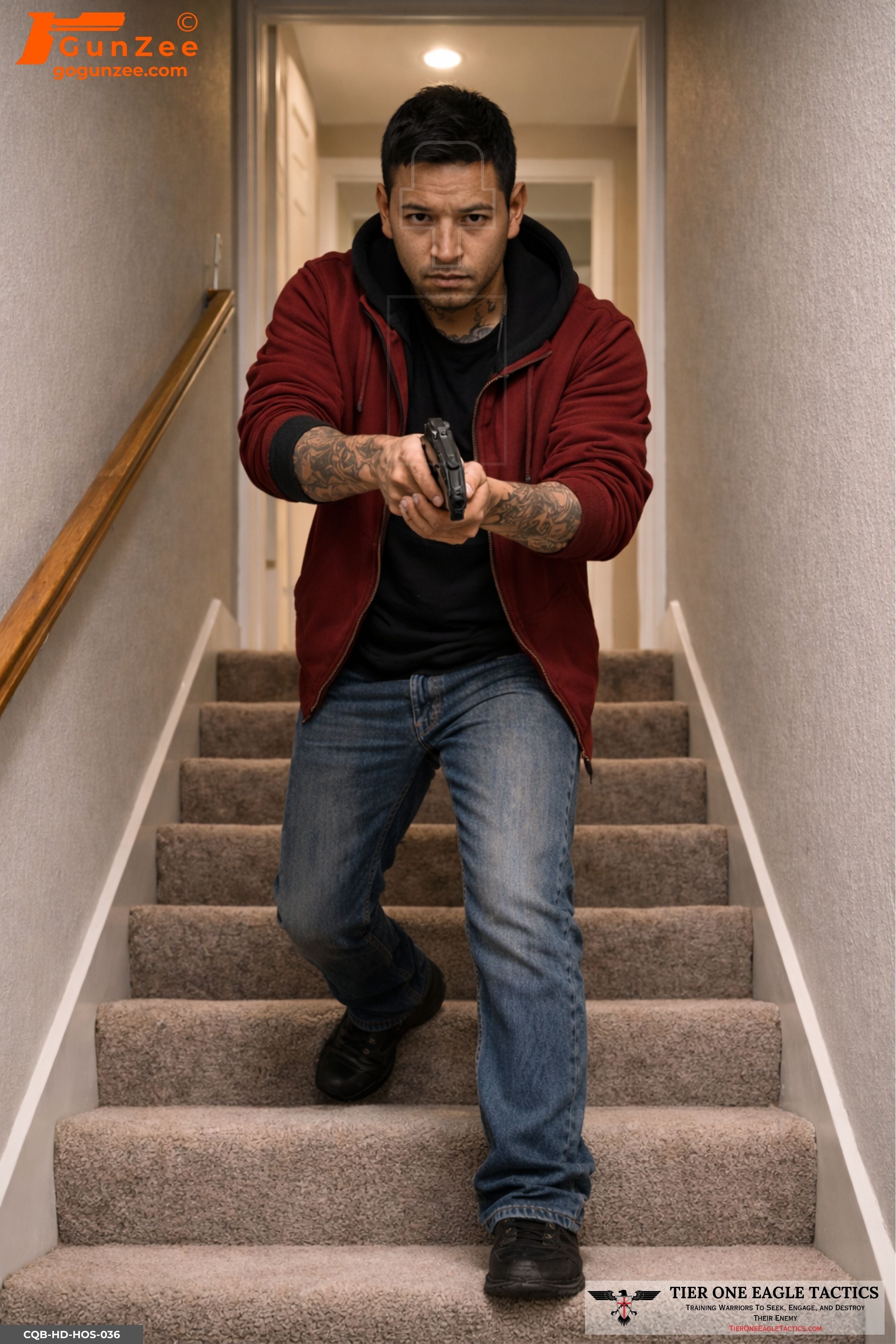
This target depicts an armed intruder advancing down a residential stairwell, weapon presented forward while descending toward the defender’s position. The stairwell environment creates a compressed engagement lane, restricted lateral movement, and severe vertical geometry challenges that significantly alter sightlines, angles, and threat timing.
The intruder’s posture, forward lean, and controlled weapon presentation indicate clear lethal intent. The confined stairwell magnifies risk by limiting retreat options and increasing the likelihood of rapid threat escalation at close range.
This scenario reflects one of the most dangerous environments in residential defense: a vertical choke point where distance collapses quickly and hesitation can be catastrophic.
This target is designed to train shooters to manage armed threats in vertical interior spaces where elevation, balance, and movement must be controlled simultaneously. It reinforces disciplined shot placement, threat recognition under pressure, and decision-making when angles are unforgiving and time is compressed.
Shooters are required to process elevation changes, maintain muzzle discipline, and commit to decisive action in a narrow, high-risk engagement corridor.
A modified T-box and cardiac zone are applied to the armed intruder to support post-engagement analysis and training accountability. These zones emphasize the importance of anatomically decisive shot placement when operating in environments where follow-up opportunities may be limited.
... ...This target depicts an armed intruder advancing down a residential stairwell, weapon presented forward while descending toward the defender’s position. The stairwell environment creates a compressed engagement lane, restricted lateral movement, and severe vertical geometry challenges that significantly alter sightlines, angles, and threat timing.
The intruder’s posture, forward lean, and controlled weapon presentation indicate clear lethal intent. The confined stairwell magnifies risk by limiting retreat options and increasing the likelihood of rapid threat escalation at close range.
This scenario reflects one of the most dangerous environments in residential defense: a vertical choke point where distance collapses quickly and hesitation can be catastrophic.
This target is designed to train shooters to manage armed threats in vertical interior spaces where elevation, balance, and movement must be controlled simultaneously. It reinforces disciplined shot placement, threat recognition under pressure, and decision-making when angles are unforgiving and time is compressed.
Shooters are required to process elevation changes, maintain muzzle discipline, and commit to decisive action in a narrow, high-risk engagement corridor.
A modified T-box and cardiac zone are applied to the armed intruder to support post-engagement analysis and training accountability. These zones emphasize the importance of anatomically decisive shot placement when operating in environments where follow-up opportunities may be limited.
Kill zones are integrated as evaluation references for instructors and shooters during after-action review and are not intended to drive visual fixation during execution.
Pair this target with related scenarios from across the GunZee catalog:
Public and everyday self-defense: Parking Garage Close-Contact Hostage Control Shooting Target, Church Aisle Hostage Crisis Shooting Target, Urban Street Two-Man Armed Confrontation Shooting Target
Home defense, CQB, and hostage: Armed Intruder with Flashlight Home Defense Shooting Target, CQB Home Defense Hostage – Woman Armed Forward Presentation Shooting Target, CQB Home Defense Hostage – Armed Aggressor Forward Presentation Shooting Target, CQB Home Defense Hostage – Two-Man Armed Threat Coordination Shooting Target
Vehicle and barrier: Vehicle Barrier Windshield Assault Shooting Target, Vehicle Barrier Daylight Carjacking Shooting Target, Vehicle Approach Threat Advancing Gunman Shooting Target
Anatomical: Anatomical Side-Profile Rifle Threat Shooting Target, Anatomical Semi-Profile Handgun Threat Vital Zone Shooting Target, Anatomical Rifle Threat Vital Zone Shooting Target