Read the Privacy Policy
Quantity must be in increments of 5
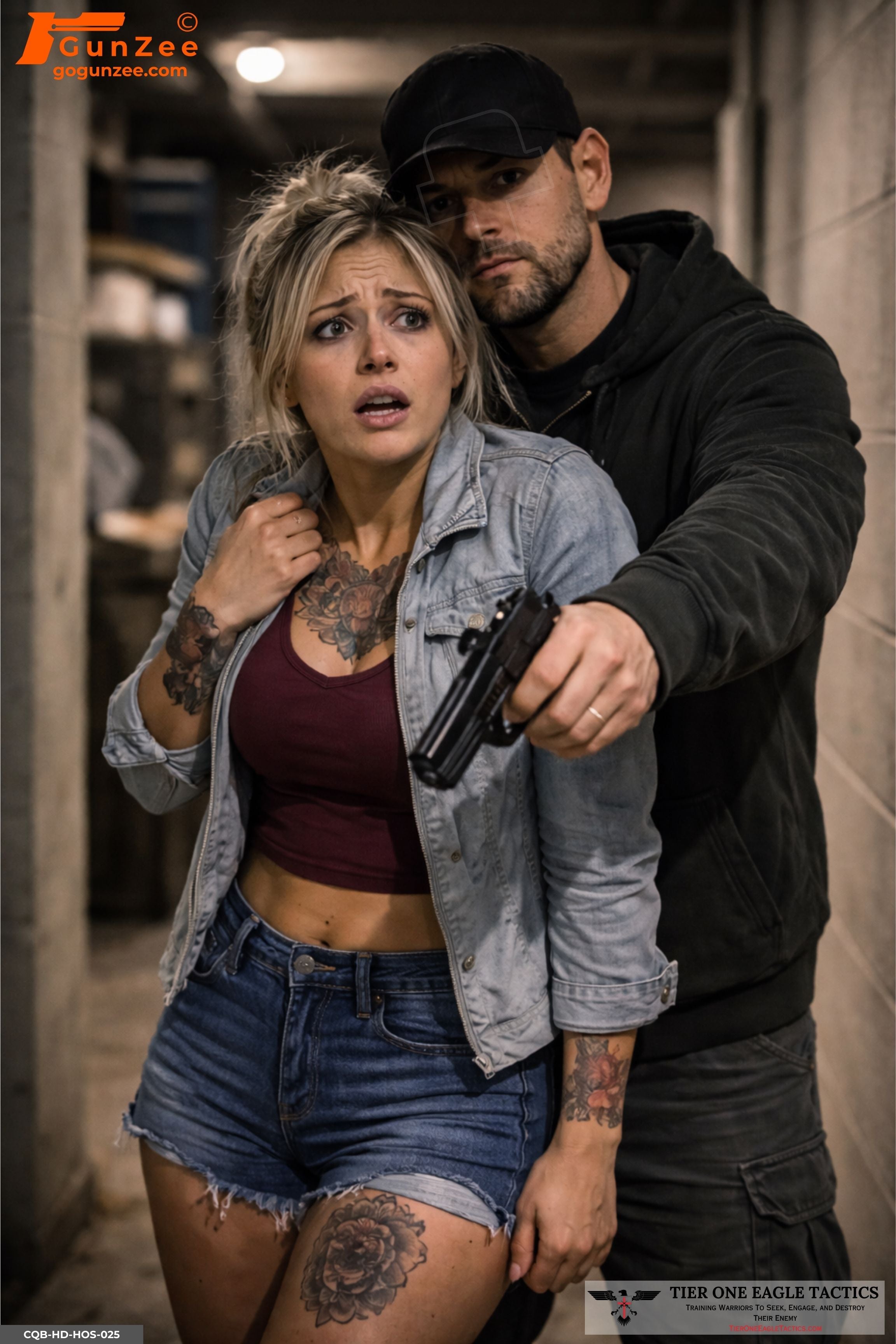
This close-contact hostage scenario depicts a male aggressor maintaining physical control of a female victim in a confined parking garage environment. The aggressor positions himself directly behind the victim, using proximity, body alignment, and partial concealment to shield his vital areas while extending a firearm outward. The victim’s distressed expression, visible tattoos, and casual civilian clothing add realism while increasing visual complexity.
The tight spacing, overlapping bodies, and limited angles force the shooter to process threat hierarchy, body mechanics, and shot accountability under severe spatial constraints. This target emphasizes the difficulty of identifying and engaging a lethal threat when the aggressor deliberately uses the hostage as both cover and distraction.
Close-contact hostage encounters represent some of the most demanding decision-making problems in defensive shooting. The shooter must identify the true threat, evaluate weapon orientation and control, and determine whether a shot is feasible without unacceptable risk to the hostage.
This target trains shooters to manage visual overload, maintain discipline under emotional stress, and make correct engagement decisions when traditional center-mass solutions are obstructed.
This target includes a modified T box on the aggressor.
The modified T box is intentionally subtle and cannot be seen clearly at typical shooting distances. It is designed exclusively for post-engagement... ...
This close-contact hostage scenario depicts a male aggressor maintaining physical control of a female victim in a confined parking garage environment. The aggressor positions himself directly behind the victim, using proximity, body alignment, and partial concealment to shield his vital areas while extending a firearm outward. The victim’s distressed expression, visible tattoos, and casual civilian clothing add realism while increasing visual complexity.
The tight spacing, overlapping bodies, and limited angles force the shooter to process threat hierarchy, body mechanics, and shot accountability under severe spatial constraints. This target emphasizes the difficulty of identifying and engaging a lethal threat when the aggressor deliberately uses the hostage as both cover and distraction.
Close-contact hostage encounters represent some of the most demanding decision-making problems in defensive shooting. The shooter must identify the true threat, evaluate weapon orientation and control, and determine whether a shot is feasible without unacceptable risk to the hostage.
This target trains shooters to manage visual overload, maintain discipline under emotional stress, and make correct engagement decisions when traditional center-mass solutions are obstructed.
This target includes a modified T box on the aggressor.
The modified T box is intentionally subtle and cannot be seen clearly at typical shooting distances. It is designed exclusively for post-engagement analysis rather than as a visual aiming reference. The modification accounts for realistic cranial engagement considerations, including an expanded incapacitation area in the upper forehead region where immediate neurological disruption is known to occur.
Shooters engage based on situational judgment and threat confirmation, then review shot placement afterward to evaluate precision, decision quality, and accountability.
Many hostage targets present clean separation between aggressor and victim. This design removes that clarity.
The aggressor is physically merged with the hostage.
The firearm is offset and partially shielded.
The environment limits movement and angles.
The victim’s appearance draws attention away from the true threat.
This target punishes rushed decisions and rewards disciplined observation, restraint, and correct prioritization.
Pair this target with related scenarios from across the GunZee catalog:
Public and everyday self-defense: Parking Garage Hostage Crisis – Cranial Incapacitation Training Target, Plainclothes Officer Contact & Crossfire Control – Partner Coordination Scenario, Crowded Street Hostage Control with Concealed Gunman Shooting Target, Church Aisle Hostage Physical Control Scenario Shooting Target
Home defense, CQB, and hostage: CQB Home Defense Hostage – Woman Armed Forward Presentation Shooting Target, CQB Home Defense Hostage – Closet Ambush Armed Subject Shooting Target, Group Conflict Knife Escalation Shooting Target
Vehicle and barrier: Vehicle Barrier Multi-Aggressor Carjacking Shooting Target, Vehicle Barrier Windshield Gunman Engagement Shooting Target, Vehicle Barrier Elderly Victim Carjacking Shooting Target
Anatomical: Anatomical Semi-Frontal Handgun Threat Precision Shooting Target, Anatomical Hostage Shield Vital Zone Shooting Target, Anatomical Semi-Profile Handgun Threat Vital Zone Shooting Target