The most common real-world hostage geometry is not on most range targets. A male threat — taller, larger-framed, often armed — holding a smaller female hostage from behind is the pattern that dominates domestic violence escalations, home invasions, kidnappings, and many public-space abductions. It is the geometry the defensive shooter is most likely to face. It is also the one most paper targets do not train.
Female-hostage targets exist because gender-neutral hostage geometry does not match reality. The threat is almost always larger than the hostage. The hostage is almost always shorter. The exposed angles, the height differential, the visible decision cues — all of it changes when the hostage is a 5'4" woman and the threat is a 6'0" man. Training the abstract version produces hesitation when the real version appears. Training the actual geometry produces a shot.

Why height differential matters
A hostage shield works because the hostage's body covers vital structures on the threat. The size of the hostage determines how much of the threat is covered.
Two same-height figures produces a near-total occlusion — the threat's torso disappears behind the hostage, leaving only a sliver of head and one shoulder. The T-box may be partially obscured. The shooter is forced to wait, move, or take a shot they should not take.
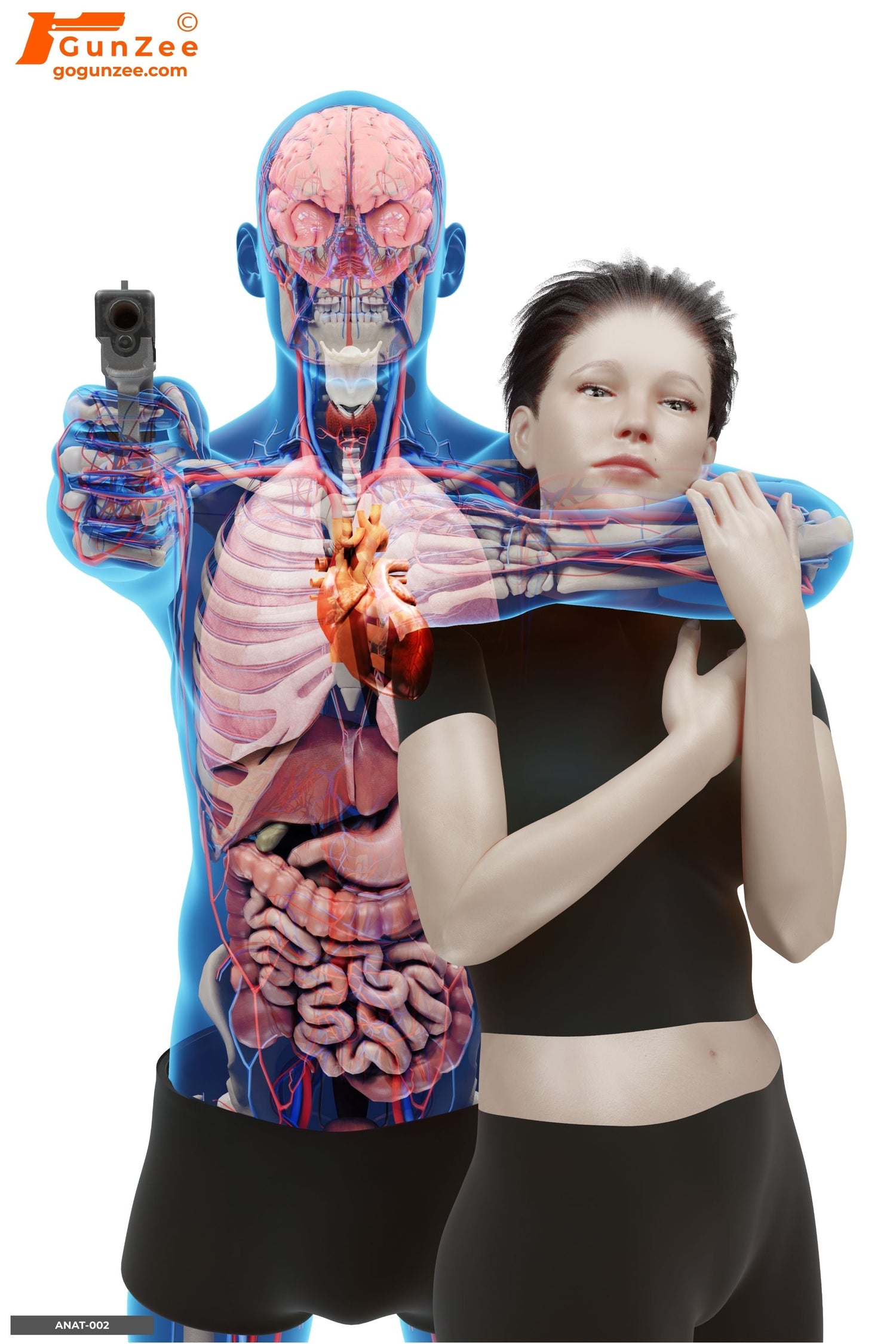
A taller threat behind a shorter hostage exposes the threat's full head and upper shoulders above the hostage's head. The cranial T-box is fully visible — sometimes more visible than it would be on a face-on threat without a hostage. The cardiac box is occluded, but the T-box shot is unambiguously available.
This is the geometry the Anatomical Hostage Shield target shows: a taller threat behind a shorter hostage, cardiac box denied, T-box exposed. The shooter who has not rehearsed this exact picture takes longer to recognize it under stress. The shooter who has trained it sees the cue and moves.
Female hostage with knife threat — the rear-control geometry
Many real hostage encounters do not involve a firearm on the threat side. A subject controlling a hostage with a knife — held at the hostage's throat, against the kidney, or at the femoral — is the geometry of most domestic violence escalations and many home invasions. The threat's hands are occupied; the threat's posture is close to the hostage; the visual cues are different from a firearm hostage situation.
The CQB Home Defense Hostage Knife Threat Rear Control target shows exactly this — a male threat holding a female hostage from behind with a knife at her neck, the threat's head fully exposed above the hostage's. The cardiac box is denied; the T-box is the answer; the decision pressure is immediate.
A variant of this — the CQB Home Defense Hostage Rear Knife Threat Distraction target — adds visual ambiguity. The threat is positioned behind the hostage with a knife visible but the hostage's posture suggests potential dual involvement. The shooter has to read the geometry, identify the threat, and confirm the placement decision before taking the shot. This is closer to real-world conditions than a clean-cut hostage presentation.

The corridor hostage — environmental complexity layered on top
A clean hostage scenario on a paper target removes the environment. Real hostage encounters happen in places — hallways, doorways, corridors, rooms — and the environment changes the shot. Movement direction, partial cover, distance compression, and visual obstacles all alter the geometry as the threat advances or retreats.
The Corridor Hostage Control with Rear Gunman target shows the threat advancing down a narrow corridor with a female hostage in front and a partner threat behind. Two threats, one hostage, an environment that compresses the engagement window. The decision sequence — primary target, secondary target, hostage avoidance — has to happen in a single beat.
The Two-Man Corridor Hostage Escort with Primary Gunman target adds the inverse geometry: the primary threat is the front man with the hostage, and the secondary threat trails. Which target gets engaged first depends on the read — and the read depends on having seen this picture before.
Child-shield variants — same decision, harder context
The decision framework for a child hostage is identical to a female hostage. The geometry and the decision pressure are not.
A child hostage is much shorter than even a small female. The threat's full torso may be exposed above the child's head — sometimes the cardiac box is fully available, sometimes the entire upper chest. The shot menu expands; the decision changes.
The CQB Home Defense Hostage Child Shield Handgun Threat target shows this exact geometry — a male threat behind a child, a handgun presented at the child's head, the threat's chest and head fully exposed. The decision is harder despite the shot being technically easier, because the hostage is a child.
The CQB Home Defense Hostage Child Shield No Weapon Confirmation target adds the discrimination problem: the threat is behind a child but the weapon is not yet visible. This is the no-shoot version. The defensive shooter who trains this target builds the restraint that the actual encounter will demand.
A practical curriculum for hostage training
Hostage scenarios are not where a shooter starts. They are where a shooter graduates to after cardiac box and T-box fundamentals are reliable. A useful sequence:
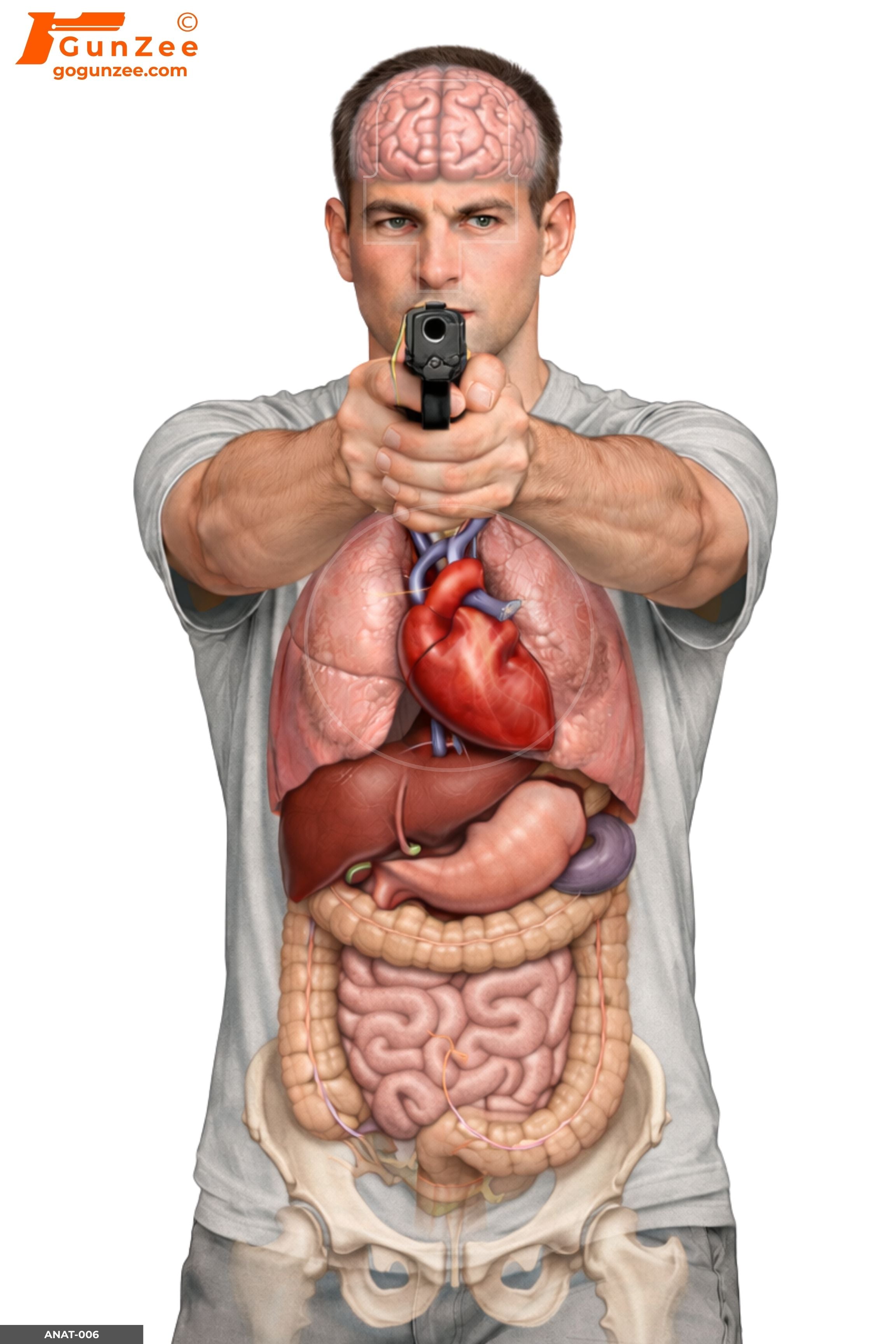
- Anatomical reference work. Cardiac box and T-box reliability on a clean Anatomical Full-System target before any hostage geometry is introduced.
- The shift drill. Cardiac-to-T-box transitions on the Anatomical Hostage Shield target, isolating the placement decision before adding environmental complexity.
- Single-threat hostage drills. The Knife Threat Rear Control and Forward Weapon Presentation targets — one threat, one hostage, no environmental modifiers.
- Discrimination drills. The Rear Knife Threat Distraction target and the child-shield no-weapon variant force the shoot/no-shoot read before the placement decision.
- Environmental complexity. The Corridor Hostage Control and Two-Man Corridor Escort targets fold the decision into a real engagement environment.
This progression compounds. Each layer assumes the previous one is stable. Shortcutting it produces the worst-case outcome — a shooter who can take a clean T-box shot in isolation but freezes or makes the wrong call when the geometry, the hostage, and the environment all show up together.
Where this fits in the broader scenario curriculum
Female-hostage and child-shield training is a specific application of the broader hostage skill set. The pillar article Hostage Scenarios: The Decision-Making Drills Most Shooters Skip covers the full hostage training framework. The anatomical placement layer that this entire skill rests on is covered in Human Anatomy Shooting Targets: A Complete Training Guide. The specific cardiac-to-T-box transition is covered in Cardiac Box vs. T-Box: When to Shift Your Aim Mid-Engagement.
The full hostage-scenario library lives in the Home Defense, CQB & Hostage Scenarios collection.
→ BROWSE HOSTAGE-SCENARIO SHOOTING TARGETS
Frequently asked questions
Why do female hostage targets matter for training?
The most common real-world hostage geometry is a male threat holding a female hostage — domestic violence escalations, home invasions, and public-space abductions almost always present this pattern. A target showing this exact geometry trains the visual recognition and shot placement decision that the actual encounter will demand.
What is a hostage shield in shooting target terminology?
A hostage-shield target shows a threat positioned behind a non-threat figure, using the non-threat as physical cover. The threat's torso and cardiac box are usually occluded; only the head, partial shoulder, or weapon-side arm remain exposed. The shot decision becomes a precision T-box shot or no shot at all.
Is height difference important in hostage target design?
Yes. A taller threat behind a shorter hostage exposes a different visible area than two same-height figures. Female-hostage geometry typically presents the threat's full head and upper shoulders above the hostage's head — exactly the T-box presentation a defensive shooter must train against.
What targets train the female-hostage scenario?
The Anatomical Hostage Shield target trains the anatomical placement decision. The CQB Knife Threat Rear Control target shows a male threat using a female as a shield with a knife. The Rear Knife Threat Distraction target adds visual ambiguity. The Corridor Hostage Control target adds environmental complexity.
Should the shooter ever take a chest shot in a hostage scenario?
Only when the threat's cardiac box is fully visible and the hostage is not in the round's path, including the path after penetration. When the cardiac box is occluded or the bullet would pass through the threat into the hostage, the cranial T-box is the only ethical shot.
Are child-shield targets the same as hostage-shield targets?
The decision framework is the same but the geometry is different. A child hostage is much shorter, exposing more of the threat above the child's head — sometimes the threat's full torso. The Child Shield Handgun Threat target and the Child Shield No Weapon Confirmation target train this geometry with the additional decision pressure of a child non-threat.
Build these into a training plan with our dedicated hostage-rescue targets collection — scenario-specific paper targets for shield-take, single-aggressor, and multi-figure drills.
Go deeper: build the hold/press decision with shoot / no-shoot judgment drills, train no-threat discipline on NKZ threat / no-threat targets, and browse the full paper shooting targets collection.