
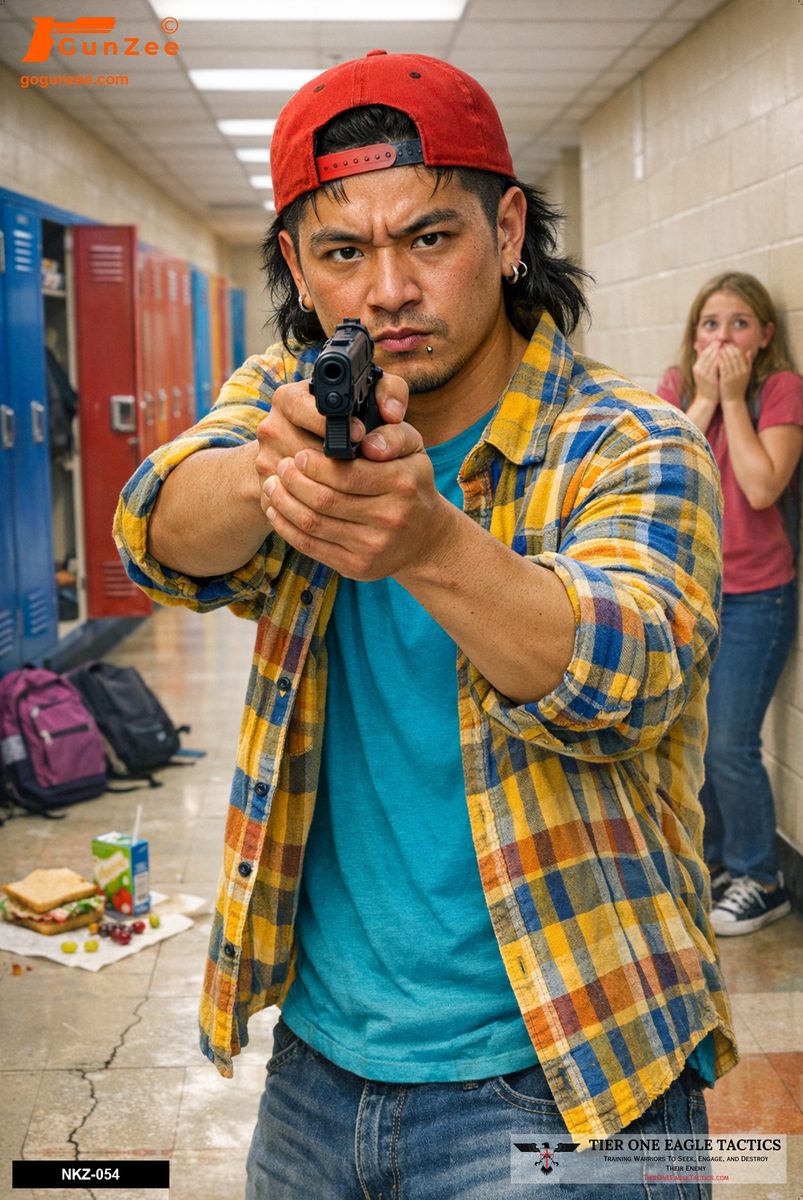
School Hallway Armed Threat Shooting Target [24" x 36"]
each · sold in 5s · mix any designs
Price drops automatically: 50+ $1.85 · 100+ $1.76 · 250+ $1.66 · Up to 25% off at 999+ · Volume quote →
$40 order minimum for your whole cart, not each design. Mix any targets.
Quantity must be in increments of 5
School Hallway Armed Threat Shooting Target
Life-size 24" x 36" scenario target depicting an armed threat in the School Hallway Armed Threat scenario. Trains scenario recognition, threat assessment, and precision engagement under realistic conditions — no printed T-boxes or scoring zones on the threat figure. Built for LE patrol officers, defensive-shooting civilians, and firearms instructors running qualification refreshers and scenario immersion drills.
This scenario mirrors real-world active shooter situations that law enforcement officers, school security personnel, and defensive shooting civilians might encounter. The confined space of a school hallway increases the complexity of the engagement due to potential ricochets and the presence of innocent bystanders. The subject's focus and the bystander's proximity demand rapid decision-making under stress, a critical component of modern tactical training. The chaotic environment, with personal belongings scattered, suggests a sudden escalation, requiring responders to quickly adapt and assess the unfolding threat.
Training Purpose
The primary training purpose of this target is to develop precision shot placement in a high-stakes environment where bystander safety is paramount. The shooter must quickly assess the threat and determine the safest course of action. This scenario also emphasizes the importance of situational awareness and the ability to make split-second decisions when lives are at risk. The presence of a bystander in close proximity to the threat adds an additional layer of complexity, requiring shooters to exercise extreme caution and precision.
Instructors can utilize this target in various drills, including cold cognitive presentations where the shooter is unaware of the scenario until the target is revealed. Timed engagements using a shot timer can add pressure, simulating real-world urgency. Additionally, integrating movement drills can help trainees practice relocating to safer positions while maintaining control and accuracy. The scenario encourages shooters to engage in decision-tree exercises, evaluating multiple potential outcomes and responses in real-time.
Skills Reinforced
- Precision shooting under... ...
School Hallway Armed Threat Shooting Target
Life-size 24" x 36" scenario target depicting an armed threat in the School Hallway Armed Threat scenario. Trains scenario recognition, threat assessment, and precision engagement under realistic conditions — no printed T-boxes or scoring zones on the threat figure. Built for LE patrol officers, defensive-shooting civilians, and firearms instructors running qualification refreshers and scenario immersion drills.
This scenario mirrors real-world active shooter situations that law enforcement officers, school security personnel, and defensive shooting civilians might encounter. The confined space of a school hallway increases the complexity of the engagement due to potential ricochets and the presence of innocent bystanders. The subject's focus and the bystander's proximity demand rapid decision-making under stress, a critical component of modern tactical training. The chaotic environment, with personal belongings scattered, suggests a sudden escalation, requiring responders to quickly adapt and assess the unfolding threat.
Training Purpose
The primary training purpose of this target is to develop precision shot placement in a high-stakes environment where bystander safety is paramount. The shooter must quickly assess the threat and determine the safest course of action. This scenario also emphasizes the importance of situational awareness and the ability to make split-second decisions when lives are at risk. The presence of a bystander in close proximity to the threat adds an additional layer of complexity, requiring shooters to exercise extreme caution and precision.
Instructors can utilize this target in various drills, including cold cognitive presentations where the shooter is unaware of the scenario until the target is revealed. Timed engagements using a shot timer can add pressure, simulating real-world urgency. Additionally, integrating movement drills can help trainees practice relocating to safer positions while maintaining control and accuracy. The scenario encourages shooters to engage in decision-tree exercises, evaluating multiple potential outcomes and responses in real-time.
Skills Reinforced
- Precision shooting under stress — vital for ensuring bystander safety
- Threat assessment — quickly identifying and prioritizing threats
- Decision-making in compressed timeframes
- Situational awareness in dynamic environments
- Controlled breathing and focus amidst chaos
- Movement and repositioning for tactical advantage
- Engagement and scanning for additional threats
- Communication with team members and bystanders
- Shot accountability — ensuring every round counts
- Hesitation avoidance — making confident decisions under pressure
NKZ Series — What Makes It Different
The NKZ series emphasizes accountability for every shot fired, making it essential for training environments where bystander safety is a priority. The presence of the NKZ-054 pill box in the bottom-left corner serves as a cataloging tool for instructors during after-action reviews, helping track performance and improvement areas. This system ensures that shooters are not only engaging threats effectively but also minimizing risk to innocents.
This specific target advances the NKZ methodology by presenting an unambiguous engagement decision with a clear armed threat. The scenario's complexity lies in the need to protect bystanders, reinforcing hold-fire discipline and hesitation avoidance. It challenges shooters to maintain precision and control, even under extreme pressure. The NKZ framework encourages thoughtful engagement, underscoring the importance of shot placement and threat discrimination.
Instructor Notes
When running this scenario in class, it's recommended to position shooters at a realistic engagement distance, typically around 10-15 yards. Starting from a holstered or low-ready position can add realism. The target can be used in a cold run, with no prior briefing, to simulate sudden threat recognition. Scoring should focus on shot placement and decision-making speed, emphasizing the balance between accuracy and urgency. Instructors may also consider incorporating verbal commands to simulate communication with potential bystanders and team members during the engagement.
Who This Target Is For
This target is ideal for law enforcement officers, school security teams, defensive shooting instructors, and civilian defenders. It serves as a crucial tool for qualification preparation, scenario immersion training, and decision-tree drills. The target's realism and complexity make it suitable for both individual and team-based training sessions, enhancing readiness for real-world encounters. Law enforcement agencies can use this target to prepare officers for active shooter situations, while civilian defenders can practice critical decision-making skills in a controlled environment.
Product Details
- Size: 24" x 36" paper — full-size, torso-plus-frame for realistic engagement distance
- Price: $1.95 each · volume tier discounts apply (50-99 = 5% off, 100-249 = 10% off, up to 25% at 999+)
- Print: True-to-life scenario imagery, life-like realism on heavy paper stock
- Ships: Same day from Raleigh, NC — orders in by 2pm ET ship the same afternoon
- SKU: NKZ-054
- NKZ pill box printed in bottom-left corner for cataloging and after-action review
Related NKZ Targets
Pair this target with other NKZ scenarios to build a mixed decision-making deck. Instructors: stringing 3-5 NKZ targets across a training block trains the shooter to process each new scene cold, without knowing whether the next reveal is an armed threat, a no-shoot, or a hostage engagement.
- School Hallway Armed Threat
- Apartment Hallway Armed Threat
- Office Armed Suspect
- Alleyway Woman Charging With Stick
- Commercial Interior Armed Threat
Browse the full NKZ — No Kill Zone Scenario Targets collection for all 59 targets in this series. See also the parent Paper Shooting Targets keystone, and the related Hostage Rescue Targets + Shoot / No-Shoot Targets keystones.
Also ships in: NKZ 150-pack, Best Sellers 125-pack, 150-Target Training Pack — the 30 best sellers, 5 each — five of each design, priced below singles.