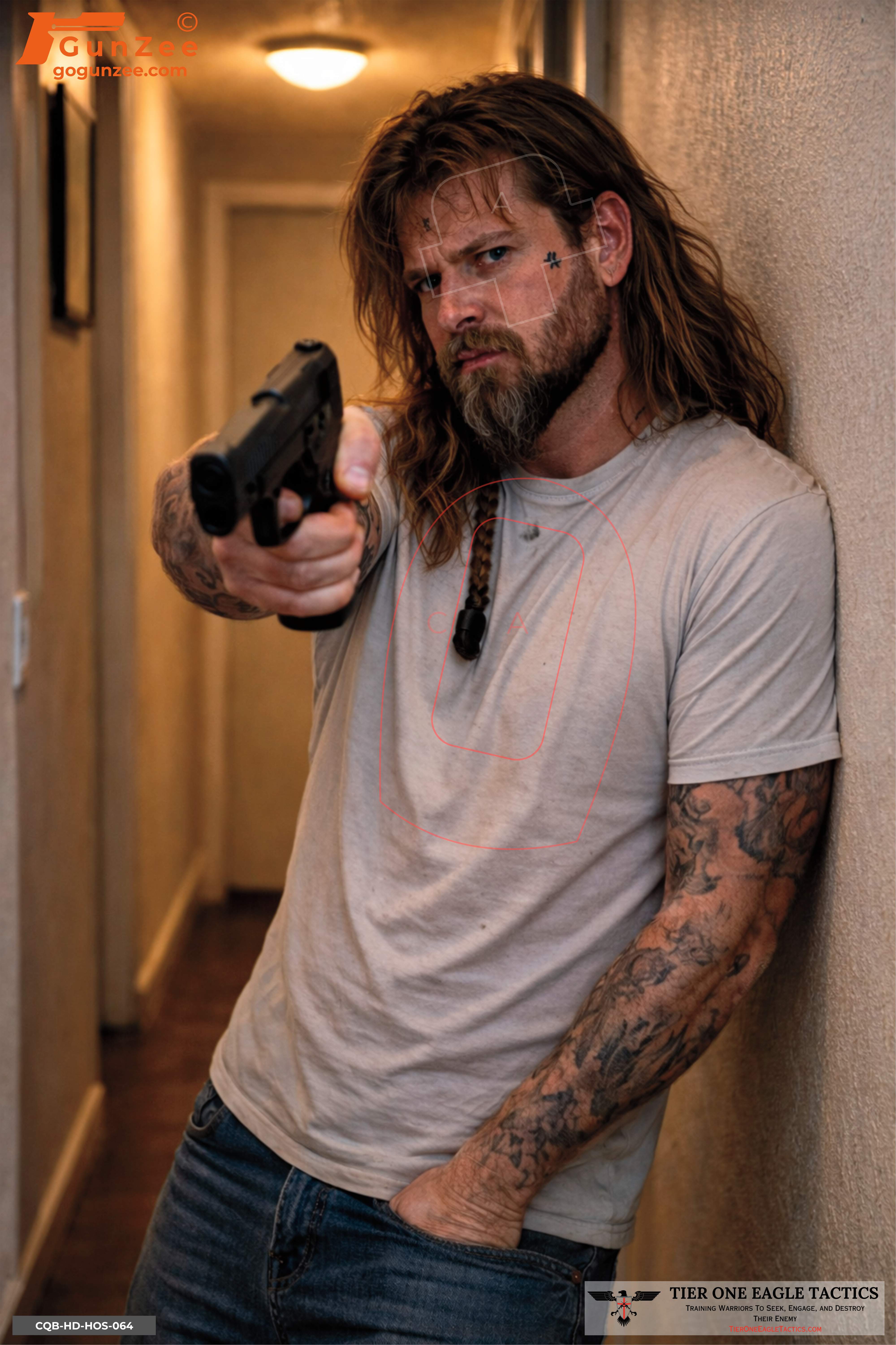
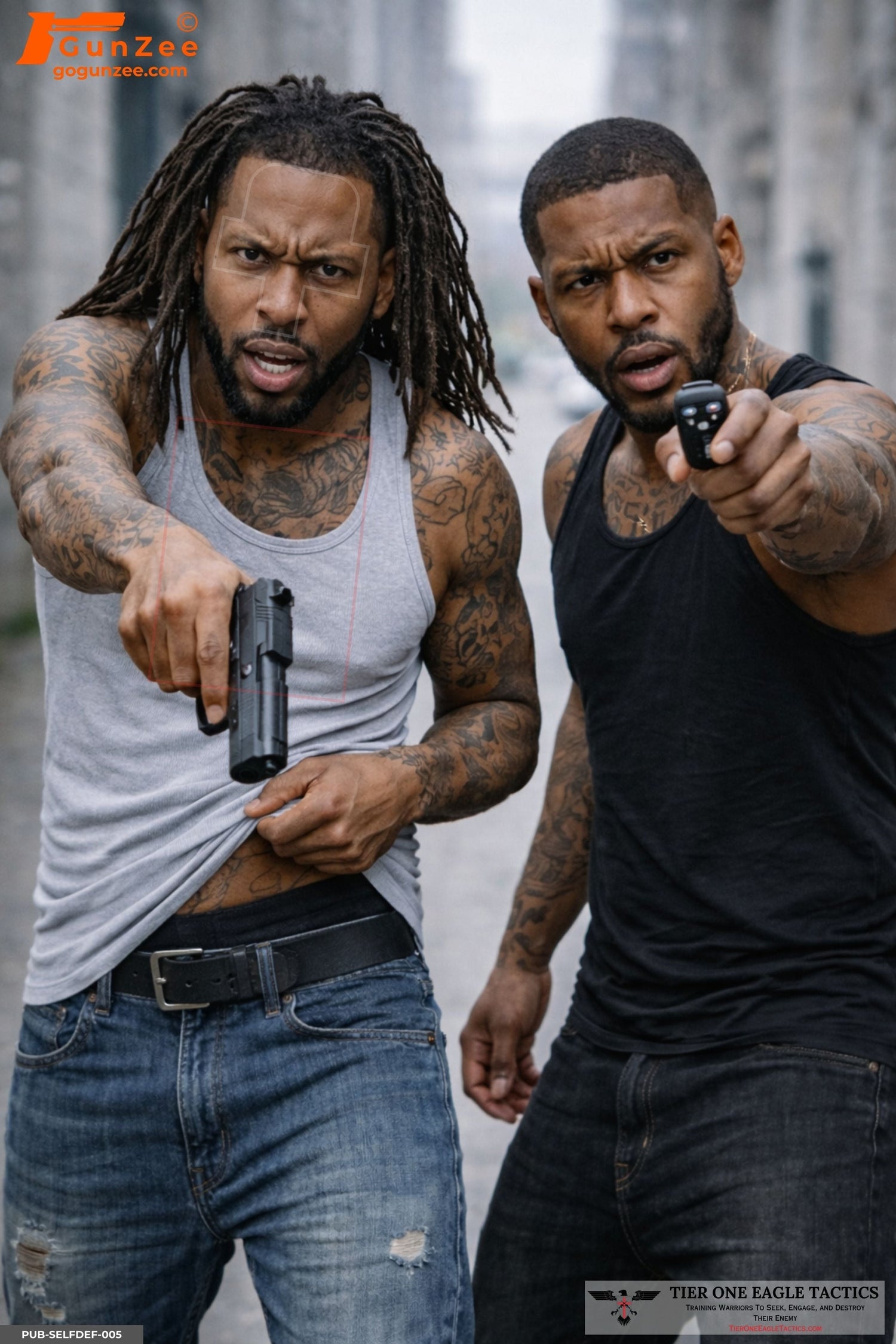
Shoot no shoot targets separate real defensive training from range marksmanship. A silhouette assumes the decision to fire has already been made; a shoot no shoot target makes the decision the drill. The shooter is presented with a scene — a person, an environment, a hand position, a weapon-or-not — and has to choose, in the same second they would normally use to draw, whether to engage. The wrong call is built into the target on purpose.
This is the buyer's guide: what to look for, the four scenario classes that produce real discrimination training, which specific GunZee targets fall into each, and how to assemble a starting set that builds the skill rather than gestures at it.

Why decision-making — not marksmanship — is the life-saving skill
A trained shooter can place a round inside a four-inch circle at seven yards. That capability is necessary and it is not what determines the outcome of a defensive encounter. The outcome is determined by an earlier question: should the round be fired at all?
The wrongful-discharge case file is full of shooters who placed the round well. The subject was unarmed. The subject was a plainclothes officer. The subject was a family member in an unlit hallway. In every case, the shot was accurate and the decision was wrong. The decision is a trainable skill — the eye learns to read hand position, weapon silhouette, and posture the same way it learns sight alignment, by drilling it against scenes where the read is the test. Marksmanship targets cannot do that. Discrimination targets are built specifically to.
What separates a real shoot no shoot target from a gimmick
Most "decision-making" targets on the market are silhouettes with a weapon drawn on them. That is not a discrimination target. A real shoot no shoot target meets four conditions:
- Genuinely ambiguous on first read. If a glance confirms the answer, the target trains pattern-fire. The cue has to be subtle enough that the shooter has to actually look — hand under a jacket, weapon behind partial cover, posture that reads as either compliance or staging.
- The wrong answer is a recognizable real-world scenario. Plainclothes officer. Subject reaching for ID. Verbal aggressor with no weapon. Civilian behind a separate armed threat. The categories that produce wrongful discharges are the categories the target must depict.
- The scene is a place, not a void. Corridors, parking lots, doorways, retail aisles, vehicle interiors — environmental context lets the shooter train the read the way it actually happens.
- The figure is a person, not a stick. Skin tone, clothing, age, posture, expression all carry information the shooter uses. Stylized targets strip the cues out; lifelike scenario targets keep them in. A B-27 with a gun shape inked on does not train the decision because the decision is obvious.
The four scenario classes that produce real discrimination training
Every effective shoot no shoot target falls into one of four classes. A starting library should contain at least one from each.
Class 1 — Plainclothes officer and mistaken-identity scenarios
The catastrophic discrimination failure. A plainclothes officer drawing a weapon to engage a threat looks, to an untrained eye in a stressed moment, like an armed civilian. The result of misreading this scene is an officer down and a defensive shooter facing prosecution. The cues that disambiguate are subtle — a badge on a chain, a duty belt, a verbal identification, posture consistent with training rather than aggression.
The Low-Light Plainclothes Officer Threat Assessment Scenario target is the canonical example. It places the subject under reduced light, where the disambiguating cues are even harder to read, and forces the shooter to slow the decision long enough to actually see them. Most CCW holders should treat this as the first shoot no shoot target they own.
Class 2 — Dual-threat and civilian-in-frame scenarios
More than one subject in the scene, where at least one is a non-threat or where the threats must be sequenced. The decision is no longer binary. Who engages first? Is the second subject a co-threat, a victim, or a third party defending themselves?
The Urban Street Two-Man Armed Confrontation target presents two subjects with different threat clarity — one clearly armed, one ambiguous. The Grocery Aisle Dual-Threat Confrontation target compresses the same problem into a confined retail aisle. The Dual-Threat Mall Corridor Assault target escalates further by mixing weapon types — one knife, one handgun — so the question becomes "what kind of armed, and which threat goes first."
Class 3 — Partial-cover threat-or-not scenarios
The subject is obscured by an environmental object — a doorway frame, a vehicle, a piece of furniture. Only a portion of the body and the hand are visible. The decision has to be made from limited information, which is what almost every real engagement in CQB, home defense, and vehicle-defense actually presents. A shooter who has only trained on fully exposed silhouettes will hesitate on partial-cover presentations or, worse, fire on the partial cue without confirming.
The Anatomical Head-Out Vehicle Window target shows the threat presenting only head and shoulders through a window frame — vehicle-defense geometry where partial cover is the rule, not the exception. The discrimination is whether the partial presentation is a threat or a passenger.
Class 4 — No-shoot pictures
A target with no threat at all. The subject is aggressive, advancing, or verbally hostile — but unarmed, and the engagement is not justified. The shooter who has never trained against a no-shoot defaults to a shot the moment any stress cue appears.
The Verbal Aggressor No Weapon Visible target is built specifically for this — hostile, gesturing, advancing, no weapon presented. This is the most common civilian wrongful-discharge scenario and the target most ranges do not have on the wall. Putting one in regular rotation is the simplest single change a CCW holder can make.
A starting library — three, five, or seven targets
Three-target starter: Low-Light Plainclothes Officer, Urban Street Two-Man Armed Confrontation, Verbal Aggressor No Weapon Visible. Covers the highest-consequence discrimination failure, the most common dual-threat read, and the no-shoot decision.
Five-target rotation: Add Grocery Aisle Dual-Threat Confrontation and the Anatomical Head-Out Vehicle Window. Curriculum, not sampler.
Seven-target program: Add Dual-Threat Mall Corridor Assault and the Crowded Street Knife Threat target. Every discrimination geometry the civilian-defense set produces is now in rotation.
Buy them in order. Run the three-target starter for thirty days, add the next two for the following thirty, then the final two. The progression is what builds discrimination as a stable skill rather than a novelty.
How to run a shoot no shoot drill
Targets alone do not train the decision. The drill structure does:
- At least one no-shoot per drill. If every target is armed, the shooter is rehearsing pattern-fire and calling it discrimination.
- Engage from concealment. The draw under stress is part of the decision time. A gun already in hand makes the drill artificially easy.
- Verbal command before the shot. "Drop the gun" or equivalent — part of the real engagement, builds the legal habit, gives the no-shoot subject an out.
- Track wrong-target hits as harshly as missed shots. Hitting the threat is necessary; not hitting the non-threat is mandatory.
- Rotate the layout between reps. If the shooter knows which target is the threat before the buzzer, the discrimination is memorized rather than read.
- Add low-light reps. Discrimination fluency drops thirty to fifty percent under reduced light. Train under the conditions it will be used.
Where shoot no shoot fits in the broader curriculum
Threat discrimination is the decision layer of defensive shooting. It rests on the placement layer covered in Human Anatomy Shooting Targets: A Complete Training Guide, connects directly to the cue-reading skill in Shoot or No-Shoot: Training to Identify Armed vs. Unarmed Subjects, and sits inside the broader scenario stack covered in 10 Defensive Shooting Scenarios Every CCW Holder Should Train For.
The full discrimination, dual-threat, and public-defense library lives in the Public & Everyday Self-Defense collection. CQB and home-defense partial-cover scenarios are in the CQB & Home Defense collection. Hostage-rescue compositions — where precision and accountability matter most — are at /collections/hostage-rescue-targets, and the complete shoot/no-shoot decision library aggregates every class above into a single browse.
→ BROWSE SHOOT NO SHOOT TARGETS
Frequently asked questions
What is a shoot no shoot target?
A scenario-based paper target that trains the decision before the shot — not just marksmanship. The threat status is not obvious; the shooter has to identify the cue (weapon presentation, hand position, badge, posture, secondary subject) and decide whether to engage. The wrong call is built into the drill on purpose.
Why are shoot no shoot targets more important than standard silhouettes?
The most consequential decision in defensive shooting is whether to fire, not where the round lands. Silhouettes train placement under the assumption the decision is already made; shoot no shoot targets train the decision itself. A perfect shot at the wrong person is the worst possible outcome for a defensive shooter.
Which shoot no shoot target should a CCW holder buy first?
The Low-Light Plainclothes Officer Threat Assessment Scenario target. It presents the most catastrophic discrimination failure — mistaking a plainclothes officer for a threat — under low light, which compresses the cue set. Train this read and every other discrimination call gets easier.
How many no-shoot targets should be in a drill?
At least one. A discrimination drill with zero no-shoots is a pattern-fire drill in disguise. A practical ratio is one no-shoot for every two threats. The Verbal Aggressor No Weapon Visible target is the standard no-shoot to keep in rotation.
How do partial-cover threat-or-not targets work?
A partial-cover target shows the subject obscured by an object — doorway, vehicle, furniture — with only a portion of the body and hand visible. The shooter has to make the threat read from limited information. Real engagements in CQB, home defense, and vehicle defense almost always present partial cover, and a shooter who has only trained on fully exposed targets has not trained the read that matters.
Related reading in the Range Manual
-
Hostage Shooting Targets — Buyer's Guide
Where shoot/no-shoot decision-making gets hardest — friendly and threat in the same frame. -
Gun Targets — The Buyer's Guide for Serious Training
Comparative overview of target types — scenario targets are one branch of a bigger tree. -
Shooting Targets — The Buyer's Guide for Serious Training
Category-level framework for choosing training targets across the full spectrum of scenarios. -
Shoot / No-Shoot Decision Drills: Building Judgment Under Stress
The companion drill guide — graduated judgment drills to run with the targets in this guide. -
Paper Shooting Targets: Material and Manufacturing Insights
What these targets are printed on, and why the material matters for repeated drill use. -
Paper shooting targets — full collection
Every scenario category on 24" x 36" paper — CQB, hostage, vehicle, anatomical, shoot/no-shoot.