Unarmed Male Looking At Phone No-Shoot E-Backer Target [19" x 38"]
each · sold in 5s · mix any designs
Price drops automatically: 50+ $2.37 · 100+ $2.24 · 250+ $2.12 · Up to 25% off at 999+ · Volume quote →
$40 order minimum for your whole cart, not each design. Mix any targets.
Quantity must be in increments of 5
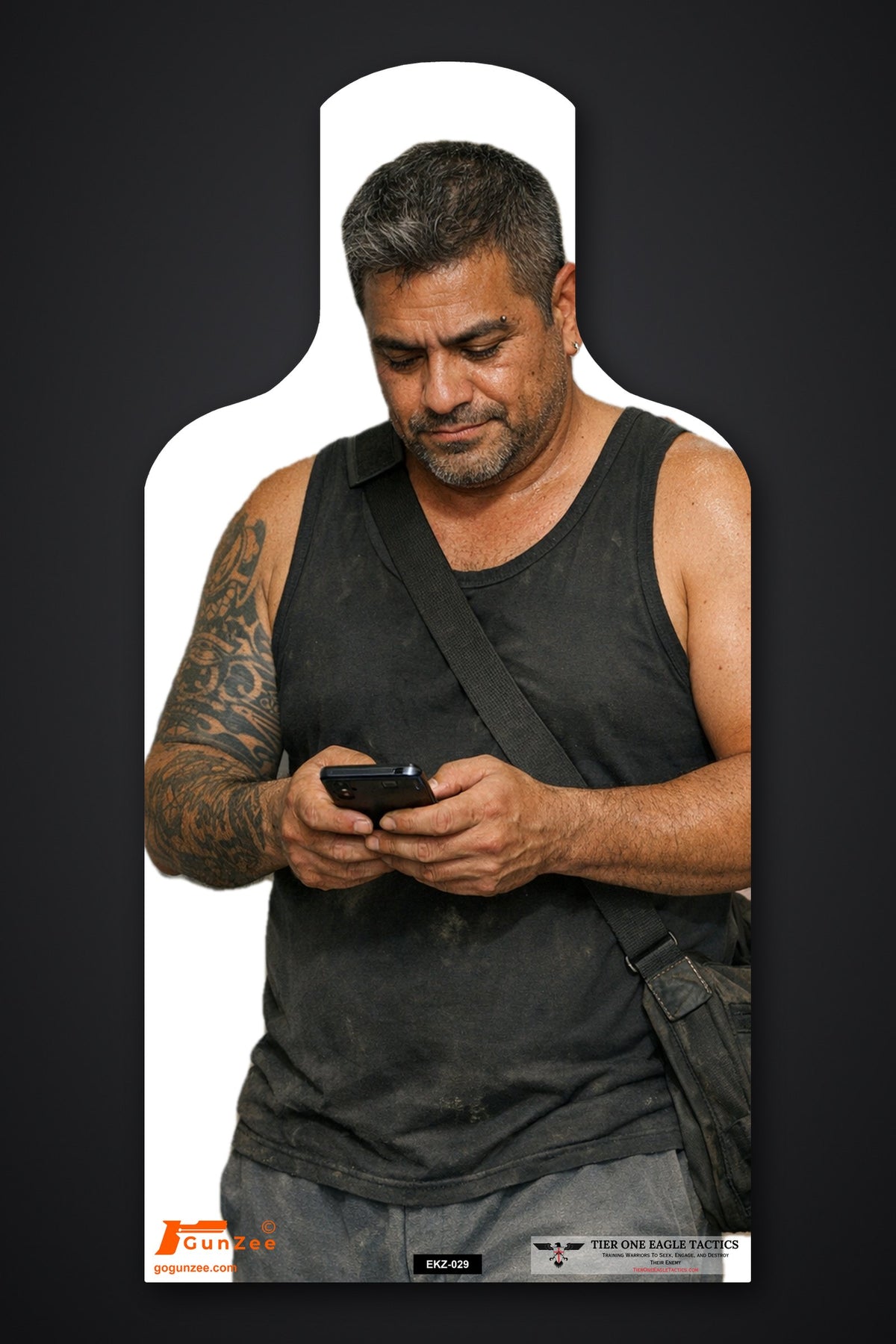
Unarmed Male Looking At Phone No-Shoot E-Backer Target
An unarmed man looking down at a phone held in both hands. The phone is the object most often mistaken for a handgun, and this is the target that trains the difference.
What the Trainee Has to Work Out
A dark rectangular object held in two hands in front of the chest. At distance and at speed it is the classic mistaken-identity object. He is also not responding to anything, because he is not paying attention.
Training Purpose
The phone no-shoot. It trains object identification on the most common item that gets mistaken for a handgun. In a mixed deck it is a figure that must not be engaged.
Skills Reinforced
- Telling a phone from a handgun at speed
- Reading an inattentive subject as a non-threat
- Target identification at qualification distances
- Shoot / no-shoot discrimination under time pressure
- Checking the hands before deciding
No Kill Zones: This Is a No-Shoot Target
This target has no kill zones. No head circle, no cardiac box, no rings. The person on it is not a threat, so there is nowhere on the paper that earns a point. One hole anywhere fails the run.
The armed E-backer targets in this line carry a 4-inch head circle and a 10-inch cardiac box, and the hostage targets carry the head circle on the gunman only. A no-shoot hung among them is scored one way: clean or not. The Range Manual covers how to build shoot / no-shoot decision drills and identifying armed and unarmed subjects.
Cut to Fit the E-Type Backer
This target is die-cut to the E-type silhouette, the kneeling-figure outline that military and law enforcement ranges have used for decades. It measures 19" x 38" and is sized to sit on a standard E-type backer (19.5" x 40") with a small margin all around.... ...
Unarmed Male Looking At Phone No-Shoot E-Backer Target
An unarmed man looking down at a phone held in both hands. The phone is the object most often mistaken for a handgun, and this is the target that trains the difference.
What the Trainee Has to Work Out
A dark rectangular object held in two hands in front of the chest. At distance and at speed it is the classic mistaken-identity object. He is also not responding to anything, because he is not paying attention.
Training Purpose
The phone no-shoot. It trains object identification on the most common item that gets mistaken for a handgun. In a mixed deck it is a figure that must not be engaged.
Skills Reinforced
- Telling a phone from a handgun at speed
- Reading an inattentive subject as a non-threat
- Target identification at qualification distances
- Shoot / no-shoot discrimination under time pressure
- Checking the hands before deciding
No Kill Zones: This Is a No-Shoot Target
This target has no kill zones. No head circle, no cardiac box, no rings. The person on it is not a threat, so there is nowhere on the paper that earns a point. One hole anywhere fails the run.
The armed E-backer targets in this line carry a 4-inch head circle and a 10-inch cardiac box, and the hostage targets carry the head circle on the gunman only. A no-shoot hung among them is scored one way: clean or not. The Range Manual covers how to build shoot / no-shoot decision drills and identifying armed and unarmed subjects.
Cut to Fit the E-Type Backer
This target is die-cut to the E-type silhouette, the kneeling-figure outline that military and law enforcement ranges have used for decades. It measures 19" x 38" and is sized to sit on a standard E-type backer (19.5" x 40") with a small margin all around. It staples or glues straight onto the backers your range already owns. There is nothing to trim and no stand to change.
The figure is printed life-size. Heads, shoulders and hands are the size they are on a real person at that distance, so sight pictures and hold-offs carry over.
Instructor Notes
Pair it with any of the two-handed pistol figures. The hand position is close to identical. It works on static stands, turning stands and pop-up lifters that take an E-type backer.
Who This Target Is For
Firearms instructors who need believable no-shoot figures for E-type backers: law enforcement and military police cadre, academy staff, and private trainers running decision drills.
Product Details
- Size: 19" x 38", die-cut to the E-type silhouette
- Fits: standard E-type backers (19.5" x 40")
- Figure: life-size
- Kill zones: none. This is a no-shoot target
- Paper: heavy, durable stock with a matte finish, so there is no glare under range lights
- Printed in full color on one side
- Price: $2.49 each. Volume pricing on quotes runs from 5% off at 50 targets to 25% off at 999. Request a quote
- SKU: EKZ-029
- Made in the USA
Related E-Backer Targets
A course of fire needs armed threats, no-shoots and hostage problems side by side. These five come from across the E-backer line:
- Unarmed Male Backpack Hands Up No-Shoot E-Backer Target
- Unarmed Female Holding Infant Hand Raised No-Shoot E-Backer Target
- Armed Female Short Hair Handgun Aiming Forward E-Backer Target
- Armed Female Yellow Shirt Carbine Low Ready E-Backer Target
- Hostage Scenario Tank Top Gunman Handgun To Victim Head E-Backer Target
See all 48 designs in the E-Type Silhouette Targets collection, or browse Shoot / No-Shoot Decision Targets and Law Enforcement Training Targets. For agency programs, see from qualification to decision training.
The same decisions on a 24" x 36" scenario sheet: Living Room No-Shoot Scenario Shooting Target, CQB Home Defense Hostage – Closet Ambush Hands-Up Compliance Shooting Target and Interior Doorway Male With Phone Ambiguous Threat Shooting Target.