

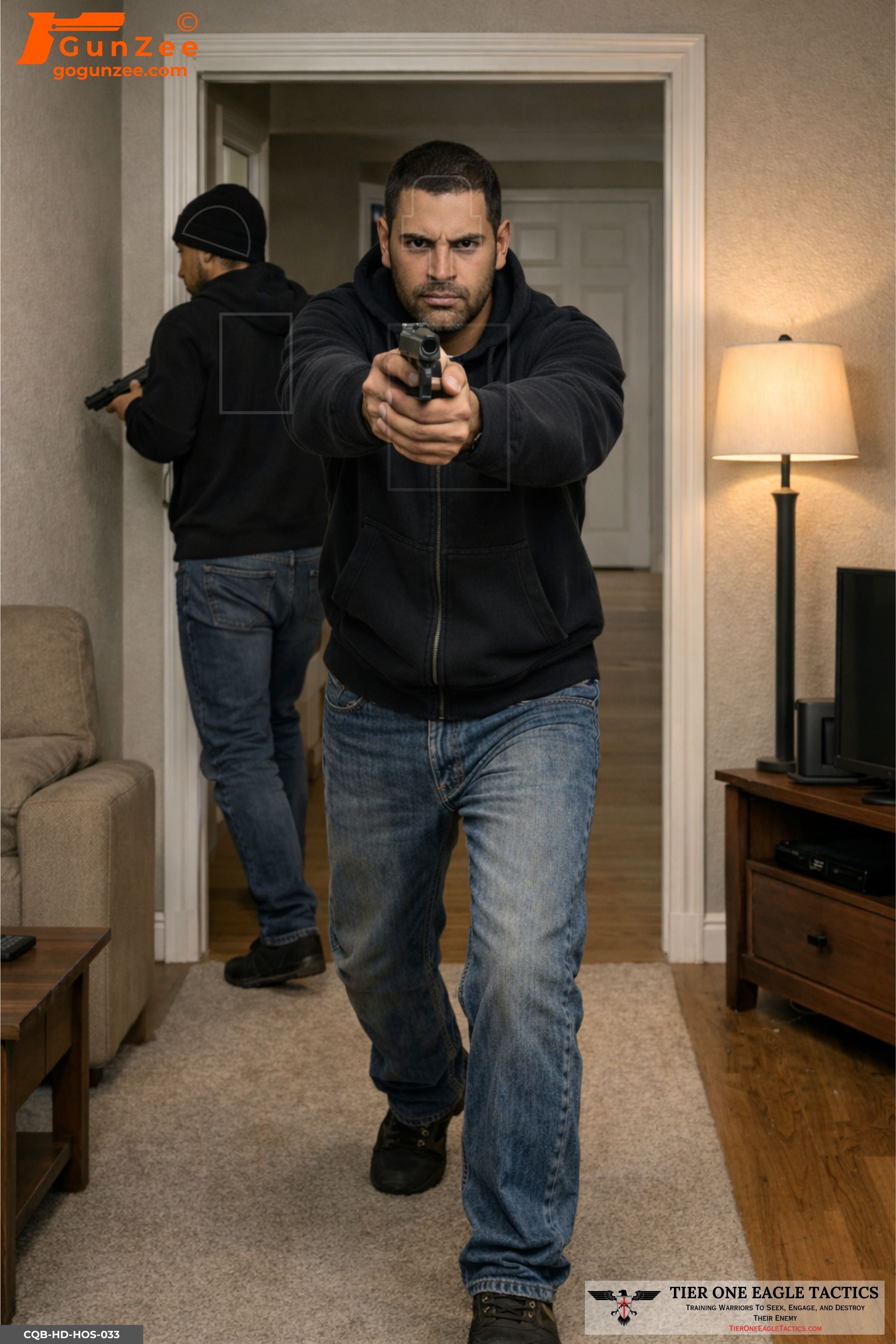
Two-Man Interior Advance Dual Threat Shooting Target [24" x 36"]
Quantity must be in increments of 5
Two-Man Interior Advance Dual Threat Shooting Target
Scenario Overview
This target depicts a high-risk residential interior encounter involving two armed intruders advancing through a doorway and into a living space. The front aggressor presents a direct handgun threat while moving forward with intent, dominating the shooter’s visual focus. Behind him, a second armed individual occupies deeper interior space, creating a layered and evolving threat environment.
The scene forces the shooter to process depth, movement, and threat hierarchy simultaneously. The immediate danger is obvious, but the secondary threat carries equal lethality and requires disciplined awareness beyond the primary visual channel.
This scenario reflects real-world interior engagements where multiple armed attackers operate in close proximity, often within confined residential layouts.
Training Purpose
This target is designed to train decision-making and threat prioritization during multi-attacker CQB encounters inside a home or similar interior structure. Shooters must correctly assess immediate danger, manage depth and angles, and remain accountable for secondary threats that emerge behind the primary aggressor.
The scenario emphasizes composure, visual discipline, and structured problem-solving under extreme time pressure.
Skills Reinforced
- Threat prioritization between multiple armed aggressors
- Visual processing across depth in a confined interior environment
- Managing primary and secondary threats without tunnel vision
- Precision shot placement under close-range pressure
- Maintaining situational awareness beyond the dominant visual threat
- Accountability for every round fired in a residential context
- Decision-making under compressed time and space constraints
Kill Zone Analysis
The front aggressor includes a modified T-box and a cardiac box to support evaluation of neurological and high-probability incapacitation shot placement during post-engagement analysis.
The rear... ...
Two-Man Interior Advance Dual Threat Shooting Target
Scenario Overview
This target depicts a high-risk residential interior encounter involving two armed intruders advancing through a doorway and into a living space. The front aggressor presents a direct handgun threat while moving forward with intent, dominating the shooter’s visual focus. Behind him, a second armed individual occupies deeper interior space, creating a layered and evolving threat environment.
The scene forces the shooter to process depth, movement, and threat hierarchy simultaneously. The immediate danger is obvious, but the secondary threat carries equal lethality and requires disciplined awareness beyond the primary visual channel.
This scenario reflects real-world interior engagements where multiple armed attackers operate in close proximity, often within confined residential layouts.
Training Purpose
This target is designed to train decision-making and threat prioritization during multi-attacker CQB encounters inside a home or similar interior structure. Shooters must correctly assess immediate danger, manage depth and angles, and remain accountable for secondary threats that emerge behind the primary aggressor.
The scenario emphasizes composure, visual discipline, and structured problem-solving under extreme time pressure.
Skills Reinforced
- Threat prioritization between multiple armed aggressors
- Visual processing across depth in a confined interior environment
- Managing primary and secondary threats without tunnel vision
- Precision shot placement under close-range pressure
- Maintaining situational awareness beyond the dominant visual threat
- Accountability for every round fired in a residential context
- Decision-making under compressed time and space constraints
Kill Zone Analysis
The front aggressor includes a modified T-box and a cardiac box to support evaluation of neurological and high-probability incapacitation shot placement during post-engagement analysis.
The rear aggressor includes a cranial kill zone and a cardiac box, representing an alternate lethal threat profile that may require a different engagement solution depending on position, exposure, and timing.
These reference zones are integrated to support structured after-action review, allowing shooters and instructors to evaluate hit placement, threat order, and decision quality once the exercise is complete. They are not intended to influence aiming behavior during execution.
Related training targets
Pair this target with related scenarios from across the GunZee catalog:
Public and everyday self-defense: Grocery Aisle Dual-Threat Confrontation Shooting Target, Crowded Street Hostage Control with Concealed Gunman Shooting Target, Grocery Aisle Explosive Vest Imminent Threat Shooting Target
Home defense, CQB, and hostage: Interior Two-Man Deception & Rear Threat Shooting Target, CQB Home Defense Hostage – Two-Man Armed Threat Coordination Shooting Target, Two-Man Corridor Hostage Escort with Primary Gunman Shooting Target, Two-Man Residential Entry Armed Threat Shooting Target
Vehicle and barrier: Vehicle Barrier Armed Driver Engagement Shooting Target, Vehicle Barrier Windshield Gunman Engagement Shooting Target, Vehicle Barrier Closed-Door Armed Driver Shooting Target
Anatomical: Anatomical Head-Out Vehicle Window Engagement Shooting Target, Anatomical Semi-Profile Handgun Threat Vital Zone Shooting Target, Anatomical Rifle Threat Vital Zone Shooting Target