

Interior Two-Man Deception & Rear Threat Shooting Target [24" x 36"]
Quantity must be in increments of 5
Interior Two-Man Deception & Rear Threat Shooting Target
Scenario Overview
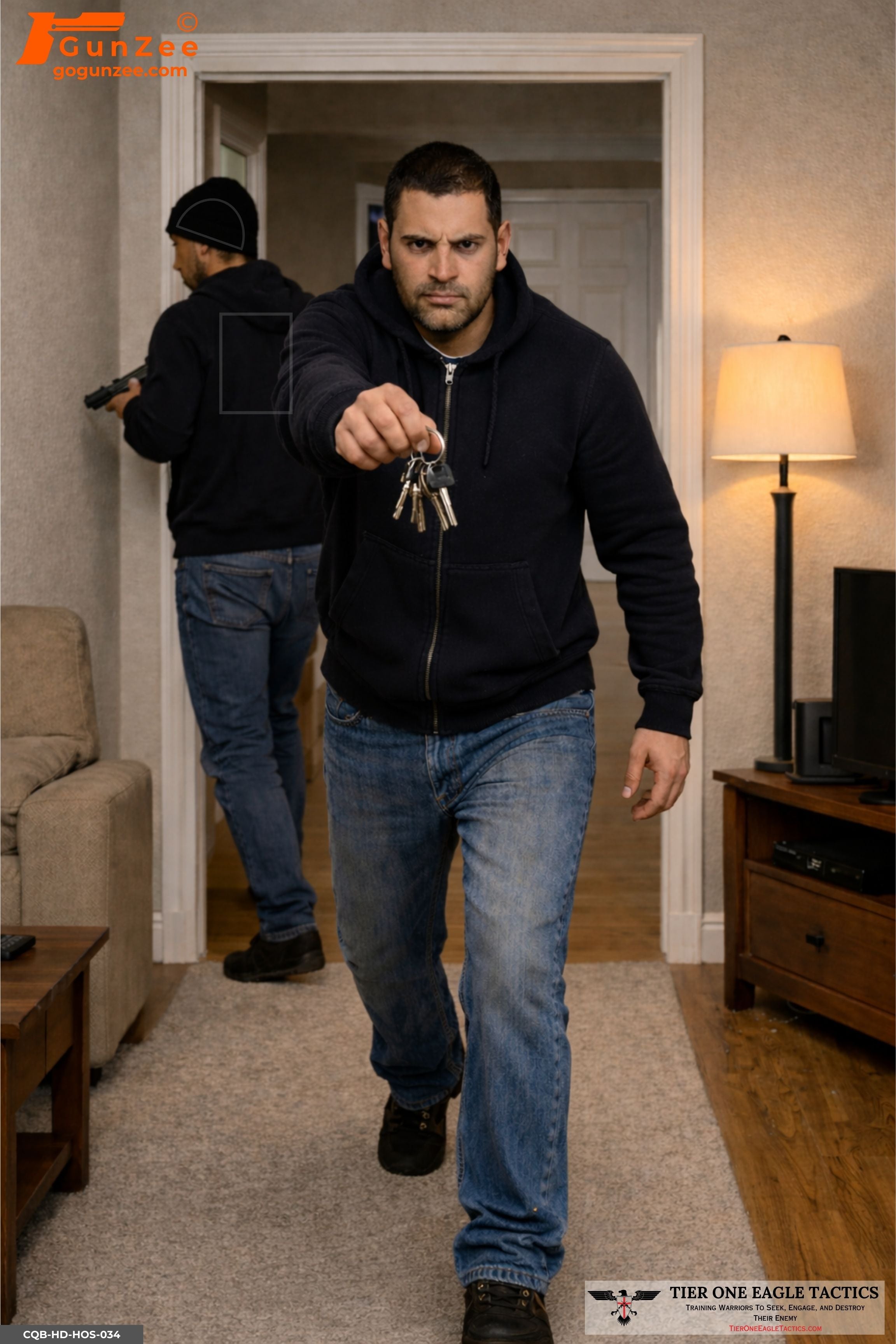
This target depicts a deceptive interior encounter involving two intruders inside a residential living space. The front individual advances directly toward the shooter while presenting a set of keys, creating the appearance of compliance, surrender, or non-threatening intent. His posture and movement demand restraint, visual discipline, and threat confirmation.
Behind him, a second male occupies deeper interior space and is armed with a handgun. This rear threat introduces a delayed but lethal danger that is easy to miss if the shooter becomes fixated on the closer individual.
The scene reflects a realistic and dangerous pattern seen in real-world home invasions, where deception, role-splitting, and misdirection are used to draw attention away from the true lethal threat.
Training Purpose
This target is designed to train shooters to resist proximity bias and emotional distraction while maintaining full situational awareness inside a confined residential environment. Shooters must visually process both individuals, confirm actual threat status, and avoid premature engagement based solely on distance or perceived intent.
The scenario reinforces disciplined decision-making when a non-armed individual is used as visual cover or distraction for an armed accomplice.
Skills Reinforced
- Threat confirmation under deceptive visual cues
- Managing proximity bias versus actual lethality
- Identifying armed threats beyond the primary subject
- Maintaining situational awareness in confined interiors
- Decision-making under ambiguity and emotional pressure
- Precision engagement on a delayed lethal threat
- Accountability for engagement order and target selection
Kill Zone Analysis
Kill zones are applied exclusively to the rear male, who is armed and represents the confirmed lethal threat. These... ...
Interior Two-Man Deception & Rear Threat Shooting Target
Scenario Overview
This target depicts a deceptive interior encounter involving two intruders inside a residential living space. The front individual advances directly toward the shooter while presenting a set of keys, creating the appearance of compliance, surrender, or non-threatening intent. His posture and movement demand restraint, visual discipline, and threat confirmation.
Behind him, a second male occupies deeper interior space and is armed with a handgun. This rear threat introduces a delayed but lethal danger that is easy to miss if the shooter becomes fixated on the closer individual.
The scene reflects a realistic and dangerous pattern seen in real-world home invasions, where deception, role-splitting, and misdirection are used to draw attention away from the true lethal threat.
Training Purpose
This target is designed to train shooters to resist proximity bias and emotional distraction while maintaining full situational awareness inside a confined residential environment. Shooters must visually process both individuals, confirm actual threat status, and avoid premature engagement based solely on distance or perceived intent.
The scenario reinforces disciplined decision-making when a non-armed individual is used as visual cover or distraction for an armed accomplice.
Skills Reinforced
- Threat confirmation under deceptive visual cues
- Managing proximity bias versus actual lethality
- Identifying armed threats beyond the primary subject
- Maintaining situational awareness in confined interiors
- Decision-making under ambiguity and emotional pressure
- Precision engagement on a delayed lethal threat
- Accountability for engagement order and target selection
Kill Zone Analysis
Kill zones are applied exclusively to the rear male, who is armed and represents the confirmed lethal threat. These zones support post-engagement evaluation of hit placement, threat recognition, and engagement discipline.
The forward individual intentionally contains no kill zones, reinforcing the requirement for threat confirmation and preventing conditioning toward automatic engagement of the closest subject.
All zones are integrated for structured after-action review and instructor-led analysis following execution.
Scenario Pairing Recommendation
This target pairs exceptionally well with CQB-HD-HOS-033. Both targets feature the same environment and individuals but reverse threat presentation and engagement priority. Used together, they create a powerful training progression that highlights how small visual changes dramatically alter decision-making requirements.
Related training targets
Pair this target with related scenarios from across the GunZee catalog:
Public and everyday self-defense: Seated Injury Deception – Concealed Handgun Public Encounter Shooting Target, Plainclothes Officer Badge Reveal – Law Enforcement Identification Scenario, Church Corner Threat Concealed Weapon Presence Shooting Target
Home defense, CQB, and hostage: Two-Man Residential Entry Rear Gunman Threat Shooting Target, Two-Man Interior Advance Dual Threat Shooting Target, CQB Home Defense Hostage – Two-Man Armed Threat Coordination Shooting Target, Two-Man Corridor Hostage Escort with Primary Gunman Shooting Target
Vehicle and barrier: Vehicle Barrier Windshield Gunman Engagement Shooting Target, Vehicle Approach Threat Advancing Gunman Shooting Target, Vehicle Barrier Windshield Assault Shooting Target
Anatomical: Anatomical Rifle Threat Vital Zone Shooting Target, Anatomical Semi-Frontal Handgun Threat Precision Shooting Target, Anatomical Semi-Profile Handgun Threat Vital Zone Shooting Target