

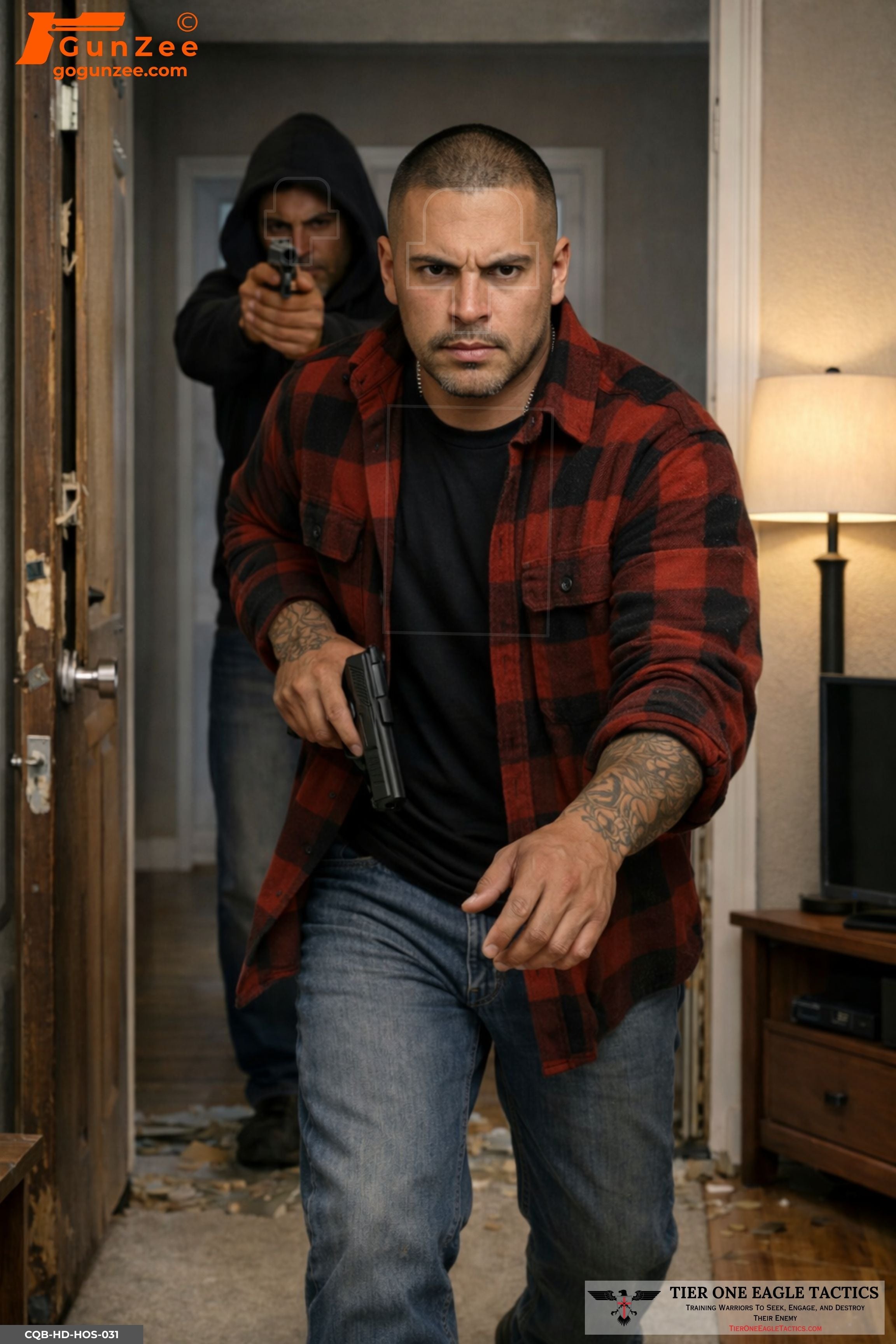
Two-Man Residential Entry Armed Threat Shooting Target [24" x 36"]
Quantity must be in increments of 5
Two-Man Residential Entry Armed Threat Shooting Target
Scenario Overview
This target depicts a coordinated residential entry by two hostile intruders moving through a damaged doorway into an interior hallway. The lead aggressor advances aggressively while armed, with a second armed individual positioned behind him, creating a layered and compressed threat environment inside a private dwelling.
The scene reflects a high-risk home defense or CQB encounter where depth, angles, and proximity dramatically reduce reaction time. The shooter is forced to process multiple armed threats in sequence while accounting for narrow sightlines, interior obstacles, and the rapid escalation that occurs once a breach has already taken place.
This scenario emphasizes disciplined threat assessment, visual prioritization, and precise engagement under extreme spatial and temporal pressure.
Training Purpose
Interior engagements following forced entry are among the most dangerous scenarios a defender may face. Distance is limited, angles are unforgiving, and mistakes carry immediate consequences.
This target was designed to train shooters to rapidly identify the most imminent lethal threat, manage secondary armed actors, and apply decisive shot placement while operating in a confined residential space. The presence of two armed intruders forces continuous reassessment as the situation unfolds rather than reliance on a single static decision.
Skills Reinforced
- Threat prioritization between multiple armed aggressors at close range
- Visual processing and decision-making inside a confined doorway and hallway environment
- Precision shot placement under compressed time and space constraints
- Managing primary and secondary threats without target fixation
- Controlled transitions between targets while maintaining situational awareness
- Accountability for every round fired in a residential interior context
- Maintaining discipline and composure during high-risk, multi-attacker encounters ... ...
Two-Man Residential Entry Armed Threat Shooting Target
Scenario Overview
This target depicts a coordinated residential entry by two hostile intruders moving through a damaged doorway into an interior hallway. The lead aggressor advances aggressively while armed, with a second armed individual positioned behind him, creating a layered and compressed threat environment inside a private dwelling.
The scene reflects a high-risk home defense or CQB encounter where depth, angles, and proximity dramatically reduce reaction time. The shooter is forced to process multiple armed threats in sequence while accounting for narrow sightlines, interior obstacles, and the rapid escalation that occurs once a breach has already taken place.
This scenario emphasizes disciplined threat assessment, visual prioritization, and precise engagement under extreme spatial and temporal pressure.
Training Purpose
Interior engagements following forced entry are among the most dangerous scenarios a defender may face. Distance is limited, angles are unforgiving, and mistakes carry immediate consequences.
This target was designed to train shooters to rapidly identify the most imminent lethal threat, manage secondary armed actors, and apply decisive shot placement while operating in a confined residential space. The presence of two armed intruders forces continuous reassessment as the situation unfolds rather than reliance on a single static decision.
Skills Reinforced
- Threat prioritization between multiple armed aggressors at close range
- Visual processing and decision-making inside a confined doorway and hallway environment
- Precision shot placement under compressed time and space constraints
- Managing primary and secondary threats without target fixation
- Controlled transitions between targets while maintaining situational awareness
- Accountability for every round fired in a residential interior context
- Maintaining discipline and composure during high-risk, multi-attacker encounters
Modified T-Box and Cardiac Box Analysis
The lead aggressor includes both a modified T-box and a cardiac box to support post-engagement performance analysis. The modified T-box incorporates an expanded forehead region representing a known neurological incapacitation area associated with immediate shutdown when accurately struck. The cardiac box represents the high-value thoracic region associated with rapid physiological incapacitation.
The secondary aggressor includes a modified T-box only, reinforcing the need to adapt shot placement based on threat position, exposure, and sequence.
Related training targets
Pair this target with related scenarios from across the GunZee catalog:
Public and everyday self-defense: Nightclub Exit Hostage Crowd Crisis Shooting Target, Wheelchair Ambiguous Threat – Concealed Handgun Public Encounter Shooting Target, Plainclothes Officer Contact & Crossfire Control – Partner Coordination Scenario
Home defense, CQB, and hostage: Two-Man Residential Entry Rear Gunman Threat Shooting Target, CQB Home Defense Hostage – Two-Man Armed Threat Coordination Shooting Target, Two-Man Kitchen Armed Intrusion Shooting Target, Two-Man Corridor Hostage Escort with Primary Gunman Shooting Target
Vehicle and barrier: Vehicle Barrier Multi-Aggressor Carjacking Shooting Target, Vehicle Barrier Armed Driver Engagement Shooting Target, Vehicle Barrier Daylight Carjacking Shooting Target
Anatomical: Anatomical Full-System Vital Zone Shooting Target, Anatomical Hostage Shield Vital Zone Shooting Target, Anatomical Semi-Profile Handgun Threat Vital Zone Shooting Target