
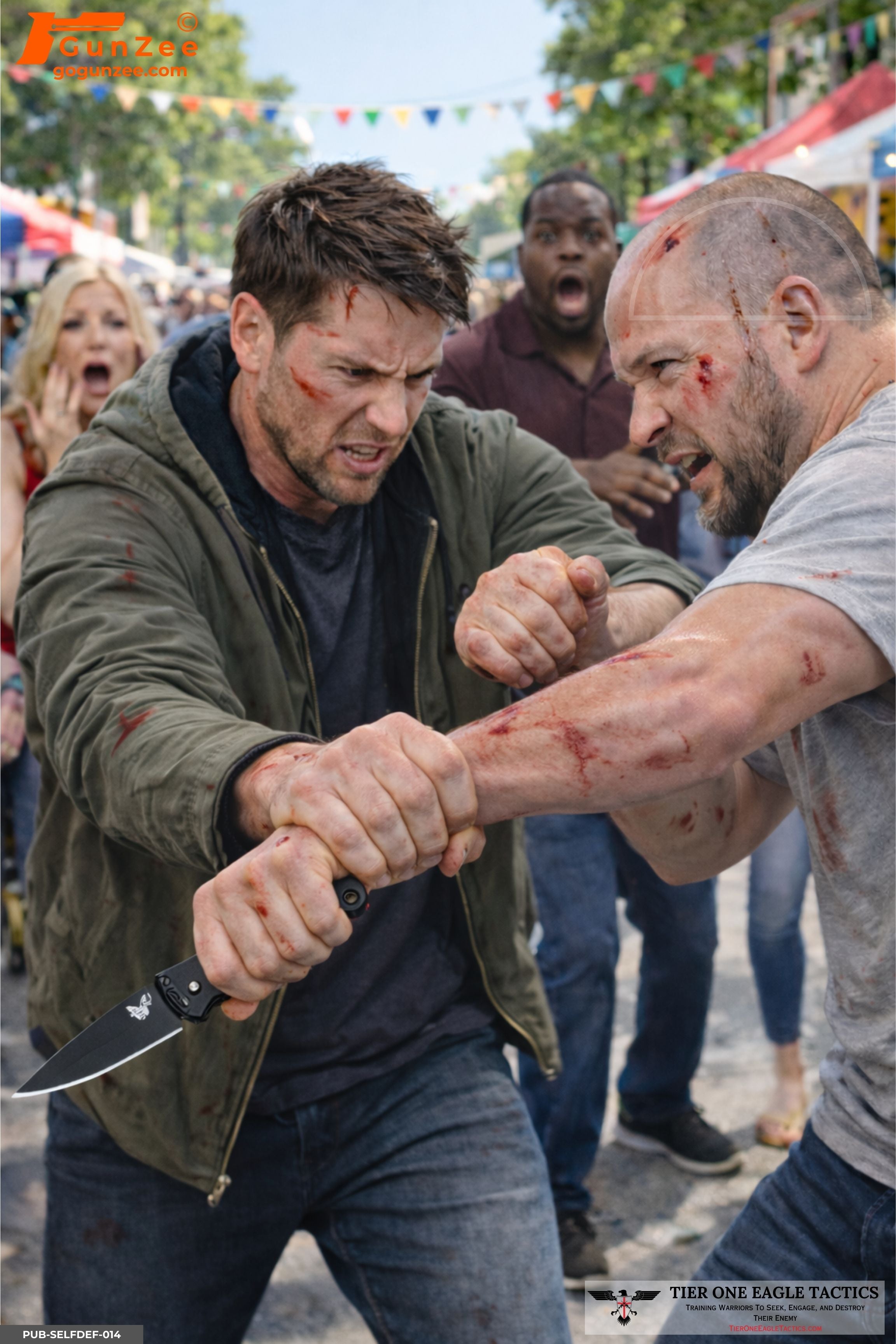
Public Knife Assault Disarm – Close-Range Edged Weapon Encounter [24" x 36"]
each · sold in 5s · mix any designs
Price drops automatically: 50+ $1.85 · 100+ $1.76 · 250+ $1.66 · Up to 25% off at 999+ · Volume quote →
$40 order minimum for your whole cart, not each design. Mix any targets.
Quantity must be in increments of 5
Public Knife Assault Disarm – Close-Range Edged Weapon Encounter
This training target depicts a violent, close-range edged-weapon encounter unfolding in a public environment. Two adult males are engaged in a physical struggle over a knife, with overlapping movement, compressed distance, and no clear separation between attacker and defender.
This target incorporates an intentionally placed transparent cranial kill zone designed specifically for side-profile threat presentation, supporting post-engagement shot placement evaluation following a training sequence.
Training Purpose
Edged-weapon assaults occur at extreme close range and evolve rapidly into chaotic physical struggles. Distance collapses instantly, body positioning changes moment to moment, and opportunities for anatomically decisive shots may be fleeting or unavailable.
This target is designed to train shooters to recognize an active lethal threat, understand the risks associated with close-contact movement, and apply disciplined decision-making when engagement options are limited. The cranial kill zone is not intended to dictate engagement decisions, but to provide objective feedback after the drill regarding shot placement, precision, and accountability.
Skills Reinforced
- Visual recognition of an active edged-weapon threat
- Threat discrimination during physical struggle
- Distance and proximity awareness at contact range
- Shoot / no-shoot decision discipline in dynamic movement
- Bystander and backdrop accountability
- Cognitive control under extreme time pressure
Why This Target Is Different
Most knife-related targets present attackers in frontal or simplified orientations. This target intentionally uses a side-profile head presentation, reflecting the reality that lethal threats are rarely square to the shooter during close-contact violence.
The shooter must:
- Process partial anatomical exposure
- Account for head orientation and movement
- Avoid assumption-based shot placement
- Evaluate results only after the engagement sequence
The transparent cranial kill zone enables meaningful post-event analysis without simplifying or pre-programming decisions during the drill.
Scenario Context (Educational)
Public knife assaults frequently escalate into grappling-range struggles within seconds. During these encounters, attackers are rarely stationary or facing forward. Head orientation may be angled, turned, or partially obscured, increasing the complexity of any engagement decision.
Cranial Kill Zone Reference (Side-Profile)
This target includes a transparent cranial kill zone designed for side-profile presentation.
-
Side-Profile Cranial Kill Zone
The cranial kill zone covers lateral regions of the skull known to result in immediate neurological incapacitation when disrupted. The zone is intentionally shaped to account for side-angle presentation and realistic head positioning during close-contact encounters.This area reflects anatomical structures associated with rapid incapacitation, while recognizing that outcomes depend on angle, penetration, and situational factors.
The cranial kill zone is:
- A purpose-built training reference
- Used to judge shot placement after a drill or sequence
- Not a scoring ring
- Not a mandatory aim point
- Not a substitute for judgment, legality, or threat assessment
Related training targets
Pair this target with related scenarios from across the GunZee catalog:
Public and everyday self-defense: Advancing Crowd Knife Assault Shooting Target, Backyard Pool Knife Assault – Crowd Chaos Scenario, Wheelchair Ambiguous Threat – Concealed Handgun Public Encounter Shooting Target, Seated Injury Deception – Concealed Handgun Public Encounter Shooting Target
Home defense, CQB, and hostage: Two-Man Corridor Hostage Escort with Primary Gunman Shooting Target, Interior Doorway Male With Phone Ambiguous Threat Shooting Target, Corridor Hostage Control with Rear Gunman Shooting Target
Vehicle and barrier: Vehicle Barrier Windshield Gunman Engagement Shooting Target, Vehicle Approach Threat Advancing Gunman Shooting Target, Vehicle Barrier Multi-Aggressor Carjacking Shooting Target
Anatomical: Anatomical Hostage Shield Vital Zone Shooting Target, Anatomical Semi-Profile Handgun Threat Vital Zone Shooting Target, Anatomical Side-Profile Rifle Threat Shooting Target