
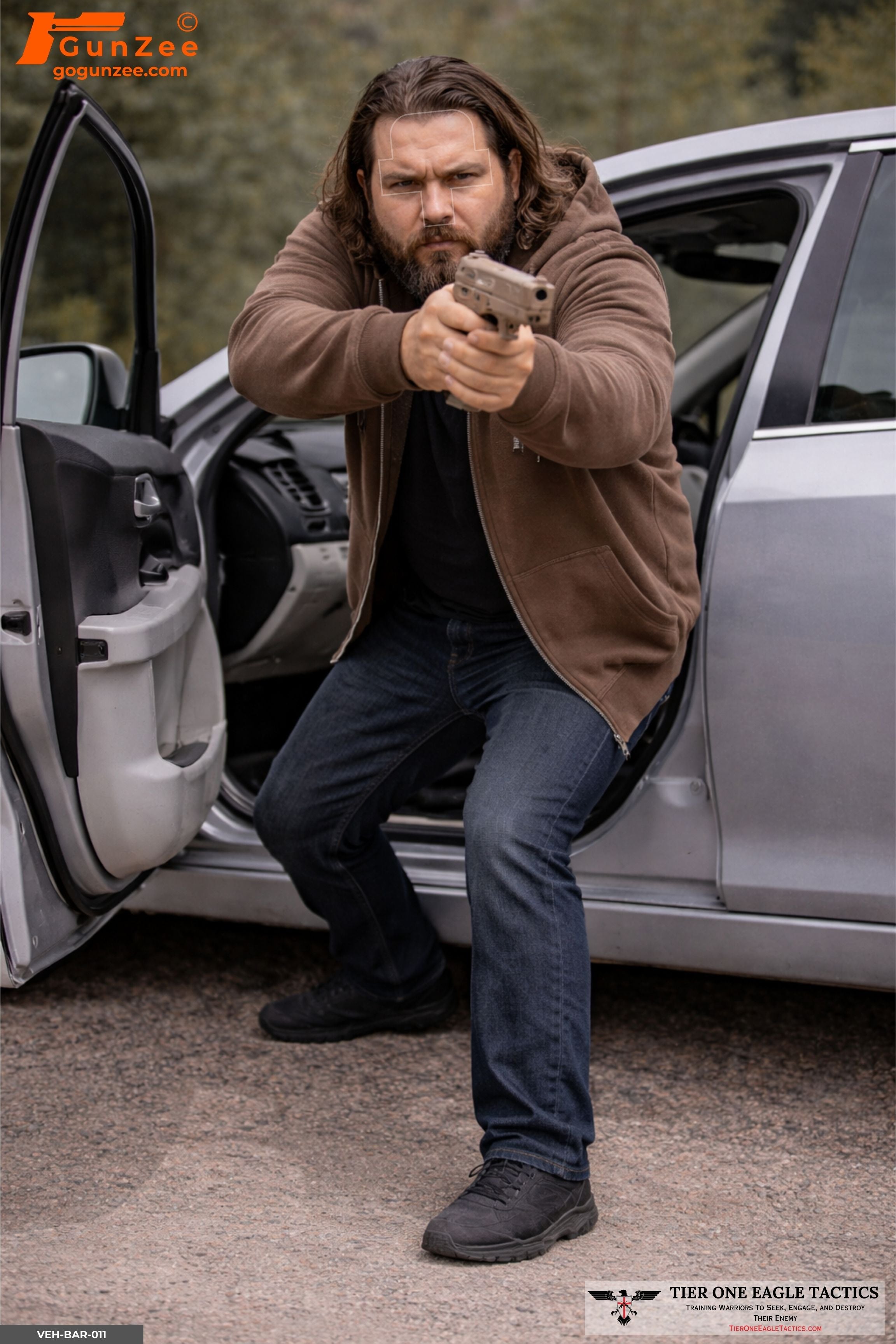
Vehicle Barrier Armed Subject Exiting Vehicle Shooting Target [24" x 36"]
each · sold in 5s · mix any designs
Price drops automatically: 50+ $2.14 · 100+ $2.03 · 250+ $1.91 · Up to 25% off at 999+ · Volume quote →
$60 order minimum for your whole cart, not each design. Mix any targets.
Quantity must be in increments of 5
Vehicle Barrier Armed Subject Exiting Vehicle – Dynamic Movement & Precision Engagement
The Vehicle Barrier Armed Subject Exiting Vehicle Shooting Target depicts an armed aggressor actively stepping out of a vehicle with a handgun presented toward the defender. The door is open, the subject is mid-transition from seated to standing, and body alignment is unstable and changing. Distance is short, angles are shifting, and the vehicle itself creates visual clutter and partial obstruction.
This scenario captures a critical transition moment that is often overlooked in training. The threat is neither fully inside the vehicle nor fully outside it, forcing the shooter to process movement, posture, and intent simultaneously. The presence of a modified T box reinforces disciplined, anatomically effective shot placement when lethal force is unavoidable, even as the threat’s position and exposure are changing.
This target reflects real-world encounters where armed subjects exit vehicles rapidly during confrontations, traffic stops, or ambush-style engagements.
Training Purpose
Transitional moments are where decision-making often fails. This target is designed to train shooters to recognize immediate lethal intent during movement rather than waiting for a static, ideal presentation.
As the aggressor exits the vehicle, head position, chin angle, and upper-body alignment shift rapidly. Traditional aiming references can break down under these conditions. This scenario forces shooters to maintain visual discipline, confirm anatomy, and commit to precise shot placement without relying on a stationary target profile.
Skills Reinforced
- Immediate lethal threat recognition during movement
- Precision cranial engagement using a modified T box
- Shot placement on unstable, transitioning targets
- Understanding vehicle doors and frames as partial barriers
- Managing stress during dynamic, close-range encounters
- Decision-making under rapidly changing exposure conditions
Why This Target Is Different
Most vehicle targets depict static threats either fully inside or fully outside a vehicle. This target focuses on the moment in between, where posture, balance, and exposure are constantly changing.
The modified T box on this target extends upward to include the forehead and upper cranial vault rather than relying solely on a narrow eye-to-nose reference. In aggressive exit movements, attackers often lower or tuck the chin, lean forward, or present altered head angles that make a traditional cranial box unreliable. By incorporating the forehead, the modified T box reflects anatomical realities associated with rapid neurological disruption and immediate incapacitation when lethal force is justified.
This design forces shooters to process head orientation and movement rather than defaulting to idealized, static aiming assumptions.
Related training targets
Pair this target with related scenarios from across the GunZee catalog:
Public and everyday self-defense: Dual-Threat Mall Corridor Assault Shooting Target, Low-Light Badge Presentation – Plainclothes Officer Identification Scenario, Convenience Store Counter Robbery – Close-Range Threat Recognition Shooting Target
Home defense, CQB, and hostage: CQB Home Defense Hostage – Child Shield No-Weapon Confirmation Shooting Target, CQB Home Defense Hostage – Closet Ambush Armed Subject Shooting Target, Group Conflict Knife Escalation Shooting Target
Vehicle and barrier: Vehicle Barrier Armed Driver Engagement Shooting Target, Vehicle Barrier Closed-Door Armed Driver Shooting Target, Vehicle Barrier Door-Jamb Armed Threat Shooting Target, Vehicle Barrier Carjacking Confrontation Shooting Target
Anatomical: Anatomical Head-Out Vehicle Window Engagement Shooting Target, Anatomical Semi-Frontal Handgun Threat Precision Shooting Target, Anatomical Rifle Threat Vital Zone Shooting Target