
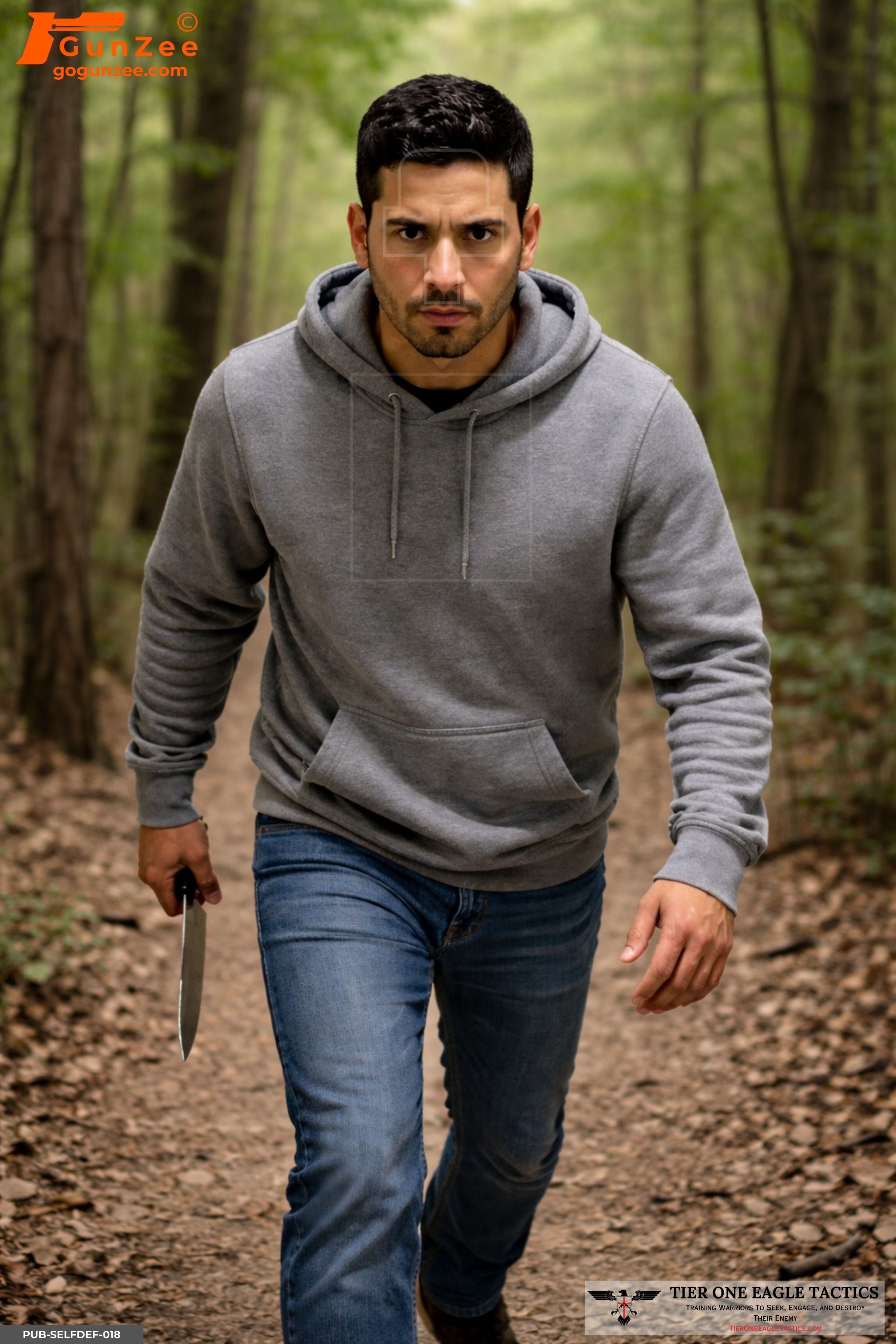
Forest Trail Advancing Knife Threat Shooting Target [24" x 36"]
each · sold in 5s · mix any designs
Price drops automatically: 50+ $1.85 · 100+ $1.76 · 250+ $1.66 · Up to 25% off at 999+ · Volume quote →
$40 order minimum for your whole cart, not each design. Mix any targets.
Quantity must be in increments of 5
Forest Trail Advancing Knife Threat Shooting Target
The Forest Trail Advancing Knife Threat Shooting Target presents a high-risk edged-weapon encounter in a quiet outdoor environment where an attacker advances deliberately with a concealed blade held low and out of immediate view. The setting is calm, isolated, and deceptively non-threatening—forcing the shooter to rely on behavioral cues and movement rather than obvious aggression to recognize imminent danger.
This target is designed to train shooters to identify lethal intent before it becomes visually obvious. The attacker’s posture, forward momentum, and hand position demand disciplined observation and controlled decision-making, particularly in environments where the absence of crowds or noise can create a false sense of safety.
Training Purpose
Edged-weapon attacks do not always begin with dramatic motion or raised weapons. Many real-world assaults start with subtle cues such as a bladed stance, a concealed hand, steady forward movement, and focused intent.
This target replicates that reality. The shooter must process the attacker’s approach, recognize the concealed knife, and assess the rapidly collapsing distance without relying on exaggerated visual signals. The scenario reinforces early threat recognition, distance management, and decisive action when a threat transitions from ambiguous to imminent.
The purpose of this target is to train shooters to act based on behavior and intent—not just visible weapons—while maintaining accountability in environments where help may be distant and reaction time is limited.
Skills Reinforced
- Threat recognition based on posture, movement, and intent
- Visual identification of concealed edged weapons
- Managing closing distance in low-distraction environments
- Decision-making under deceptive calm conditions
- Shot accountability in isolated public or semi-public spaces
- Stress control during silent, forward-moving assaults
Anatomical Kill Zones & Shot Evaluation
This target includes intentionally placed evaluation zones used for post-engagement assessment and training review.
-
Modified cranial T-box kill zone
The cranial zone is based on the conventional T-box but expands upward into the forehead region. This area corresponds to neurological structures known to cause immediate incapacitation when disrupted. This zone is used to evaluate precision, timing, and instant-stop capability under pressure. -
Cardiac box kill zone
The cardiac box represents the heart and upper vascular structures responsible for rapid circulatory shutdown. This zone supports evaluation of effective center-mass shot placement and physiological incapacitation over time.
Both zones are designed to be reviewed after a training sequence to assess shot placement, decision timing, and outcome effectiveness.
Why This Target Is Different
Most edged-weapon targets rely on overt aggression—raised knives, lunging motion, or exaggerated attack cues. This target removes that clarity.
The attacker’s blade is held low and partially concealed, requiring shooters to interpret intent through body language and movement rather than weapon visibility alone. The forest trail setting strips away distractions, exposing hesitation, cognitive bias, and delayed recognition that can be catastrophic in real encounters.
Because the scenario is subtle yet dangerous, it supports repeatable training that consistently challenges perception, judgment, and restraint.
Related training targets
Pair this target with related scenarios from across the GunZee catalog:
Public and everyday self-defense: Advancing Crowd Knife Assault Shooting Target, Crowded Street Knife Threat Shooting Target, Backyard Pool Knife Assault – Crowd Chaos Scenario, Public Knife Assault Disarm – Close-Range Edged Weapon Encounter
Home defense, CQB, and hostage: Interior Three-Man Misdirection & Armed Threat Shooting Target, Corridor Hostage Control with Rear Gunman Shooting Target, Group Conflict Knife Escalation Shooting Target
Vehicle and barrier: Vehicle Barrier Carjacking Confrontation Shooting Target, Vehicle Barrier Windshield Gunman Engagement Shooting Target, Vehicle Barrier Elderly Victim Carjacking Shooting Target
Anatomical: Anatomical Side-Profile Rifle Threat Shooting Target, Anatomical Hostage Shield Vital Zone Shooting Target, Anatomical Semi-Frontal Handgun Threat Precision Shooting Target