
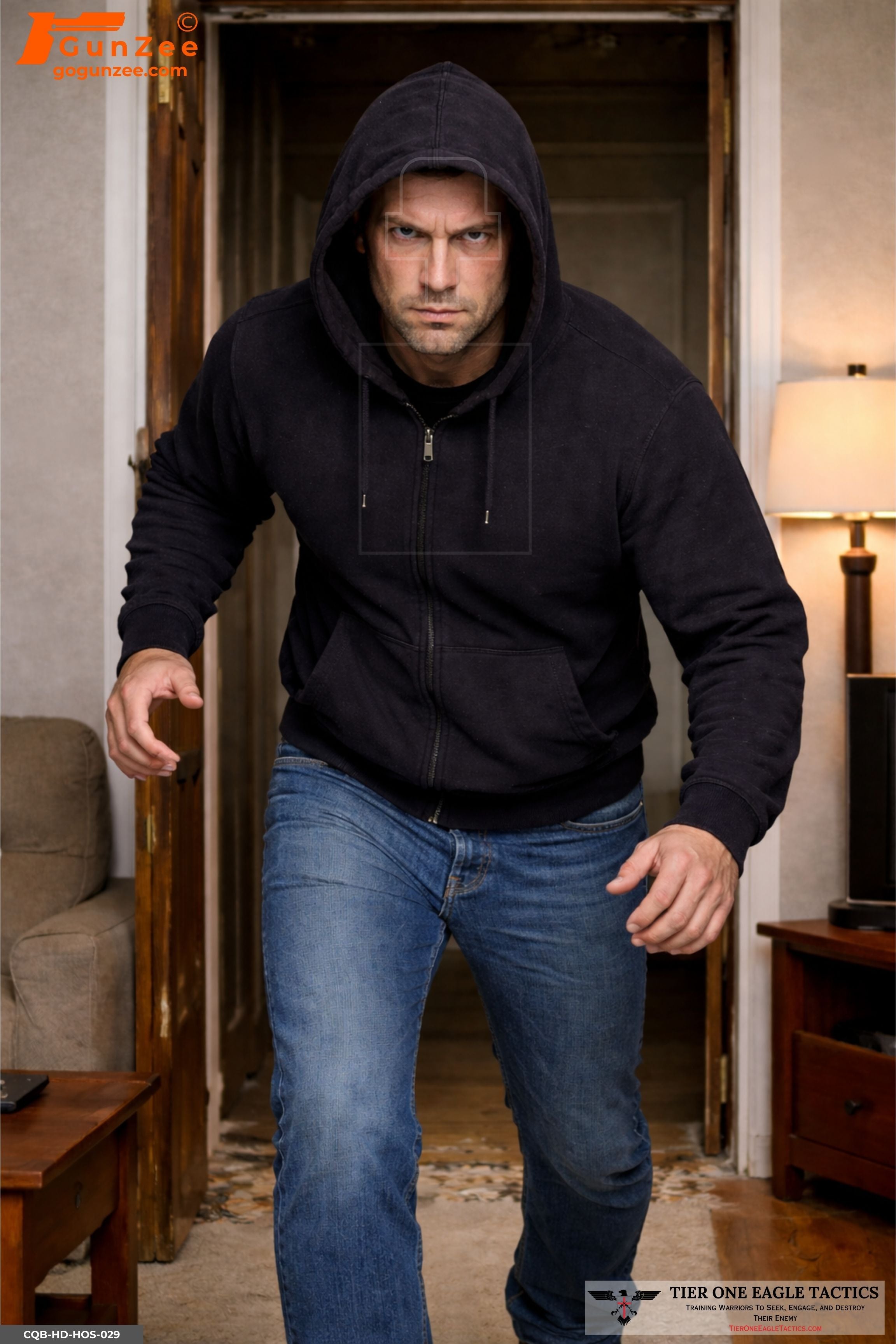
Home Invasion Doorway Breach Decision-Making Shooting Target [24" x 36"]
each · sold in 5s · mix any designs
Price drops automatically: 50+ $1.85 · 100+ $1.76 · 250+ $1.66 · Up to 25% off at 999+ · Volume quote →
$40 order minimum for your whole cart, not each design. Mix any targets.
Quantity must be in increments of 5
Home Invasion Doorway Breach Decision-Making Shooting Target
This target depicts a high-threat home invasion scenario where an intruder has forced entry and is advancing through a residential doorway. The subject’s posture, forward momentum, and focused gaze signal imminent violent intent without exaggerated motion, forcing the shooter to rely on threat recognition rather than theatrics. The confined interior environment, limited angles, and close proximity replicate the compressed timelines common to real-world home defense encounters.
This scenario is designed to pressure the shooter’s ability to rapidly assess intent, manage interior angles, and deliver precise shots under extreme time constraint. The advancing movement through a doorway emphasizes the dangers of transitional spaces and the importance of disciplined decision-making when reacting to sudden forced entry.
Training Purpose
Home invasions unfold fast and rarely offer ideal conditions. Doorways, hallways, and interior rooms compress distance and eliminate reaction time, leaving no margin for hesitation or poor shot placement.
This target is built to train decisive engagement in those conditions. The shooter must process threat cues immediately, maintain muzzle discipline in a confined environment, and deliver accurate fire while managing stress and spatial awareness.
Skills Reinforced
- Rapid threat recognition in confined residential spaces
- Engagement through doorways and transitional areas
- Precision shot placement under time compression
- Decision-making during sudden forced-entry scenarios
- Accountability for shot placement in close-quarters environments
Why This Target Is Different
This target avoids exaggerated motion or cinematic aggression. The subject’s posture, facial expression, and body alignment reflect a realistic advancing threat rather than an overtly staged attack. The residential setting reinforces environmental realism, training shooters to work within the visual and spatial constraints they are most likely to face inside the home.
A modified T-box and cardiac box are integrated into the target design to support structured evaluation without compromising realism. The modified T-box includes an expanded forehead zone associated with immediate incapacitation, reflecting contemporary understanding of cranial shot placement.
The modified T-box and cardiac box are integrated as performance reference zones for post-engagement evaluation. They are intentionally subtle and do not function as visual aiming aids, preserving a realistic threat-focused engagement while allowing instructors and shooters to assess precision, accountability, and shot placement after the fact.
Related training targets
Pair this target with related scenarios from across the GunZee catalog:
Public and everyday self-defense: Grocery Store Parking Lot Armed Approach – Public Threat Interception, Grocery Aisle Explosive Vest Imminent Threat Shooting Target, Convenience Store Counter Robbery – Close-Range Threat Recognition Shooting Target
Home defense, CQB, and hostage: CQB Home Defense Hostage – Bedroom Doorway Armed Subject Shooting Target, CQB Home Defense Hostage – Bedroom Doorway Cell Phone Ambiguity Shooting Target, Interior Doorway Armed Male Home Defense Shooting Target, CQB Home Defense Hostage – Forward Weapon Presentation Shooting Target
Vehicle and barrier: Vehicle Barrier Door-Jamb Armed Threat Shooting Target, Vehicle Approach Threat Advancing Gunman Shooting Target, Vehicle Barrier Carjacking Confrontation Shooting Target
Anatomical: Anatomical Frontal Handgun Threat Vital Zone Shooting Target, Anatomical Full-System Vital Zone Shooting Target, Anatomical Semi-Profile Handgun Threat Vital Zone Shooting Target